Tag Archives: bAKEHOUSE Theatre Co

3 Billion Seconds

1 May

This is part black comedy, part satire, and all fun.  

Directed by Dominique Purdue, the show is thrillingly fast-paced. Actors Izabella Louk and Victor Y Z Xu give wonderfully audacious, high-energy performances. (I’ll admit it took me time to attune to the piece’s theatrical language: at first, I was fearful of sensory overload.)

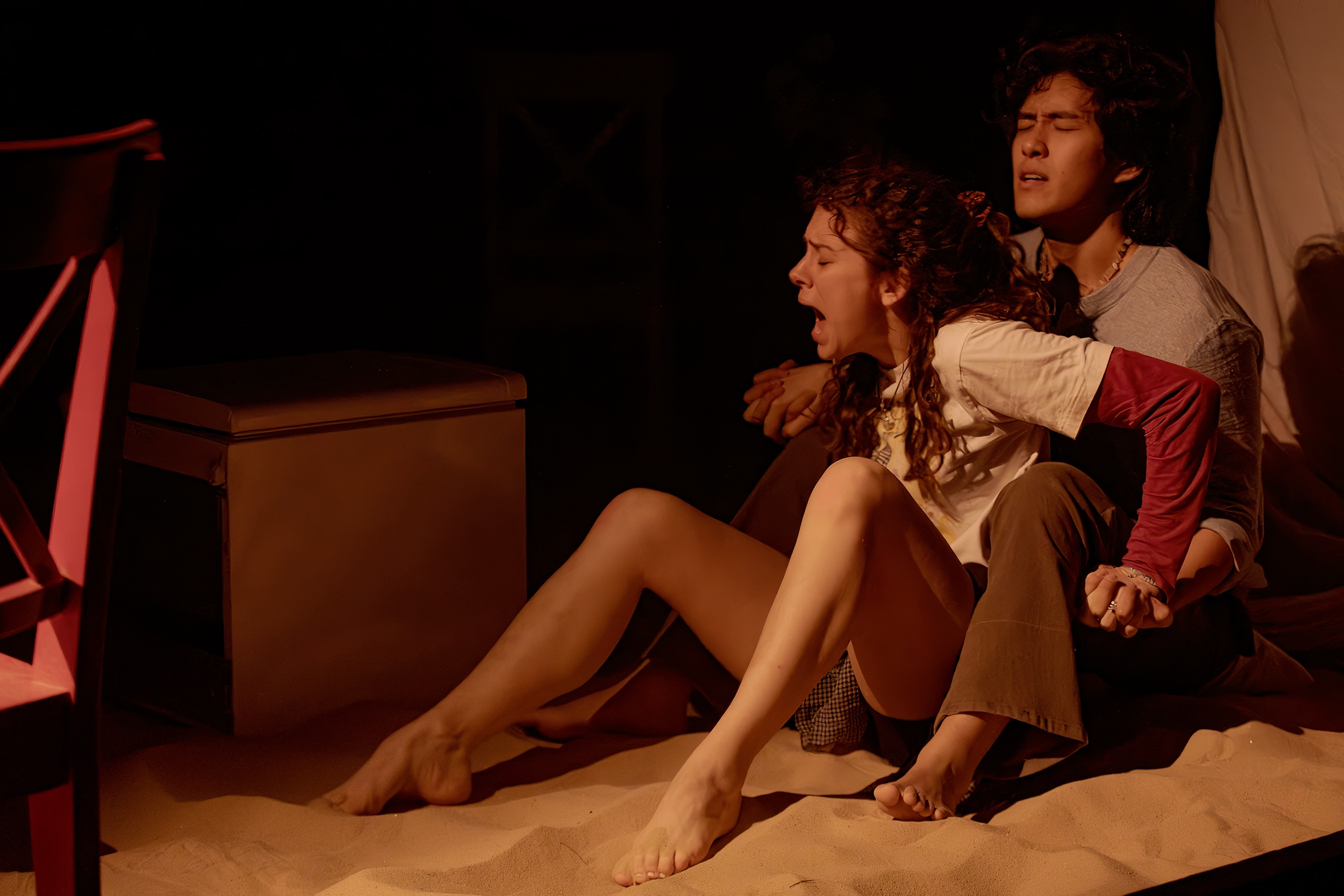
By British playwright Maud Dromgoole, 3 Billion Seconds tells the story of two population growth activists, Daisy and Michael. Acknowledging that one of the greatest challenges facing humankind is our exploding numbers, they dedicate their lives to raising awareness about the problem. And then they find they have a little problem of their own: Daisy is pregnant. How can they offset the impact of bringing a child into the world?

Their answer is what makes this black comedy.

The satirical element could be broken into two strands.

One is a poke at the dreadful arithmetic of consequentialism, that oddly reductive vision of ethics which (in its worst forms) assumes the difference between right and wrong can be calculated numerically. In the play, this is signified by a fixation on pie charts. Consequentialism’s vision of morality is based on outcomes. To most people, this might seem an entirely natural approach. After all, don’t we determine whether an action is right or wrong depending on its consequences? Trouble is, we don’t always know the consequences. (A radical critique, or a radical honesty, might suggest we never know the consequences. And certainly not in a way that can be expressed numerically.) It takes little imagination to see that an ethical philosophy that manifests both a whiff of epistemological arrogance and a weakness for calculation might only too easily mutate into a force for dehumanisation. The events of the play certainly suggest this – though not with little imagination, with glorious comic invention.

The other satirical strand targets anyone (everyone?) who puts their personal wants before the needs of the community. (And that community can be defined in ever widening circles.) The production’s final haunting image brilliantly encapsulates this threat. But juxtaposed with this image of menace are the closing lines of dialogue, which are a very human expression of a very human desire. In this refusal to be reductive, the piece attains dramatic excellence. To face the greatest of challenges – the threat to our planet, to our species, to all species – we will need all our best qualities, and that includes honesty.

Paul Gilchrist

3 Billion Seconds by Maud Dromgoole

presented by Blinking Light in association with bAKEHOUSE Theatre Co

at KXT on Broadway until 2 May

kingsxtheatre.com

Image by Phil Erbacher

Monster

12 Mar

Why are there so many violent children?

What do we do about them?

And how do we stop the problem arising in the first place?

Our culture assumes there must be simple answers to questions such as these. We’re certain of the destination, so there must be a path. Perhaps this attitude is a product of our hubris, or a result of the current fashion for self-righteousness. Or maybe it’s a consequence of something closer to universal, the spell of language: if you can formulate a question, then there must be an answer.

In Duncan Macmillan’s beautifully wise play there are no simple answers.

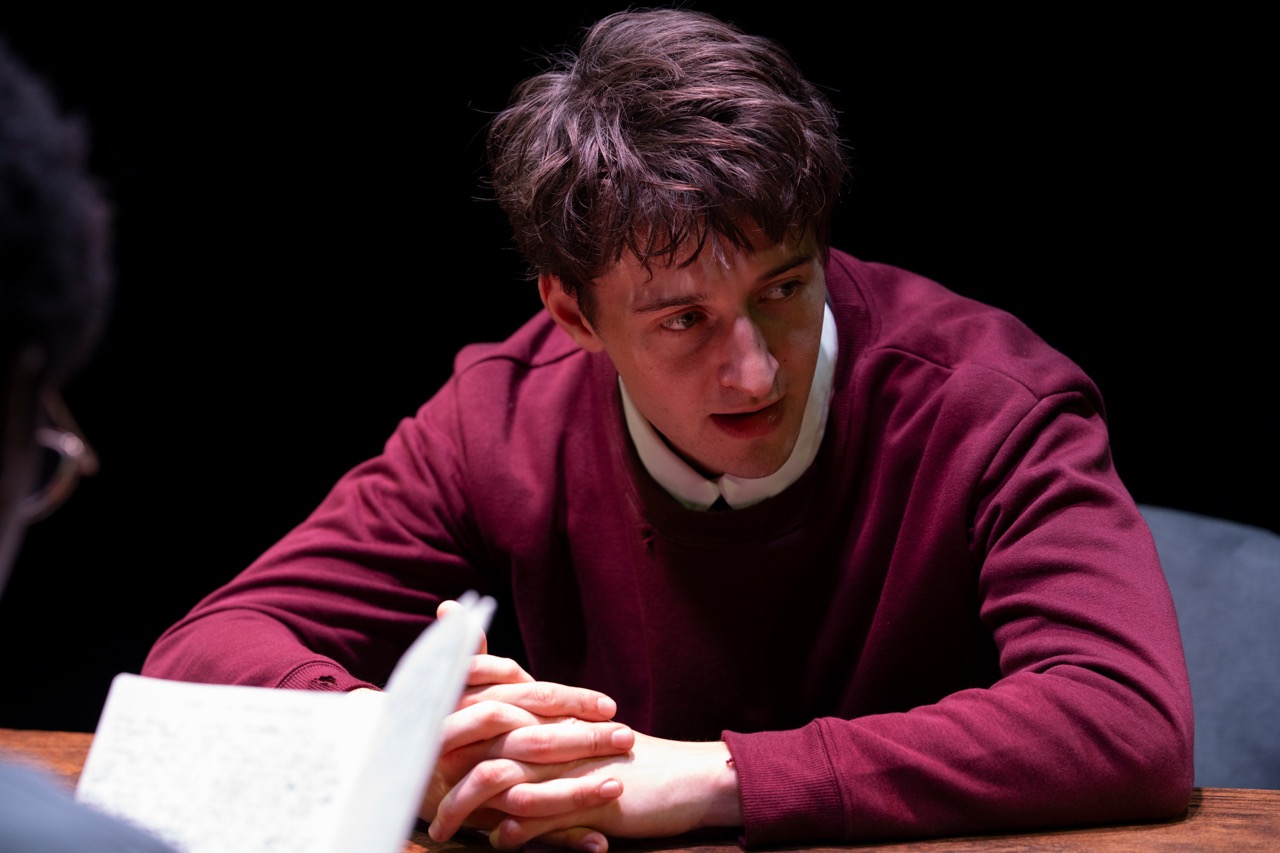
Fourteen year old Darryl is obsessed with violence. School staff member Tom doesn’t know how to help. And Rita, Darryl’s only remaining family member, desperately wants to pretend he’s just a normal teenager.

There’s a brilliant piece of dialogue between Tom and his partner, Jodi. (I’m probably paraphrasing, but this is its core)

Jodi: Who’s to blame?

Tom: Noone.

Jodi: Then what hope do we have?

Darryl also refers to this blame game.

Counter-intuitively, blame bestows hope. Blame assumes powerful dangerous forces could have been controlled, if only we’d done what was right. (As though perfection were possible in this sub-lunar world, as though we could return to Paradise after the Fall.)

Director Kim Hardwick’s production is excellent; aided by designer Victor Kalka and a splendid cast, there’s a pared back simplicity that lays bare the complexity of the human heart. (There is one simplicity – but more on that later.)

Campbell Parsons as Darryl is magnificent. Macmillan gives Darryl an incendiary idiolect – a hilarious, frightening language sourced from English working class slang and American gansta rap – and Parsons has utter command of this explosive mix. His portrayal of the troubled, piteous Darryl is an utterly fascinating and moving combination of a bouncy-youthful energy, a cynical- saddening understanding of power, and a heart-breaking innocence and self-doubt.

Having just jumped into the role a few days ago, Tony J. Black as Tom does great work, capturing the character’s struggle for patience, his bubbling frustration, and the terrifyingly all-consuming nature of the task of helping Darryl.

Romney Hamilton as Jodi gives a superb portrait of a beautifully imperfect human soul. Though creating a silly woman – one who too easily believes emotional outbursts are Truth –  Hamilton still finds space to evocatively manifest the woman’s real need for companionship and security, and to express both her crushing fear and its all-too-common companion, anger.

Linda Nicholls-Gidley as Rita gives a gloriously rich performance. Confronted about Darryl, she’s defiant, even to obtusity, but also sharply loyal. And after a family loss, Rita has rediscovered her faith. It might be easy to dismiss this as mere rationalisation, and its manifestation – a fascination with angels – is cringey …. but its emphasis on Love is not. It’s the very heart of the piece. (Even Jodi, pondering the possibility that their first child might turn out another monster, asserts We will just love them more.)

So is Love the solution?

Once again, the same habit: a question expects an answer.

But, in the dark middle of the brutal wilderness that is Life, perhaps our chosen path is all the destination we can know.

Paul Gilchrist

Monster by Duncan Macmillan

presented by Tiny Dog Productions, in association with bAKEHOUSE Theatre Co,

at KXT until 21 March

kingsxtheatre.com

Image by Abraham de Souza

A Chinese Christmas

14 Dec

One of the many things that makes KXT an invaluable part of the Sydney theatre scene is their support of early career artists.

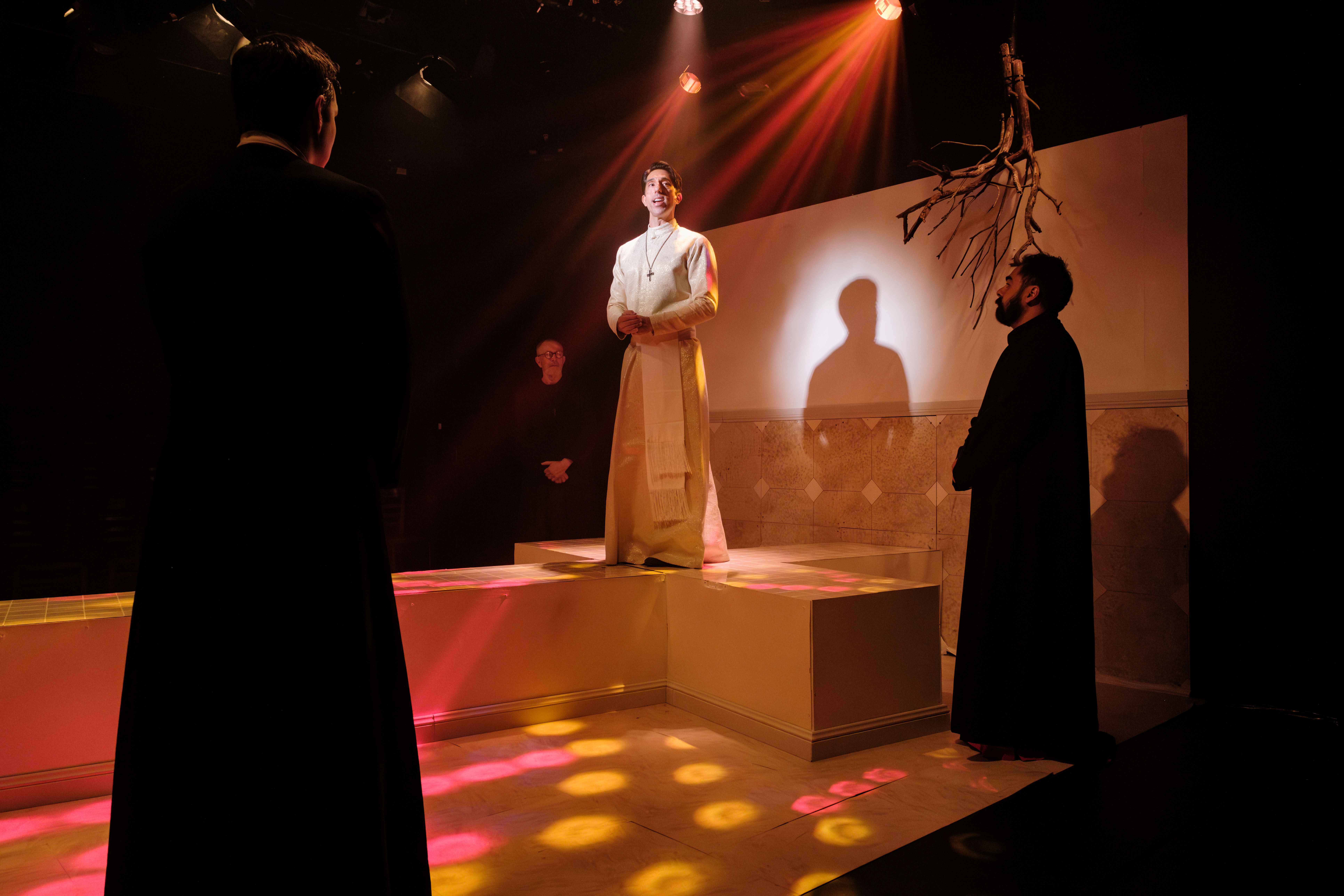
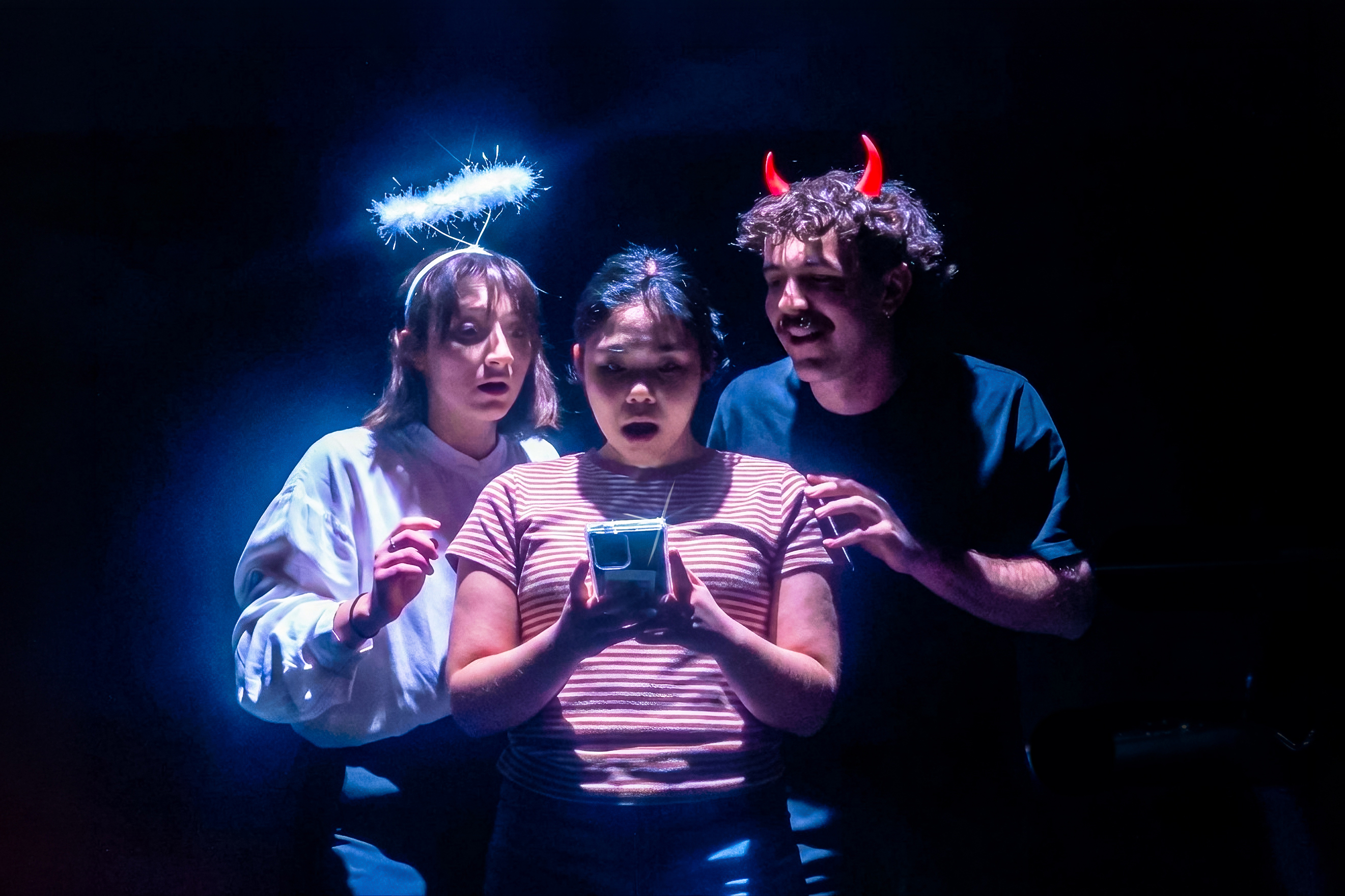
Directed by Monica Sayers, this is Trent Foo’s debut play. It tells the story of Heepa, who visits the underworld to enlist the aid of his ancestors to ensure his Paw Paw attends the family Christmas.

Despite this particularly Australian-Chinese setting, the piece deals with a universal theme: our relationship with those who came before us.

Heepa expresses a mix of feelings towards his grandmother: a rejection driven by his hunger for independence, a gratitude for all she’s done, and a regret that too often the first of these emotions has trumped the second. It’s a wild, heart-breaking, soul-making blend of feelings, a mix experienced by most of us, and it’s easy to imagine that the migrant experience only ramps up the intensity.

The whimsical conceit of the piece – that the protagonist speaks to his deceased ancestors – is the perfect vehicle for the exploration of what we owe family. (In contrast, the Christmas aspect of the piece is rather lightweight; the veneration of the dead taking precedence over the Christian myth. In fact, the Christian myth is given rather short shrift, reduced to the irrelevant Virgin birth and dismissed as ridiculous, no more worthy of attention than a laughable Chinese melodrama. For some audience members, however, the unspoken tension between the two spiritual traditions will be both provocative and thrilling. In contrast to the veneration of the dead, the Christian myth is about transcending our ancestors and shedding the common inheritance of selfish misery supposedly passed down from our forebears, Adam and Eve. Ultimately, it’s about new beginnings and looking forward. Add to that the conceit of the Divine choosing to enter the human world via a stable, the child of two nobodies, the birth witnessed by farm animals, and you have a tale that challenges all commonly accepted human values. Absurd simplification: you could place the two traditions, the veneration of the dead and the Christian myth, in stark contrast – one asserts the importance of connections, the other the importance of fresh starts. And a healthy spirituality requires both.)

Portraying Heepa, Foo has an easy stage presence, a charming, playful, natural manner that leans delightfully into the script’s use of the youthful vernacular. For the majority of the piece, the structure is amusingly loose, as Heepa shares anecdotes about his relationship with his Paw Paw. The finale is very moving (but the plot is dependent on the protagonist withholding information, and so the overall impact of the piece will be determined by whether you believe this reticence aligns psychologically with the way the earlier anecdotes are delivered.)

As Heepa’s Paw Paw, Tiang Lim beautifully combines comedy with dignity, playing with the grandma tropes of being overly demanding yet not openly affectionate, while at other times projecting a mature nobility, one that’s both inspiring and pathos-inducing.

Performing on traditional instruments, Jolin Jiang creates an accompaniment which is wonderfully evocative. As an actor, she creates a character of poignant mystery.

Paul Gilchrist

A Chinese Christmas by Trent Foo

Presented by FooFrame Productions in association with bAKEHOUSE Theatre Co,

At KXT on Broadway until Dec 20

kingsxtheatre.com

Image by Robert Miniter