Archive | February, 2026

Tonsils + Tweezers

20 Feb

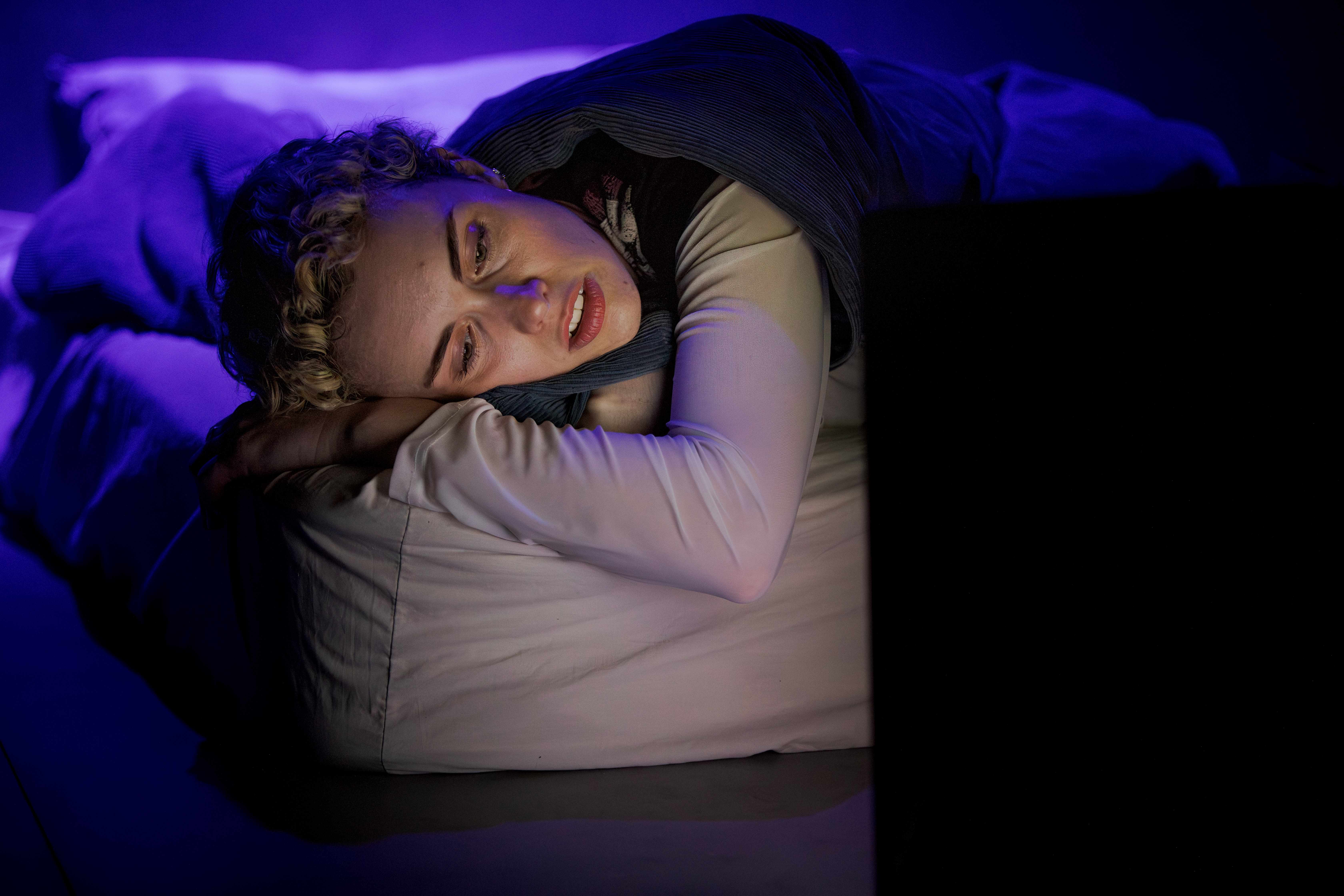
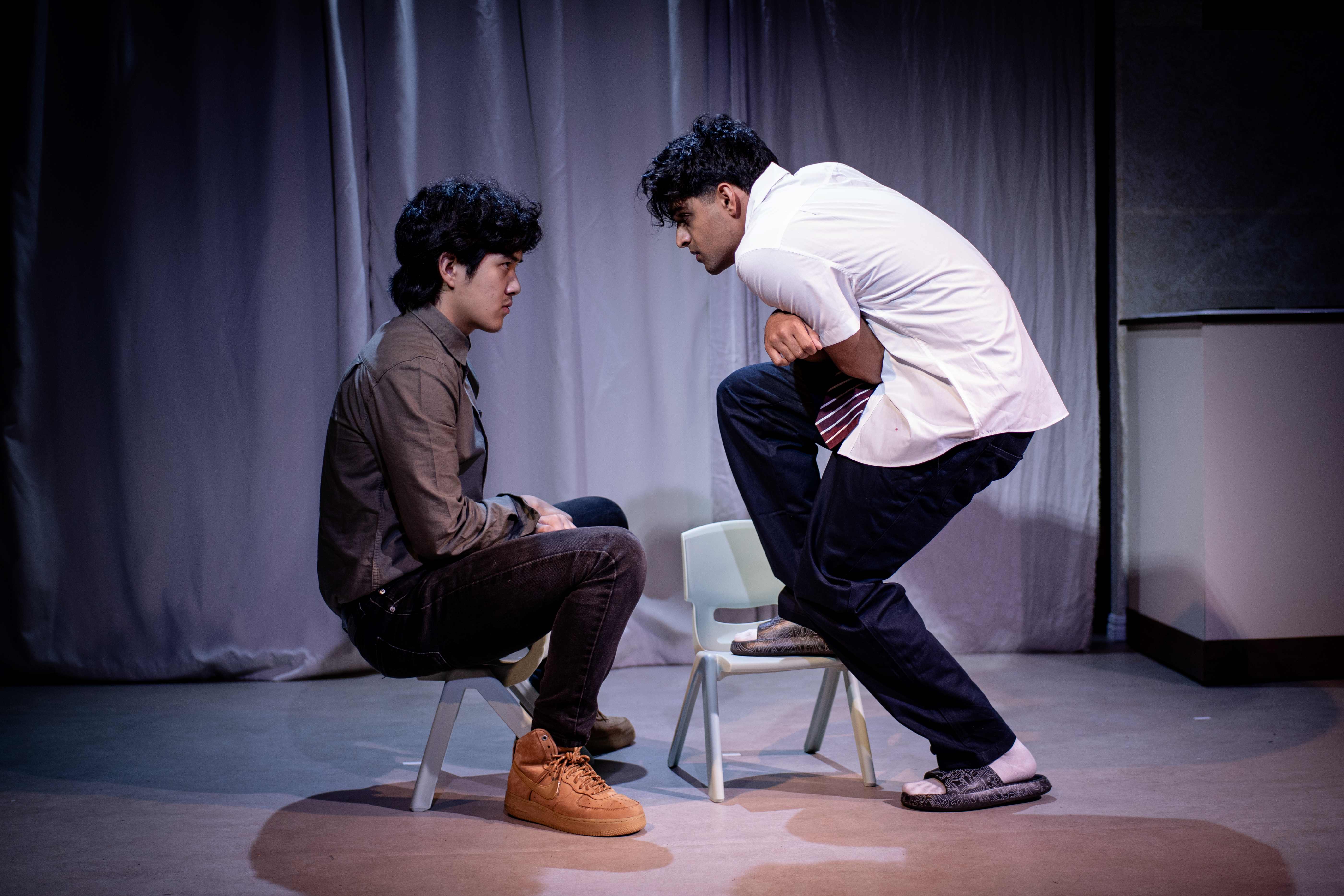
Tonsils and Tweezers are friends at school, possibly each other’s only ally. But when Tonsils gets the chance to join the cool group (read the bullying group), the friendship is put under strain – with consequences that are long and deep and terrible.

Despite the serious themes, this is theatre given wings by the spirit of youth. It’s mischievous, energetic and exuberant.

Writer Will O’Mahony gives us a script that’s fun and fast-paced, bouncy and bubbly, but with jagged edges that foreshadow danger. A natural chronology and a flat realism are eschewed, with Tonsils (Ariyan Sharma) sometimes functioning as an upbeat omniscient (and therefore unsettling) narrator.

The script is rich in motifs. Some plainly evoke cruelty – like the recurring reference to a skinned dog, silent and horrible in its suffering. Other motifs resist a simplistic reading. Is the binary star a symbol of loyalty? Or of mutual dependence? Or perhaps, in its wobble, of the loneliness of a loss never publicly acknowledged? Is the fact a piece of paper can’t be folded more than seven times suggestive of the impossibility of packing away one’s pain? Cause it also operates as dreadful portent of the key plot point. It’s all a playful, poignant puzzle.    

Director Lucy Rossen leans into the theatricality and, with the help of designer Bella Saltearn, gives us a stage replete with puppets and puckish props, presenting a show of ironic vitality (which is as close to a spoiler as I’ll get.)

Her cast of four – Victor Y Z Xu, Caitlin Green, Toby Carey & Sharma– give excellent comic performances.  

This is an example of what I’ve called the Theatre of Audacity. This is theatre that asks to be valued because it surprises, shocks and delights. It has us say of the actors I can’t believe you stood in front of people and did that! (In contrast is the Theatre of Authenticity, theatre that asks to be valued because of its veracity and honesty, theatre that has us say of the actors You made me believe that was true.)

So am I saying Tonsils + Tweezers is without veracity and honesty? That it is, somehow, dissatisfyingly untruthful?

Who is to make such a judgement? In every production, the least convincing performance is always by the critic pretending to be objective.  

What the audacity of Tonsils + Tweezers does (it seems to me) is express a scandalised astonishment that the world is not just. That’s why I suggested earlier that it’s a youthful piece. Which is hardly a criticism. To paraphrase someone who was not a theatre critic (though he did associate with the most disreputable members of his society) Except ye become as little children, ye shall not enter into the kingdom of heaven.

Paul Gilchrist

Tonsils + Tweezers by Will O’Mahony

Produced by Sharehouse Production Company

At the Old Fitz, as a late show, until 27 Feb

oldfitztheatre.com.au

Image by Nicholas Warrand

Es and Flo

19 Feb

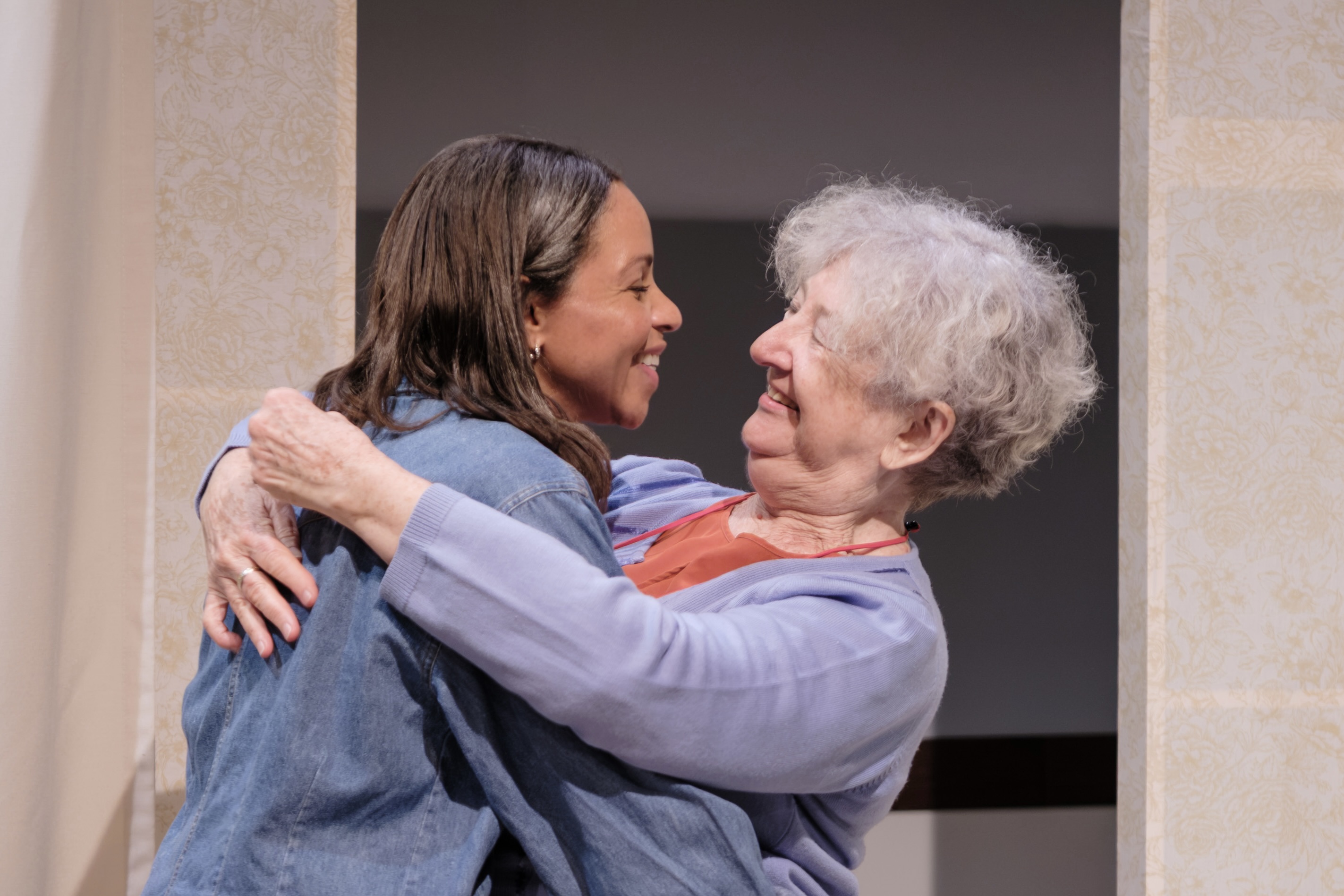
This is a beautiful presentation of an absolutely terrific play.

Written by Jennifer Lunn and first presented in the UK in 2023, it tells the story of the lesbian couple of the title.

Es and Flo met and fell in love during the anti-nuclear protests of the 1980’s, but now, like us all, they have aged. Es is beginning to have difficulty with her memory, and Flo is caught between acknowledging this and wanting to wish the problem away.

And then care worker Beata and her daughter turn up, paid for by Peter, Es’ never present son. A battle has begun, for control of Es, and her property.

Director Emma Canalese allows the pace to be truthfully gentle, and she elicits wonderful performances from her cast.

As Es, Annie Byron splendidly blends the exuberance of the woman at her peak with a growing bewilderment at her diminishment and a pathos-inducing fear of being a burden. Fay Du Chateau as Flo offers a superb portrait of indignation tempered by doubts and personal inadequacies. (Her stunned disbelief, her unwieldy tongue, her unreflecting mistakes are so much more truthfully human than the self-righteous grandstanding which too often struts our stages, a pontificating that is probably the unconscious projection of a need to be moral heroes in a world so loud and large that it threatens us with irrelevancy.)  

In seeming contrast to our flailing protagonists, Charlotte Salusinszky as Beata, Polish immigrant and carer, offers a model of no-nonsense competency. But Lunn’s script is textured so that Beata does not reduce to some sort of magical migrant dispensing wisdom; she suffers challenges and makes errors, and Salusinszky marvellously captures both her practicality and her vulnerability. As her daughter Kasia, Erika Ndibe presents delightfully both the grace of innocence and its naïve moral certainty. If there was a moment that best encapsulates the piece’s extraordinary achievement, it’s when Kasia shares a plan she has for good with Es’ daughter-in-law, Catherine. Played brilliantly by Eloise Snape, Catherine is on the surface a silly, glibly narrow-minded woman, but realising the danger of little Kasia’s plan, she gently warns her it might be more complicated than she imagines.

Simplicity is resisted. Even forever offstage Peter is not simplified to mere villainy. His attitude to his mother and Flo may seem self-interested, but he is given reasons, ones that are – if not acceptable – certainly comprehensible.

The play is a moving representation of the challenges of aging, a stinging indictment of the erasure of lesbian experience, and a glorious hymn in praise of loyalty and love in their many, many forms.

But its brilliance is its honest acknowledgement of complexity. This is drama in the great tradition, a stage in which the human condition is honestly portrayed, where good and its opposite might be real, but are never found unmixed in any human soul. And to acknowledge complexity is to stand at the gateway to compassion.

Paul Gilchrist

Es and Flo by Jennifer Lunn

Presented by Mi Todo Productions

At the Old Fitz until 28 Feb

oldfitztheatre.com.au

Image by Robert Catto

Possession

17 Feb

Full disclosure: I come to this piece, if not an opera virgin, then certainly a novice to the artform (but still a seeker of Truth and Beauty.)

When I do what I usually do – which is write about theatre – I like to give the impression that I’m a knowledgeable expert. I get away with this because theatre audiences are used to actors pretending to be someone they’re not, and I guess it’s not too big a jump for them to continue playing this fun game when they read my reviews.

But I won’t pretend expertise here. I’ll write as someone fortunate enough to have been shown a doorway to an exciting new world.

Directed by Adam Player, Possession is what I might call a pocket opera – less than an hour, and presented in a beautiful, intimate venue. It would be a marvellous introduction to the artform. (With its simple but evocative staging, it’s also a model for how opera could be enjoyed by a greater number of people than only those who can get to the Opera House and can afford those tickets!)

Mezzo soprano Ruth Strutt, accompanied by pianist Michael Curtain, presents samples from the works of Gioachino Rossini, Gaetano Donizetti and Ethel Smyth.

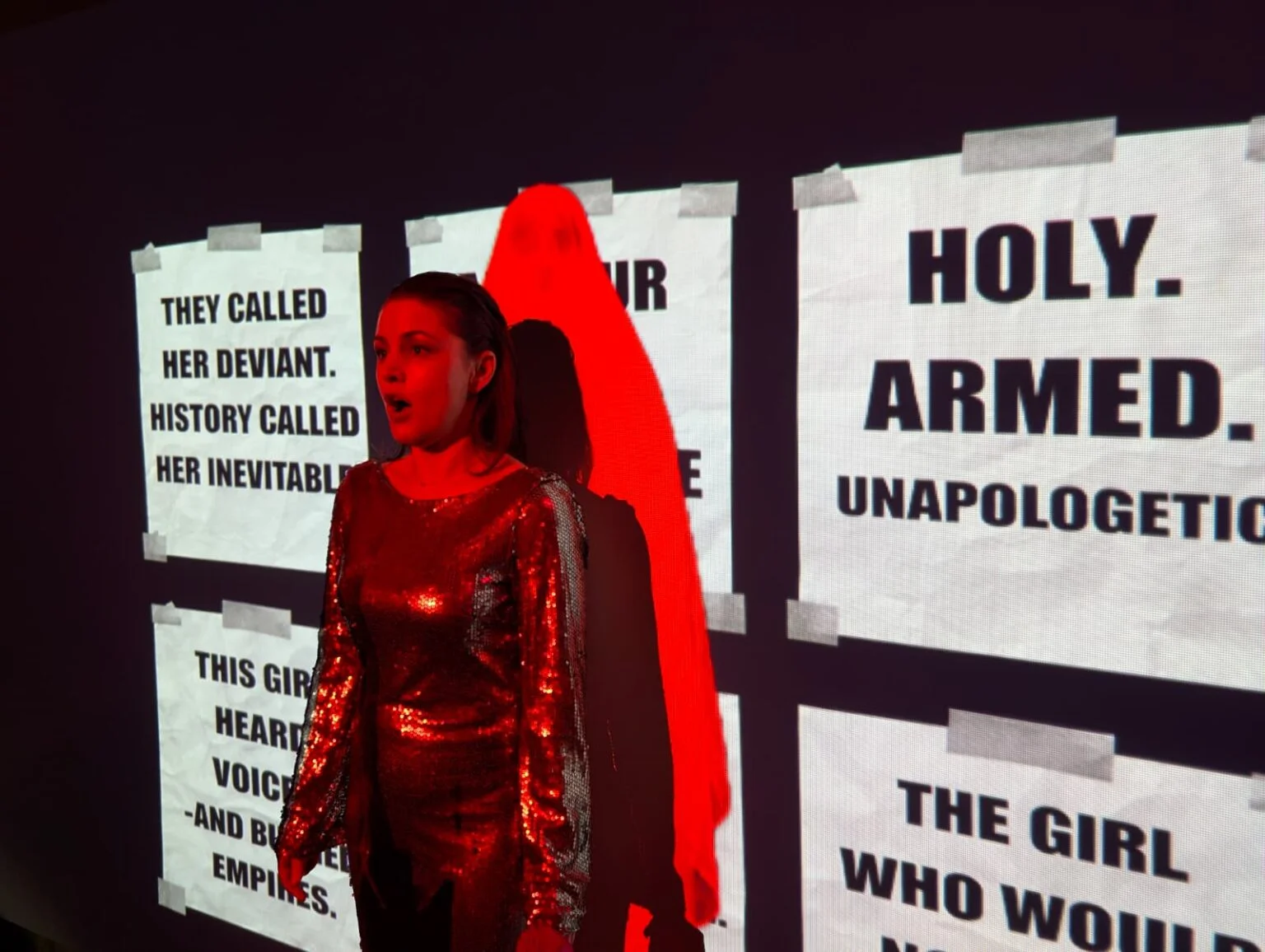
The Rossini is his Giovanna d’Arco, the solo cantata presenting Joan of Arc’s farewell to home before battle. It’s inspiring, it’s poignant and Strutt’s performance, in both voice and physicality, beautifully captures the character’s emotional range.

The Donizetti is his Saffo, which gives voice to the ancient Greek poet. Here Strutt has the opportunity to portray a character with even more vulnerability, and she embraces this with mesmerising passion. The Italian libretto is presented in English surtitles, as it was for the Joan piece, and it’s a wonderful chance for the creative team to use projection to establish setting and mood. Here Sappho’s lament for lost love is presented as though it were a series of text messages, and it’s a cheeky decision that underlines the universality of the experience, that Sappho’s 7th century BC concerns, via the medium of Donizetti’s 19th century opera, are still very much ours.

The Smyth pieces are her Nocturne and Possession. The latter is her work dedicated to suffragette Emmeline Pankhurst. Here surtitles are no longer necessary, and Smyth’s romantic influences are apparent. Performed with a luscious, welcoming warmth by Strutt, the melodies are rich and accessible.

Why Joan, Sappho and Smyth? These are voices of female resistance, but none has been flattened to mere slogan by the weight of opposition. Each is deeply human, acknowledging challenges while all the time reaching for joy.

Under the direction of Player, Curtain and Strutt give us a gem, a small piece that dazzles (for me, a jewel given at the threshold of a previously unexplored land, a promise of treasures, of Truth and Beauty.)

Paul Gilchrist

Possession, consisting of works by Rossini, Donizetti and Smyth,

14 – 15 Feb,  

at the Substation, Qtopia, as part of Mardi Gras.

qtopiasydney.com.au

Image by Adam Player.

Gia Ophelia

16 Feb

I’m twice as old as the protagonist of this piece, but I can still relate to the story because it’s about a failed artist and I’m a reviewer.

(Incidentally, the protagonist claims that the reviewers in Sydney are dogs. The more sensitive among us might find this offensive, but fortunately no dogs were in the audience.)

But seriously, I found Gia Ophelia, written by Grace Wilson and directed by Jo Bradley, very intriguing, vastly entertaining and quite disturbing (in a good way.)

Despite obstacles possibly unjust but entirely predictable, Gia desperately wants to play the role of Ophelia.

It can be difficult to care whether someone (else) succeeds in the arts. It’s a small story, even for those who love art (or perhaps even more so for people who love art and are familiar with Stanislavski’s exhortation Love the Art, and not yourself in the Art.) And, anyway, success is what we pursue until we realise there are more important things to work for.

In Gia Ophelia, I’m not sure we’re not being gifted a portrait of a sort of madness. There are parallels to Ophelia’s famous mad scene from Shakespeare’s play, with Gia handing random audience members books just as Ophelia distributes flowers. (And, just like Laertes, it lit in me a burning desire to find out who had done this to her.)

Somewhere, I’d heard that this was a story about ageism and sexism in the arts. Such evils clearly exist – they exist throughout our society – but this story seems far too idiosyncratic to be a serious attempt to take them on. It does riff on the societal privileging of youthful looks and of motherhood. But if it does operate as an indictment of ageism, it does this most provocatively by presenting Gia as having internalised the very prejudice she rails against. And curiously, in regard to sexism, it’s Gia who reduces Shakespeare’s Gertrude to the mother. Ironically, this diminution of Gertrude is in direct contrast with Hamlet’s response, who is upset that his mother is refusing to fulfill the conventional female role. (I know Gia’s dismissal of Gertrude as the mother is also fed by the bitter irony of her own situation but, as I’ve suggested, there’s also a stimulating lack of self-awareness. More on that later.)

Rather than a social justice piece, the play most fascinatingly operates as a Saturn returns story. Characters in stories of this type often ask Is this all Life offers? Or have I settled too early? But here, Gia’s quarter life crisis is about confronting the question If this is what Life has dealt me, can I really go on pretending otherwise? Gia must cope with the closing of two of Life’s opportunities, one rather specific and small (the opportunity to play Ophelia), the other much closer to universal (a situation which Gia refers to most of the play as my secret, and concerns her fertility.)

I found Gia a difficult character to like – she’s too-cool-for-school, oddly obsessed with the Ophelia role, and dangerously dishonest. Despite the enormous dissonance between the characters’ personalities, we’re tempted to view both Ophelia and Gia as mainly sinned against. It’s a temptation to which Gia seems to succumb. But she’s also perfectly capable of doing the sinning herself – the keeping of her secret being the prime example – but Gia never seems to consider her choice problematic.  

All this is not a criticism of the writing; it’s a rich, complex, very human portrait. And it’s not a criticism of the performance; actor Annie Stafford is magnificent. A droll but fierce intelligence simmers through the first two-thirds of her performance, textured beautifully by brief but very skilful embodiments of other characters. And when Gia’s exterior cool is finally broken, Stafford presents her grief with a heart-rending power.

Grief. Is this the key to the connection between Gia and Ophelia? Shakespeare’s play is often read as suggesting Ophelia goes mad with grief. Is this what has happened to Gia? But what, exactly, is she grieving? The obvious answer, one that relates to her secret, her fertility, is mooted. But Gia seems unwilling to own that plainly, to state that her other obsession is just a type of psychological smokescreen, conjured to hide a more fundamental pain. But, then again, maybe it’s not…. Thrillingly, the play resists simple answers.

Early on, I suggested I found this play disturbing (in a good way.) Here’s why.

In Shakespeare’s play, in a moment of lucidity despite her madness, Ophelia says Lord, we know what we are, but know not what we may be. In Wilson’s play, Gia could be accurately described by an inversion of this famous observation. It’s as though Gia imagines she knows all she needs to know about her future, whilst not knowing herself.

If that’s a type of madness, it’s one many of us suffer.

I find this piece thrilling and disturbing (in a good way) because it represents the incomplete messiness of very human Truths.

Paul Gilchrist

Gia Ophelia by Grace Wilson,

presented by JB Theatre Co. in association with bAKEHOUSE Theatre,

at KXT on Broadway until Feb 15

kingsxtheatre.com

Image by Phil Erbacher

Perfect Arrangement

9 Feb

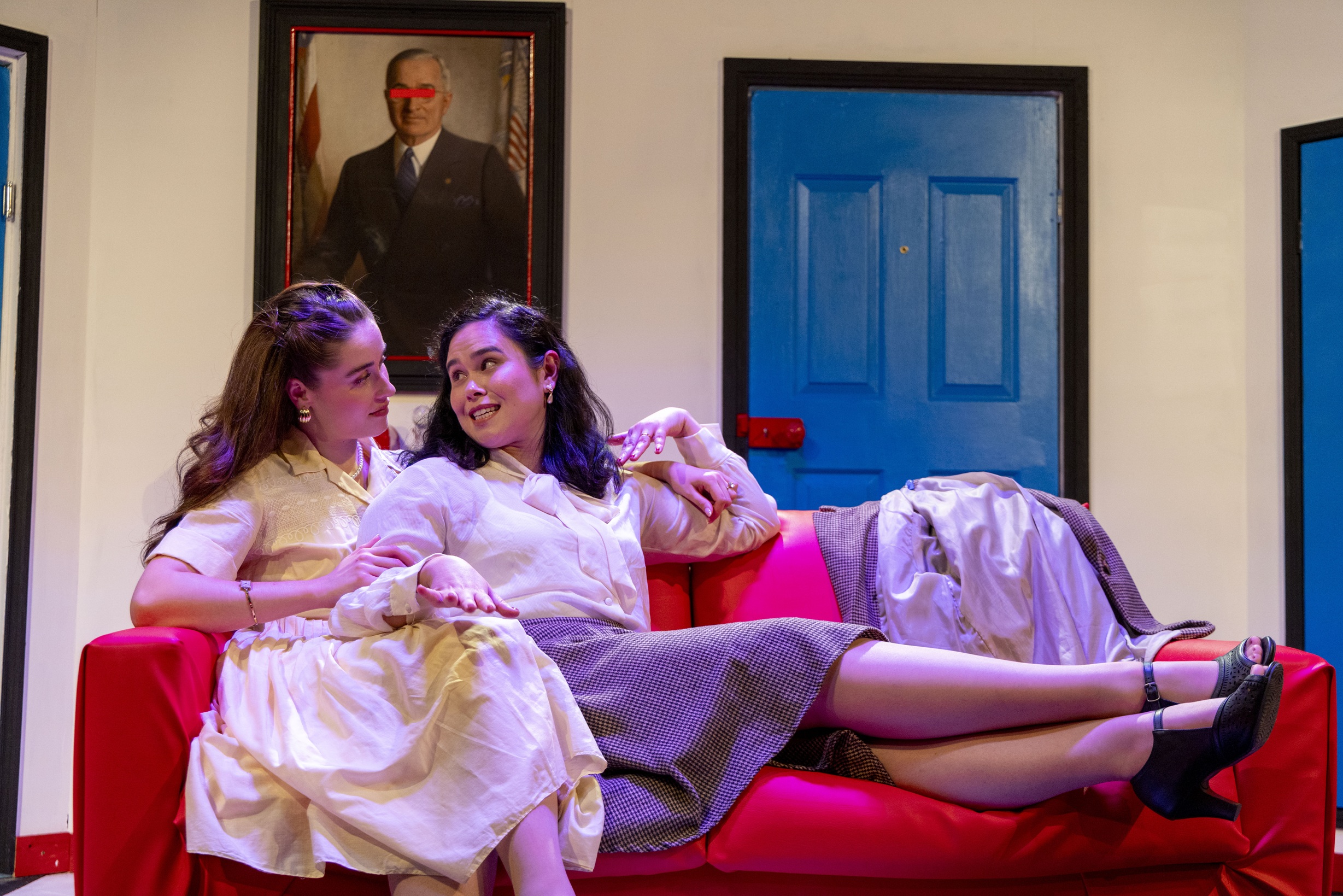
Millie loves Norma.

And Bob loves Jim.

But it’s 1950, so Millie is married to Bob, and Norma is married to Jim.

It’s a Perfect Arrangement.

The irony of the title is indicative of the humour of much of the piece; we’re invited to laugh at that pretence of contentment we’ve come to see as endemic to post-war America.

The humour is superbly playful. Both the script by Topher Payne and design by Patrick Kennedy and Tom Bannerman lean into a meta-theatricality that underlines the performative aspect of the characters’ lives. There’s the suggestion they’re being filmed on a TV set, complete with an offstage camera and an Applause sign. There’s allusions to the advertisements of the times in which chipper housewives give glowing endorsements of household products. There’s moments when the whole set deliberately lurches forward, highlighting this existence’s lack of a solid foundation. And perhaps most revealingly, there’s the mischievous conceit that when the characters exit this pretence of perfection, they retreat into a closet.

Clearly, what is being espoused is authenticity. And despite the wonderful comedy, the injustice of enforced secrecy is powerfully represented.

Director Patrick Kennedy creates a theatrical world that has a fun sit-com wrapping and soul-provoking centre. His cast beautifully bring to life both the humour and the tension.

Luke Visentin is excellent as the serious, authoritative Bob, whose playacted conservatism risks convincing even himself. Brock Cramond as Jim is lighter, a contrast to his lover that rings wonderfully true (in the disconcerting way that Truth both threatens danger and promises liberty.) Dominique Purdue as Norma bristles with defiance. Jordan Thompson as Millie gives a brilliant portrait of stifled potential, one that is intelligent and inspiringly pathos-free. Huxley Forras as a State Department official is appropriately stuffy. Brooke Ryan as his wife is delightfully silly. Lucinda Jurd shines as the brassy, unabashed Barbara.

The historical impetus for the play is the Lavender Scare of the early 50’s (or the period just prior to it) when homosexuals were hounded out of the US State Department. They were perceived as susceptible to blackmail and hence a security risk. (The logic is painful; why not accept homosexuality and watch the risk dissolve? It appears that option – sane and human – was inconceivable.)

Perfect Arrangement was first performed in 2013. Like most historical dramas, it has a whiff of anachronism about it. This is probably inevitable. Consciously or not, when we choose a story set in the past, we’ll focus on what most resonates with a contemporary audience.

Here that resonance is our current tendency to apportion blame to unlikely parties. It’s a tendency typified today in certain slogans you see at rallies or on social media, ones like If you’re not part of the Solution, you’re part of Problem or Silence is Violence. (I suspect this coercive attitude is one reason the Right has recently gained in support; accusation is a poor creator of fellow feeling, and guilt an imperfect motivator.) This play reflects the contemporary tendency to allocate blame to parties other than the obvious perpetrators – and it does so in an even more surprising manner than my above examples.

Perfect Arrangement could be read, not primarily as an indictment of the prejudice of the narrow-minded majority, but rather as a criticism of the victims of that prejudice who are too fearful to denounce it. Near the climax, Bob is told in no uncertain terms that he is the problem.

Digging further into this reading, Perfect Arrangement is not a protest play, but rather a play about protest.

But does it really blame those unwilling to object to the status quo?

Or rather, will those who suffer find in it the possibility of empowerment, an inspiring reminder that if one seeks authenticity, it can only begin with oneself? (Authenticity also ends with oneself; it’s the middle that’s the tricky bit, the bit where it helps if the majority come onboard.)

If it weren’t for the publicity requirements that push every reviewer of theatre to publish as soon as they reasonably can, I could write so much more about this piece – it’s rich, energising, and vastly entertaining.

Paul Gilchrist

Perfect Arrangement by Topher Payne

presented at New Theatre as part of Mardi Gras until March 7

newtheatre.org.au

Image by Bob Seary

God’s Cowboy

5 Feb

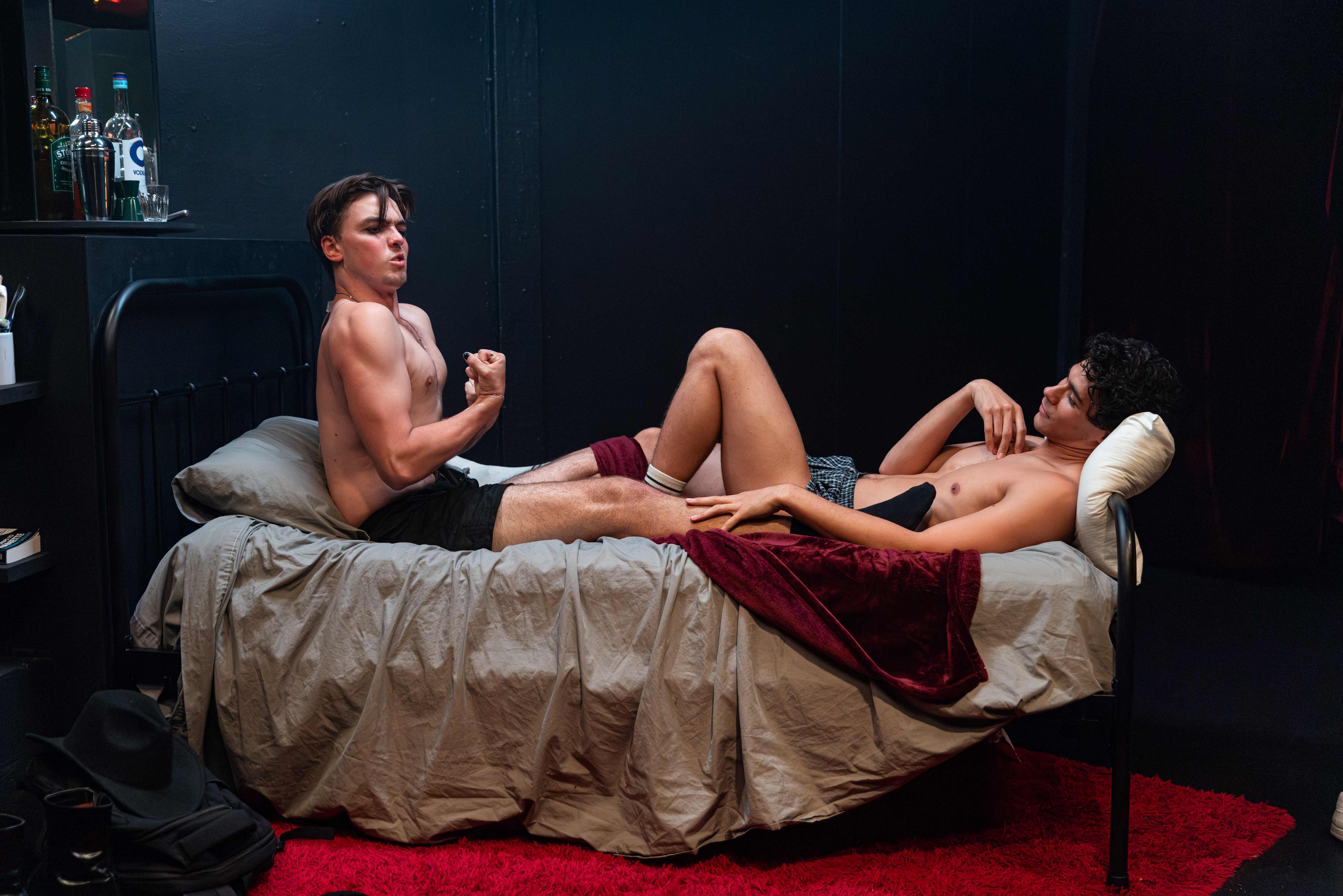
There are times in God’s Cowboy when you could be excused for thinking that budget considerations alone have determined the costuming choices – though you might wonder how much is really saved by not providing the actors with shirts.

I’m being silly, of course. The costuming is fine. The actors do have shirts.

Though they do take them off.

A lot.

Gay male theatre often has a lot of bare chests. That’s partly because such theatre is a celebration of the diversity of human sexuality. (One unintended consequence of this is that straight audiences can be left with the impression that gay men are obsessed with sex  – which is to miss the salient point that theatre celebrating gay sexuality is still making up for the millennium and a half in which our culture pretended gay sexuality simply didn’t exist. Except, of course, for the times when it was acknowledged so it could be persecuted.)  

Though a paean to difference, gay theatre is also an assertion of kinship. It says In some ways my life may be different from the majority, but I share the same joys and face the same challenges.

In Les Solomon’s play, the universal joy is love, the challenge abuse.

Gentle, naïve twins Penny (Sophia Laurantus) and Peter (Nathaniel Savy) audition for a show. They’re successful, and join a cast filled out by the charismatic Daniel (Max Fernandez) and the disturbing Demetrious (Tate Wilkinson Alexander).

Peter and Daniel begin a showmance – but Daniel’s back history makes it difficult for him to give Peter what he needs.

Under the direction of Ella Morris, performances are engaging (though the pacing could be sharpened to make more of both the humour and the rising tension.)

The story is simple and appealing. Ironically, it could be argued the script needs both a trim (to stick closer to the chase) and a fleshing out (to answer some questions, especially regarding Daniel’s revelation to Penny and the response it invites.) But these supposed faults could be exactly how Solomon’s script achieves its winsome mood of wistful nostalgia.

For me, the most enthralling aspect is the presentation of that eternally uneasy relationship between love and sex.

There’s a wildness about sex, a physicality that has a disturbingly soft border with violence. Excitement is its bright side, abuse its dark.

The play represents several attempts by characters to tame this wildness: Peter and Penny valorise romantic love; Peter is a refugee from the dependable dream-land of classic movies; Daniel’s cowboy swagger safely repackages threat as confidence; and Daniel, as his character in the play within a play, cheekily posits a God who has gifted us sexuality and who wants us to enjoy it in every-which-way-we-can.

Provocatively, the Daniel of the dressing room also posits a God, though his spirituality has less of the cowboy about it, being rather a soul-stretching awareness that the divine gift of joy comes wrapped in moral responsibilities.  

Paul Gilchrist

God’s Cowboy by Les Solomon

Produced by Little Stormy productions in association with LambertHouse Enterprises

At Flight Path Theatre until Feb 21

flightpaththeatre.org

Image by David Hooley