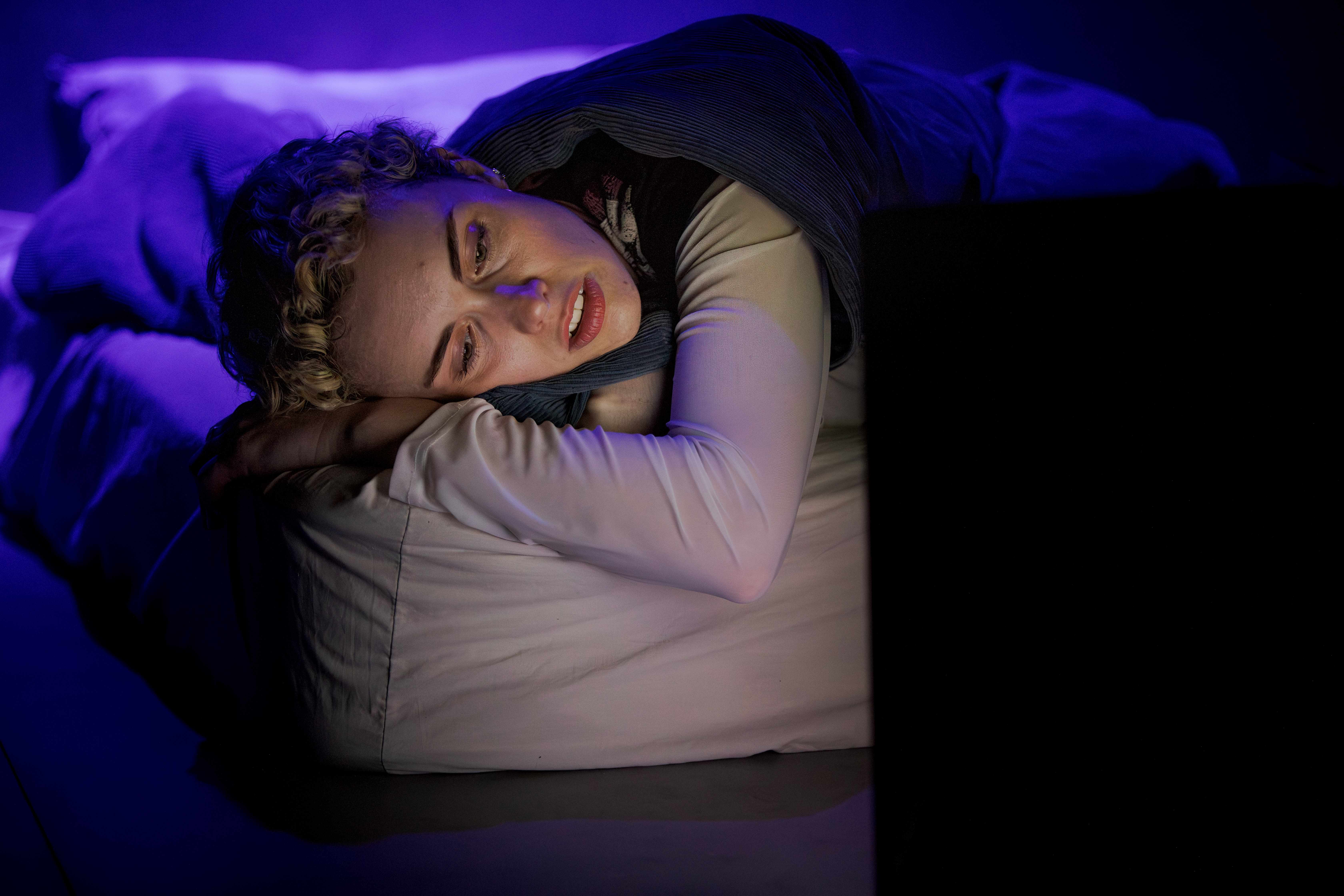
I’m twice as old as the protagonist of this piece, but I can still relate to the story because it’s about a failed artist and I’m a reviewer.
(Incidentally, the protagonist claims that the reviewers in Sydney are dogs. The more sensitive among us might find this offensive, but fortunately no dogs were in the audience.)
But seriously, I found Gia Ophelia, written by Grace Wilson and directed by Jo Bradley, very intriguing, vastly entertaining and quite disturbing (in a good way.)
Despite obstacles possibly unjust but entirely predictable, Gia desperately wants to play the role of Ophelia.
It can be difficult to care whether someone (else) succeeds in the arts. It’s a small story, even for those who love art (or perhaps even more so for people who love art and are familiar with Stanislavski’s exhortation Love the Art, and not yourself in the Art.) And, anyway, success is what we pursue until we realise there are more important things to work for.
In Gia Ophelia, I’m not sure we’re not being gifted a portrait of a sort of madness. There are parallels to Ophelia’s famous mad scene from Shakespeare’s play, with Gia handing random audience members books just as Ophelia distributes flowers. (And, just like Laertes, it lit in me a burning desire to find out who had done this to her.)
Somewhere, I’d heard that this was a story about ageism and sexism in the arts. Such evils clearly exist – they exist throughout our society – but this story seems far too idiosyncratic to be a serious attempt to take them on. It does riff on the societal privileging of youthful looks and of motherhood. But if it does operate as an indictment of ageism, it does this most provocatively by presenting Gia as having internalised the very prejudice she rails against. And curiously, in regard to sexism, it’s Gia who reduces Shakespeare’s Gertrude to the mother. Ironically, this diminution of Gertrude is in direct contrast with Hamlet’s response, who is upset that his mother is refusing to fulfill the conventional female role. (I know Gia’s dismissal of Gertrude as the mother is also fed by the bitter irony of her own situation but, as I’ve suggested, there’s also a stimulating lack of self-awareness. More on that later.)
Rather than a social justice piece, the play most fascinatingly operates as a Saturn returns story. Characters in stories of this type often ask Is this all Life offers? Or have I settled too early? But here, Gia’s quarter life crisis is about confronting the question If this is what Life has dealt me, can I really go on pretending otherwise? Gia must cope with the closing of two of Life’s opportunities, one rather specific and small (the opportunity to play Ophelia), the other much closer to universal (a situation which Gia refers to most of the play as my secret, and concerns her fertility.)
I found Gia a difficult character to like – she’s too-cool-for-school, oddly obsessed with the Ophelia role, and dangerously dishonest. Despite the enormous dissonance between the characters’ personalities, we’re tempted to view both Ophelia and Gia as mainly sinned against. It’s a temptation to which Gia seems to succumb. But she’s also perfectly capable of doing the sinning herself – the keeping of her secret being the prime example – but Gia never seems to consider her choice problematic.
All this is not a criticism of the writing; it’s a rich, complex, very human portrait. And it’s not a criticism of the performance; actor Annie Stafford is magnificent. A droll but fierce intelligence simmers through the first two-thirds of her performance, textured beautifully by brief but very skilful embodiments of other characters. And when Gia’s exterior cool is finally broken, Stafford presents her grief with a heart-rending power.
Grief. Is this the key to the connection between Gia and Ophelia? Shakespeare’s play is often read as suggesting Ophelia goes mad with grief. Is this what has happened to Gia? But what, exactly, is she grieving? The obvious answer, one that relates to her secret, her fertility, is mooted. But Gia seems unwilling to own that plainly, to state that her other obsession is just a type of psychological smokescreen, conjured to hide a more fundamental pain. But, then again, maybe it’s not…. Thrillingly, the play resists simple answers.
Early on, I suggested I found this play disturbing (in a good way.) Here’s why.
In Shakespeare’s play, in a moment of lucidity despite her madness, Ophelia says Lord, we know what we are, but know not what we may be. In Wilson’s play, Gia could be accurately described by an inversion of this famous observation. It’s as though Gia imagines she knows all she needs to know about her future, whilst not knowing herself.
If that’s a type of madness, it’s one many of us suffer.
I find this piece thrilling and disturbing (in a good way) because it represents the incomplete messiness of very human Truths.
Paul Gilchrist
Gia Ophelia by Grace Wilson,
presented by JB Theatre Co. in association with bAKEHOUSE Theatre,
at KXT on Broadway until Feb 15
Image by Phil Erbacher
 Theatre Red
Leave a comment