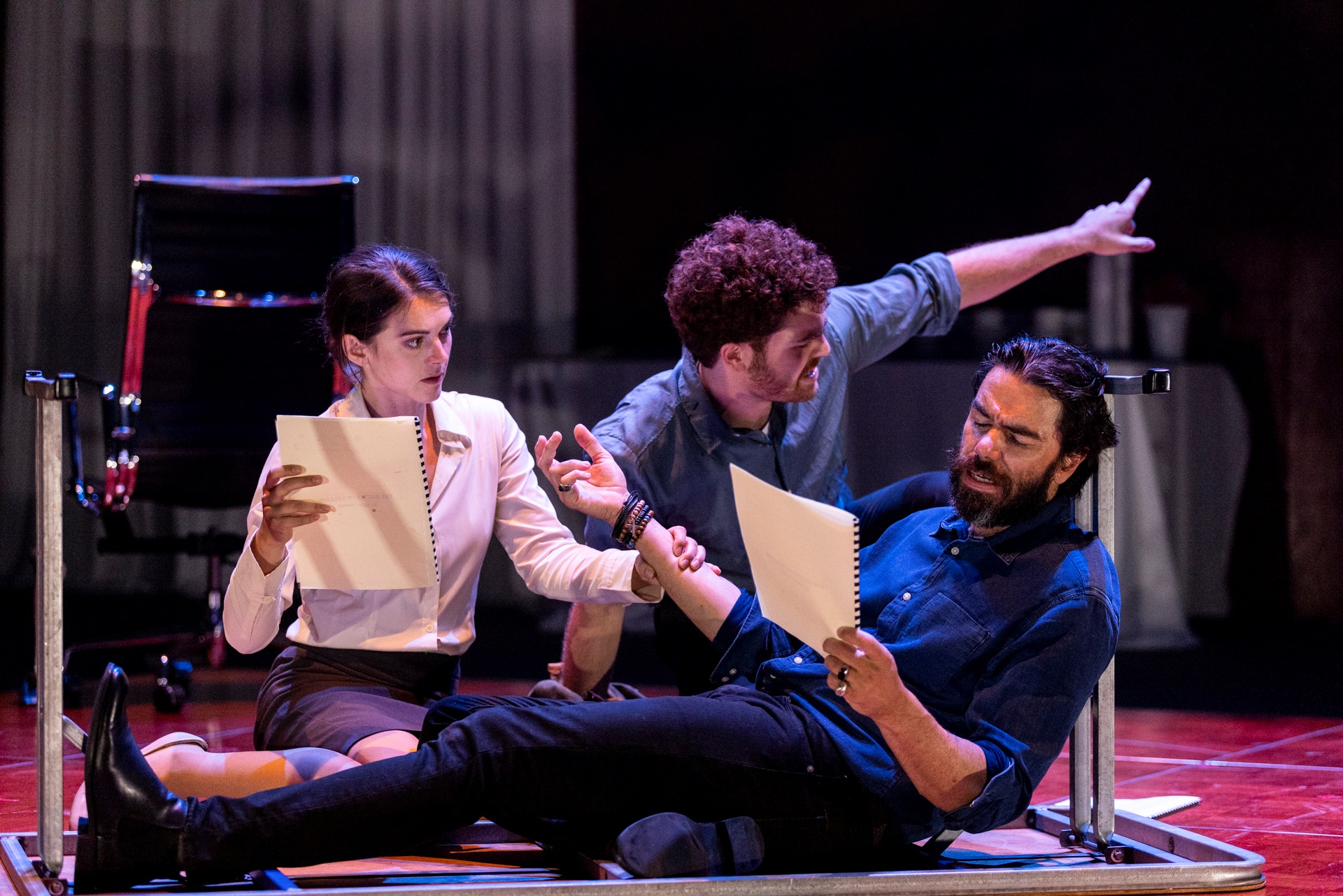
This is an utterly engaging production of a clever, curious piece.
Written by Sam Holcroft, it was first produced in the UK in 2023.
It has a play-within-a-play structure; it’s art about art.
It’s set in a fictional oppressive regime, one in which the Ministry of Culture censors plays critical of that regime and promotes ones that encourage a positive vision. In this regime, plays like Julius Caesar and Romeo & Juliet are banned. It’s not obvious why. Certainly, the Ministry’s response to any new work is to go at it hard with a red pen, eliminating anything deemed inappropriate – from garden-variety profanity to whatever might cast life in the regime in a poor light. Plays, it is dictated, must inspire.
The outer play – the one that frames the other – presents an underground theatre company producing an illegal play. We the audience are included in this act of transgression; we’re addressed as co-conspirators, as though we’ve defiantly come to see this clandestine performance. (Everyone’s familiar with that sometimes-true fantasy that artists are cool rebels, and it was nice to be included in the cosplay – though sitting in my comfortable Belvoir seat after a good meal and a glass of wine, with the promise later of my usual warm bed, I’m not sure I could entirely fool myself that what I was doing was an act of rebellion.) But in the world of A Mirror, surveillance is overarching, and this underground theatre company is prepared, at any moment, to hide their illegal play and us, its audience, behind the pretence of a legal wedding and joyful congregation.
The play-within-the-play, the supposedly illegal play of which we are the risk-taking audience, presents the story of a playwright called to the Ministry of Culture. He is asked to explain a play he has submitted, one which has broken many of the dictated guidelines.
Despite the serious themes of A Mirror, the structure I’ve outlined obviously invites playful mischief – and it’s an invitation director Margaret Thanos and her cast fully embrace. Despite its one hour fifty length, the production has an exhilarating energy.
Performances are splendid. (I’ll refer only to the performers in their roles in the play-within-a-play.) As Čelik, Director of the Ministry of Culture, Yalin Ozucelik is superbly suave, but also animated and personable, a tension that beautifully hints at danger. As his new assistant, Mei, Rose Riley presents a character arc of brilliant comic awkwardness, hilarious enthusiasm, and moving desperation. As Bax, legendary playwright and long-time inhabitant of the theatre milieu, Eden Falk gives a portrayal, equally funny and poignant, of that world’s painful potential to promise more than it can deliver. Faisal Hamza, as Adem, is suitably bewildered by the Department’s unexpected attention.
But back to those serious themes. Apart from the critique of political repression, Holcroft’s play is about the nature of theatre. The most obvious tension is between theatre as fiction and theatre as non-fiction, or between theatre as myth-making and theatre as reality-recording.
What Holcroft does that is so curious, or so stimulating, is to present these two alternatives in strawman fashion; that is, they are presented so hyperbolically that both seem absurd. Embodied in the attitudes of the Director of the Ministry of Culture, Čelik, the myth-making aspect of theatre is reduced to the promotion of a problematic regime. Embodied in young playwright, Adem, the reality-recording aspect of theatre is reduced to the verbatim transcription of actual conversations. Adem is not even characterised as possessing a gift for dialogue; he just has a photographic memory.
With these two facetious alternatives set before us, we the audience are impishly asked What is the nature, and potential, of theatre?
You could be tempted to think Adem’s perspective is meant to be the correct one; after all, you’ve got to get brownie points for not being actively complicit in oppression. But Čelik gets the best speeches, ones expressing the purpose and power of storytelling. In contrast, for much of the play-within-a-play, Adem seems without an aesthetic philosophy at all, appearing not that far from an individual with Savant Syndrome, exhibiting a political and artistic naivete that is unexpectedly combined with one extraordinary ability. And to assume Adem’s supposedly simple truth-telling is superior to Čelik’s myth-making is to ignore that the very play that might lead you to this conclusion is gloriously artificial, meticulously structured and entirely fictional – nothing like the sort of play Adem would write.
It’s Hamlet who suggests theatre is the holding of a mirror up to nature. The metaphor that Art is a Mirror has long been in circulation, but it is a figure of speech that deconstructs itself. If a mirror exemplifies the reflection of an unadorned reality, while art implies some sort of craft or artifice, then (like all metaphors) the metaphor that Art is a Mirror is more arty than it is mirrory.
Of course, theatre can do something mirrors do: both show us ourselves from the outside – which is the exact opposite of how each individual experiences Life. It’s no wonder that both mirrors and theatre can be fascinating in a disturbing way. I’ve quipped before that There are times and places in which theatre has been banned, and if you don’t know why, it’s because you haven’t seen it done well. But I would add, it’s not the being-done-well part that is the only disconcerting, and thrilling, aspect of theatre. And when Savonarola lit his famous Bonfire of the Vanities in Florence, mirrors were among the many soul-sapping fripperies thrown into the flames.
As you can probably tell (if you’re still reading) A Mirror set me thinking.
Real mirrors are flat; only in fantasy is there any through the looking glass. Mirrors just stare back at us, dully. But this play and this production entirely transcend this quality; intelligent and exuberant, it’s all wonderfully invigorating.
Paul Gilchrist
A Mirror by Sam Holcroft
At Belvoir until 22 March
Image by Brett Boardman
 Theatre Red
Leave a comment