Archive | Responses to Plays RSS feed for this section

110% Average

21 Sep

This production is audacious and gloriously silly (and plenty of people value audacity, especially of the I-can’t-believe-you’re-letting-yourself-look-like-such-a-dag-on-stage sort.)

Anita Lovell tells her “coming of average” story, outlining her discovery of enjoyment and security in not being especially good at a whole host of activities. The glorious silliness comes from the fact Lovell enacts the routines she performed in childhood – trampolining, roller skating, gymnastics, etc.

Lovell has great comic delivery and a joy inducing commitment to the physicality.

For me, at least, the show raises some rather big questions. I’m inclined to feel we should pursue excellence, but this production aligns more with the views of Kurt Vonnegut. Vonnegut was one of those great geniuses who never won the Nobel Prize, and his advice is famous: “Practice any art—music, singing, dancing, acting, drawing, painting, sculpting, poetry, fiction, essays, reportage—no matter how well or badly, not to get money and fame, but to experience becoming, to find out what’s inside you, to make your soul grow.” In contrast, my view has more in common with that of the geniuses behind Fast and Furious 7 (inexplicably also denied the Nobel.) The soundtrack of their film features the lyrics  “Go hard or go home”.

The pursuit of excellence is inspiring, while the rejection of it, though hardly immoral, is of little relevance to anyone else… and to yourself might merely be a pastime.

But, assuming being average is not just a euphemism for being not very good at something, being average is a comparative statement. It’s about competition.

Plenty of human activities are not competitive. When you choose ones that are performative, you invite judgement. (I’m not suggesting you deserve it.)

So, in a way, the show is an exuberant assertion of independence, a mischievous reclamation of art from the tyranny of evaluation, and a teasing reminder, that in the rejection of some values, their residual will remain. (See my above comments about audacity.)

Paul Gilchrist

110% Average by Anita Lovell

Boom Boom Room as part of the Sydney Fringe (until 24 Sept)

https://sydneyfringe.com/events/110-average/

Cherry

15 Sep

Cherry is a whole lot of fun – a playful, joyful journey; one young woman’s passage into adulthood with Katy Perry as an inspiration. It’s an exuberant pop bildungsroman; a poignant study of how mass culture, despite its audience of millions, can deeply impact the individual. (And, creating a genuine dramatic tension, a question very consciously runs through it all: on our journey to authenticity, how reliant can we be on the mass produced?)

There are plenty of references to Perry and her music, which will both delight aficionados and welcome newcomers into the high-spirited world of the Katy Kats.

I suspect this story is not an anomaly; ever since radio, then TV, then the net, teenagers have been able to find a sense of community with others experiencing the same exciting, troubling stage of life. (Is “the teenager” a creation of mass media? I don’t mean this in a cynical way; simply, that for the first time in human history, poor souls struggling through that awkward, exhilarating age could know they were not alone.) And teenagers have benefited from strong voices like Perry’s advocating empowerment and acceptance.  

Both linguistically and physically, Sarah Carroll gives a terrific evocation of girlhood, its debilitating doubts and its passionate obsessions.

Musical director Marissa Saroca delivers a soundtrack of infectious energy.

The Fringe provides a perfect arena for a little bliss bomb like Cherry.

Paul Gilchrist

Cherry by Sarah Carroll

Emerging Artist Sharehouse – the Boom Boom Room until Sat 17 Sept

https://sydneyfringe.com/events/cherry/

Photograph 51

13 Sep

Ensemble’s production of Anna Ziegler’s Photograph 51, directed by Anna Ledwich, is utterly engaging theatre; intellectually stimulating and deeply moving.

It tells the story of Rosalind Franklin, one of the researchers who in the 1950’s uncovered the secrets of DNA.

Despite it’s reputation as a pure pursuit of knowledge, science is just another human activity, tainted by human failings.  

Rosalind is excluded from male enclaves and the attendant conversations in which ideas are casually shared. She’s assumed to be incapable of theoretical insight, and attempts are made to reduce her role to that of a technician. She’s portrayed by the male scientists as some sort of harridan simply for standing her ground. And she’s ultimately robbed of …. ah, but that’s a spoiler for those who don’t know her personal history. Let’s leave it this way: the conclusion is heartrending.

Yes, the play’s about science, but Ziegler’s extraordinary script is thoroughly captivating because it tells a very human story. Her Rosalind is a complete person, not a straw victim. She’s sublimely intelligent and gloriously independent, but we’re also asked to consider whether her flaws are inevitable responses to discrimination. Is Rosalind simply overly cautious? Does she really need to keep everyone at such a distance? Amber McMahon is absolutely magnificent in the role.

And the supporting cast do equally brilliant work. Garth Holcombe as Maurice Wilkins, Rosalind’s colleague at Kings College, is a superb portrait of a man threatened, one who would like to be noble, but who can’t quite manage it. His advice to PhD candidate Raymond Gosling (played with charm by Gareth Yuen) is to be kind to women; but the inadequacy of this advice – its patriarchal overtones – is beyond his comprehension. Ziegler employs a motif from The Winter’s Tale to underline this. Rosalind has seen Peter Brook’s production of the play starring John Gielgud as Leontes (but in a wonderful irony can’t recall the actor playing Hermione). Wilkins knows the work well, and the two might bond over this shared interest, except for their very different readings of the play’s finale. Does Hermione really survive? It’s a beautiful playwright’s trick, a gorgeous encapsulation of the issues at stake, and a sophisticated embrace of the openness of the dramatic form.    

Robert Jago as Francis Crick and Toby Blome as James Watson powerfully embody another very human flaw that mars the supposedly noble pursuit that is science: competition. The goal of discovering the truth of the DNA molecule is reduced to a “race” and, when an understanding is finally achieved, Crick asks grandly do you know what this means – only to offer a staggeringly uninspiring answer: wealth, status, women….

Emma Vine’s beautiful set, ostensibly a laboratory, evokes a chapel. It’s a poignant touch.  Are Science and Religion at odds? Rosalind says they are. But, at their best, both embody a humble desire for truth. At their worst, both are tragically beholden to the machinations of power.  

Paul Gilchrist

Photograph 51 by Anna Ziegler

Ensemble Theatre until Oct 8

ensemble.com.au

Photo Credit Teniola Komolafe

Chimerica

24 Aug

We all know the photo. A lone man stands before a line of tanks. Incongruously, he holds two shopping bags.

It is immediately after the events of 15 April 1989, the day the People’s Liberation Army of China turned its guns on protesters in Tiananmen Square.

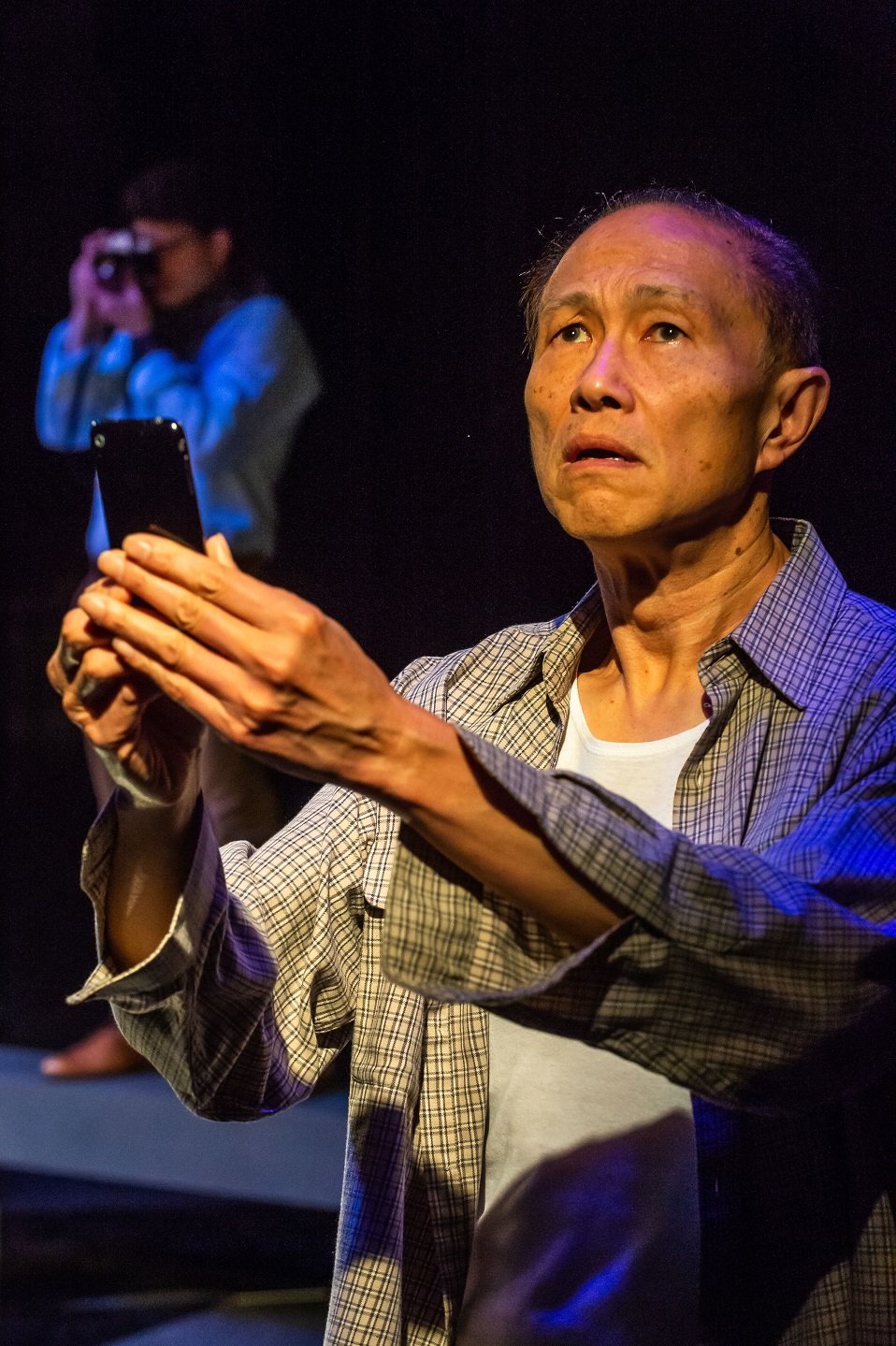
Lucy Kirkwood’s Chimerica tells the story of the American photographer who took one of the original photos and of his search for the man immortalised in the image. Did he flee to America? Is he still alive?

Kirkwood’s story is fiction, but it’s a brilliant exploration of heroism. In an age in which our vision of the hero too often reduces to someone who can deliver a cutting comeback on social media, a reminder that it might take a little more than that is invaluable.

And the power of Kirkwood’s play is that it reminds us that little more might manifest itself in many ways. We can be heroic in both what we choose to do, and what we choose not to do. The virtue of restraint, for example, might be harder to photograph, but is no less real for that.

On the night I saw this production at New Theatre, there were technical difficulties, but this didn’t hide the brilliant performances that director Louise Fischer has elicited from her cast. Oliver Burton as the American photographer powerfully portrays both the man’s charisma and his disturbing myopia. As Zhang Lin, a Chinese teacher of English in contemporary Beijing, Jon-Claire Lee is magnificent, presenting a rich emotional palette, ranging through light-hearted resilience, and seemingly infinite patience, to chronic despair. Enoch Li and Liz Lin play Zhang Lin’s younger self and his wife with engaging charm. Jasmin Certoma’s English woman abroad is a wonderful study in the challenges of genuine engagement in a world that can seem far too big for the individual to make an impact. Alice Livingstone shines in several cameos, as a prickly secretary to assured elected representative. Similarly, Katrina Chan splendidly inhabits several roles, portraying both vulnerability and an inspiring feistiness. Les Asmussen’s newspaper boss is beautifully rich, with space enough for both parody of media moguls and genuine insight into the complexities of the business of selling the truth.

Back to those technical difficulties: that they made so little difference suggests, that for theatre to be truly engaging, you simply need a great script and great cast. Easy.

Paul Gilchrist

Chimerica by Lucy Kirkwood

New Theatre until 10 Sept

newtheatre.org.au

image by Chris Lundy

Labyrinth

23 Aug

This production is inspiring for its sheer energy and effort.

Beth Steel’s play, first produced in 2016, is set in the 1980’s. It’s the story of a crash: the over lending by American banks to Latin American countries, and the dreadful consequences.

It’s tempting to say this particular production is about finance and furniture removal; this epic play has many scenes, many locations and, as a result, changeovers make up a significant part of the action. Director Margaret Thanos, movement director Diana Paolo Alvarado, and a spirited cast handle these with aplomb. It all becomes a magnificent spectacle – which is thrilling to the degree to which one classes oneself as a spectator or as an audience member. But the time that must have gone into building and rehearsing these changeovers is mind blowing, and throws the gauntlet out to other theatre makers.

The tile is odd. Is it ironic? Few plays would be more obvious in their meaning: greed is bad. Some may feel it’s a story that doesn’t especially need to be heard (and judging by the soundscape that played through some of the scenes this might be a view shared by the creative team.)

Performances are truly exuberant, and generally effective. Matt Abotomey as the protagonist, John, is eminently watchable, embodying with bold physicality and emotional power the literary trope of the man seduced by power. Angus Evans and Brendan Miles both evoke the frightening obtusity of the privileged. Camila Ponte Alvarez’s Grace, a journalist who flags the wanton irresponsibility of the American lenders, is a wonderful portrait of intelligence and sanity in a small, crazy world. Tasha O’Brien and Rachael Colquhoun-Fairweather produce some comic magic.

I implied earlier that the story was an obvious one. Perhaps that’s a criticism. Or perhaps it’s not. That injustice is as familiar as dirt, as dust, simply urges on us fresh ways to shake off our complacency.

And both play and production give it a good hard shake.

Paul Gilchrist

Labyrinth by Beth Steel

Flight Path Theatre until Sept 3

www.flightpaththeatre.org

Image by Clare Hawley

The One

10 Aug

The One by Vanessa Bates is a bit of crazy fun with a beating heart.

Focussing on a Chinese Malaysian Australian family, the title of the play throws out a couple of questions. Has Mel found in Cal her romantic “one”? Or, of the two adult siblings Mel and Eric, which is their mother’s favourite “one”?

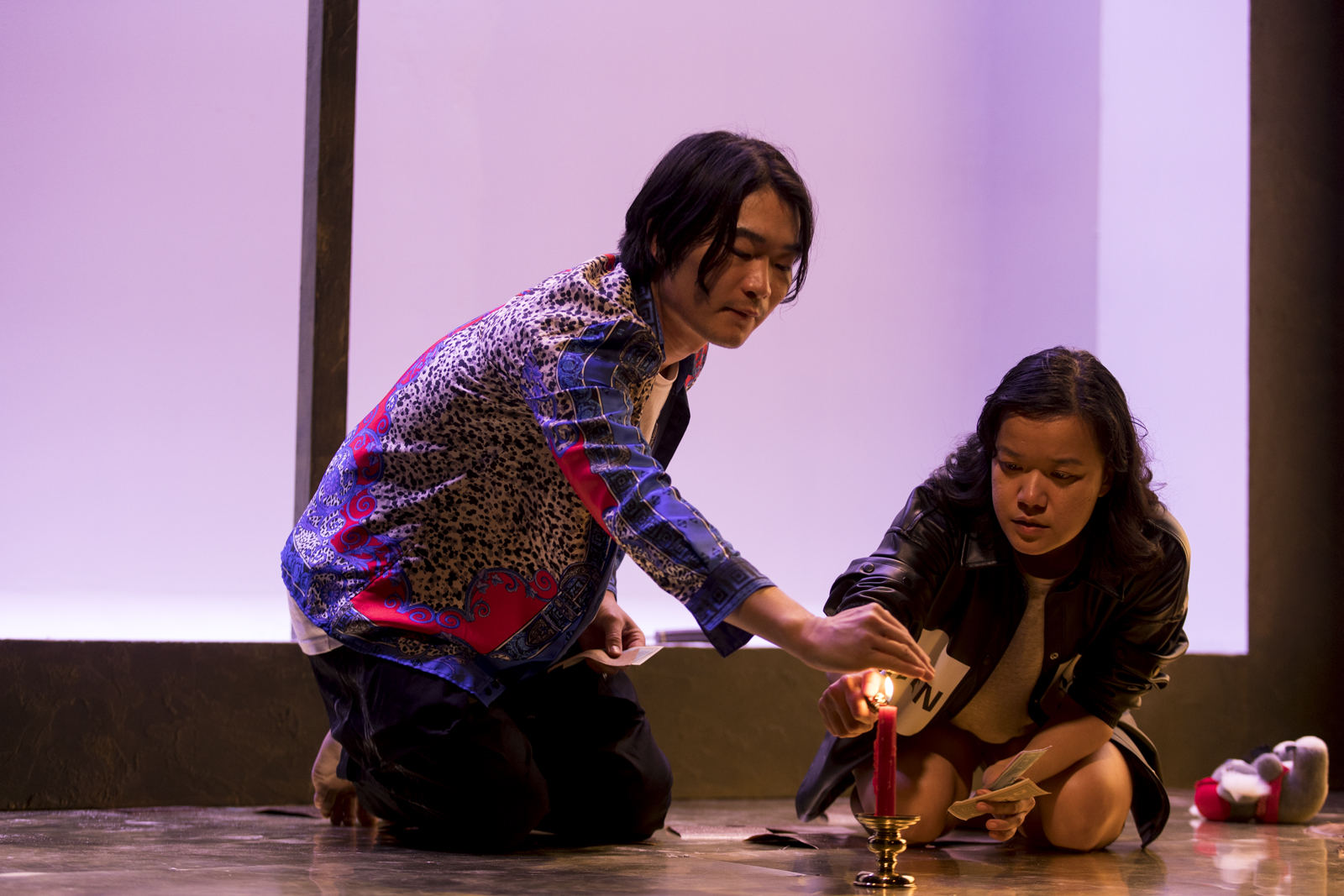
Director Darren Yap elicits wonderful comic performances from his cast. Shan-Ree Tan’s Eric, the meek librarian with a hidden side, is terrific, and powerfully affective when required. Angie Diaz’s Mel evokes the precocious child who (with her brother) once was a ballroom dancing star – albeit at the Asian-Australian Regional competition. Damien Strouthos’ Cal is gloriously hapless. Gabrielle Chan’s matriarch is a playful presentation of a woman intent on enjoying herself. Aileen Huynh’s waitress from hell is comic gold.

But, beyond all this, are issues of identity. The play asks where do the siblings belong? She remembers her childhood in Malaysia, but because of her appearance passes as non-Asian. (She’s a PPOC; a partial person of colour.) He remembers very little of Malaysia, but because of his appearance cops racist abuse.   

Belonging is an odd concept. A constant tension between belonging and not belonging is part of the human condition; an inevitable aspect of being individuals who live in communities. In one scene, Mel recalls an incident of racism from her childhood, a group of men at a restaurant hurling abuse. It’s the moment she knew she didn’t belong. But who would want to belong to a group that treats people that way? Forget the belonging, it’s the mistreatment. Belonging is a fantasy; a phantom hope born of pain. (It’s as though, stranded alone on a raft, surrounded by an ice cold sea, we tell ourselves that if we survive this horror, we’ll find a place where we’ll live forever. We won’t.) However, despite its fantastical elements, perhaps the concept of belonging functions like a legal fiction: imaginative nonsense, but useful in identifying something very real, injustice.

For all its fun, the play is a moving reminder that we must do better.

Paul Gilchrist

The One by Vanessa Bates

Ensemble Theatre until Aug 27

www.ensemble.com.au

Image by Prudence Upton

Albion

7 Aug

Mike Bartlett’s Albion is a piece of theatre on a grand scale: nearly three hours of stage time and a plethora of well-drawn characters.

This level of ambition is thrilling.

No prize for guessing where a play called Albion is set. It’s a foreign play; a state-of-the-nation play where the nation portrayed is not ours. This is Britain post-Brexit: a wealthy woman buys a rural property with the intention of redeveloping it’s once famous garden. (In the first draft, were they raising a bulldog?) The villagers (yes, that’s what they’re called) are disappointed that the new owner won’t fulfil her customary role; she won’t host their festivals in her garden. The woman’s family are divided about the London they’ve left behind: has it become a temple of mammon, or is it a life-giving alternative to a country grave?

And it’s all a very conscious homage to Chekhov. Yes, it’s a garden, not a cherry orchard – but there is a Firs, the old servant lost amongst the flux ( This Firs is called Matthew, and is played with moving poignancy by Mark Langham.) And, like The Seagull, those on the rural estate are visited by a famous writer who causes mayhem among those with artistic ambitions but less success.

State-of-the-nation plays are an odd genre; though grounded in realism, they reach to the symbolic. And what odd things symbols are: invested with meaning by who, for who, for how long? Once, I asked a young person what a lion might symbolise – and was told paddle pops.

So, what about the performances? Excellent. Director Lucy Clements gives us inspiring depth and breadth. Joanna Briant as Audrey, the matriarch, is a masterclass in glib superiority; a thought-provoking posing of the tragic question at the core of materialist societies: must success murder empathy? The visiting writer ….. and there are a lot of writers in these sort of plays: three in this one, out of a cast of eleven; a rather inflated sample, considering writers usually fill the same percentile of the population as serial killers ….. the visiting writer is played by Deborah Jones with a gorgeously warm charisma, providing her with ample space to growl when the going gets tough. Rhiaan Marquez as Zara, Audrey’s daughter, beautifully balances youthful exuberance with youthful naivete.  Jane Angharad’s Anna grieves for her lover, Audrey’s son, with powerful truthfulness. (The dead son, too, becomes a sort of symbol: a lost England to dispute over, under a very English heaven.) James Smithers as Gabriel offers a superb character arc, like a piece of lost space junk that ultimately burns with a searing white heat when it drifts into the orbit of a more imposing body. Charles Mayer as Paul, Audrey’s husband, gives a performance of gentle intelligence. Paul maintains his safe orbit, as all things do, by allowing change to be dictated by that more imposing body.

Due to popular demand, this season has been extended. (Gardens have a way of growing.)

Paul Gilchrist

Albion by Mike Bartlett

Seymour Centre until Aug 20 https://www.seymourcentre.com/

Image by Clare Hawley

Ugly Love

19 Jul

Writer director Lucy Matthews’ musical Ugly Love consists of a fine collection of songs, performed by a very tight band and some wonderful vocalists.

And it’s original. And it’s about sex.

But, for all its newness and sexiness, Ugly Love is deliberately grounded in middle-class ordinary. Jess is a teacher. Sam is a lawyer. They are married. They live in Newtown. They are not happy.

They decide to try an open relationship: an entirely rational option considering their exclusive relationship is based on bickering about who should put out the garbage. Intimacy has become him flossing in front of her – so looking elsewhere has an obvious appeal…..

… as long as it remains only physical – which raises the first of the play’s tantalising questions about sex.

What is the difference between physical involvement and emotional involvement? For many of us, the default assumption is that the two are different, and that it is possible to separate them – but then we’re not surprised, at all, if something that begins as only physical morphs into the emotional. This is what happens for Jess; she becomes emotionally involved with another woman. Why do we assume the categories physical and emotional are meaningful when the boundary between them is so very permeable? And what emotions do we expect to be excluded from encounters supposedly exclusively physical? Perhaps sex that is only physical is simply bad sex. And, if so, the persistence of the category suggests there’s a hell of a lot of bad sex out there.

(And before I’m drawn back inevitably to sex, I best talk about the cast and creatives. Performances are rich and satisfying. LJ Wilson and Lincoln Elliott present a poignant portrait of a conventional couple, simultaneously attracted and repelled by the world they’ve accepted. Cypriana Singh as Lola offers an invigorating vivacity, tempered by a sorrowful awareness that verve is not always enough. Likewise, Madelaine Osborn’s portrait of the wisecracking Maddi is movingly shaded with hints of darkness. The design by Kate Beere appears to effortlessly lift a black box theatre into an arena in which suburbia battles fantasia – what is versus what could be – and the lighting by James Wallis, in its contrast between the simple and the shimmering, magnificently evokes small lives imagining more.)

Now, that other question about sex. Is it possible, in the full knowledge of all concerned, to have sexual or romantic relationships with several people at the same time? (The corollary, of course, is why would you want to?) Though characters in the play attempt to have polyamorous relationships, no one is represented as doing this entirely happily. But that creative choice, far from dismissing the possibility of polyamory, represents the experience truthfully (warts and all: ugly love).

Which brings me back to ordinariness. At the heart of Matthews’ thought-provoking musical is a thrilling rejection of the ordinary, the predictable, the socially expected, the socially accepted. In making her characters inhabit a world so very ordinary, Matthews invites us to dream a world beyond.

Paul Gilchrist

Ugly Love by Lucy Matthews

Flight Path Theatre until July 23

https://www.flightpaththeatre.org/

Image by Katje Ford

Golden Blood

4 Jul

Plays like this make you want to shout that Australian theatre is finally growing up – and if such partisan, attention-seeking hyperbole belongs anywhere, surely it belongs in the writings of a drama critic.

Said more plainly, Golden Blood by Merlynn Tong, set in Singapore and presenting only Singaporean characters, is glorious Australian theatre.

She is orphaned at fourteen. Her estranged brother, seven years older and a petty criminal, becomes her guardian.

The developing relationship between the siblings is beautiful to watch; bewilderment and uncertainty vie with affection and a need to belong, creating scenes both comic and moving.

Director Tessa Leong elicits terrific performances from a super cast. Merlynn Tong takes innocence and intelligence and makes a lovable dreamer. Charles Wu takes amiability and bravado and makes a charming schemer. (And schemes and dreams might be as immiscible as oil and water – but out of such those roadside rainbows…..)

Tong has chosen her material well; obviously drama does conflict (do the two siblings want the same thing?) and obviously drama does duplicity (has the brother really reformed?) but, at its most humane, drama reminds us that conflict and duplicity exist, not only in relationships, but within individuals. Essentialists everywhere assert there is a real self, but Tong’s characterisation of the gangster brother is an empathy-evoking reminder that cynicism is far easier to criticise than to do. We tell stories to be believed, and one person, at least, is always listening: I say I’m doing this for your good, and I find myself very convincing.  

Such portraits of the human experience engender forgiveness – and we could all do with a little more of that.

Paul Gilchrist

Golden Blood by Merlynn Tong

SBW Stables Theatre until 30 July griffintheatre.com.au

Image by Brett Boardman

M Rock

28 Jun

Writer Lachlan Philpott’s tale is warm-hearted and fun; a paean to understanding between the generations. Tracey heads overseas on her post-HSC rite of passage, and promptly loses herself in the club scene of Berlin. Mabel, her grandmother, goes to find her.

In the manner of tales of a physical quest, the quest also becomes internal: the finding of self. (As a digression, it’s a common assumption that there’s someone to find, as against something to understand or something to do. It’s an assumption designed, oddly enough, for safety: an assertion of identity being far less confronting than an acknowledgement of liberty. See my latter comments regarding the play’s conclusion, and it’s clear this work ultimately backs radical freedom.)

Valerie Bader as Mabel offers a beautiful portrait of that most potent of mixtures, the gentleness and strength of age. Milena Barraclough Nesic as Tracey captures exquisitely the youthful tension between wonder and thoughtlessness.

The ensemble are terrific; Bryn Chapman Parish, Masego Pitso and Darius Williams play a globe of characters with subtlety, exuberance and generous humour.

Director Fraser Corfield’s staging is delightful, building a theatrical world that makes a joyous journey through three continents.

The conclusion to the tale happens fast and is awfully large; it’s as though a gentle river that has graciously slid through picturesque scenes suddenly comes to the cataract edge. Not that the end of the story is a fall – rather, the opposite – and, like all waterfalls that plunge 100 metres upwards, unbelievable. However, this is the land of symbol, where meaning trumps likelihood, and tales such as this are not told to dully record the odds, but to envision a type of victory.

Paul Gilchrist

M Rock by Lachlan Philpott

Produced by ATYP atyp.com.au

The Rebel Theatre until 17 July

Image by Tracey Schramm