Archive | Responses to Plays RSS feed for this section

Dot Dot Dot

19 Nov

New work! Thank God. And a big thank you to Gareth Boylan and the Old 505 for presenting it.

Dot Dot Dot by Drew Fairley is a murder mystery set in fin de siècle Australia. It’s a rollicking yarn with terrific performances and some beautiful set pieces. (In particular, one of these pieces is a very amusing, suspense building scene between two policemen, played wonderfully by Gerard Carroll and Matt Abell-King.)

The Crime genre often derives its appeal from its exploration of three concepts: Truth, Causation and Fear.

Truth: Whodunnit? In Fairley’s play we seek a murderer, the infamous ‘Noah’, a psychopath who kills people in pairs; two school girls, two policeman, two theatre critics (OK, maybe not the last pair – which only proves Noah is disturbed – but you get the idea.) But who can lead us to the Truth of the murderer’s identity? There’s the media, with a media baron portrayed with fitting smugness by Carroll. There’s a medium; a sideshow clairvoyant and raconteur played with a fascinating mix of fear and guile by Natalie Venettacci. And there’s the delusional dope addict, played as an intriguing battle between strength and vulnerability by Lucy Miller. But, Truth is a slippery fish; a product of the ocean it swims in…….but more on that later.

DotDotDot

Causation: the Crime genre needs connections. Actions must clearly lead to consequences which must lead clearly to other actions. The Crime genre does not do Random. The horrors of Life are not denied but rather made sense of – at least, on one level. This tidying up of the rough edges of Life probably accounts for much of the genre’s popularity. It also makes possible one of its most attractive features: the complicated plot. Fairley’s script delivers, with a plot which is both complex and intriguing, but ultimately crystal clear. Director Gareth Boylan weaves together beautifully the many moments, characters and locations.

Fear: this third in my trifecta of Crime might appear to contradict the second. But, of course, Fear is the disease for which apparent Causation is the cure. It is the exploration of Fear and the environment it creates (the sea the fish swims in) that lifts this play from its genre roots. Fear allows us to be manipulated. I suspect Fairley set the play at the eve of Federation to suggest that Fear is a congenital disease from which this country suffers. He could have further explored the idea that the historical Federation was indeed a direct result of Fear: the states decided to band together because of the illusory threat of the ‘Asian hordes’ that would supposedly overrun this tiny outpost of European civilization. He might have explored that idea……but his target is more contemporary than the fear mongers of the past.

Veronica Kaye

Dot Dot Dot by Drew Fairley

at Old 505 Theatre til 28 Nov

Tix and info here
Last Drinks & Two Mouths Four Hands

18 Nov

Whenever I see a local company produce a foreign play, or a play we’ve all seen before, I’m bemused. A part of me – a very large part of me – wants to scream ‘What’s that about?’

If someone in the team didn’t write the play, it just doesn’t seem like the real deal. It feels like an attempt to cash in on someone else’s reputation or authority.  Or like the whole event is just a showcase of the director or actors’ talents; a step in a career, as against a work of art.  Sometimes I’ve even wondered if it’s actually a type of mysterious ritual……. if we repeat these words, repeat these movements, then the world will be right. Like a rain dance. Or a Catholic mass.

In the past I’ve referred to non-original theatre as ‘cover theatre’; in the same way that The U2 Tribute Show is commonly called a ‘cover band’. I’m not really sure why what’s considered secondhand in other art forms is acceptable in theatre. (I’ve written a lot about conservatism in theatre –   here )

Brave New Word produces new work. Thank God. I wish there was more of it.

Their current double bill at Balmain’s Exchange Hotel has a lot of laughs.

Last Drinks

Photo by David Hooley

Last Drinks is a sitcom written by Jordy Shea and directed by Luke Holmes. Three blokes meet in a pub, which like them, has seen better days. The play’s an intriguing exploration of masculinity; its knockabout discourse (“Chin up, prick”) and it’s rather curious loyalties (children, alcohol, but not women.) The cast (Bob Deacon, Steve Maresca and Christopher Nehme) embrace these deliberately cartoon-like characters and it’s all very watchable.

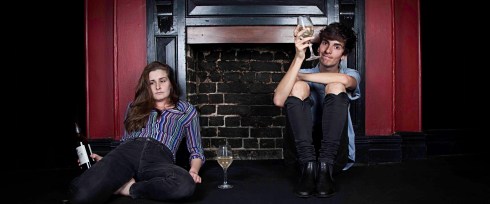
Two Mouths Four Hands.jpg

Photo by David Hooley

Two Mouths Four Hands by Nicole Dimitriadis and directed by Bokkie Robertson also follows the sitcom form. However, this time, it’s not the world of masculine dumb; this two-hander is a girl’s night in with her gay male friend. They drink. They talk sex and love.  Once again, there’s some good laugh lines, and some provocative questions are thrown up: Does it really make a lot of sense to build our self worth from our sexual experiences? Is friendship really just a type of power play?  Actors Georgia Woodward and Alex Beauman give energetic performances of these youthful characterizations.

The space is used well. The first piece is set in a bar – and we’re in a bar! We’re ushered out at intermission and return to find the second piece quite effectively set in a lounge room.

Pub theatre is good fun. Original theatre is just good.

Veronica Kaye

Last Drinks by Jordy Shea

Two Mouths Four Hands by Nicole Dimitriadis

at the Exchange Hotel, Balmain, 17-19 Nov & 24-26 Nov

Tix and info   here

Roadkill Confidential

17 Nov

Cruelty’s a funny thing.

The great liberal project of the last 300 years has been to try to diminish it. And we’re making ground. For example, fewer children die in coalmines now, or at least in the nicer parts of the world.

But we’ve still got a way to go. And, like all political action, the job will never be done. We make the world every day.

“So, can Art help?” That’s what Roadkill Confidential by Sheila Callaghan got me thinking about. It’s a very clever, very funny black comedy presented with appropriate mischievous joy by Michael Dean of Lies, Lies and Propaganda.

Trevor (a very watchable, provoking bully played by Alison Bennett) is creating her new art installation. Made from roadkill, it will highlight the world’s brutality. But it’s not just small furry animals that keep dying, and so a government agent begins an undercover surveillance mission. Played with hilarious hyperbolic seriousness by Michael Drysdale, the agent’s a very amusing addition to crime fiction’s growing number of unreliable narrators: characters supposedly driven by morality, but whose sense of right and wrong is clearly wrong. “I’m a patriot”. Enough said.

Roadkill - 8

Photo by Emily Elise

As the agent attempts to solve the mystery, he monitors all the people in Trevor’s life. There’s William, her husband, an art critic for whom theory has replaced thought (played with appropriate soft-speaking pomposity by Jasper Garner Gore.) There’s her fame-obsessed teenage stepson, Randy (played explosively by Nathaniel Scotcher), perhaps a sharp pen-portrait of an entire generation. And there’s the bubbly, bumbling, socially awkward neighbor, Melanie (a comic gem created by Sinead Curry.) In this world, all of the characters are parasites who feed off Trevor, the artist. Like I said, it’s a comedy.

bAKEHOUSE’s new Kings Cross Theatre is a great place for performers to play, and set designer Catherine Steele keeps it simple and functional. The main feature is a large lit frame. It represents a TV screen offering daily horrors. It represents the screen of the agent’s hidden surveillance device. But it also evokes a picture frame. Perhaps surveillance and Art are close cousins? After all, watching and representing are both oddly passive, even creepy, actions. In a neat trick, Callaghan has Trevor realize she’s being watched. The result: she performs for the camera. This is not artist as great soul.

The question Callaghan’s play throws up for me is whether the artistic representation of cruelty and suffering awakens us or does it merely numb us? If we do build the world every day, how much do we need to look backwards?

Veronica Kaye

Roadkill Confidential by Sheila Callaghan

Kings Cross Theatre til 28 Nov

Info and tix here


Good Works

7 Nov

As a kid, I’d occasionally be dragged to Great Aunt Dot’s for slide night.

I’d fidget, as slide after slide of people I didn’t recognise slid by. Kat, who was second cousin to Joan. Or was it Shirley? Henry, who died young in a boating accident.

Now and then, when a random image did finally hold my childish attention, it would quickly slide away, replaced by another, and then another.

And Aunt Dot, God rest her soul, had no sense of chronology. Poor young Henry would be lost, and then he’d return, smiling confidently at the camera, seemingly magically unaware of what lay ahead. At the time I giggled; Aunt Dot was dotty. But now, older if not wiser, I guess at her purpose.

Nick Enright’s Good Works felt like one of Dot’s slide nights. Enright’s slides are far better composed, but they do just keep coming.

Director Iain Sinclair builds this challenge into a beautifully fluid production and the performances are wonderful. ( I could watch Toni Scanlan do her stuff eight nights a week.)

Set in old time Anglo Australia, Good Works is a meditation on class, family, and authentic moral behaviour. (‘Good works’ being the very Catholic assertion that our salvation is tied to our actions, not – as those horrid Protestants might have it – only to our faith. Of course, there’s a troubled heart to this doctrine. Good works, when so bound up with our own salvation, our own vision of morality, can struggle to seem a genuine attempt to reach out and help others. The tension between one-time childhood friends Rita and Mary Margaret provocatively suggests this issue, and it’s performed movingly by Taylor Ferguson and Lucy Goleby.)

Taylor Ferguson and Lucy Goleby. Photo (c) Helen White.

Taylor Ferguson and Lucy Goleby. Photo (c) Helen White.

This play typifies a strand of Australian theatre for which I am not the audience. It’s nostalgic. It’s non-cerebral. ( Nostalgic? Doubly so. Enright wrote it 20 years ago, about an Australia 30 odd years before that. And it’s non-cerebral because in a world defined by sex , repression and physical brutality, some of the characters may be canny, but none is allowed an intellectual life.)

These two elements combine to create a sentimentality that speaks to me as much as one of those slide nights. A night of people I didn’t recognise, sliding by in the darkness. But like Henry, whose smiling face would always make Aunt Dot’s eyes shine, they’re clearly recognisable to others.

Veronica Kaye

Good Works by Nick Enright

Eternity Playhouse til 29 Nov

Tix and info here

Duck Hunting

5 Nov

In my responses to theatre I try to refrain from profanity. I don’t mean when I’m actually in the theatre. There, I believe, a little colour sometimes enlivens the proceedings.

No, what I mean is that I try to avoid swearing in my written responses. But for Duck Hunting, I’ll make an exception.

Let me invent a term: the ‘Dickhead play’.

The plays in this genre feel like theatre in First Person. All the attention in a Dickhead play is on a sole character – a male protagonist who treats other people really badly yet the focus is on his suffering.

Despite my derogatory terminology, a Dickhead play isn’t necessarily a bad play. It can be a form of cautionary tale.

Contemporarian Theatre’s Duck Hunting by Aleksandr Vampilov is an intriguing night of theatre. (And I do mean night; it’s over 3 hours long.)

Vampilov’s play has been contemporized. We follow Craig Stephens as he does horrible though mundane things to other people. Unsurprisingly, he finds this a dissatisfying life.

Christian Heath gives a very watchable performance. He’s in every scene; it’s a major monster of a role, and a minor monster of a character. (Though I think Craig calls every female character in the play a ‘slut’ for doing no more than he has done, so perhaps he’s best described as a garden variety misogynist.)

Christian Heath and Paul Gerrard (c) Toby B Styling

Christian Heath and Paul Gerrard (c) Toby B Styling

The rest of the cast do good supporting stuff. Directors Shai Alexander and Toby B Styling have created a stylized world; one that’s deliberately short on natural human connections. In some scenes, the movement is a type of mechanical ballet. In other scenes, the characters make no eye contact. (The occasional use of projection also adds to this lack of connection, but not between the characters, between the audience and the play.)

Part of the intrigue of this piece is the tone. It goes to a very strange place by the end. I wasn’t sure what to feel. Was it comic? Was it tragic? But I guess that’s one of the defining elements of the Dickhead play: follow a dickhead around all night and you’ve got to laugh, and you’ve got to cry.

Veronica Kaye

Duck Hunting by Aleksandr Vampilov

King Street Theatre til 29 November

tix and info

A Flower of the Lips

16 Oct

Theatre’s greatness as an art form derives from its acknowledgement of Time.

Time means flux. Characters change. Theatre suggests the fluidity, and hence the ineffability, of Life. (How easy it would have been in the last sentence to use the word ‘captures’ rather than ‘suggests’; how easy, and how false.)

Our relationship with the past is like our relationship with other people – often crucial but never concrete. (To say to another ‘I know you entirely’ is not the language of love but rather of control.)

In Valentino Musico’s play A Flower of the Lips the playwright explores his relationship with a chapter of his family history. In Calabria, post World War One, Musico’s great grandfather was in the unenviable position of chasing down deserters.

It’s tense, intriguing and true…….if ‘true’ is the right word.

How does Musico ‘capture’ the past? He’s done the research and so the play is part-documentary. There is even a character representing the playwright, narrating the proceedings.

But Musico knows this attempt at objectivity is not enough. The past must be allowed its wildness, so Musico creates a theatrical world imbued with elements of both magical realism and commedia dell’arte. Poetry plays with supposed actuality.  Director Ira Seidenstein does terrific work with this engaging script, using simple staging and eliciting fascinating performances from the cast: Michelle De Rosa, Marcella Franco, Jamila Hall, Yiss Mill and Kiki Skountzos. The decision to cast female actors in all the roles other than the narrator is powerfully subversive.

Sometimes it can feel as though our past presses down upon us, dominating our present. To be reminded that the past is a story we tell ourselves, that omniscience is beyond us, is a beautiful acknowledgement of Time and its gift of Hope.

Veronica Kaye

A Flower of the Lips by Valentino Musico

King Street Theatre til 24 October

http://www.kingstreettheatre.com.au/

Zeroville

15 May

Zeroville is fascinating theatre, presented in the Glass Pavilion, Justice Precinct as part of the Anywhere Festival Parramatta.

It’s a wonderfully engaging mix of genres – the hardboiled detective genre meets dystopian speculative fiction.

In many ways it’s a natural marriage.

Both genres have similar tropes. Both pit logic against some other element of human experience.

In the detective genre, the D uses logic, but not the scientific clarity of Sherlock Holmes. It’s logic tainted with world weariness and informed by pessimism.

In speculative fiction, scientific logic creates extraordinary worlds, but increasingly this genre suggests such brave new worlds are dystopian. And their flaws are due to logic itself. It’s logic that encourages faith in an all-encompassing-but-closed knowledge system, and it’s logic that creates the technology that can enforce control on a societal level.

Considering it’s written by the ensemble and director, Zeroville has an almost unbelievable coherence.

Director Michael Dean and designer Hugh O’Connor make brilliant use of the space. For all its simplicity, it’s a visual joy. And Benjamin Garrard and Jasper Garner Gore fill that space with an eerie evocative soundscape.

Photo by Sasha Cohen

Photo by Sasha Cohen

Amy Scott-Smith gives a tremendous performance as Godard, the tough talking detective who enters the mysterious Zeroville in search of Bacall, a lost colleague. Bacall is played by Katrina Rautenberg and it’s a perfect portrait of a woman fighting an ominous seduction. Will she and Godard eventually succumb and become like the smiling passionless zombies of Zeroville? These people-cum-automatons are played with delightfully disturbing humour by the rest of the company. They’re ranked by number and Godard is keen to meet 001. Instead she must endure frightening cat-and-mouse conversations with the deeply unsettling 002 (played beautifully by Danielle Baynes) And who, or what, exactly is the ubiquitous A.N.N.A? (played with sinister charm by Sinead Curry)

Genre work is always intriguing, because it raises two questions. The tropes being obvious, one is clearly being asked whether the assumptions underlining these tropes are valid.

Consider one example: In the world of our experience, do outside forces attempt to control our emotional lives?

The simple answer is yes: Corporations stimulate desire through advertising. Governments stimulate fear through targeting marginalized groups.

Of course, in dystopian fiction, this control is exaggerated.

Perhaps hyperbole is in the nature of all fiction, but the exaggeration can raise another question: is it indicative of a desire to believe we are being controlled?

What would be the appeal of such a belief?

The eternal tussles are not simply between good and evil, but also between aspects of good. Freedom and responsibility are two such aspects of good which battle it out in our culture. The belief that we’re in danger of being controlled supports the ascendancy of the first of these aspects.

Veronica Kaye

Zeroville by Lies, Lies and Propaganda

Glass Pavilion, Justice Precinct, Parramatta til 16 May

http://www.liesliesandpropaganda.com/lies-2

The Shoe-Horn Sonata

8 May

The Truth will prevail.

Maybe.

Simone Weil (I think it was) put the kibosh on this liberal fantasy. She pointed out that violence can kill the Truth. If no one is left to tell stories, they’ve been effectively silenced.

The Truth does not tell itself. That’s our duty.

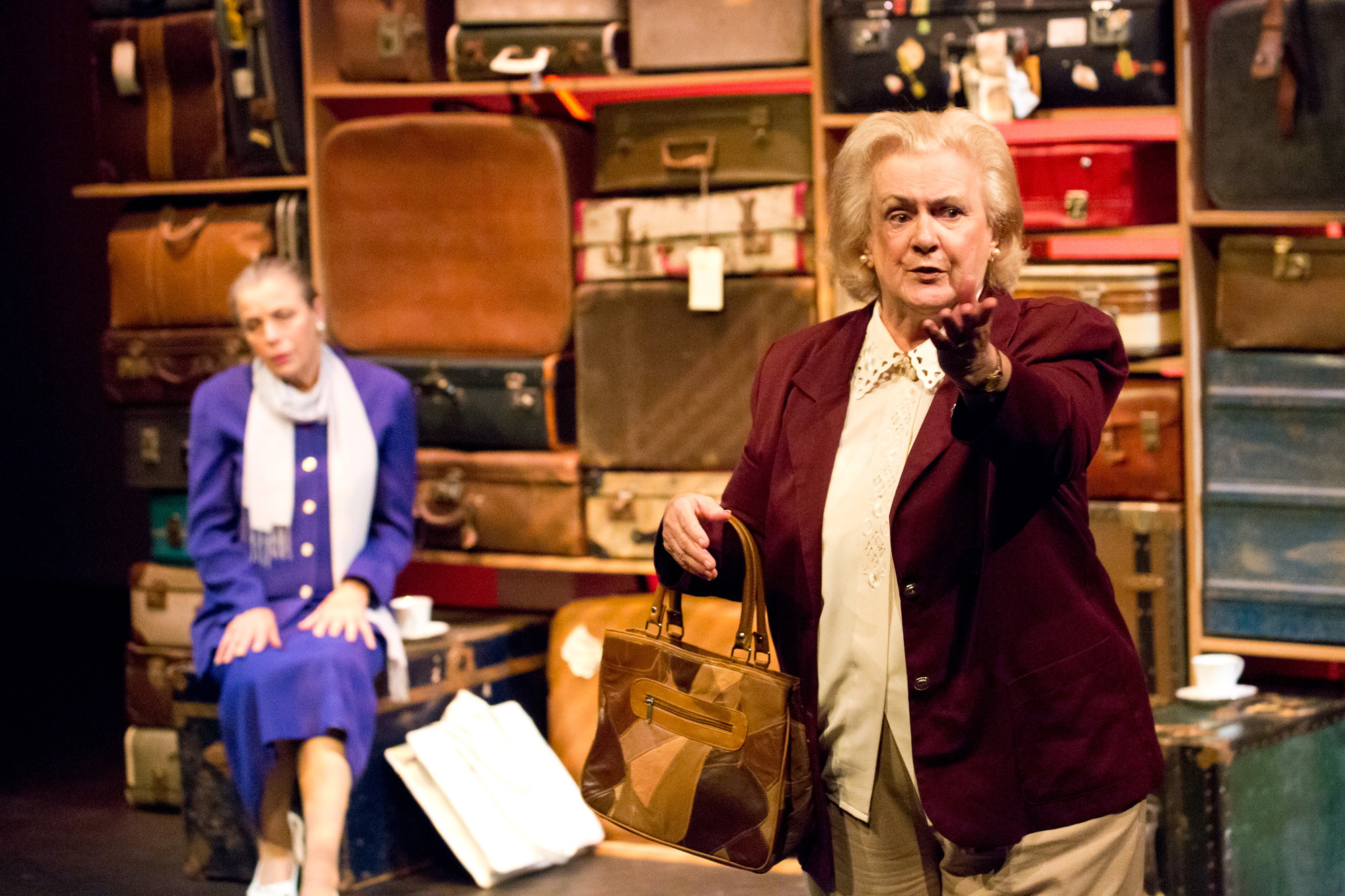
John Misto, in his classic play The Shoe-Horn Sonata, shares stories that might otherwise have been forgotten. Based on the testimonies of women who survived internment by the Japanese during WW2, Misto tells a story of suffering, of determination, and of loyalty.

Image (C) Phyllis Wong

Image (C) Phyllis Wong

These are stories that for a long time many people were happy to have silenced. It’s not Japan’s proudest moment, and both the British and Australian authorities were apparently quite reluctant to let the public know how they’d failed to protect their womenfolk.

And so, after the war, there were Australian women who returned to quiet suburban life nursing extraordinary memories.

Misto acknowledges their suffering, and their strength.

Director Ian Zammit’s production is very powerful. Annette Emerton and Diana Jeffrey give deeply moving performances, ably supported by Peter Maple.

In a year when much attention has been given to Australia’s involvement in foreign conflict, this production by Emu Heights Theatre Company – so humane in its vision – is an invaluable addition to the conversation.

And E.H.T.C. has been an invaluable addition to the arts scene in Western Sydney. Our stories have to be told.

Veronica Kaye

The Shoe-Horn Sonata by John Misto

Q Theatre, Joan Sutherland Performing Arts Centre

http://www.emuheightstheatre.com.au/

This production has already closed.

Grounded

7 May

Make ‘em laugh. Make ‘em cry. Make ‘em wait. Which is what Grounded does. And it’s absolutely brilliant theatre.

Penned by George Brant, there’s not a single word wasted. The narrative is straight forward, but seemingly innocent phrases and events are revisited, and on each return take on a greater sense of foreboding. It’s magnificent writing. (And director Kirsten Von Bibra gives it the uncluttered simplicity it deserves.)

Grounded-02

Grounded is for a single actor. It tells the story of a female officer of the United States Air Force. After becoming pregnant, she’s no longer permitted to fly fighter jets. But she is retrained – and deployed in what is currently the most controversial field of combat. (As Simone Weil would say, it’s only imaginary good that’s simple. The real thing, out in the world, is so hard, and so very, very complex. The glory that is the gender revolution has given birth to a monster: women now share the privilege of being active perpetrators of the horrors of war.)

Grounded is a masterpiece of dramatic irony. She’s after the ‘bad guys’. Combing the deserts of the Middle East, she will find ‘the guilty’. We know she has a dreadful lesson to learn, that she’s painfully naïve, but we like her anyway.

Actor Kate Cole is extraordinary. She creates a character that is tough, almost a ladette, but it’s not all bravado. The character is grounded.  Like Macduff in Macbeth, her emotions aren’t the opposite of her strength; they derive from the very same source. It’s an incredibly moving performance.

I don’t think there’s a spoiler in anything I have written so far, but perhaps there is in what follows. I’m going to briefly discuss the final moments of the play.

After Cole’s character has been inevitably shattered, and we’re busy congratulating ourselves on both our moral superiority and our generosity of spirit for warming to her despite her faults, we’re in for a shock.  She rises from the ashes, more powerful than before, and delivers the most confronting of accusations. It’s not for the complacent. It’s life changing theatre.

Veronica Kaye

Grounded by George Brant

Reginald Theatre, Seymour Centre til 16 May

http://www.seymourcentre.com/events/event/grounded/

Animal/People

6 May

Directed by James Dalton, this is a deeply atmospheric piece. Two actors deliver dueling monologues, which only occasionally intersect. Initially the actors are in the tightest of pinpoint spots; the darkness is the third character. James Brown and Tom Hogan’s soundscape is ominous.

The world of the play is one of guilt; about sins of omission, about parental error. It’s also a world of unexplained violence and reckless impulses. A man leaves an injured woman at the side of the road. Another woman vacillates as she struggles with the rearing of a troubled child. Georgia Adamson and Martin Crewes give powerful performances, textured between fear and that learnt complacency we employ to reassure ourselves that all is, in fact, OK.

Animal-WEB

Writer Brooke Robinson engages her audience in two ways.

One is through quirky observations about human responses. Is my son better off in a wheelchair? Why did I think only of myself at the time of the accident? Why do we assume that the disabled are better people? (Do we? The age old stereotype is the opposite.) This sort of offbeat observation can be wonderfully stimulating, little electric shocks which either tickle or torment.

The other way the play engages is by withholding information. What has actually happened? What connection do these characters have?  Once again, this sort of slow drip can either be a torture or a delight. Whichever way you experience it, the technique very effectively creates an atmosphere of foreboding, a heightening of the senses, and a deep questioning: In our privileged suburban lives is all, in fact, OK?

Veronica Kaye

Animal/People by Brooke Robinson

Bondi Pavilion til 16 May

http://rocksurfers.org/