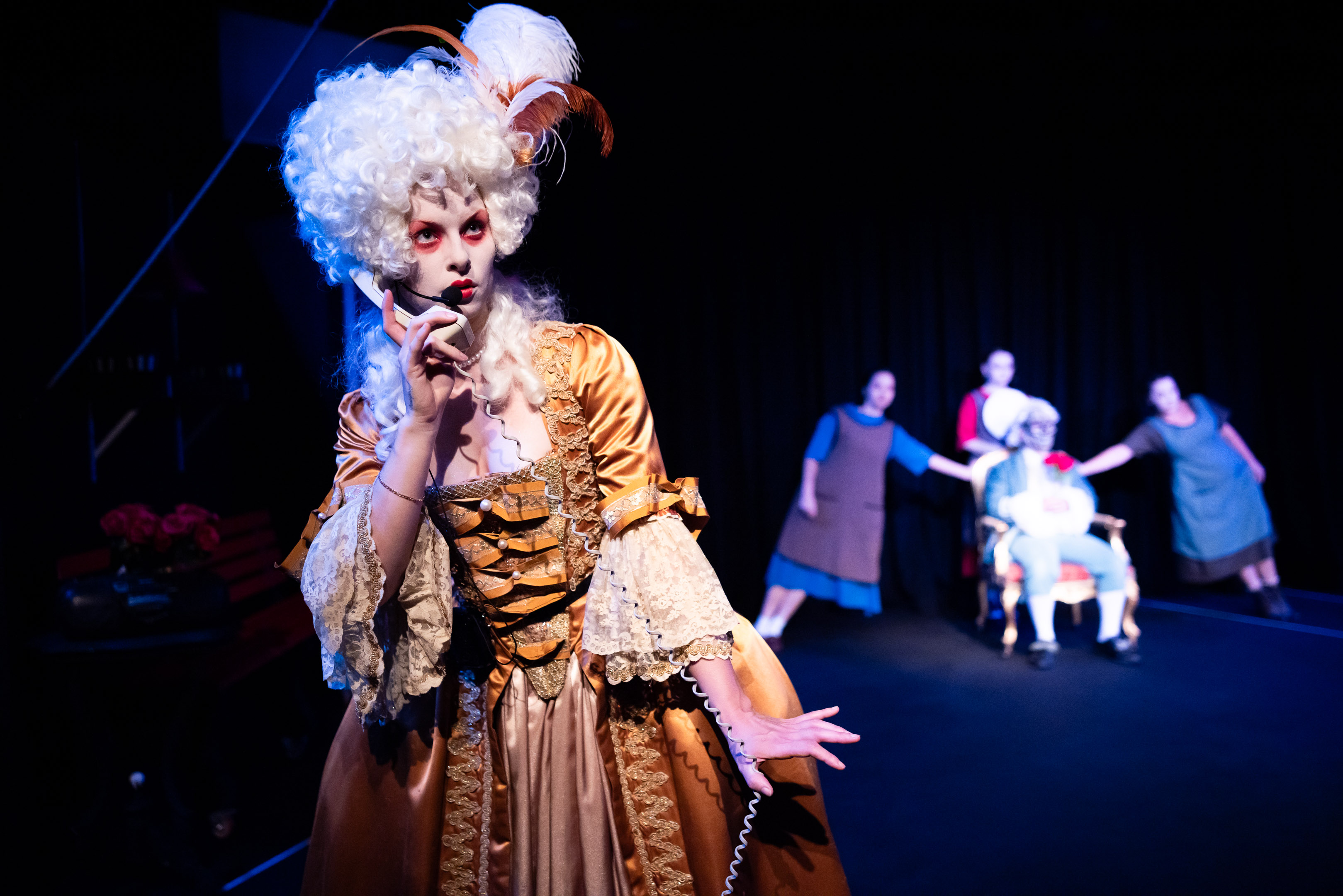
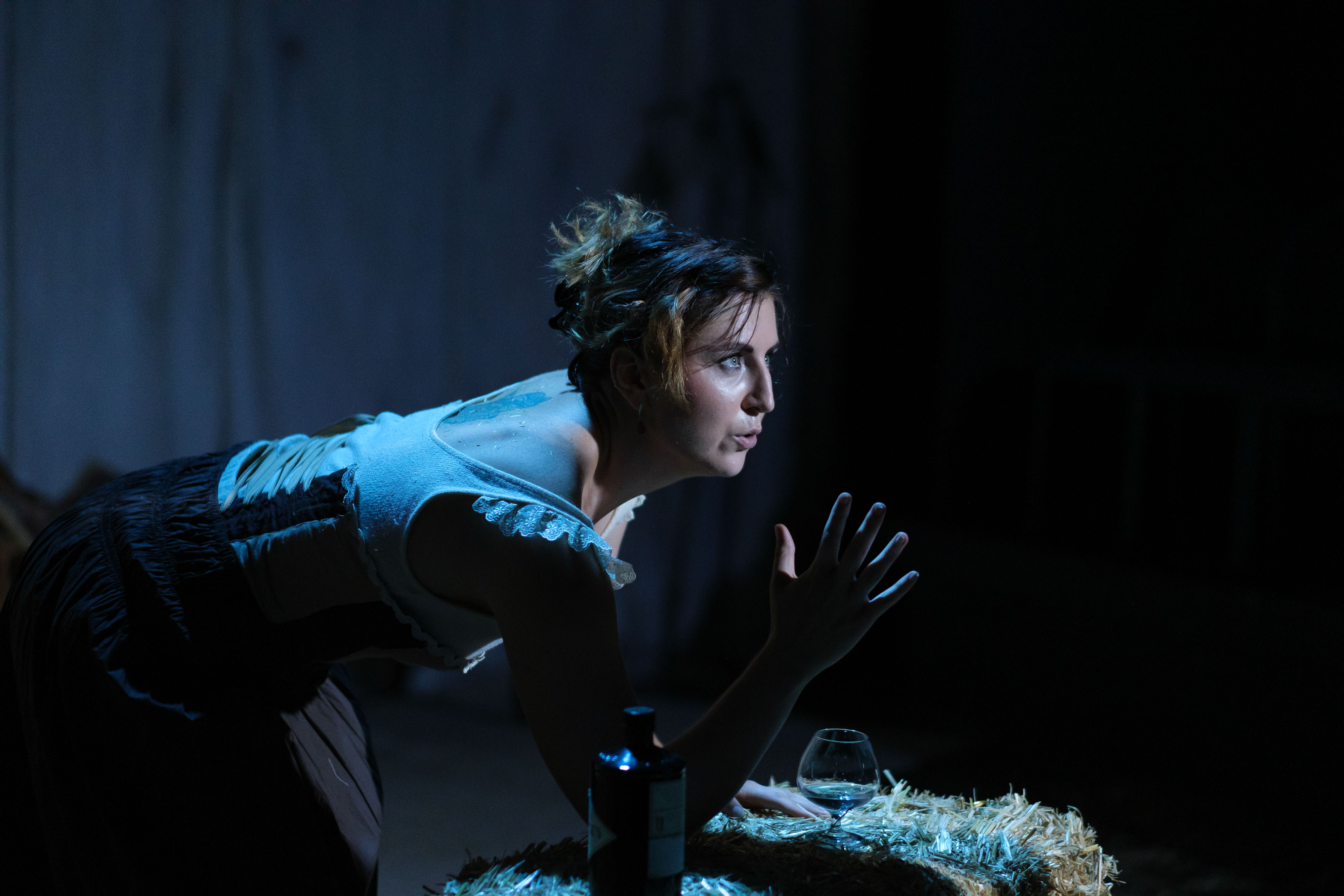
Written by Charlie Falkner, it works a few standard tropes: begin with a death that draws together some unlikely characters, then add some sort of natural phenomena (flood, avalanche, snowstorm, or the like) that prevents these characters escaping each other. Here it’s Renata and Flicks’ mother who has died, and so the dissimilar sisters meet for the very first time. The imprisoning setting is Darwin, and more particularity the daggy Palms Motel, where the guests are trapped by marauding crocodiles.
Director Samantha Young elicits suitably wacky performances from the terrific comic cast. Ainslie McGlynn is wonderful as Renata, the self-obsessed American self-help author (self-help reductio ad absurdum.) Mathew Lee as John, her goofy devotee, delivers a beautiful study of naivete, awkwardness and fixation. Danny Ball as Declan, Renata’s partner, is a giggle-inducing self-important hypocrite. Running the motel is Flick, in Zoe Jensen’s delightful portrait of the parochial local. Aiding her is Leilani Lau’s Bobbi, a kindly kook who provides plenty of laughs with Lau’s perfect delivery of Falkner’s malapropisms.
I call the piece a puzzle because I had difficulty seeing the connection between the different strands. (Of course, being a writer of theatre criticism, I’m not the sharpest tool in the shed.) I’m not sure why Declan was Irish (though I am familiar with the stereotype informing the decision to make the other two interlopers American.) I also didn’t understand the meaning of the motif that Declan could smell blood (that is, to the degree usually attributed to sharks, rather than their distant cousins, the Irish.) Similarly, what actually had happened to the sisters’ mother began as a mystery and, for me, remained one to the end. I’m not sure why Bobbi kept a wild rat in a cage (though it might’ve been a substitute for her missing husband, who was a despicable love rat.) I don’t know why Flick suffered from something akin to narcolepsy.
Perhaps the last of these puzzles hints at the solution to the rest: faced with climate catastrophe (the sort that drives crocodiles out of their natural habitats and to the streets) these quirky characters are all asleep – and so the whole thing functions as a crazy, oddball satire on myopia.
Paul Gilchrist
Darwin’s Reptilia by Charlie Falkner
at Downstairs Belvoir (as part of 25A) until 26 November
I’ve tried to read the book. Twice. Admittedly, not in Russian. Maybe it reads better in Russian. Maybe I should learn.
Eamon Flack’s adaptation of Mikhail Bulgakov’s famous book is rollicking good fun and an extraordinarily invigorating night of theatre.
Satan has come to Stalin’s Russia. (A tautology?) There he meets Margarita, who is mourning her lover. She has nicknamed him “The Master” because of the beautiful novel he has written. But his beautiful novel has got him into serious trouble and now, for all she knows, he languishes in a cell, or worse. His novel is about Pontius Pilate. Why? I guess because Pilate was one of the men who persecuted an innocent, well-meaning philosopher. Very Stalin’s Russia.
Is the production faithful to Bulgakov’s original novel? It presents as being so. (Clearly, I wouldn’t know.) The book itself is usually there on stage (even though, in this minimalist design, often little else is, except a revolve.) Matilda Ridgway as the narrator supposedly reads from the book. With her warm, intelligent stage presence, I’d like Ridgway to read me the whole thing.
The impact of this creative choice is to emphasise the novel as something distinct from this performance, something truly valuable, a cultural treasure. (It is, of course, Bulgakov who is The Master in Flack’s version. )
The whole narrator thing on a stage with a revolve (did I mention this? I’m thinking of getting one installed at home) also facilitates a gleefully impish tone, and Flack has some astonishing stage tricks up his sleeve. (I was told by the publicist to say no more, and one thing I learnt from the play, and as much as the book as I got through, is that it’s very dangerous for a writer to challenge authority.) The cast fully embrace the crazy and it’s an absolute delight. Paula Arundell as Satan crackles with mischief. Gareth Davies as Azzazelo, with perfect comic timing, is perfectly creepy. Anna Samson as Margarita is splendidly and inspiringly audacious. Josh Price as the devil’s cat and heavy is glorious goofy fun.
An intriguing texture is achieved by interspersing the madcap zaniness with scenes from The Master’s novel. Brilliant in Bulgakov’s book, they’re absolutely brilliant here. Marco Chiappi as Pontius Pilate gives a poignant portrait of a man used to wielding authority but beginning to sense both its awful weight and its surprising vacuity. Mark Leonard Winter, who is The Master in the Russian scenes, is Yeshua (Jesus) here, and delivers a performance that is divine: a luminous portrayal of the simple, truthful soul, one of those iconic characters radiating through out Russian literature, and making it a moral lamp to humankind.
Another interspersion is all Flack’s: there’s a terrific parody of the Q & A that commonly accompanies theatre and too often only illustrates the triviality of our supposedly serious critical discussions compared to the work itself. Chiappi as the chair is pathetically and hilariously unable to comprehend the experience of so many artists under communist Russia, a world in which genuine commitment braved perpetual danger.
Full disclosure: I didn’t understand the end. (Thank God for the spoiler rule, which means no one will ever, ever know.)
But one repeated line has had me thinking ever since: the greatest sin is cowardice.
It’s said to Pilate by Yeshua. Is it true? It may have been Pilate’s greatest sin, but as a maxim it’s difficult to universalise. Courage seems a secondary virtue, it’s value determined by what it’s applied to. A Nazi might be a coward, but most of us would think that the least of his sins, and one that might even be conducive to lessening the evil of which he is capable. Or is cowardice being defined in a grander way?
It’s a provocative invitation, and one fitting a piece of theatre which made me fall in love again with the art form.
Paul Gilchrist
The Master and Margarita by Eamon Flack (adapted from the novel by Mikhail Bulgakov)
(in which I write an absurdly complicated and self-indulgent response to a simply beautiful piece)
There’s something gloriously familiar about this show. This is partly because it presents a genuine slice of Sydney life: a woman waiting at the Bank Hotel for a Tinder date. It’s also familiar because a one woman show about dating follows a tried and tested path.
But Megan Bennetts does something special with this one.
Bennetts has an extraordinary stage presence, and the character she creates, Emma, is utterly adorable. Bennetts’ script is clever and superbly structured, and with the guidance of director Nisrine Amine, she executes both the verbal and physical comedy brilliantly. Let me unpack both of these.
Bennett’s vocal performance is wonderful. Tell a tale of the modern woman drinking alone in a pub and it’s oh so easy to fall into the dull, stereotypical vocal patterns of the ladette: brutality masquerading as confidence, aggression impersonating autonomy. Bennetts instead allows the humour to be grounded in natural rhythms of speech, unforced, subtle, and far funnier for that.
Her physicality is first-rate. Moments of drunkenness are played magnificently, with hints of Emma’s inebriation mischievously showing through despite the character’s best attempts to disguise them. And the flashback to Emma as a backpack wielding school girl is gold.
Now, apart from outlining the scenario in the broadest terms, I’ve avoided discussing what the show is about. Without spoilers, I can say that it explores one of the greatest tensions in human experience: sexuality versus individuality.
Though sexuality is so important for how we see ourselves, it cares nothing for us. It’s a blind, brute force. It’s as though we’re some flimsy chime and it’s all the winds of the wide world. In the collision of the two something beautiful can occur, but it seems we’re more suited to zephyrs than cyclones, and yet the earth’s great diurnal journey fuels more fury than fluff. Bennett’s script interprets the grand clash between sexuality and individuality as a battle with social expectations, and that’s indubitably true (and probably more suited to the dramatic form than my audacious metaphors.) Despite what the world says, Emma must decide what matters for herself.
I began this response by suggesting Losing It follows a well-trodden path – but with a crucial caveat. To explain myself, a diversion. Reductionists will tell us sexuality is all about reproduction. But in the human experience, reproduction is an inaccurate term; in so far as it guarantees Life’s continuance, sexuality ensures not reproduction, not replication, but rather diversity, both genetically and socially. That’s sexuality’s function. (Evolution could have simply chosen cloning, which it has for a number of species.) Sexuality’s raison d’être is to have us not eternally tread the same path. To consider sex this way is to begin to question convention. And now one final crazy metaphor (building on my previous motif of sex as a primal force): Sexuality is the ocean in which swims the fish of individuality. Sexuality is as broad and deep as the sea, and for the fish there’s no escape – but there also are no defined paths, only endless possibilities.
It’s the offering of this vision of glorious variety that makes Bennetts’ work special.
And I must emphasise, Losing It has none of the ridiculous density of my response; it’s fun, wise and splendidly Life-affirming.
The script was developed through the Katie Lees Fellowship, an initiative encouraging young women in art, and commemorating a beautiful soul.
Written by Jonathan Biggins, Drew Forsythe and Phillip Scott, and performed by Mandy Bishop, David Whitney, Andrew Warboys, Biggins and Forsythe, what gives this production countless giggles is its clever caricatures of well-known people. Standouts are mischievous portraits of Anthony Albanese, Jacqui Lambie, Caroline Kennedy, Joe Biden and Peter Dutton.
It’s a satire aimed at the famous and the supposedly powerful (though I don’t believe any of the above mentioned people were in the audience on opening night. It must be admitted, however, I do avoid all chit chat in the foyer.)
Satire always faces one huge dilemma: directly address your audience, make their lives your target, and you offend them. And, alas, the offended stop listening, and what’s worse, they don’t tell their offendable friends to buy tickets. So satire, despite good intentions, is often reduced to little more than the shadows in Plato’s cave; something that distracts us from reality, or secures us in our illusions.
One such illusion is that people who act on a political level are flawed. But isn’t that the Truth? Indubitably, but a lot of things are true that no one delights in repeating. This particular truism has the advantage that it justifies political passivity: I care, but engagement entails compromise at best, or corruption at worse, so I’ll merely watch. And, if this is my choice, then being informed must be valorised, and the consumption of media products mustbe conflated with genuine political engagement.
Two skits seem to me to particularly suggest this disdain for authentic engagement. One is a series of video projections of Lidia Thorpe. I don’t admire Thorpe’s politics, and the sight of her in a “No” t-shirt filled me, once again, with dismay – but an attack on her that consisted of merely a rhyming ditty left me with a previously unexperienced empathy for the woman. Similarly, a skit in which three French people are lampooned for rioting for seemingly trivial political objectives left me reflecting that at least they weren’t sitting comfortably on their couches watching the ABC.
Another way satire gains street cred is by its flirtation with bad taste. This show has its share of such naughtiness: an animation of the Titanic mini-sub accident; an operatic assassination of Putin; and a passing reference to the current horrors in Gaza with the suggestion the problems are perennial. I’m not certain if this type of naughtiness is a challenge to conventions or a suspension of empathy.
Subject matter aside, there are also challenges of a creative nature in a work like this. Video projection, though facilitating costume changes, might leave an audience wondering why they left home (especially an audience that it seems to be assumed watches a whole lot of TV.) Sung ditties, which made up a fair percentage of the evening, can be an inefficient and ineffectual way of making a satirical point; their critique being more rhyme than reason. And, if you perform a well loved song with altered, satirical lyrics, the prime victim is often the song.
And finally, a structural point: satire can be sharp like a scalpel, or detailed like the T & C’s for online banking, and anywhere in between risks losing either the bite or the complexity. The concluding skit, a terrific appropriation of South Pacific that explores Australian, American and Chinese diplomatic relations, gets the mix hilariously right.
Paul Gilchrist
The Wharf Revue: Pride in Prejudice by Jonathan Biggins, Drew Forsythe and Phillip Scott
The future is our home country; we’ll do things differently there. (Apologies to LP Hartley*, but more so to my readers who might have to wade through the entirety of this review in order to make sense of what I’m getting at.)
One of the greatest cultural revolutions of the last millennium was that lead by Freud. Because of he and his followers, we look to our personal past to explain our present. I am like this because I was treated like that. Maybe it’s true. Whatever the case, it’s a perspective that greatly impacts the modern world, even trivialities like theatre.
It’s extremely common for modern plays to look backwards. The heroine eventually realises (or remembers!) something about her past (that is before the events depicted in the play) and this motivates her to either accept that something or to transcend it. If you want a point of difference, consider Shakespeare. Macbeth and Lady Macbeth have pasts (who doesn’t?) but the Bard doesn’t dwell on their back history to explain their actions. These are explained, in so far as they’re explained at all, by current desires and influences. (I’ve deliberately chosen the Macbeths as my example because modern directors love to read Lady Macbeth’s line “I have given suck and know how tender tis to love the babe that milks me” as an explanation for her extraordinary behaviour. Lady Macbeth has obviously lost a child and that has driven her to this – which might make sense if it wasn’t for the fact that the premodern infant mortality rate was so high that virtually every woman had lost a child, and yet only a small percentage of women went on to become regicides.)
Stephen Sewell’s The Lives of Eve is a fully conscious exploration of the tradition of the unconscious (or at least our focus on our personal histories.) His protagonist, Eve, is a Lacanian analyst. We are shown her sessions with patient, Sylvia. There’s even a couch. Sylvia suffers from sexual disfunction. (I’m prevaricating: She can’t come.) It’s a brave male dramatist who writes about the female orgasm. (No doubt, if I was to do so, some wag would gleefully quip that not only had I never had one, I have probably never been in the room when one was happening.) In addition to the challenges of Sylvia, Eve has trouble at home; she and husband Paul are drifting apart, driven by unequal sexual desires. Fortunately, Eve gets support from her dead mother. Yes, the past, again. There’s a lot of talk about the past.
Directed by Kim Hardwick, the cast are eminently watchable. Helen O’Connor as Eve offers a powerful portrait of strength seeking depth. Louisa Panucci effectively presents Sylvia as the swirling whirlpool that is the growing soul: attraction competes with repulsion, inhibition with bluntness, doubt with certainty. Noel Hodda as Paul superbly depicts affability and affection in their oh so painful collision with a hostility that’s incomprehensible. Annie Byron as Eve’s departed mother, Madeline, is charmingly nonchalant and ethereal.
Sewell’s characters are extremely erudite. They quote or reference Lacan, Freud, Augustine, Plato, Aristotle, Sappho, Donne, Shakespeare, Einstein, Badiou and Grieg (though, admittedly, the composer just happens to share his name with one of Eve’s friends.) I think it’s absolutely wonderful when dramatists present Australians as educated and intelligent. (It’s like watching a Marvel movie: sure, the suit couldn’t actually help Iron Man to fly, but it’s a fun fact to forget.)
A lot of top shelf ideas are shared. Marvel fans might suggest it’s merely psycho-babble vs socio-babble. (Lacan on language vs gender generalisations.) If it takes a brave male playwright to write about the female orgasm, you’d have to be a superhero to take on philosophy in Australian theatre.
But Sewell knows what he’s doing: it’s rich and provocative, and I’ll enjoy thinking about this work for some time to come.
I want to mention two moments that stood out for me. At one stage Eve suggests (something like) we are both mysteries and disappointments to ourselves – and to other people. It’s a beautiful, deeply humane encapsulation of what it is to be alive. Similarly, in argument with Sylvia, Eve asserts that some problems might simply not have solutions; our politics can take us only so far; being conflicted and confused is the human condition.
So, despite being a play interested in how our personal past informs our present, Eve becomes a model for maturity, for both acceptance and transcendence. The future is our home country, because our dearest dream is that we’ll do things differently there.
This evening of two short plays is part of the Everything But The Kitchen Sink Festival.
The first show, Dazza, written and performed by Frankie Fearce, is seriously top class satire. It’s a beautiful, measured criticism of the parochial Australian male, focusing especially on his attitudes to gender identity. “You’re one of those pronoun people, aren’t ya?” Dazza says to an unexpected visitor to his local. Fearce’s writing is wonderfully sharp, and the rhythms of the vernacular are spot on.
Like all top rate satire, there’s little hyperbole, just a commitment to truth. Garden variety satire criticises. Great satire portrays. If the artist tells us the character is flawed we might choose to read it all as a comment about the artist themselves. However, if it’s we who decide the character is flawed, the criticism appears indubitable.
The beauty of the portrait is that Dazza refuses to consider that he might be closed-minded, which is, of course, the epitome of closed-mindedness. Dazza is a good bloke in a world that’s certain he is one, and that’s the very problem.
The change from the introductory scene where Fearce plays themselves (I guess) to where they play Dazza is a piece of theatrical magic. It was also a feast for thought: the change in the audience was utterly electrifying. We had been witnessing a person give testimony of their lived experience and the vibe was definitely supportive. Then came the change, and suddenly we were confronted with the delicious, dangerous lie that is fiction and, in addition to abundant laughter, there was a shifting in seats, an intake of breathe, a palpable uncertainty. It was as though we had been in a church and now we were in a theatre. The experience clarified for me why I prefer performance to personal testimony: when someone genuinely shares, only a dickhead (such as Dazza) is not supportive; when someone performs we feel little moral necessity to respond to the character in any fixed way, and so it is we who are encouraged to be genuine.
The second show of the evening is Horse Play. It’s a clever title for a clever show. Zoe Tomaras directs a fun sitcom, devised and written by the team (Nat Knowles, Sophea Op, Angela Johnston, Linda Chong, Georgia Drewe and Tomaras.) Five soldiers (men, of course) wait inside the Trojan horse. Sometime in the night they will slip out and open the city gates … and the rest is known. (And told in its full horror by Euripides in his The Women of Troy.)
In this tale, the men just wait. It’s Waiting for Godot in togas. (Ok, not togas, but you get the point.) It’s a wonderful set up which the team doesn’t so much use to discuss war as masculinity. The very gifted comic cast present the male characters as being unable to transcend the puerility of teenagers (a criticism which dovetails well with who is often left to do the fighting of wars.) There are dick and masturbation jokes aplenty and homosexual curiosity masquerades unconvincingly as homophobia. There’s also a playful exploration of how we attempt to fill time until the big moment, whatever that big moment might be (which is the family connection to Godot.) To portray characters who are bored is always risky, but Tomaras deals with it astutely. The piece is not presented in real time but is offered in multiple brief scenes, moreish slices of experience, cute skits cut and served to us by the dimming and raising of lights, a directorial choice which functions as an effective laugh track.
If I’ve made it all seem merely wacky fun, the concluding scene of Horse Play throws down the gauntlet. It powerfully reminds us that those we find most laughable might be just that because of the infantilizing impact of the trauma that they face, and that we ignore. Euripides followed a tragedy with satyr; here we have something that poignantly approximates the reverse.
These two short shows exhibit the inspiring wildness that makes the Everything but the Kitchen Sink Festival a terrific addition to the Sydney theatre scene.
Paul Gilchrist
Dazza by Frankie Fearce
Horse Play by Nat Knowles, Sophea Op, Angela Johnston, Linda Chong, Georgia Drewe and Zoe Tomaras
Part of theEverything But The Kitchen Sink Festivalat Flight Path Theatre until Nov 4
The Memory of Water follows some familiar tropes. Members of a dysfunctional family gather for a loved ones’ funeral. Forced to be in the same room, they argue their conflicting perceptions of family history. Though hard to imagine, if any of my reviewing colleagues were ever tempted to petty mindedness they might dub this piece The Memory of Other Plays. However, the seeming familiarity of the plot has no doubt been enhanced by the presentation of other similar stories in the twenty seven years since this play was originally written.
But the plot is not the play, and it’s certainly not the production. Playwright Shelagh Stephenson’s take on family differences is hilarious and director Rachel Chant elicits from her cast brilliant comic performances. Madeleine Jones as Catherine is especially engaging, presenting a personality whose enormous energy knows no matching purpose. Jones’ portrayal of this lost soul is both terrifically funny and deeply poignant. Thomas Campbell’s Frank is also extremely amusing, as he desperately tries to maintain distance from the family craziness. Michala Banas as Mary is the emotional heart of the piece, with sarcasm balancing beautifully with vulnerability she attempts to understand her relationships, both with the living and with the dead.
Designer Veronique Benett deserves special mention; her vibrant set and costuming create the perfect space for comic fun.
Not that it’s just frivolity; one of the tropes of modern theatre (and one I don’t grow tired of) is that it has philosophical ideas. The title invites us to consider memory. I’m not sure if the play’s observation that memories are neither objective nor deliberate will strike many audience members as particularly insightful – however, eighteen hours after seeing it, my memory of the play is neither entirely objective nor entirely deliberate.
But the glory of the philosophical in theatre is that it provokes reflection. Rather than being told what to think, we’re teased into thought.
Written and directed by Damien Ryan, this is big, bold, and delightfully ambitious. It’s also very entertaining (but more on that later.)
It is not a dramatization of Shakespeare’s poem but rather follows a growing tradition of fictionalising aspects of the poet’s life.
It’s not a surprising tradition; Shakespeare’s influence on the language and theatre is overarching (and I will admit somewhere in the first act, for just a moment, I understood why some people call for the total erasure of everything to do with the Bard so we could all just start again.)
Several Elizabethan stories are layered together here: the death of Shakespeare’s son Hamnet; the possibility that poet Aemilia Lanier was the Dark Lady of the sonnets; the performance by Shakespeare’s company of Venus and Adonis before the monarch herself (which I guess is completely fictional??)
The play is a musing on love, and love may be a many splendored thing, but it’s certainly a thing of enormous semantic diversity. Sparked by the poem Venus and Adonis we are offered love as desire, but the play also explores sexual love beyond physicality, and friendship and familial love. In one provoking moment, lust is juxtaposed with grief, the little death lying side by side with its stronger sibling.
Though moving and provocative, the production forefronts entertainment. There’s excellent physical humour aplenty, theatre jokes abound, and there are constant allusions to Shakespeare’s work (which might be either diverting or distracting, depending on whether you buy into the theory Shakespeare was less a creator of enormous vitality and more of a sponge absorbing nutrients from the ocean of language in which he swam.)
Performances are magical. Anthony Gooley as Will is both poignant in his pain and funny in his frustrations, a very human take on a man we have diminished by raising to an icon. Aemilia Lanier is Will’s lover and one of the earliest published female poets, and possibly the first explicitly feminist one. Adele Querol is glorious in the role: fire and strength; at one moment a lightning bolt falling mercilessly on the earthly patriarchy, and at the next, that even more miraculous phenomena, a bolt shot back heavenwards, lighting the way to a brighter future. Jerome Meyer as Nathaniel Field, who plays Adonis to Amelia’s Venus, is brilliantly comic as he navigates some truly teasing tensions: in Shakespeare’s company he plays the women, but before the Queen he is asked to play a man, a gorgeous man, who as the target of Venus’ unrelenting desire might feel somewhat reduced to passivity…. like that projected on women by the male gaze. Belinda Giblin as Queen Elizabeth is magnificent, perfectly regal and (as the script demands) unexpectedly sage. Perhaps the character operates as a coda. Certainly she is a deus ex machina, arriving from the beyond and offering …. But perhaps all fictional histories function as such, offering a solution, of a certain type, to our problems: assuring us they are eternal.
New work is always exciting, and here we have two original, distinct pieces.
Home Country, written by Stephanie Reeves and directed by Glen Hamilton and Romney Hamilton, is a gentle but sophisticated tale about loss and belonging. Dot, played by Reeves, has migrated to Australia from Britain. She feels the distance from the home country and from family members she left physically behind and who seem to have left her emotionally behind. Dot visits Uluru, where she must camp with a stranger, Jane played by Susan Jordan. In the very watchable growth of their friendship, the thematic concerns of loss and belonging are further teased out: the indigenous connection with the land, the evaporation of pride in what it is to be British; the dislocation that results when cultural discourse moves to a certainty that jettisons subtlety; the personal grief of bereavement.
The One, written and directed by Mel Jensen, feels almost like two plays. It begins as a satire on dating via the apps. The female protagonist (Jensen) tells her friend (Emily Shaddick) of the absurd and disgusting behaviour of some of the men she has communicated with or met. An interesting theatrical gimmick is to have the friend play out scenes that the protagonist has already lived; this creates humour but also distance, with focus being on the evaluation of the lived experiences, rather than the actual experiences themselves. (More on this phenomena later.) There are some great one liners delivered by both Jensen and Shaddick, and the male actors (Oliver Harcourt-Ham, Enoch Li and Matthew Van Den Berg) playing the victims of this satire display wonderful comic commitment. There’s a provocative ambiguity to the satire; the female characters are hardly presented as flawless. You’ll struggle to find a play in which both the words “feminist” and “dick” are repeated more often, and said by the same character the logical incoherence is stark. Similarly, there is much talk of “love”, of the I-want-someone-to-love-me or the I-deserve-someone-worthy-of-my-love types; so it all falls into that horrible trap of validation or evaluation (a reminder that romance is the stupidest of the serious things.) One way out of this trap is to focus on the physical mechanics of sex, which is what both the men and women do.
In the last third of the piece we get something much more dark and confronting, with John Michael Narres giving a terrific performance of both vulnerability and frightening volatility. It’s difficult to write about the end without spoilers, but the shift in genre and tone is so very large in the final scenes that I’m not sure the piece doesn’t inadvertently sabotage itself. What I guess is meant to be a warning that dehumanising dating apps and immature, entitled masculinity inevitably culminate in violence ends up potentially implying something rather different, and sinister: that any sensible woman simply should know better than to get herself in such a situation.
But, of course, good theatre often sends you out into the darkness feeling the darkness to be deeper than when you arrived.
Paul Gilchrist
Home Country by Stephanie Reeves
The One by Mel Jensen
at Darlo Drama Studio Theatre as part of the Sydney Fringe
But howling has been heard in the wind. And there have been sightings, admittedly in half light, and from witnesses less than reliable. But now a girl has gone missing. The people of the village barricade themselves in the local hall.
This is a terrifyingly good play about fear, about that greatest of tensions in the human experience: how much of Life can we manage or control, and how much of it must we leave wild, to grow and flourish in gloriously unpredictable ways?
Joel Horwood’s script was first produced in the UK in 2017, and it’s both evocatively poetic and entirely truthful to the nuances of everyday speech.
This production directed by Georgia Britt is magnificent. Britt, Riley McNamara and Cameron Hutt play all the roles, and their performances are utterly enthralling. I love this sort of fringe production because it spotlights what I think are the things about theatre that really matter: fine writing and fine acting.
It’s probably beyond my skill to give a complete description of these virtuoso performances, so I’ll cherry pick.
Hutt gives us a splendid portrait of an adult son overwhelmed by the responsibility of managing his aging mother, and then slips effortlessly into the role of local teacher, calm and almost, almost, almost in control, and then off into the local councillor, a hilarious combination of self-importance and paranoid hysteria.
McNamara masterfully presents an uncertain but wonderfully sane small town policeman and then, living in the nearby forest in a dilapidated caravan, an almost mythically self-aware outlier, only to offer a thrilling contrast to these characterisations of male pragmatism, that of an aging farm woman whose failing mind is being overcome by the bestial anger that is the natural child of fear.
Britt gives two superb portraits of young people: one a teenage girl refusing to be defined by her physicality, and the other a small child – perhaps the boy who cries wolf, except with the insight born of innocence that stories actually do matter. And then to top this off, Britt plays the local vicar, and it’s a deeply moving portrait of a soul on a journey to understand the true nature of Good. The epiphany she presents is powerfully provocative, a Life affirming response to the coming of the wolves, in whatever shape they may take.
Paul Gilchrist
Wolves are coming for you by Joel Horwood
at the Emerging Artist Sharehouse, Erskineville, as part of the Sydney Fringe