The Wasp

9 Dec

I don’t warm to the idea of granting stars to productions. (You know the stars I mean: “This Sydney Festival production of Hamlet by Swahili speaking puppets – Five Stars!!!”) As a writer about theatre I want what I’ve written to be read, and I know if my response to a production is abbreviated to a rating out of five then there goes my audience. (Unless, of course, I give a One Star rating, in which case a whole bunch of goblins pretending to be people will devour every word I’ve written with cold-hearted glee.)

But I don’t like star ratings for other reasons. They imply that productions are being compared and ranked according to some known and accepted criteria.  And they’re always so parsimonious:  Five Stars is hardly generous considering how many stars there actually are in the universe. And, finally (you’re thinking), ratings seem rather counter-intuitive: everything I enjoy eating from Woolies has a pitifully low rating compared to those life denying products that get full marks.

But, having said all that, some productions seem to beg a rating – because anything else I write about them gets dreadfully close to spoiler territory, and that wouldn’t be kind.

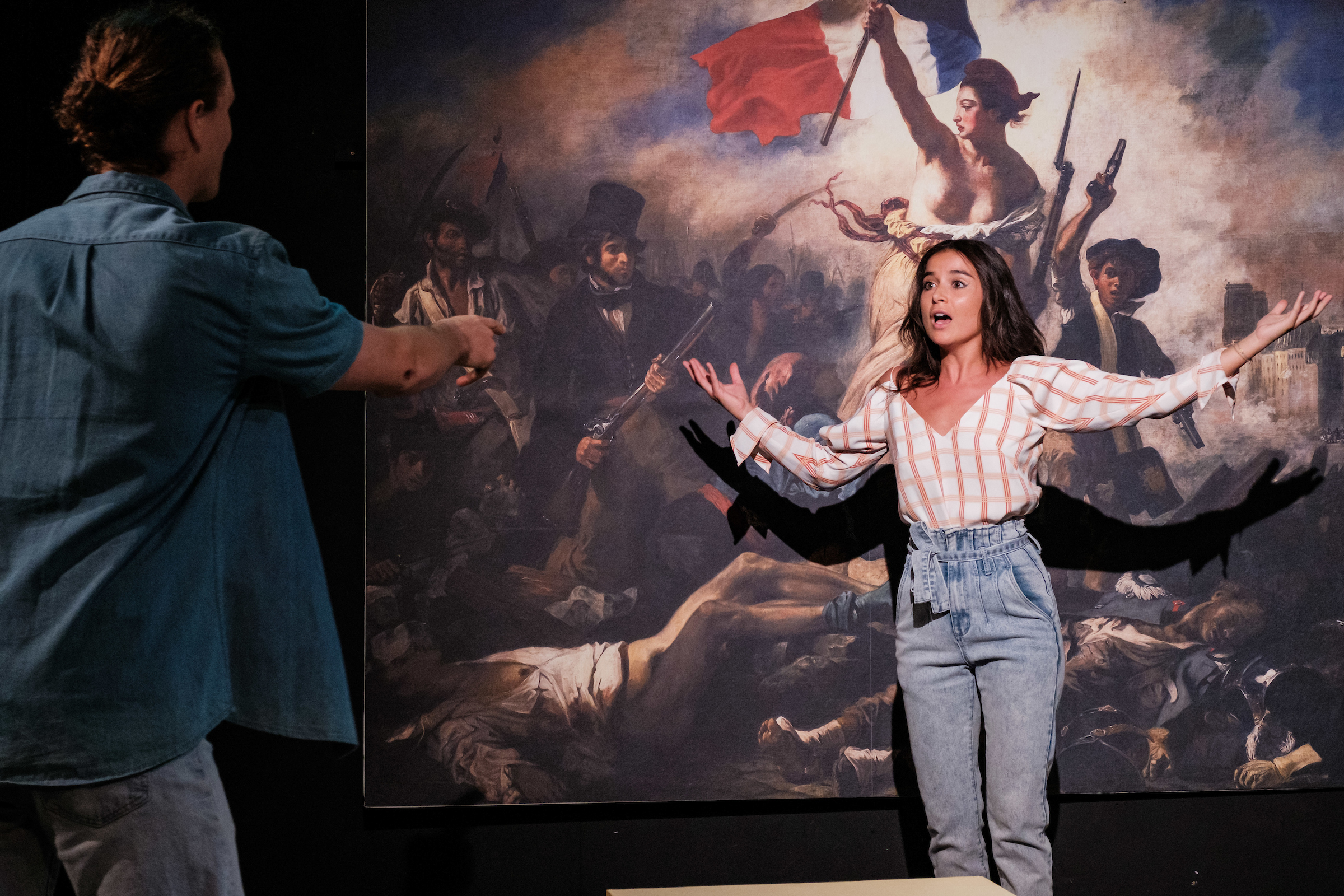
The Wasp by Morgan Lloyd Malcom is one of these productions. To discuss the themes of this production (which is what I like to do with every production, and why I attend theatre) is fraught with danger. As a play, The Wasp values twists and turns of plot. And what it values, it does extremely well. It’s an intense ride.

This particular production, presented by Akimbo & Co and directed by Becks Blake, is tight and brilliantly performed.  It’s a two hander (though even that feels like a spoiler.) Heather and Carla meet up years after school. They were very different people then, and things haven’t changed. Helen is awfully middle class and Cara Whitehouse’s portrayal is marvelous, and deeply discomforting. Carla is lower working class (or am I using a middle class euphemism for criminal class?) Jessica Bell as Carla is fantastic, capturing the casual brutality of a woman who’s done it hard. Lloyd Malcom’s script gives the characters a wonderful arc, and these two actors make it work superbly. The initial humour (and there’s a lot of it) is extraordinarily good, and when things get more…well less humorous, we find ourselves in very close company with the fractured and frightened.

Yes, I know, what a vague review. If I was to hazard a spoiler-free observation about the meaning of the play I would suggest it’s about the relationship between kindness and cruelty. We tend to think of these qualities as sort of binary opposites, that is defined by their opposition to each other (like “positive” and “negative” or “on” and “off”). But the play reminds us that the relationship between the two qualities is complex. I don’t mean the cliché that you have to be cruel to be kind. I mean that one of those two qualities can be so overwhelming that even when the other appears, or seems to do so, it’s reduced to a façade, a brittle shell that barely conceals its nemesis.  (And, usually, only one person is deceived….)

So, that star rating I was talking about? The one I was going to give because I’m kind?

Even theatre reviews can have twists.

Paul Gilchrist

The Wasp by Morgan Lloyd Malcom

KXT until 17 December

www.kingsxtheatre.com/

Image by Clare Hawley

A Christmas Carol

1 Dec

Ebenezer Scrooge is one of the best known characters in literature, and his catch phrase “Bah humbug” is oft quoted. (Especially by me when assaulted by Xmas muzak in shopping centres.)

It’s an absolute joy to watch John Bell in this role, and the pantomime-like retelling of Dickens’ famous tale by writer Hilary Bell and director Damien Ryan is delightful.

Dickens was one of those great nineteenth century writers who gave cruelty a bad name. If that seems a joke, as if cruelty could ever have been valorised, it’s indicative of how influential voices like Dickens have been. For much of our history, cruelty has not only been tolerated, it’s been encouraged. (Spare the rod and spoil the child was not the injunction of some sick sadists, or not only so: it was read from the Bible and taught from the pulpit.)  

Dickens had a gift for empathy. It’s suggested by his take on damnation. Marley, Scrooge’s deceased business partner, returns on Christmas Eve to warn of what awaits beyond the grave: an eternal vision of human suffering but no ability to intervene. It’s an odd vision of Hell. Compare it to Sartre’s. A cynic might say that to witness suffering and to do nothing is the very definition of secular heaven, a paradise the privileged enjoy perpetually.

What happens to Scrooge – that the visions he’s shown by the Ghosts of Christmas Past, Present and Future affect a change in his character –  epitomises Dickens’ artistic purpose. If Scrooge’s moral transformation seems merely convenient to the cynic, Dickens might well look down on us and humbly suggest such visions do indeed make a difference. And clearly, by his own definition, he’s in Heaven, because if he is witnessing the suffering we inflict on each other, his stories, and this particular dramatization, do have the ability to intervene. They gently urge kindness.

And Dickens’ stories brim with good will. There are villains, of course, but there are also an extraordinary number of kind souls. (The cynic would say Dickens was a great writer of fiction.) The conceit of this production is that it’s performed by the Crummles, that inept but good-hearted acting troupe from Nicholas Nickleby.  

Part of the fascination of A Christmas Carol is its role in our image of the holiday. Christmas had long been built on solstice feasting but, in an increasingly secularised Victorian England, the day began to shed those other elements that made it a religious festival honouring the supposed incarnation of the divine in Jesus of Nazareth, and morphed into what it has become in the modern West – the day we wish each other well. (Good will to all was Dickens’ every day; we have at least gifted him Christmas.)

Dickens was endlessly comically inventive, and Ryan’s production captures this glorious exuberance. With Bell on stage is a terrific troupe, much more gifted than the Crummles. Valerie Bader, Jay James-Moody, Emily McKnight, Anthony Taufa, and Daryl Wallis on keyboard, give playful performances that evoke both laughter and tears. There’s song, dance, and puppetry.

And there’s one moment between Bell and a puppet (expertly given life by McKnight) that elicits gasps from the audience. You might call it the sound of hearts melting. Or you might call me sentimental. Dickens wouldn’t.

Paul Gilchrist

A Christmas Carol by Charles Dickens, adapted for the stage by Hilary Bell

Ensemble Theatre until 29 Dec

www.ensemble.com.au/shows/a-christmas-carol/

Image by Jaimi Joy

Art + Information

24 Nov

We live in an age of specialist knowledge. The woman sitting across from you in the bus might be a world expert on continental drift. The man ahead of you in the supermarket queue may know more about the venom of the Eastern brown snake than has ever any living soul. The person sitting dully in the park at lunch might not be dreaming of the holidays that will eventually free them from the tyranny of deadlines; they might be musing on the evolution of grass.

The more we know, the more difficult it is to share; especially with those who have no grounding in our speciality. And the sharing is crucial, because knowledge is a communal thing. Much of its value comes from its ability to enrich the community, and much of its pursuit is only possible through the support of that community.

So how can the rest of us come to appreciate what the specialist does?

This set of performance lectures, directed by Kate Gaul, is a magnificent sharing of deep knowledge.

A person (not an actor!) holds the stage and, with evocative light and projection (Morgan Moroney) and sound (Zac Saric), we’re invited into a particular corner of reality.

Beth Yahp, creative writing lecturer at U Syd, tells us of Small Pleasures. In limpid poetic language, she muses on several simple objects – a Christmas beetle, a remnant of cloth, a physio’s “hammer” – reminding us that when we focus solely on the extraordinary we blind ourselves to the value of the everyday. In giving all our attention to the mining disaster, we ignore the riches that come from the routine mining itself.

Tara Murphy, professor of astrophysicist at U Syd, shares a story of Exploding Stars. Exquisitely balanced between the minutiae of working in a lab and the gargantuan event of the collision of two neutron stars, Murphy’s tale is one of truth and awe. She also considers the evolution of the great scientific project; long a practice based on sharing, science has now become such that the ‘hive mind’ is crucial, as no individual alone can make sense of the universe. (Perhaps as it should be, for if there’s any insight the lay person like myself can offer, it’s that the universe is bigger than me.)

Mitchell Gibbs tells us about The Humble Oyster. A PhD in Marine Biology/Biochemistry and a postdoctoral researcher in the School of Geosciences at U Syd, Mitchell is also a Dunghutti man. With moving personal anecdotes, he tells of researching and writing his thesis, his deep dive into speciality, while maintaining close connection with family. He quotes his father, who asserted that if you really understand something, you should be able to explain it to anyone. He speaks with inspiring optimism of his desire to bring indigenous insights into Western academia, for the benefit of all and our fragile environment.

This is not conventional theatre; it’s part of an exciting movement to challenge what we might expect to see on stage. It does, however, share with drama, and fiction in general, one crucial aspect: the focus on the particular, the assumption that this certain corner of reality repays close inspection.

It’s an entertaining night, and a tantalising one, because corners have a way of dissolving, unfolding, and offering extraordinary vistas.

Paul Gilchrist

Art + Information

Seymour Centre until Nov 26

www.seymourcentre.com/event/art-information-2022/

Image by Jacquie Manning

The Dazzle

22 Nov

This is an intriguing piece of theatre; 100 minutes of fascinating language play that doesn’t want to let you go.

Richard Greenberg’s play was written in 2002, but is set in 1940’s New York. It feels earlier, as though the past were something to not let go.

A play about recluses, about hoarders; the whole thing’s about not letting go.

Langley (Alec Ebert) is the more obviously neurotic of two brothers. He was once a performing pianist, but his playing has slowed down, because he hangs on to every note.  Nor does he want to let go of all the stuff he has brought into the house. And change, of any sort, is a problem. When Milly, a wealthy heiress, shows an interest, he longs to be “Adam before the inconvenience of Eve”.

Homer (Steve Corner), the primary carer for Langley, explains his situation as “I am my brother’s…accountant”. Considering the tensions between the siblings, it’s a suitable allusion to Cain and Abel.

It some ways, it feels a little like Henry James on speed; we remain in the drawing room of the brothers’ house and 140 tonnes* of words, fast, loud and fun, bounce off the walls, and fall in bewildering, ever-growing piles around us.

Director Jane Angharad’s cast, despite the contained nature of the play’s world (or maybe because of it) deliver high-energy vocal performances: tight, intense and inspiringly focused.

Meg Hyeronimus as Milly presents an especially engaging character arc, moving adroitly from a glib flirtatiousness to a deep vulnerability tempered by dignity.

Homer makes sense of the title for us; he’s conscious of a “dazzling” array of neurotics who command the world with their imperatives: I cannot throw out a single piece of paper; I cannot listen to poorly performed music; I cannot let things go. The list of imperatives is mine, but I believe they are true to the spirit of the human experience explored – the temptation to control.

(From personal experience) I term it a temptation, and that is, of course, a harsh way to describe what might be called a mental illness, but theatre – and theatre like this especially – dissolves all disputes regarding nomenclature, being like that long warm soak in sparkling suds that loosens all labels.  

Paul Gilchrist

The Dazzle by Richard Greenberg

Meraki Arts Bar until 3 Dec

www.meraki.sydney

Image by Clare Hawley

*140 tonnes of collected items was what was eventually discovered in the home of the Collyer brothers of New York, whose lives inspired this play.

Tongue Tied

17 Nov

“The fox knows many things, the hedgehog one big thing” Archilochus*

Drama achieves greatness when it offers its audience the vision of the fox; the vision that life is multifarious. However, in an age of overt politicization such as our own, drama often aspires to the vision of the hedgehog. A work about sexual violence, like this play, will often simply and correctly assert that such violence is an abomination. But the fox sees further; in addition to condemnation there is more – premonitions, seeming digressions, warnings – because in the long shadow thrown by suffering, further evils breed.

Tongue Tied by Clare Hennessy is a true fox of a play; funny, insightful and very powerful.

It begins in the sharp sunlight of satire but, as focus moves to the victim and the perpetrator, we find ourselves in a much darker place.

The play does not ask us to consider the alleged perpetrator’s innocence or guilt – the accused is guilty – the play asks us to consider what is done after the wrong. Is a crime purely a matter for individuals, one in which the victim should be free to find whatever peace she can, using whatever methods are available? Or is a crime indicative of wider societal failure, and so is the victim therefore beholden to us, since by bearing witness to her pain she plays a crucial part in fixing what otherwise remains broken? In a nutshell, is private suffering public property?

If the answer is yes, then your suffering can be used by others. For good and for bad.

Director Sarah Hadley has assembled a magnificent cast, and wisely gives them a simple playing space, allowing them to bring alive the subtleties of this work.

Eloise Snape as Mia, a journalist chasing the “blockbuster” sexual assault story of the year, brilliantly portrays the tensions between the pursuits of public good and private gain. Kieran Clancy-Lowe plays her main sparring partner, Parker, the PR man for the company whose CEO is guilty of the assault. Snape and Clancy-Lowe work Hennessy’s clever satire expertly (and in the chemistry between the two characters, in this play about assault, both writer and actors offer a rich reminder that sex can be, as well as sinister, stupid.)

Di Adams, as Mia’s editor is delightfully droll, and Michael C Howlett as the perpetrator delivers a performance that encapsulates the cold menace of privilege.

With illness striking the cast, two actors stood in with scripts, but were still extraordinarily effective. Clementine Anderson as Sarah, the woman abused, compelling portrays a character of both understandable trepidation and unremitting dignity. Madelaine Osbourne’s Holly, the woman who now has Sarah’s job, is well-meaning and instinctively confident, leaving us transfixed between awe and horror, uncertain whether this is strength or gullibility. The scene in which these two women finally meet is the moment compassion meets bewilderment – they care, but they don’t know how to care – glorious theatre. (True fox theatre.)

And the final image of the play, evocative of the long shadow of the violent act we’ve been blessedly spared, is absolutely haunting.     

Paul Gilchrist

Tongue Tied by Clare Hennessy

KXT until Nov 26

www.kingsxtheatre.com/tongue-tied

*I have stolen this reference from Isiah Berlin

In This Light

15 Nov

This is big, bold storytelling.

Spanning generations and continents, Noel Hodda’s In This Light is a grand tale of longing and reconciliation. It’s a wonderful addition to that most glorious of theatre traditions – the honest acknowledgement of the pains of life, paired with the promise that beauty is still possible.


Occasionally there are challenges in the stage logistics demanded by such a substantial story, but Des James has put together a brilliant cast. Still raw from the agonising death of an elderly parent, Sandra and Chris must confront again questions of what makes a worthwhile life – and Sophie Gregg and David Adlam play the siblings with a grippingly truthful mixture of warmth and desperation. Tom Cossettini is Peter, an Australian abroad, where he meets French woman, Camille, played by Omray Kupeli. The portrayal of these young lovers is utterly charming. (And it’s always a delight to hear a language other than English on stage.) David Woodland plays an artist living in rural Australia in isolation– until he gets an expected visitor. Woodland presents an absorbing fusion of frustration and acceptance, a sparkling miniature of the play’s vision of the human condition. Similarly, Kate Bookalil plays a woman whose past won’t let go, and her portrayal of a soul that has felt the cold touch of steel is inspiring.    

Standing before Van Gough’s Wheatfield with Crows, one character asks “What do the crows mean?” My answer? Texture; a profound awareness of the competing currents within Life – for that’s the deeply honest and compassionate vision this play offers.

Paul Gilchrist

In This Light by Noel Hodda

Flight Path Theatre until Nov 19

www.flightpaththeatre.org  

Image by Robert Catto

Blacklisted

14 Nov

Almitra Mavalvala has an absolutely beautiful voice and is a gifted songwriter.

Blacklisted is non-fiction, a sharing of Mavalvala’s personal story.

The title refers to Canada’s refusal to give her a visa. She holds a passport from the Islamic Republic of Pakistan. She tells the story of leaving Karachi to pursue her dreams, and eventually ending up here.

Supported by a terrific band  – Tim Cunniffe on keyboard, Kayla Flax on cello and Sarita McHarg on sitar – Mavalvala’s music is mesmerising. Her spoken story has intriguing gaps. I wanted to know more about why she felt had to leave Pakistan. I wanted to know why she thinks Pakistan is “broken”. I would have loved the story to dig deeper into her assumption that she should be able to travel anywhere on the planet. Her argument is that she has been a victim of discrimination and I don’t question that – but when you consider how human cultures have long fought over land and access to resources, it’s odd that we moderns feel we have a right to go everywhere. I’m not defending parochialism, but living in a society in which virtually every theatre production begins with an acknowledgement of country that asserts “sovereignty was never ceded” it should come as no surprise that not every border is automatically open to us.

Mavalvala has some rich musings on belonging and the nature of home. As this work continues to develop – and I hope it does because Australian audiences need more like this – I encourage her to transcend the current theatrical tropes of victimhood, using her testimony of injustice as a step to explore the many walls we build and our reasons for building them, and sharing the beauty that is revealed when even a single brick is removed from one of those walls.

That beauty is implicit already in Mavalvala’s musical performance, and I count myself fortunate to have been in the audience for the show’s “First Look” season.   

Paul Gilchrist

Blacklisted written and performed by Almitra Mavalvala       

First Look Season, 9 -12 Nov, Hayes Theatre

www.rogueprojects.com.au/blacklisted

Tis a Pity She’s A Whore

8 Nov

This is big, bold and bloody. (FYI one of those thanked on the program is a butcher.)

John Ford’s tragedy was written sometime in the 1620’s and initially enjoyed popularity. However, it dropped out of favour for several hundred years, and has only being revived since the 20th Century. It’s an absolutely terrific play, but its presentation of incest has discomforted many audiences.

Some critics have claimed it virtually condones the act, but you only have to do a body count to appreciate that Ford believed that such behaviour might end rather messily.

The taboo against incest is almost universal (though some of the Ancient Egyptian pharaohs gave it red hot go.) It’s a curious prohibition; if it’s between consenting adults (as it is in this play) and if there is no chance of conception (not as it is in this play) it can be difficult to explain exactly why we find it problematic. The more ethically adventurous might question if it actually is – though seeing this production, and realising that the act involves the incestuous lovers sharing a raw egg, its repulsiveness becomes plain. Excluding that odd touch, and some rather patchy lighting, this is a thoroughly thrilling production.

Flow Studios, with its clear playing space, balcony and simple décor featuring exposed wood, almost evokes a Jacobean or Caroline theatre. Director Harry Reid uses the space beautifully and elicits from his cast high-energy performances and a glorious commitment to the bloodiness. 

The lovers are brother and sister, and the actors deserve respect for taking on such confrontational roles. But it’s not just about shock; the siblings are performed with a fascinating richness.  Bayley Prendergast’s Giovanni is a single-minded selfish school boy academic, not above lying to his sister, clever but not wise. (You could argue he lacks even common sense; bed a healthy young woman without using effective contraception and the consequences are both damnable and predictable.) Olivia Hall-Smith’s Annabelle is less bull-headed than her brother, and so is buffeted by storms that appear only partly of her making. She’s giddily delighted when a secret desire is miraculously fulfilled, and terrified of hell fire and fearful for her life when the balloon bursts.

Annabella’s maid, Putana, is a descendant of Juliet’s nurse – vulgar and dispensing terrible advice – and Claudia Schnier wonderfully captures the character’s earthiness and glib devotion to hedonism. Putana’s turning of a blind eye to the potential consequences of her mistress’ actions gives her ultimate fate a horrific aptness.

Isabella Williams as Hippolito, a lover scorned, is powerfully waspish, and her masqued dance is a highlight, an extraordinary piece of movement.

Vasquez, the servant of Soranzo, who Annabella eventually marries, is a creation indicative of Ford’s genius, and Clay Crighton plays all the twists and turns of the character with consummate skill.  Utterly unscrupulous, Vasquez is in the tradition of the Machiavellian villain, a distant cousin of Iago – but what makes him so fascinating is that his apparent amorality is not driven by self-interest but rather by devotion to his master. In a play in which the focus is often perceived as the giving in to desire, it’s a thought-provoking subversion, an exciting addition to this beautiful, blood-splattered journey into the dark chambers of the human heart.

Paul Gilchrist

Tis a Pity She’s a Whore by John Ford

Flow Studios until 13 Nov

https://www.trybooking.com/events/landing/972696

One Hour No Oil

30 Oct

One hundred minutes no intermission. Now, that’s a trigger warning. It triggered me – but my fears were misplaced. This play by Kenneth Moraleda and Jordan Shea is easy viewing.

It did, however, lead to much lengthier post-show musings. But more of that later.

John Gomez Goodway plays Bhing, a Filipino migrant working as a masseur in a town near the Western Australian mining fields. He has magic hands. He has a gift which verges on the supernatural; he can see physical pain in others. He is an inheritor of a grand tradition. Bhing has a new client, Scott, played by Shaw Cameron, a “skip”, a boiler maker from one of the mines. Scott is a “caveman”, desperate to ease the pain in his damaged shoulder, but uncertain about such close physical contact with a man, especially an Asian man.

We witness their massage sessions. Moraleda and Shea’s decision to privilege physicality is unexpectedly intellectually stimulating, and an exciting theatrical invitation. Director Moraleda and movement director Lauren Nalty effectively stylise the massage sessions – there’s no lying face down on a table – there’s a smooth flowing beauty.

Sometimes Bhing and Scott speak to each other, but often they express their thoughts and feelings in a stream of consciousness that’s sometimes directed at us, and sometimes not. Their relationship gradually changes. The marketing implies the transcending of hate…. but that’s marketing; the play offers something darker than that.

The performances are captivating, bravely participating in the creation of two rather unlikeable characters. (After beginning the show with the longest and most combative acknowledgement of country I’ve heard for a while, we were presented with two non-indigenous characters clearly living off the proceeds of that country. Similarly, there’s a moment when one of the characters – vagueness due to spoiler rule – has a clear duty of care but is conflicted about fulfilling it because he really wants to attend an interview with a bureaucracy so he can prove he has read their documentation about duty of care.) But don’t get the impression we’re being asked to watch two entitled bores; the writers provide plenty of moments of humour and charm which the performers play wonderfully.

The two actors share the space with musician Alec Steedman, who creates fun sound effects, and also performs two amusing cameos.

Two handers are notoriously difficult. How do you get the balance right between the characters? Do you try for balance at all? In this play, Bhing is assumed to be vastly superior to Scott. So what responsibilities, if any, might this incur?  Any answer to that is dependent on the answer to this: How does a relationship between two specific individuals – and there’s a lot of stage time to make them quite specific – evoke something wider to an audience?

The spoiler rule makes my point difficult to make, but it is tempting to read this play as a type of parable, or maybe even fable. If so, it’s moral is this: New comers owe you nothing. It’s just a “business arrangement”. They don’t like you, and maybe you should just die, so they can leave their past behind in the inevitability of their rise to middle class status. But don’t blame them, because you’ve done it yourself, to those who came before.

It’s an easy evening of theatre, written and performed with a gentle warmth that belies a deeper darkness. You’ve got to be happy with that.

Paul Gilchrist

One Hour No Oil by Kenneth Moraleda and Jordan Shea

Kings Cross Theatre until 5 Nov

kingsxtheatre.com

Image by Clare Hawley

The Italians

28 Oct

Danny Ball’s The Italians is a fast and furious farce. It’s gloriously silly, and gleefully subversive.

The Italians are Australians. This is contemporary Sydney.

Director Riley Spadoro elicits fantastic comic performances from the entire cast. Here’s a few highlights. Teenage Maria, played by Amy Hack, delivers a dance number that is absolute gold, and not just because of the lamé outfit. Similarly, her love affair with Mikey the plumber, played by Philip D’Ambrosio, is brilliant bogan bombast. Doubling as elderly Giuseppina, D’Ambrosio in walking frame, holding court at the Catholic Club, handing out prescription drugs like homemade biscotti, is hilarious. Emma O’Sullivan as Patrizia, the Italian visiting from Italy, is delightfully audacious, and her turn as the Virgin Mary is miraculous. The two gay lovers, played by Ball and Brandon Scane, and cousin Luca, played by Nic English, are very funny and very real.   

Ball’s play is an exciting, intelligent and much needed interrogation of the concept of identity. As Maria says to her brother “Everybody’s gay now. Or at least queer. So you’re not special.” Who am I? is a question that resists definitive answer, at least when asked by a human being. But there are many reasons why we might assert an answer to that question – not all of them either wise or good.

The Italians challenges monolithic visions of what it is to be “Italian” in contemporary Australia. It does this through its playful awareness of stereotypes. It does it through the ongoing dispute as to the status of being Sardinian, Sicilian or Milanese. (Will the real Italian please stand up?) It does it through an onstage visit by Albo, the Australian prime minister with an Italian father. It does it when the only actual Italian character in the play screams at the rest You’re not Italian! And then there’s the absurdity of Ozzie. In a parody perfect portrayal by Deborah Galanos, decked in green, gold and uggies, sporting a blonde mullet, Ozzie complains he felt marginalised at his multicultural high school. It induces tears – of laughter.  And then there’s the end, which I can’t reveal because of the spoiler rule. Let’s just say it’s a mischievous invitation to consider who it is that constructs identities and asserts they are “realities”, and what they hope to gain.

Paul Gilchrist

The Italians by Danny Ball

Downstairs Belvoir, as part of 25A, until 6 Nov

belvoir.com.au

Image by Katherine Griffiths