Lady Precious Stream

6 Apr

This is a life-affirming production.

I don’t read anything about a show before I see it. (This decision is all about retaining objectivity and absolutely nothing to do with the fact reading takes effort and, if I was into effort, I wouldn’t write about theatre.)

Having read nothing about Lady Precious Stream, I initially thought it was an example of charming orientalism. It tells of a noble family’s attempts to marry off their youngest daughter to an appropriate suitor, despite her utterly unreasonable desire to live her own life.

What is orientalism? (And can it be charming? Or is it merely sinister?) Orientalism is a positing of the Other in a way that benefits the Occident. It may function as a justification of imperialism. It may function as way of establishing identity – by way of definition by opposition. (For example; in this play, characters are mocked for their misogyny and obsession with status. And, of course, there’s absolutely nothing like that in our society.)

That’s the sinister form of orientalism; what about the charming form? This presents the exotic. It offers a vision of life that is invigorating because it’s so different from our own. (And, potentially, from anyone anywhere’s actual life. Much thrilling and life-expanding theatre is this type of orientalism.)

As it turns out, Lady Precious Stream is a Chinese play.

What exactly is a Chinese play? What does the adjective in that term signify? (Skip this bit of pedantry if you want; after all, language is merely a net we drag through the ocean of reality; it doesn’t catch everything, and everything it catches it kills.) Is a Chinese play a play written in Chinese? Or a play written by someone born in China? Or a play written by someone not living in China but descended from people who did? Or a play that just happens to be about China, written by anyone?

Lady Precious Stream is based on a traditional Chinese story and was written in English by Chinese playwright S. I. Hsiung. It was first performed in the 1930’s in England, with an English cast. Is it accurate to call this play a piece of orientalism? After all, it was written by a Chinese playwright. But for who? An English audience. (See my earlier comment about pedantry.)

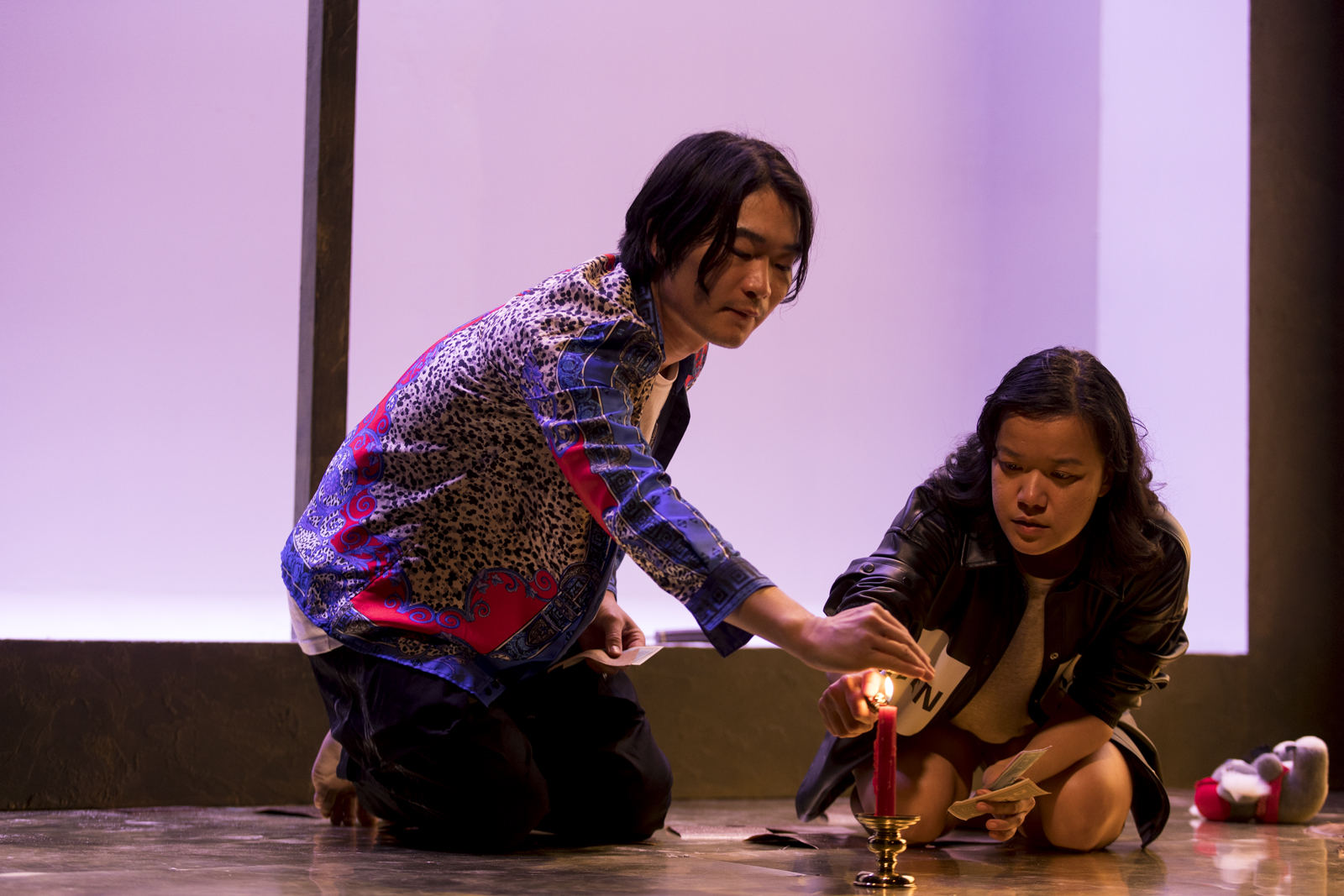
This production is by Asian-Australian company Slanted Theatre, and it’s a whole lot of fun.

It works beautifully on two levels: working within the parameters of the charming form of orientalism, and operating as a gentle parody of the reductionism that all orientalism tempts us into if we read it as realism.

What’s so marvellous about this production by director Tiffany Wong and her brilliant cast is its exuberant lightness.

The whole team offer wonderful comic performances. Wise beyond her years and cheekily independent, Susan Ling Young shines as Lady Precious Stream; it’s an inspired piece of casting. Steve Lu and Mym Kwa each play a couple, each doubling as both husband and wife, and the effect is dizzyingly mischievous.

The Flying Nun by Brand X provides an invaluable space for artists to experiment, and Wong uses the opportunity magnificently. Her playful mixing of modern tech and more traditional elements of movement and sound create an art work that is gloriously conscious of its status as an artefact. Who needs reality; this is magic.

Veronica Kaye

Lady Precious Stream by S. I. Hsiung

The Flying Nun by Brand X  1 April – 2 April

Image by Liangyu Sun @ theatreworks

The Spook

30 Mar

With apologies to L P Hartley, the past is a foreign country (more specifically, one of those obscure, miniscule European states who take Eurovision seriously.)

Historical comedies often function on the premise that we’ll happily laugh at people from the past. The temptation to feel superior is….overwhelming. And, really, who’s being hurt?

Photo by Bob Seary

Set in Bendigo in the late 60’s, The Spook by Melissa Reeves presents the conflict between small time ASIO operatives and the local branch of the Australian Communist Party. Much of the humour – and there’s plenty of it – comes from the skewing of pettiness and posturing in the face of genuine issues.

Laughing at our own irrelevance is an Australian tradition.

Or is it something more sinister? Humility is healthy, until it becomes negligence. The Spook guarantees a lot of fun in its playful mockery of banality and ego-driven myopia, but Reeves makes clear that political action is both necessary and significant. It has to be done, and it has to be done with care.

All politics are local, except when they’re not – and they’re not when our neighbours cease to be people and become types. See those around you as participants in some grand apocalyptic battle and it’s easy to forget they are human beings, fragile and flawed, just like yourself.

The Spook is a Cold War comedy, but only Australian political naivety could explain a failure to recognise the play’s contemporary relevance. The myth of the grand battle is still being told.  

(Speaking of forces of darkness: COVID hates theatre. It’s done its evil best to close this production on several occasions. Theatre needs actors to have spent lots of time together beforehand, in the rehearsal room, on the set – and on the first weekend of this production it was apparent that the wicked schemes of the malevolent virus had had some impact. But this is a brilliant team offering some wonderful performances, and I am sure by now the enemy has been vanquished and theatre holds the field. Courageous. Audacious. Exuberant.)

Veronica Kaye

The Spook by Melissa Reeves  

New Theatre until April 9

https://newtheatre.org.au/the-spook/

The Merchant of Venice

8 Sep

This is Shakespeare by video conference – which suggests something about the times, and about the nature of drama.

During a pandemic we seek new ways to share dramatic stories, and this production of The Merchant of Venice is inventive and intriguing.

I’ve never been a huge fan of the play. For me, the comedic situations sit awkwardly with the more serious exploration of intolerance. And the courtroom scene – despite Portia’s paean to mercy, or perhaps because of it – is awful. Not awful in the modern sense of being bad, but awful in the older sense of striking one with awe or causing dread.  That scene – with its deliberate mixing of theatrical artifice and painfully raw honesty, with its disconcerting confluence of the best and the worst in human nature – makes it difficult to care much about the lovers’ fooleries that follow.

Director Roslyn Hicks navigates this dangerous play with a light hand; allowing exuberance to glisten on the surface, while permitting the audience to sense for themselves the disturbing currents that swirl beneath. The cast embrace this approach with admirable energy and a fine control of the Shakespearean language.

And what a peculiar production in which to perform!

Presumably, each actor is alone in their own private space, waiting before their own camera. When they’re in a scene, they’re always in view, regardless if they’re speaking or not, isolated in their own little segment of screen. When they do speak, they speak directly to the camera. No one ever can touch.

What is this?

Theatre?

Film?

Zoom.

It’s not, of course.

What it is, is an invitation to consider both the parameters and potential of form.

Everyone wants the pandemic to end soon. This experiment might be a response to that pandemic, but hopefully it will live and grow.


The Merchant of Venice

by William Shakespeare

produced by Streamed Shakespeare

performed live 21st to 23rd August

now available on demand http://www.streamedshakespeare.com/


Welcome to the Masque

25 Aug

Last Sunday, at Riverside Parramatta, Genevieve Lemon and Max Lambert offered a soulful hour of cabaret.

Twenty five kilometres away, comfortable on my couch, I gratefully accepted their gift.

This is one way live performance continues in the age of COVID. Live streamed and shot with multiple cameras, Lemon and Lambert shared classics by mournful, magical composers like Carol King and Jodie Mitchell. There were songs of loss, love and hope; those aspects of the human experience, wild and intense, that call to be sung rather than said.

And though some of the banter between numbers felt strained, the musical presentation was brilliant.  Lambert played like a waterfall in the sunshine; great primal forces channeled, naturally and seemingly effortlessly, as eternal flow and sparkle. And Lemon’s voice – extraordinarily beautiful, rich and subtle – was used with an actor’s attention to meaning. The potential limitations of the small screen were transcended, a connection was kindled, and each classic shone with light and love.

Welcome to the Masque – Riverside Theatres Digital

riversideparramatta.com.au

Angry Fags

12 Feb

Those expecting a queer subversion of Angry Birds will be disappointed. Or not – depending on how far they’re willing to stretch the whole bird, egg, pig analogy. (Yes, I had to research that.)

But as a political black comedy, Mark Nagle’s production of Topher Payne’s play is thought-provoking, fun theatre.

It’s a play about political strategy, and that’s a conversation our society needs to have. Too often we imagine our goals are all that matter, but how we attempt to achieve those goals is just as important. (An example: in Australia, current attempts to build an equitable society in regard to race are often hampered by well-intentioned voices who unthinkingly slip into the very racist attitudes they hope our society could leave behind. And so the process is made slower and more difficult. It’s the mistake Hilary Clinton made with her infamous “deplorables” comment. And, for that mistake, we are all paying.)

The world is made by our actions, not our intentions, and we must begin how we hope to end.

Set in the contemporary south of the USA, the queer characters reel at ongoing hate crimes. How can a more just world be made? One gay man says to another “They’re not frightened of us.” Is that the solution? A terror campaign?

                  Photo Credit Chris Lundie

Side note: all black comedies risk the same danger – that after the first death, there is no other (……laughter, that is.) This production has laughs a plenty despite the growing body count, and though the more sensitive may squirm, Nagle’s cast succeeds in both the pathos and the humour.

And the play’s discussion of political strategy is satisfyingly multileveled. Parallel to the debate about the use of violence is that of whether compromise is unavoidable, and whether it’s best to work from within the establishment or not.

With this intelligent and playful production, New Theatre shows once again why it is a vital part of Sydney’s theatre ecology.

Angry Fags by Topher Payne

New Theatre until March 7

A Manifesto; or Reflections on Writing about Theatre over a Decade

28 Jan

“Manifestos are written by revolutionaries as they wait for the next shipment of bullets. Oh, and by reviewers waiting for the next play.”

When I began this site in 2011, writing as the character Veronica Kaye, I wrote the above, and then continued:

Not that this will be a manifesto. But, then, I’m not a reviewer.

Which in two sentences [sort of] sums up my attitude.

I’m not in the slightest interested in judging plays. I’m interested in responding to them. I intend to write about what plays make me feel and what they make me think. I don’t intend to label them as failures or successes. Other writers can do that. And they will. And I don’t think it’s enough.

I hope to encourage the appreciation of plays as what I believe they are – sharings of our visions of the world.  They are not tricks that are done either well or not. Theatre is not Olympic diving.

Of course, theatre can be done horribly. But I’m not going to write about that. It’s tempting to be all Oscar Wilde for a moment and say that task can be left in far less capable hands than mine. But, it’s actually just a choice.

Theatre is not space flight. When you get it wrong, no-one dies. We just don’t get to visit new worlds.

[So I suppose it is like space flight.]”

Looking back, almost a decade on, I agree with most of what Veronica wrote (and she did write beautifully.)

But she was a young pup and, in her exuberance, I feel she was guilty of …. exuberance.

Now older, I find I differ with her attitude to both reviewers and artists. These differences are only subtle, but when we trip, it is not over Mt Everest but rather a mere crack in the pavement.

Veronica criticised how others wrote about theatre. I’m not much interested in this anymore. We must all work out our own salvation (and there is more than enough to be done on mine.)

Veronica also gave the impression she would talk about herself.  She did not (though her focus on the meaning of plays did surprise some people – especially if you didn’t think your play meant anything at all. Or didn’t want it to.)

I’ll continue with the same focus as Veronica, but I want to make clear that I’ll be analysing and discussing what the artist is doing, not using the production as a hook to hang my erudition.

I’m still not particularly interested in evaluating theatre. But I know some people like it. And I know it slips in anyway, unbidden, a sort of reflex action. After all, judgement is a natural response to Life  (“This coffee is awful!” and “What a beautiful day!”) and also a necessary one (“This society is unjust.”)

And, following Veronica, I’ll continue to write about artists with respect.

And her space flight analogy is charming (didn’t we all want to be astronauts when we were young?) but I’m going to rejig it, and make it something more down to earth.

I will consider a play as a gift.

And I’ll unwrap it.

And share it around.

Paul Gilchrist

Theatre Red is Re-Open for Business

10 Jan

About two and a half years ago I decided I didn’t have enough time to write about theatre anymore.

Well, things have changed.

Recently, as I was ferreting around the dark and dusty corners of my subconscious, hidden behind boxes labelled Bad Habits and Dis-organisation, I discovered this big bucket of extra Time.

I’ve decided to use this extra Time writing about theatre, because I enjoy it so much.

My contact details can be found on the page inventively entitled About/Contact.

Why I don’t write about theatre anymore

9 Jun

Everyone loves a rant, don’t they? So perhaps I should begin with a complaint about disorganized publicists who never had my name at the door, a whine about painful productions by hopeless incompetents, a whinge about competent productions by cynical CV-fillers, and a despairing howl about my inane colleagues who wrote only fluent cliche.

Unfortunately, I have no such rant in me. I’ve enjoyed writing about theatre and I have met some truly wonderful people.

But, before I explain why I no longer write about theatre, I’d like to explain why I began in the first place. Over the years, some people have responded as though there was something inappropriate about me doing so, suggesting it was either wrong or unwise for a working dramatist to comment on other dramatist’s work. But surely artists should be able to talk about Art? The moral discomfort seemed based on the assumption that if I wrote about theatre my aim must be to criticize. I don’t think this is the only way we can respond to Art.

Paul and Croc

I wrote about other artists’ theatre in the way I wished my own theatre was written about. I wrote about theatre in an attempt to acknowledge and appreciate the gift being given. Evaluation is the default position in most critical writing and, of course, it has its place. But I don’t write as a dramatist to be judged. I write to share.

As a playwright, I write to share my vision of Life. I use the theatrical form because it allows complexity and contradiction. (Dramatists who say they’re writing the Truth are simply substituting that word for an expression I believe more humble and honest.)

My vision of Life is joyful and hopeful – I hope. But if it were sad and miserable I would share it anyway, because you have to bring to the table what you have. (Occasionally as an artist I’ve come up against the view ‘Who are you to do that?’ and my response is ‘Who are you to not?’ Sharing is not arrogance. Deliberate isolation is.)

There are many qualities required in order to write about theatre well. One of them is time. I find I have increasingly less of that, and so I can no longer write about theatre, not when there are plays to write.

However, I have enormous admiration for those who do write about theatre (whether they’re driven by the need to evaluate or not). It’s not an easy task, as I’ve discovered. But I believe it is vital. If we don’t discuss our Art, it’s as though we are spitting Life in the face.

Paul Gilchrist

Down an Alley Filled with Cats

27 Apr

Talk to virtually anyone in the theatre world and you soon learn that there is a grand tradition of self-obsession.

This production refuses to honour this tradition, instead presenting the audience with a simple, engaging entertainment.

I, however, uncomfortable with such radicalism, will adhere to the time tested way.

I would not choose to direct this play – because it’s so difficult.

Down_An_Alley_Filled_With_Cats_Production_Photo_09

Photo by Andrew Langcake

Down an Alley Filled with Cats by Warwick Moss was first produced in 1984 and won the Premier’s Literary Award before seasons in the West End and New York. It’s a comic thriller. And that’s what makes it so challenging – getting the balance right between the playful and the serious.

This production has a good shot at it, but I’ll be honest, it took me a long time to pick the tone. Maybe I’m just slow. (See, it’s all about me.)

Actors Gabriel Egan and William Jordan easily hold our attention, but I suspect opening night nerves may have played a part in making vocal performances a little muddied.

The two participants in this cat and mouse game to possess a valuable object are (conveniently) locked together in a room. Dramatists love this trick of offering the characters no possibility of escape, and audiences often go along with it as it mirrors their experience of the theatre. But it’s a trick that demands careful consideration of the physicality of the performances; it’s inevitable that close proximity will have to reflect both intimacy and antipathy, and in so far as this genre is a distant cousin of naturalism, there’s enormous pressure to get the pacing right to make this appear believable.

Moss’ script uses other classic tricks – you might end up wondering with it’s intricately plotted or all just a sleight of hand – but it will lead to interesting post-show discussions. Were you taken in or not? Of course, if you’re part of the grand theatrical tradition, you never were, not for a second.

Paul Gilchrist


Down an Alley Filled with Cats by Warwick Moss

Directed by Tom Richards

at King Street Theatre until 13 May

tix and info here

Future Seekers

25 Apr

Carol Dance’s Future Seekers is made up of ten loosely interlinked short pieces. It boldly traverses time (1917 to 2017) and place (Russia, USA, Lithgow). Excepting costume, design is minimalist in the extreme.

This is big theatre, presented simply.

It explores how the past informs the present. Generation connects with generation.  It is a powerful reminder that our actions matter, that our present impacts on more than ourselves.

Dance’s writing is charming and good-hearted. A cold soul might call it naïve and, at times, convenient but it’s these very features that create the magic of its wide-eyed wonder and the appeal of its optimism.

Future Seekers - IMG_0044 (1)

Director Mark Langham elicits good performances fitting the broad, bright style of the piece. Occasionally characterizations falter, but there’s a real pleasure in watching four skilled actors (Neveen Hanna, Eli Saad, Sana’a Shaik and Michael Wood) move from role to role, exhibiting a playful versatility.

Between scenes pianist Philip Eames presents a series of classical pieces. His performance is beautiful, and the breadth of the selection eminently suits the play’s purpose: the sharing of the belief that in the immensity of the wide, wild world there is space enough for both surprise and connection – and from such a union hope is born.

Paul Gilchrist


Future Seekers by Carol Dance

at Philharmonia Hall, Hickson Road, Walsh Bay Arts Precinct until 30 April

tix and info here