The Screwtape Letters

23 Nov

When I read The Screwtape Letters years ago I loved it. C.S. Lewis is a first-rate Christian apologist and an incomparable stylist.

What is an apologist? Apologists defend the claims of Christianity, but not by a call to faith, but rather by historical evidence, philosophical arguments and the like.

Apologists attempt to make the magical appear possible, the absurd seem reasonable.

What Lewis does in The Screwtape Letters is save the Devil.

What I mean is that he saves the concept of the Devil from contemporary cultural forces that would have us view temptation as exciting and evil as transgressive.

Lewis presents Satan as hell bent, not on some metaphysical concept of damnation, but rather on human misery. As one human soul says, as he finds himself in Hell, I have arrived here by doing neither what I ought nor what I enjoyed.

Screwtape is a senior devil dispensing advice to a junior devil on how to best make the human soul in his charge damnable – that is miserable.

screwtape-11-low-res

Photo by John Leung

It’s a cute conceit, and one of Lewis’ neat tricks is to make Hell a bureaucracy. Sharp letters go back and forth between the departments, and it’s all great fun, but the result is that we’re given some wonderful insights into how we can potentially waste our lives: in sleepwalking habit, in obsession with trivia, in petty vanities. (A simple example: Encourage your human charge to read, suggests Screwtape, though not for enjoyment, but that he may say clever things to his friends.)

There have been several stage adaptations of the book, and this version by director Hailey McQueen works well. This is an achievement; the original source material is not fundamentally dramatic, nor even a dramatic monologue, but rather a set of essays framed in Lewis’ ironic epistolary form.

To make it work, you need a top notch cast, and Yannick Lawry and George Zhao provide the goods. As Screwtape, Lawry is suitably dapper and articulate, classically and coldly reasonable…until provoked. Zhao as Toadpipe gives a wonderful physical performance, his clowning providing the necessary texture which allows us to appreciate Lewis’ rich, beautiful prose.

Do you have to be Christian to enjoy this?

I’m not and I did.

Paul Gilchrist


The Screwtape Letters by C.S. Lewis (adaptation by Hailey McQueen)

Reginald Theatre, Seymour Centre, Tuesday 22 November- Saturday 10 December, then Melbourne and Canberra.

Tix and info here

Tiny Remarkable Bramble

21 Nov

I’m going to pretend I understood this one. Not that understanding is crucial for theatre. Or enjoyment. Or life.

Our protagonist, Alice, seems to need help in order to face the world.  At hand are a kooky collection of characters, played with appropriately high energy by Cathy Hunt’s cast. (I’ve been a fan of Hunt since I saw her Judith at the Bondi Pav a few years back.) Thomas Campbell plays a terrific toy soldier. Lucy Suze Taylor is a delightful vamp. Michael Whalley is a gorgeously awkward geek. Contessa Treffone is a charming innocent, bright-eyed and bubble-wrapped. (Yes, she actually is.) Catherine Terracini is the slogan-speaking motivator, engaging to us, maddening to Alice. Geraldine Viswanathan plays Alice with an intriguing mix of cynicism and vulnerability.  She’s in a sort of Wonderland, and soon it becomes apparent that these crazy kids are in as much need of help as she is. They’re hiding from the outside.

trb-1

Photo by Clare Hawley

Someone smart, someone like Picasso, said something like “I don’t paint what a tree looks like. I paint how it makes me feel.”

So, as Jessica Tuckwell’s Tiny Remarkable Bramble is clearly not a piece of naturalism, what aspect of human experience does it explore?

Perhaps it’s a riff on how the world can feel overwhelming, and on the potential for the mind to transcend this feeling. The script is jam packed with snappy dialogue, half-gag, half-nonsense (or perhaps all-gag if you’re in the likely position of being smarter than me.)

The characters are preparing for a talent quest. “It’s all a talent quest out there.” It’s a stimulating metaphor, though not one that especially resonates with me. (Life, for me, is that ocean swim where you don’t know which way is land. Or it’s a bunch of us on a raft, rationing the resources, and trying to get on.) But Life as a stupid compulsory competition probably seems a good description for a lot of people.

Paul Gilchrist

Tiny Remarkable Bramble by Jessica Tuckwell

Kings Cross Theatre as part of Invisible Circus

Tuesday 22nd November, Friday 25th November

Full program and tix here

Let’s Talk About You

21 Nov

‘I contain multitudes’ sang Walt Whitman.

Let’s Talk About You is a distillation of this idea.  Elaine Hudson and Anne Tenney portray different parts of the same person. I could simplify even more, and suggest Tenney plays the grander parts of the soul and Hudson plays the lesser. (This degree of distillation can be either potent or unpalatable, depending on how much you’ve already drunk.) Taylor Owynns plays the generous spirited friend attempting to make sense of her conflicted companion. All three actors give astounding performances, physically engaging, and vocally delicious.

Rivka Hartman’s script is full of sparkling one-liners. Is the divided self conceit just a device for making jokes, or is it an exploration of the human experience? This is light comedy. But though there are plenty of froth and bubbles, lurking below, in the back stories, are some rather frightening (male) sharks.

scarfcomposite

Photo by Vicki Skarrat

The play is a paean to self-reflection. Like Socrates, I believe an unexamined life is not worth living; but I do feel it should be a take-home exam. Much of the play’s fun comes from the fact that the divided character’s very necessary self-examination is being practiced at exactly the wrong time. It’s difficult to have two conversations at once, and to be good in company, you must first learn to talk to yourself.

Paul Gilchrist

Let’s Talk About You by Rivka Hartman

The Depot Theatre til 26 Nov

Tix and more info here

The Angelica Complex

16 Nov

Early in this production the character says words to the effect: “As a woman, you can be either strong or vulnerable. You can’t be both.”

And then we’re gifted a performance that is both strong and vulnerable: strong in that Kym Vercoe is an extraordinary actor whose vocal and physical work is of the highest quality; vulnerable in that we’re given a heartbreaking insight into the challenges facing a woman who has newly become a mother.

angelica-5

Kym Vercoe, photo by Phil Erbacher


Part of Invisible Circus, a festival of work by female theatre practitioners currently at KXT, Sunny Grace’s The Angelica Complex is one of the voices we need if our theatrical culture can claim to be truly diverse. (Though the fact I can use the word ‘diverse’ to label a work that explores such fundamentals of human existence as birth and breastfeeding suggests we might have a way to go. I blame society, not myself; in polite company, that’s always best.)

This is a powerful tale presented with both humour and pathos. Director Priscilla Jackman uses the traverse stage to full effect. Sometimes it’s a theatrical space for an individual woman’s intimate sharing of her joys and desperate challenges. At other times it becomes a symbol of a social space offering no escape from the gaze that sees only the role and never the person. Lucia May’s live video feed effectively captures the tension of a particular woman put on the spot, while Naomi Livingston’s vocals beautifully evoke the forces that tug at the boundaries of individuality.

Paul Gilchrist


The Angelica Complex

Priscilla Jackman (Co-creator & director)
Sunny Grace (Co-creator & writer)

Kings Cross Theatre

Saturday 12th November, Tuesday 15th November,Friday 18th November, Thursday 24th November and Sunday 27th November

As part of Invisible Circus. Full program and tix here

Rats (Dirt)

31 Oct

I’m sitting in a park. In a few hours I’ll be in a theatre, but now I’m outside. It’s a magnificent spring day, the sort of day that makes you think God has bought herself a new Photoshop suite and is having some fun. The green of the trees and the blue of the sky vie with each other in brilliance. I’m not alone in my enjoyment: children play in raucous excited groups; parents gather in twos and threes and fours, chatting, smiling, laughing; and older people sit quietly, sunning themselves in the warmth. This park is in Hurstville. Demonized recently by Pauline Hanson, the suburb is the epitome of a gloriously diverse Australia.  It is difficult to picture a more beautiful scene: the trees, the grass, the flowers, the sky, the children, the howitzer.

Yes, tucked away in the corner of the park is a howitzer. It sits on a pedestal, but there is no plaque. It’s a veteran of I don’t know which conflict. The children are oblivious to it. Why is it here?

A few hours later I’m at the Old 505. It is the premiere performance of a new Australian work. I know many of the cast and the writer director. I’m excited about the show and I’m not disappointed. Chris Huntly-Turner has created a piece that’s ambitious, energetic and engaging. It’s an exploration of the experience of Australians during the siege of Tobruk in the Second World War. There are two plays in repertoire; Dirt, which explores the experience of the men at the front, and Moonshine, which explores the experience of the women at home. Tonight is Dirt.

dirt

Photo by Liam O’Keefe

It’s the story of Little People caught up in Big History. (These men are not in a park in Hurstville in 2016.) The division of Rats into plays dealing with the male and the female experiences reaps fascinating dividends in Dirt. These men face real current danger, but what are the expectations from home? And are they real or imagined? Why are we here? To do our duty? And what, exactly, is that?

I’ve never been a fan of World War Two. (Neither were most of the people who fought it.) It lends itself too easily to simplistic readings. Like some children’s book, the enemy seems too clearly bad, and we seem too clearly good. Every sabre rattler evokes WW2. But Huntly-Turner and his terrific cast and crew do a great job in exploring the treacherous nature of the terrain.

Our duty, whatever that may be, is difficult to map. But we will attempt to connect our suffering, our sacrifice, our sins with something larger. We will try to make sense of them.

And so a howitzer sits in a park in Hurstville.

Paul Gilchrist


Rats (Dirt) by Chris Huntly-Turner

fledgling theatre company

Old 505 Theatre til Sat 5 Nov


Dirt 

Tue 25 October 7pm, Thu 27 October 8pm, Sat 29 October 8pm, Tue 1 November 8pm,Wed 2 November 8pm, Fri 4 November 8pm and Sat 5 November 6pm

Moonshine

Tues 25 october 7pm, Wed 26 October 8pm, Fri 28 October 8pm, Thu 3 November 8pm and Sat 5 November 8pm

The Wit and Wisdom of Veronica Kaye

26 Oct

The trouble with reviewers is that, ultimately, they’re always writing about themselves. Every evaluation is simply their world view writ large. The more sophisticated critic will acknowledge this, but rarely in a review (usually in a bar).

I, however, will not hide behind any pretense of objectivity.

If it’s going to be all about me ULTIMATELY, then it may as well be all about me INITIALLY.

So, while other theatre writers might present lists of the best they have seen, I prefer to present the best of what I have written.


The Wit and Wisdom of Me

“Theatre is not space flight. When you get it wrong, no-one dies. We just don’t get to visit new worlds. (So, I suppose, it is like space flight.)” By Way of a Manifesto

“We judge art so it does not judge us.” To the Death, 2011

“Don’t give me that crap about theatre being the most natural thing in the world. ‘All the world’s a stage’ is just professional myopia. To footballers, all the world’s a game. To risk assessors, all the world’s an accident waiting to happen. To fishermen, all the world smells of fish.” StoryLines, 2012

“We should be wary when too many of our conversations about theatre sound like demarcation disputes, performance reviews, price negotiations, quality control panels, courts of petty session and magistrate’s verdicts. Only one conversation is vital. And it happens in the desert, when the artist battles with the devil – alone, naked and true – and in that battle forfeits her ego to win her soul. And tired but free, she returns to the city, and scratched in the dirt if necessary, she offers a vision of the kingdom of heaven.” Let the children keep their paint boxes

 “‘I’m only being honest,’ says the bully……It is naïve to think we communicate primarily to tell the truth. ‘Pass the salt’ is far more typical, and meaningful, than ‘That is the salt’. Truth maybe crucial but it is always secondary. We speak, we write, to impact on the world.” A Hoax, 2012

 “The obsession with acting in the drama theatre is like an obsession with anesthetic in the surgical theatre. Of course, you have to get it right, but it’s hardly the point of the process.” Masterclass, 2015

“There have been times and places where drama has been entirely banned. If you can’t see why, you haven’t seen it done well.” The Venetian Twins, 2012

“Reviews are our revenge on theatre. (And not just when we dislike it; after all, even 5 stars is rather parsimonious, considering how many stars there actually are.) In answer to the beautiful multiplicity of theatre, reviews offer a stern monotone. Which is why no-one takes them too seriously. Which is why I don’t write them. (They’re like trying to catch starlight in a jar.) When the Rain Stops Falling, 2012

Rochester

Now, where are those pigeons?

“To be honest, I find it difficult to be overly interested in judging the technical details of a production.  Maybe I lack something. But I want a play to give me more than the satisfaction that I am superior to it and its creators. No-one survives this life, but I intend to go down fighting. I want a play to arm me for that fight. I want to leave the theatre with more than I entered. And that “more” is not disdain – or even admiration – for the artists. The plays I need are fuel for life; logs to feed our open fire. They give warmth. They give light.  So we’ll gather, in silent fascination, and watch. And as one flickers out, we’ll throw on another, and no two will burn the same. And so we’ll pass this night, the dark and the cold all around us, and know that no dawn comes, except of our own making.” But What’s It All About?

“If a piece of theatre doesn’t appear truthful, maybe it’s not. Maybe it’s original.” Conservatism in Theatre 2

“Whenever someone begins a comment with ‘I see a lot of theatre’ I’m left wondering whether it’s a claim to expertise, or just a cry for help.” The Small Poppies, 2013

“People go to the theatre for all sorts of reasons. For me, one of the greatest attractions is the insight it offers into how the world is viewed by others. If we’re asked our values we’re often lost for words. It’s hard to sum up our worldview in a few pithy sentences. It’s like asking a fish to describe the ocean. (Feel free to test the truth of this analogy.)” Shopping Centres and Gutters, 2011

“The problem with the pursuit of excellence is not that you’ll never catch it. The problem is you miss so much else. Doing something without fault is a secondary virtue. The crucial issue is what you’re trying to do, not how well you do it. Surely, it’s better to fail at something worthwhile than succeed at something worthless. Do you really want to be remembered for producing the play that most effectively keeps the world small and cold?”  The Pursuit of Excellence

“I’ve come to accept that people will attempt to inoculate themselves from art. In terms of theatre, most people do this by not going. Those of us forced to go – because of career, or the pursuit of career – adopt other methods. Most of us don’t want to be changed. We don’t want to be challenged. And, considering the lives of unparalleled privilege that most of us enjoy, that’s perfectly understandable.” Theatre as Just a Trick

“Only God knows the complete Truth. And She’s not sharing…What we call the Truth is simply the point at which we cease asking questions.” Dangerous Corner, 2013

“Remember when the most important question was ‘What is to be done?’, rather than ‘Who am I?’” Indian Embrace, 2013

“We reviewers need to keep in mind that if the artist really valued our opinion, they’d ask us to read the script before the production, or at least get us along to a couple of rehearsals. As it is, they ask us in when they’re finished. Obviously, they don’t intend taking what we say that seriously. (Analogy: We think we’re specialists, yet we’re only ever called in for the autopsy.) What are reviews for?

“It’s difficult to see you as serious writer if you won’t help mount a production of your play that could be truly awful. Worthwhile writing challenges established values, so a writer seeking status is as absurd as a spy wanting recognition. ‘But if it was any good wouldn’t someone pay me for it?’ That attitude is loud and clear in our society, and perfectly designed to silence dissent.” Natural Born Producers

“In a capitalist society, co-operation is not encouraged. Competition is. Careerists – people interested primarily in personal advancement – are held up as model citizens. To support this world view, it’s expected that writers about theatre will focus on evaluating performers and productions, as against discussing ideas. And so the prevailing economic structure influences everything; even trivialities like theatre criticism.” His Mother’s Voice,  2014

“Theatre’s particular oddness is that it is not first person. Theatre presents Life from the outside, which is decidedly not how Life is experienced.” Tell Me Again, 2014

“Every evaluation is a political act.” Truth in the Theatre Foyer

Veronica Kaye

Reviewers say the darndest things

14 Oct

Over the last 8 years I’ve been reviewed as a writer and director over 200 times. The vast majority of responses to my work have been very generous-spirited, and some of them have even been intelligent.

There have been exceptions. At times, I’ve been described as unimaginative, mean-spirited and self-indulgent. And I’ve been branded a coward, a racist, a misogynist and a homophobe.

(The last three accusations all came in a single review. Admittedly, it was the work that was so labeled, not me; but when you’re the writer and director of the production such a distinction seems somewhat irrelevant.)

So what do you do when you get a review like that?

I complain.

Of the derogatory reviews listed above, only once did I fail to take the reviewer to task – the time I was accused of cowardice. Insert own joke here.

Each of my complaints was successful, in that the reviewer was willing to discuss the issue in a public forum, or in the case of the alleged racism, misogyny and homophobia, the review was withdrawn.

I want to make clear that I haven’t complained every time I received a less than glowing review. Who’s got the time?

What I do want to suggest is, that every time I elicited the type of response I’m discussing here (that is, a personal moral attack), it was perfectly obvious to me that the play had hit home. It had angered someone. That was never all that happened in the audience; each of those plays received glowing reviews from other critics.

But that anger? Was I pleased about it?

No.

And yes.

Paul Gilchrist

Hamlet

4 Dec

Famous plays have baggage. They have a past. Which is, of course, what makes them interesting to a lot of people.

Having been produced so many times, each new production can end up feeling like a commentary on previous productions. (It’s one of the reasons I like new work. I don’t like to see that much theatre about theatre.)

When you produce Hamlet, a reasonable percentage of audience members will ask ‘Is this about Hamlet or Hamlet?’

Montague Basement’s adaption of Hamlet is a snappy, engaging 90-minute, five-character version. We lose (to name a few) Gertrude, Laertes, Fortinbras, Rosencrantz , Guildenstern and the players. Ophelia and Gertrude are melded and the result is curious. Horatio, Laertes, Rosencrantz and Guilderstern are combined and the result is intriguing. And the structure is altered; there aren’t just cuts, there are also rearrangements. And the end………..

If you’re familiar with the text the changes are massive, and ultimately stimulating. Do they simply make the play easier to perform? Or is there a method……… I won’t say to the madness (because friends who weren’t familiar with the play very much enjoyed it. And I’ll add that a woman in the foyer said it was the funniest Hamlet she’d seen.)

Hamlet MB Program-7314

Performances are high quality. Patrick Morrow as Polonius is very funny. Christian Byers as Hamlet is antic, energetic and highly watchable. Lulu Howes as Ophelia is terrific (especially considering the challenging decision to have her witness her father’s death, and then alone on stage descend into madness and commit suicide in a handful of minutes.)

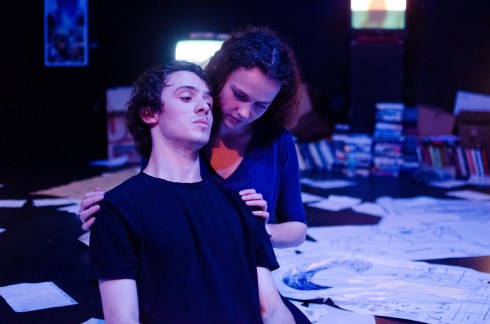
Director Saro Lusty-Cavallari’s set, with its TV screens and strewn paper, suggests both a teenager’s bedroom and the weight of the thousands of previous productions.

I did miss Laertes and Fortinbras, who are such foils to Hamlet. (The latter especially lifts the play into the political realm; “madness in great ones must not unwatched go”). I did miss Gertrude (especially her response to the lost Ophelia; “I will not speak with her.”) And, most of all, I missed……… but, of course, talking this way only highlights the power of text, and the beguiling allure of the past.

Veronica Kaye

Hamlet by William Shakespeare (sort of)

PACT til Sat 5 Dec

tix and info here


Dinkum Assorted

1 Dec

Another play dominated entirely by female actors. It’s disgusting. All those millennia of oppression – for nothing!

Set in a country biscuit factory during WW2, the fifteen strong all-female cast provides a fun and thought-provoking night out.

Dinkum Assorted is part of that genre that treats war as though it were a natural disaster. And if you’re far enough down the pecking order, I guess it is. These women have to make the best of a difficult situation. And they do, with both fight and laughter.

There are some terrific performances: Colleen Cook as the down-to-earth forewoman; Debra Bryan as the maligned and misunderstood outsider; Bodelle de Ronde as the struggling young mother; Sonya Kerr as the sophisticate facing tough choices; and Amanda Laing and Hannah Raven as the effervescent youngsters dreaming of another world.

Dinkum-10

Photo by Bob Seary

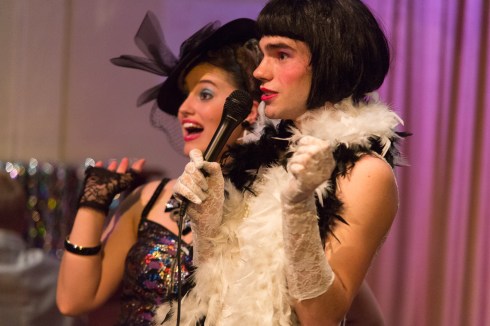
It’s sort of a musical with all the songs at one end. The closing numbers have huge energy and Laing and Raven’s tap dance is brilliant. The costuming of these numbers, by Kiara Mullooly, is delightfully and gloriously over the top.

Some people might find the book a little dissatisfying; there’s so much in it that some parts can feel a little sparse, but Aronson and director Sahn Millington get the tone right. This is a story of Big History catching up with little people. Sure it’s a tribute to determination, but the play’s also a paean to innocence.

Kerr’s Joan says ‘Don’t make me something I’m not’. De Ronde’s Millie replies ‘It’s what people always do.’

Perhaps in the past we were innocent. It’s a myth we tell. It’s what we always do. I wonder why.

Veronica Kaye

Dinkum Assorted  Book, lyrics & music by Linda Aronson

at New Theatre til 19 Dec

tix and info here

Through a Beaded Lash

1 Dec

Four funerals and a wedding.

Well, not exactly. There are no funerals (on stage). There is a wedding (slightly off stage).

But, despite the humour, the atmosphere is thick with loss.

Robert Allan’s deeply moving play is about the struggle between the acknowledgement of grief and the quest for growth.

With two concurrent time periods, the play is a cleverly structured dialogue between the past and the present.

In the past, we follow the developing relationship between Brent and Adam. Brent (Ryan Henry) performs as a drag queen. With the help of effervescent Zoe (Emily McGowan) and crotchety but lovable Phil (Roger Smith), Brent raises money for those battling the newly recognized Acquired Immune Deficiency Syndrome. A charming bumbler, Adam (Oliver Rynn), arrives. The attraction is obvious, but he’s out of his depth. There’s a war going on, and Adam – like so many of the population – has not caught up with the reality.

photo Clare Hawley

Photo by Clare Hawley

In the present, we follow Adam and Zoe twenty odd years on. Played engagingly by Cherilyn Price and Leo Domigan, their friendship has survived, but beyond the fun banter, there’s real tension.

Clever direction by Julie Baz highlights both the continuities and discontinuities between the two time periods and so brings to the fore the fundamental question of the piece: What is, What should be, What can be, our relationship with the past?

Both funny and touching, Through a Beaded Lash is a powerful call both to remember the dead and to remember to live.

And it’s a new play and I congratulate The Depot on that.

I began with a glib reference. Four funerals……..

In the 80’s, 90’s and today, here and worldwide, if only the toll was so low.

It’s more like forty million.


Veronica Kaye

Through a Beaded Lash By Robert Allan

The Depot Theatre til 12 Dec

Tix and info here