The Small Poppies

21 Jan

I like to sit in the front row. And I usually get what I want, especially when it’s general admission. I’m fast, I’m nimble, and I’m not held back by manners.

But at The Small Poppies it was on for young and old.

I was surrounded by little people. There was wriggling. There was giggling. And there was a refreshing absence of pretension. (No comments of the “I see a lot of theatre” type. Not a single six year old sniffed anything like “I saw the 2000 production. At Belvoir. Geoffrey Rush was superb”. Whenever someone begins a comment with “I see a lot of theatre” I’m left wondering whether it’s a claim of expertise, or just a cry for help.)

Felicity Nicol’s production of David Holman’s play is high energy from the get go. I’d only just finished elbowing a five year old when I was assaulted by a cacophony of Outside Voices being used inside.

Yes, Inside.

Children love that sort of thing. And rightfully so. They appreciate there’s little point to theatre if it’s not subversive.

But David Holman’s play is not just for children. Nicol’s ensemble is superb. Playing both adults and kids, they deliver a fun and moving story of three kindergarten children and their parents.
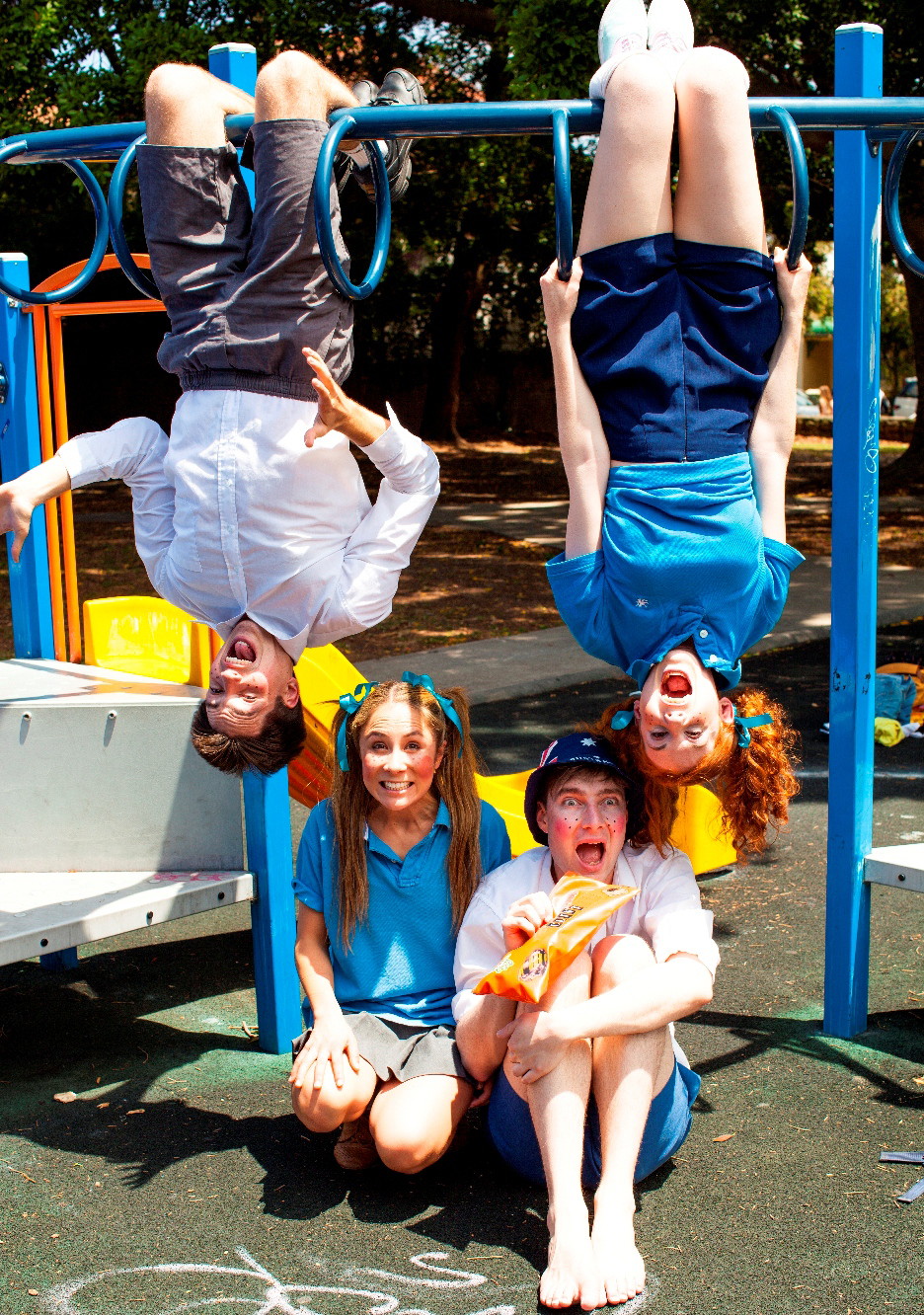
The Small Poppies 5s

But it’s also the story of the extraordinary institution that is school – one the great experiments in human history. Universal schooling, based on the belief  knowledge should be shared equally, is democracy in action. Because we all went through it, we assume it’s natural. It’s not. It has to be made. And made right. And the play honours those who have tried to make it so.

The play is also the story of an ethnically diverse society. Set in the 80’s, the demographics might have changed, but many of the challenges remain. Rosie Lourde’s moving portrayal of Lep, the 5 year old Vietnamese refugee brought me to tears.

Multiculturalism is another of our great experiments. We struggle with it. I’m not proudly Australian. I’m not proudly anything. But watching The Small Poppies I felt we’ve had a go. There’s more to do. And the job, such is its nature, will never be complete. But we’ve had a go. We’ve used our Outside Voices.

And let’s continue to do so. Because, as kids know, that’s what Voices are for.

Veronica Kaye

The Small Poppies by David Holman

New Theatre til 26 Jan

http://www.newtheatre.org.au/

Recommended!

16 Jan

Writing that evaluates theatre doesn’t especially interest me.

I don’t want consumer advice.

Audience members are not consumers. They’re co-producers.

Sure, there’s a place for evaluative writing – the recycling.

No, seriously, the place is on marketing collateral. Artists don’t want to be judged, but they’ll endure it – for the chance to convince potential audience members to co-produce. Who’s going to knock back a “Recommended”?

Reviews are our revenge on theatre. (And not just when we hate it. After all, 5 STARs is rather parsimonious, considering how many stars there actually are.)

In answer to the beautiful multiplicity of theatre, reviews offer a stern monotone. Which is why no-one takes them too seriously. Which is why I don’t write them.

They’re are a bit like trying to catch starlight in a jar.

We need to find ways to respond to art other than mere evaluation.

So what do I want from writing about theatre?

Truth?

To speak truthfully is one of the lessons of childhood. But maturity has a different lesson: to listen truthfully.

To listen truthfully is to hear a voice other than your own and ask ‘In what way is this true?”

Not “Is this true?”

It is true.

But in what way?

Just as actors and writers are called to truthfulness, so are audiences.

Theatre writing that focuses solely on evaluation conceals this.

Creation is a wondrous act.

Appreciation is even more so.

Veronica Kaye

Peter Pan

13 Jan

Children need adults. And adults need children.

In a full life, reason must co-exist with imagination, knowledge with innocence, security with surprise.

This is a very quotable play. In one of my favourite lines, Peter boasts “To die would be an awfully big adventure.”

Peter Pan is a rich myth, but it’s not a universal one. (This is no criticism; the desire for universals is an attempt to contain Life, which was far from Barrie’s purpose.)

The nineteenth century’s interest in childhood coincided with the decreased infant mortality rate. Suddenly, childhood as such could be valued. No longer was it merely a dangerous period, to be gotten through as quickly as possible.

And childhood became an effective contrast to adulthood.  Just as the Industrial Revolution (eventually) decreased infant mortality, it increased the division of labour. Work, and hence adult life, came to appear dreadfully dissatisfying. Peter, asked whether he ever wants to grow up, replies no; he doesn’t want to work in an office.

This tension between childhood and adulthood is a defining aspect of our culture. It has not been so in every culture. It is the result of our privilege.

Many contemporary stories, particularly Hollywood comedies, are the stories of men who refuse to grow up. But too often these stories imply that growing up means only fulfilling expectations and becoming conventional.

Barrie’s story, however, gives a more persuasive vision of maturity. For him, growing up is caring and giving. He adores childhood imagination and innocence, but accepts they are not enough. We rightly adore children, but we cannot respect them.

I don’t want to give the impression this Belvoir production is dark just because it has depth. Far from it. It’s joyous. Tommy Murphy’s adaptation works wonderfully for both adults and children. Ralph Myer’s cast is absolutely terrific. Robert Cousins’ set is versatile and fun.

I began by suggesting this is a very quotable play. Barrie wrote Peter Pan as both play and novel. In this adaptation, Murphy takes a line from the novel and makes it the final line of the performance. Spoken by the mature Wendy, it is one of the most powerful, and shocking, in contemporary theatre.

Veronica Kaye

Peter Pan

at Belvoir til 10 Feb

http://belvoir.com.au/productions/peter-pan/

The Pitchfork Disney

6 Dec

Children dream of adulthood and adults dream of childhood. Which goes a long way to explaining the popularity of children.

In Philip Ridley’s very funny, very sophisticated black comedy, two adult siblings remain as children. They have allowed themselves to become frozen by fear.

“Don’t you realize how easily horrible things can happen?” warns Haley, played with a delightful mania by Jessi LeBrocq.

It’s sometimes suggested that love is the opposite of fear. She is too afraid to love, we say.

But what about our love of fear?

Cosmo Disney, played with a riveting blend of charisma and disdain by David Malloy, states the issue plainly: “We all need our daily dose of disgust”.

The play has some astounding monologues and the cast handle them magnificently. Brett Johnson, as the gentle Presley, both fascinated and repulsed by his recurring nightmare, is particularly engaging.

Recurring motifs slide in and out of Ridley’s language, and the effect is mesmerizing.  One motif, that of a snake, slithers through the play, becoming more ominous each time it raises its malevolent head. It’s a potent symbol of both danger and temptation.

Director Rachel Chant’s production of this fine play is amusing and thought provoking.

To what degree are we drawn to fear? To what degree is it our adversary?

If fear is our foe, it pays to know our enemy. And that means, in our privileged lives, acknowledging he’s more often seducer than soldier.

Veronica Kaye

(Apologies to Philip Ridley for any misquotes!)

The Pitchfork Disney

Sidetrack Theatre until Dec 9

http://www.sidetrack.com.au/

Into the Mirror

25 Nov

Each of us is in the process of becoming.

And that’s glorious.

And frightening.

So we attempt to define ourselves; to have something, in all the flux, to hold on to.

But, in our definitions, we tend to look backwards. We base who we are on who we’ve been.

And we were born male or female. In all the confusion of life, that’s one certainty. To be held tight.

Photo by Pat Carter

But, of course, it’s not. We are all both woman and man. In each of us is all of us.

Life is the tussle between certainty and potential, between security and possibility. Yesterday’s claims fight Tomorrow’s hopes, forever in the battlefield of Today.

Into the Mirror tells the story of a woman transitioning to a man. Shelly Wall’s script is thought provoking and sensitively explores this courageous choice.

Wall directs, drawing strong work from her cast. Penny Day as Kendall in the process of transitioning captures a fragile confidence. Helen Stuart and Amber Robinson give beautifully nuanced performances.

In this tale it is Kendall’s daughter who struggles most with her mother’s choice. Why won’t people just stay in the boxes we put them in? Oh, they will. One day. And we’ll desperately wish it otherwise. For only the living are maddeningly irrepressible.

This production is a beautiful plea for acceptance. For a truly open society, it’s theatre we need to have.

Veronica Kaye

Into the Mirror

King Street Theatre until 16 Dec

http://www.kingstreettheatre.com.au/

The Venetian Twins

17 Nov

Ah, colour and movement! Give it to the groundlings. Provide it for the plebs. Combine it with a scrap of bread, and it’s enough circus to keep the masses content.

And what’s so bad about that? Does joy have logic? Does delight need depth? Does fun require an arc? The Venetian Twins is joyous, delightful and fabulous fun! It’s great to see a play that’s seriously that – ‘play’ful.

And now I get serious. (Oh, Veronica, you can be such a bore. Admittedly, you never rain on a parade, but must you always over think them?)

Mistaken identity is a common old dramatic trope. Because they saw far fewer stories than us, earlier audiences were quite thrilled at the concept of representation of identity. (It’s worth remembering that some cultures are uncertain as to whether we can do it at all. Or whether we should. There have been times and places where drama has been entirely banned. If you can’t see why, you haven’t seen it done well.)

But we’ve become soaked in it. We believe it, which is just another way of saying we no longer think about it.

But it has been newish, a novelty, and so it was played with. Having just moved beyond a theatre dominated by the stock types who inhabit commedia and morality, the idea of the unique individual had not become fixed. It was the catalyst to much speculation. (And Nick Enright and Terence Clarke’s take on the original play by Carlo Goldoni retains this potential to induce wonder.)

Mistaken identity is also (clearly) a great opportunity for laughs. Jay James-Moody as the twin brothers Tonino and Zanetto gives a brilliant comic tour-de-force.  Director Mackenzie Steele’s production bubbles over with laughter and song. His whole cast is superb and the evening is a real treat for both the eyes and ears.

But laughter derived from mistaken identity can, in its own madcap way, make us question identity altogether. How different are we really? How different do we want to be? Is there really a ‘real me’ that exists outside and apart from the wild confusion of life?

Mistaken identity in theatre is the source of much comedy. In real life, it’s the source of much misery. Too often we allow our invented idea of ourselves to get in the way of genuine connections with others.

But how can we transcend this obsession with the imagined ‘me’?

Seriously playful theatre might do the trick.

Veronica Kaye

The Venetian Twins 

By Nick Enright and Terence Clarke

New Theatre til 15 Dec

http://www.newtheatre.org.au/

Great Expectations

12 Nov

Dickens was one of the great critics of nineteenth century capitalism.

But he goes in and out of fashion. For some, his characterization is too broad, his plots too neat, and his passions too sentimental. But I pray that his message – and, yes, like any writer worth their salt, he had one – never goes out of fashion.

Loudly and clearly, Dickens said cruelty was wrong. If that seems self evident to us, we have writers like him to thank.

In Great Expectations, Dickens explored one of the more subtle forms of cruelty that capitalism engenders. Capitalism broke down many of the old class structures. In itself, this was a good thing. But its dark side was that it gave rise to a new contempt for those at the bottom of the social pyramid. If society is freer then the lower orders have only themselves to blame for their misfortune.

In a wonderful piece of irony the main character, Pip, through no effort of his own, finds himself the heir to a fortune. And it’s through the lens of his great expectations that he then views his friends and family. His embarrassment at his step father Jo, the village blacksmith and the most gentle and caring of men, provides some of the most painful pages in English literature.

Nick Ormerod and Declan Donnellan’s stage adaption of the novel captures the power of the original.

And this production by bAKEHOUSE Theatre is fast paced, funny and very moving. Director John Harrison marshals a terrific cast and brings this magnificent story to life.

At uni, I was made to read Great Expectations twice. At 19 I was left cold. At 22 I thought it the funniest book I’d ever read, and one of the saddest.

This production is utterly accessible and a great introduction to a literary giant who saw further than many of his contemporaries.

May we all be blessed with his vision.

Veronica Kaye

Great Expectations

ATYP til 17 Nov

http://www.atyp.com.au/under-the-wharf/productions/great-expectations

Sidekicks

4 Nov

Words. I like ‘em.

And writer Stephen Vagg uses them gloriously.

Built on the conceit that the sidekick phenomena found in rom-coms is often repeated in real life, Vagg’s Sidekicks is a very funny, very engaging piece of theatre.

Director Louise Alston’s simple production wisely allows the language to do its magic. And actors Emily Rose Brennan and Dan Ilic are superb; their understated delivery is a real delight.

In the movies, the sidekicks often speak more intelligently and imaginatively than the heroines and heroes

Is this true in life?

Is language the opposite of action?

There’s certainly an enormous prejudice in our culture towards this belief. ‘Actions speak louder than words.’

But volume isn’t everything. Give me subtlety any time. Through it we’ll build a richer world.

The play suggests we should stop accepting the role of sidekicks. We should let go of our self doubts and live an authentic fully-engaged life.

I think it’s a great tragedy to believe that, somehow, we’re doing good when we relegate ourselves to second place. We fool ourselves we’re being humble, when we’re just being irresponsible.

The world will be made with us, or without us.

So, all you fast talking deep thinking sidekicks, step forward!

Veronica Kaye

Sidekicks 

Old 505 Theatre til 18 November

http://venue505.com/theatre

When the Rain Stops Falling

1 Nov

Andrew Bovell’s When the Rain Stops Falling is a beautiful play.

Inspiring in its reach, it joins in story characters from across three generations and two continents. It’s a symphony to human connection. It’s about connections we can’t avoid and so must keep in good repair. It’s about children running from parents, parents running from children, and the futility of running.

Julie Baz’s production wonderfully brings to life the joy and sorrow of these human connections. Her cast does a magnificent job. Alex Nicholas and Christina Falsone’s scenes are brilliant.  Both Rebecca Scott and Erin McMullen brought me to tears more than once.

It’s about now that I always point out I don’t write reviews.

Reviews are our revenge on theatre. (And not just when we dislike it; after all, even 5 STARs is rather parsimonious, considering how many stars there actually are.) In answer to the beautiful multiplicity of theatre, reviews offer a stern monotone. Which is why no-one takes them too seriously. Which is why I don’t write them. (They’re like trying to catch starlight in a jar.)

We need to find other ways to respond to art other than mere evaluation. And I suspect the best responses won’t be written ones at all.

I suspect the best response to When the Rain Stops Falling is to be grateful that art can offer such powerful reminders – and then to act upon it.

Because we’re all in this together.

Veronica Kaye

When the Rain Stops Falling

til 17 Nov, Sydney Independent Theatre Company

http://www.sitco.net.au/

Savage in Limbo

25 Oct

Firstly, a story.

I used to live with a cop. He was a good man, but he had his personal demons.

One Tuesday morning he came home from a night shift more quiet than usual. I asked him how the shift had been. He’d driven around in a patrol car with his partner. At about 1 am they’d got a pizza. At 3 at a late night servo they’d got Slurpees. At 4 they got a call to a house where a teenage boy had hanged himself.

He’d left a note blaming dad.

‘And what was I doing?’ my flat mate said. ‘Just driving around!’

Then, for a while, he said nothing.

‘If I’d been there,’ he said, ‘I know what I would’ve said: Things change. I know shit all about your dad. Maybe he is the biggest dickhead in the world, I don’t know. But things change. I’m not saying him. I’m saying you.’

For 20 years I’ve told this story to anyone who’ll listen.

I don’t write reviews. I write about what plays make me think and feel.

Savage in Limbo by John Patrick Shanley is about our desire to change. It’s also about our desire to be known. It’s about how these two desires are mutually exclusive.

From this tension, Shanley has created a very funny, very moving play.

And director Stuart Maunder elicits performances of extraordinary energy from his superb cast.

People don’t change. That’s what you hear.

Don’t believe it.

For even if it was true, who of us would be in the position to know it? How much do we actually know of anyone’s life? And who can know what tomorrow holds?

We say people don’t change because it’s simpler. Sadder, but simpler.

The titular character, Denise Savage, played brilliantly by Katherine Beck, has a cracker of a speech about what she calls ‘dead issues’. Everybody’s too damn smart, she complains. No one talks about things, she says, because they already know everything.

But we don’t.

And we need to be reminded that’s a blessing.

Veronica Kaye

Savage in Limbo

TAP Gallery til Nov 3

http://www.tapgallery.org.au/2012/09/savage-in-limbo-by-john-patrick-shanley-oct-16th-nov-3rd/