Tag Archives: TAP Gallery

An Intervention

28 Jun

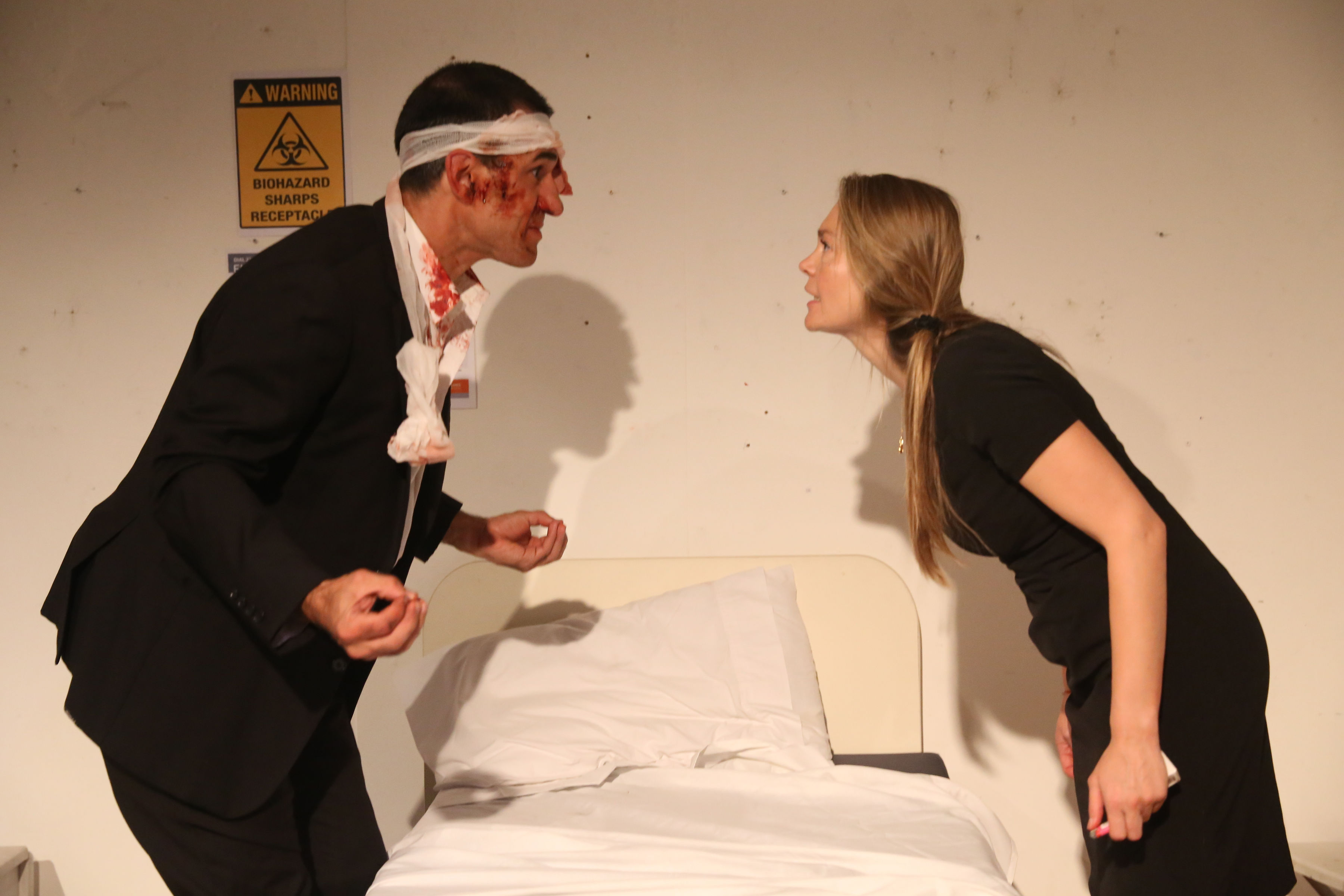
The “An” in the title is misleading. There are actually three interventions in Mike Bartlett’s very funny, mischievous play.

A and B are good friends. B intervenes in A’s life regarding her drinking. A intervenes in B’s life regarding his choice of partner. And, somewhere offstage, their nation is intervening in another nation’s civil war.

It’s a brilliant device for exploring both one of our culture’s current peccadilloes, and a more universal aspect of the human condition.

Contemporary culture is very keen that we tell each other what to do. The standard you walk by is the standard you accept is a popular mantra, and one that valorises ethical imperialism. It holds that when the world behaves as you think it should, then and only then, can you be morally at ease. Of course, the intention behind such an attitude is usually/often/sometimes/occasionally/perhaps praiseworthy. (Yes, I’m offering a sort of Choose Your Own Ethical Adventure.) We say we entertain this attitude of telling other people what to do because we genuinely care, but we know it can be problematic. A accuses B’s partner of being the “joy police”, but also criticises B’s absence from a rally opposing the overseas military intervention – even though she knows it’s an action he supports.

A and B’s friendship has always been exhilaratingly combative; they like to argue for their personal vision of the Truth. We sometimes say that individuals in such a relationship like the Drama of it. But that can’t be the case if each of the friends wants to win the arguments – for Drama’s gift to humankind is its ability to resist simplicity, to embrace the expression of multiple voices. In great Drama, no single character wins, only the audience. (One of my favourite moments in this very funny play occurs in a gallery.  The two friends examine an artwork. We’re told it depicts Tony Blair taking a selfie in front of a war-torn cityscape. A has wanted B to see this artwork. But B‘s response is to ask if it’s some sort of magic eye picture. He asks if he looks at it long enough, or if he squints in some weird way, will it finally reveal itself, despite all appearances, as being a work of subtlety and depth?)

Directed by Mike Booth, this production is a comic delight and a thrilling invitation to thought. As A and B, Brea Macey and Jake Harvey are terrific, delivering Bartlett’s hilarious contemporary dialogue with aplomb. Despite being only eighty minutes in length, it’s a beautiful slow burn of a piece. It’s a joy to watch Harvey present B’s gradually growing awareness that a gladiatorial relationship might not make him happy. Similarly, Macey’s portrayal of A’s slide from sarcasm to bitterness is both pathos-inducing and utterly engaging.   

I suggested earlier the play wasn’t only contemporarily relevant, but also universal.  

Consider the final scene. (Don’t worry, no spoilers.) To be honest, the final scene did leave me feeling as if the play had morphed into a different genre, that we were now watching a black comedy. And the script does dictate some staging that wrenched me out of its invented world, emotionally and intellectually. But the final image, both visually and aurally, is absolute gold, an almost Beckettian encapsulation of the human condition. Other people are both the cause and cure of our Desperation.

But a Desperation shared is a Desperation halved/doubled.

(Another Choose Your Own Adventure.)

Paul Gilchrist

An Intervention by Mike Bartlett

Presented by Harvey Family Co.

At TAP until July 4

bit.ly/An-Intervention

Image by Patrick Phillips

Gruesome Playgound Injuries

27 Apr

TAP Gallery is a Sydney treasure, a place truly dedicated to art. I was witness to so many beautiful pieces of theatre at the old TAP, when it was on Palmer Street. Well, it’s long moved to Riley Street, and there’s no micro-theatre anymore – but there’s still the potential for brilliant theatrical work to be done here.

Unorthodox Productions are currently presenting Rajiv Joseph’s Gruesome Playground Injuries.

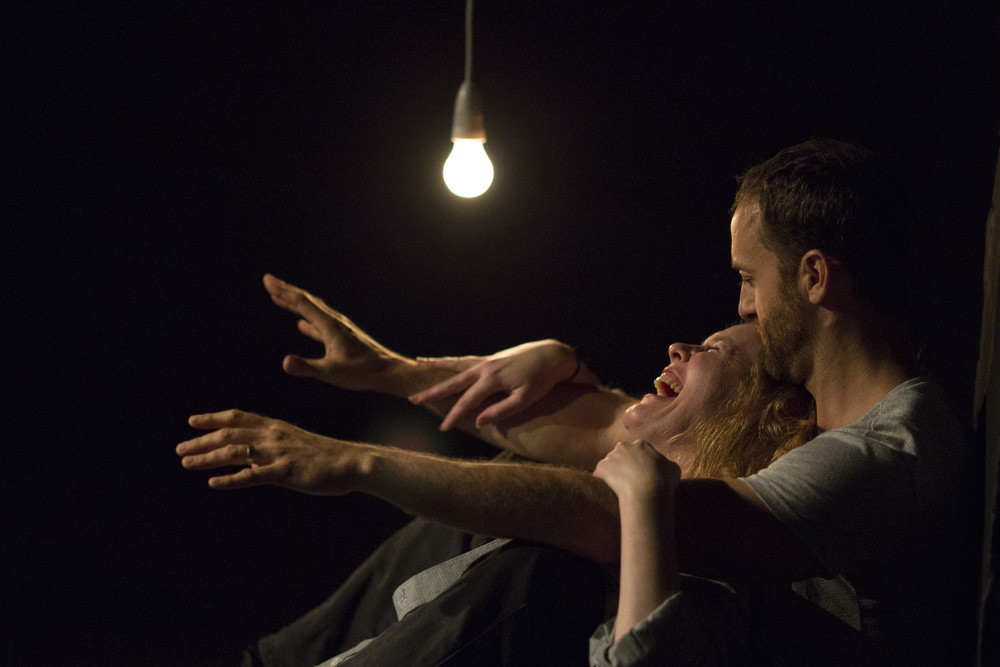
It’s a 75 minute two-hander, an exploration of pain and its cure. In eight non-chronological scenes, the play covers a thirty year span in the relationship between Kayleen and Doug. These two are injured in so many ways, some of them physical.

It’s not really a narrative, or at least it doesn’t privilege narrative. It’s fun to try to guess the links between the scenes, but I don’t think that’s the point of the nonconventional structure. By not asking us to focus on the development of the relationship, it lifts it beyond time, and highlights the transcendent nature of love. The genius of the piece is that this spiritual transcendence is juxtaposed so clearly with the physical: what stronger reminder of human fragility and ephemerality can there be than injury? And the junction between these two spheres of Life – the miraculous place where the spiritual meets the physical – is beautifully evoked by the suggestion that wholeness may be gifted by a touch.

Director Brea Macey makes effective use of the simple space. Darya Miroshnikova and Chris Stamoulous give truly committed performances and are entirely present as they explore the complexity of the characters (though some variation in pace might bring out more of the script’s rich humour.)

I have to admit I find something deeply thrilling about productions like this. Find a space. Share Beauty and Truth. Don’t wait for permission. Sydney needs more of it.

Paul Gilchrist

Gruesome Playground Injuries by Rajiv Joseph

Presented by Unorthodox Productions

at Tap Gallery until May 3

Tickets www.trybooking.com/events/landing/1538915

Image by Simon Pearce

The God of Carnage

10 Dec

Two couples meet, with the intention of maturely discussing a fight between their children. It’s a neat comic set up, which playwright Yasmina Reza employs to good use.

It’s built upon an enduring myth, a common assertion: that what we call civilization is actually a thin veneer over our essential savagery.

So broad an assertion borders on meaninglessness. It certainly resists easy discussion of its truth or falsity.

So I’ll ignore its veracity, for now, and discuss its appeal.

Why might people choose to believe it? What is the possible purpose of this assertion?

Perhaps it’s an ethical indictment. There are harsh aspects of our society, but we either forget them or choose to ignore them. For example, most of us feel we live decent lives, even though we know there are people elsewhere who are quietly starving.

But there’s another possible purpose of the assertion that we are, in fact, savages. It justifies our moral failings. ‘It‘s just human nature, so how can I be to blame?’

God of Carnage

This production, directed by Steven Hopley, is high energy and good fun. The cast (Jacki Mison, Chris Miller, Hailey McQueen and Yannick Lawry) deliver lively, engaging performances. On the night I attended, there were a few problems with rhythm and pacing, but these are difficult to avoid considering the absurdly tight parameters Reza puts on the setting. Despite the building tensions, the characters must remain in close proximity.

In a single room.

In France.

This production transfers the setting to Australia. (Though there are some disquieting references to Le Monde and the repeated use of the word ‘madam’.) Are these characters Australian? You could question if the relocation works, if you assumed the play is meant to be representational.

Alternatively, you could let the play be an intriguing tease. It tantalizingly offers an old chestnut of reductionism, a broad generalization of supposed universalism, and laughingly asks “Is this really true?”

Veronica Kaye


The God of Carnage by Yasmina Reza

Downstairs TAP Gallery

26 Nov – 7 Dec. (This production has closed.)

Twisted Tree Theatre

Brother Daniel

26 Sep

How can we make our ideals become reality? It’s one of the great human dilemmas.

Simone Weil wrote that imaginary good is easy. While our ideas remain in our head, they’re obvious and unproblematic; simple, smooth and flawless. They haven’t yet had to face the roughness, the wild unpredictability, of the external world.

And, in a sense, perhaps all attempts to bring our ideals into fruition are acts of violence. We are, after all, trying to make the world fit our pre-ordained pattern. There’s a type of brutality to it. Like taking the gentle fractal intricacy of a snow flake and forcing it into a round hole. (Like those made by bullets.)

James Balian’s Brother Daniel is a fascinating and intriguing exploration of the complexity and challenge of political action. Director Travis Green presents the tale with tension and humour, and the cast produce some good performances.

Photo by Mark Banks

Photo by Mark Banks

Daniel, played by Adam Hatzimanolis, is being tortured by representatives of a repressive regime, the very regime that twenty years earlier he helped bring to power. Lucinda, played by Mel Dodge, is a young lawyer desperate to help him. She’s a member of a growing student movement, inspired by both the idealism of the earlier revolution and its actual impact. Women didn’t become lawyers in the old days, she reminds Daniel. But Daniel is deeply disillusioned, and not just because of the electrodes. Violence begets violence, but there’s more; the dreadful discordance between dreams and reality.

This is sophisticated theatre. The pleasure and depth of the play is that it offers no simple reading. It reminds us political action is utterly necessary, but won’t tell us how.

Perhaps any such crude certainty would only lay the seeds for future violence? Perhaps we must find our own way, gently.

Veronica Kaye


Brother Daniel by James Balian

TAP Gallery til Oct 5

http://www.tapgallery.org.au/brother-danial-8pm-wed-24-sept-sat-27-sept-tues-30-sept-sat-4-oct-4pm-matinees-sun-28-sept-wed-24-sept-upstairs-theatre/

Phaedra

22 Jul

This is a brilliant production.

I’ve made no bones about the fact I don’t like the Greeks. (Not the current ones. The ones who died about 2,500 years ago.  And, no, the bones comment wasn’t an intentional pun.)

The great Greek dramatists explored ‘universals’, or at least that’s what we’re tempted to think. Distance has lent them a grandeur. But they wrote in a society every bit as fractured and filled with contention as ours, and much of what we have raised to the status of classics were in their day part of a hard fought cultural war.

In Greek society one of the great divides was that between the philosophy of rationality and the theatre of fate and deep dark forces. Socrates and Euripides were contemporaries.

When I see current productions of the ancient Greeks, I ask ‘Why are we interested in their myths?’

From a purely personal perspective, I’m suspicious of any view that sees the world as ruled by fate and irrationality. It seems like just one more way of disempowering ourselves, of trying to mask the fact that we enjoy lives of extraordinary privilege, and hence of unprecedented responsibility. If the Furies were to drag me off today and I was to die horribly, blind and in exile, it would not override the fact that up until this point I’ve lived 49 years without ever being hungry except through choice.

Photo by Sasha Cohen

Photo by Sasha Cohen

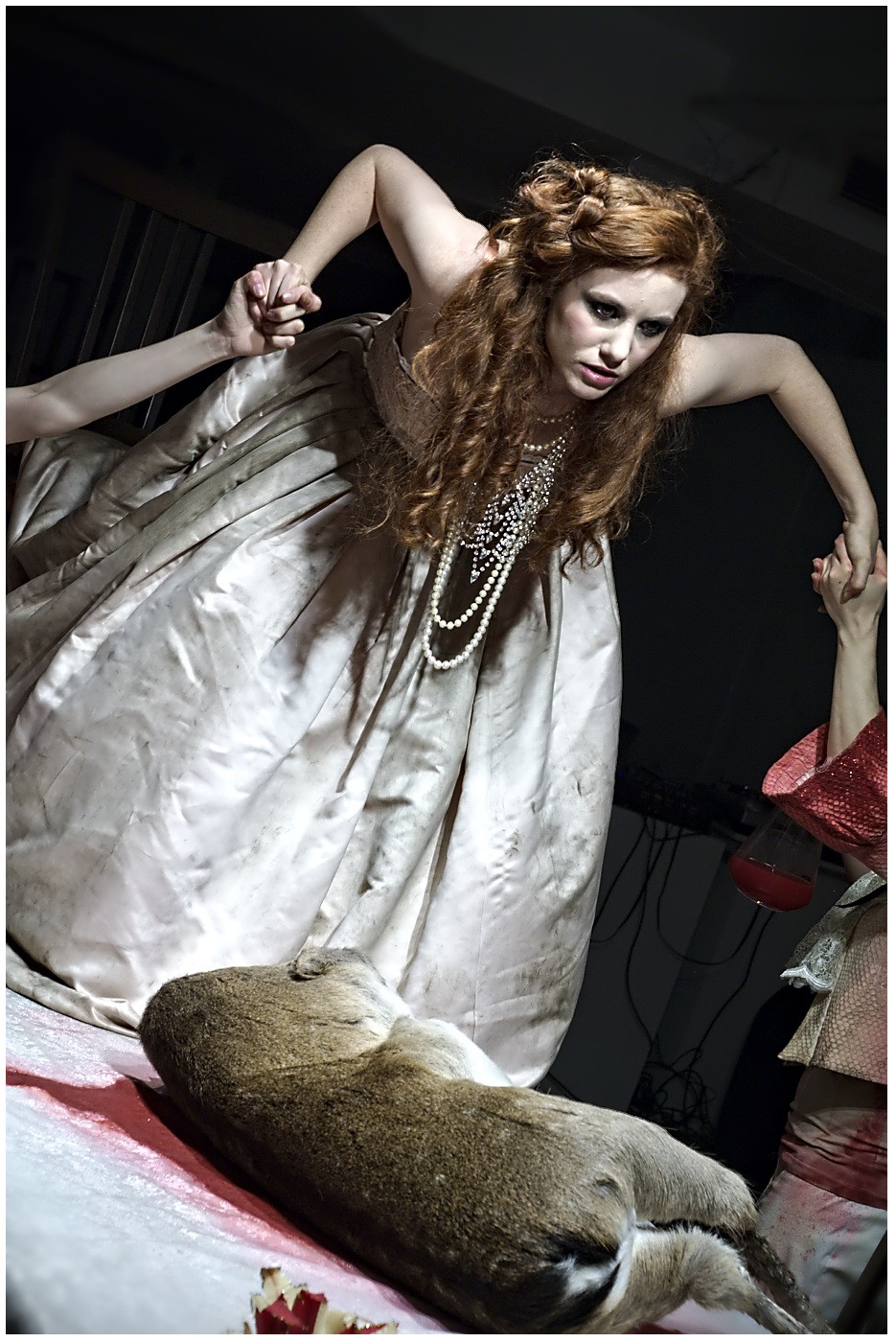
But I started by suggesting that Michael Dean’s production of Euripides’ play is brilliant. And it is. It’s extraordinarily inventive and a visual treat. The cast are marvellous. The individualised characters (Danielle Baynes as Phaedra, Melissa Brownlow as the Nurse, Richard Hilliar as Hippolytus and Katrina Rautenberg as Theseus) are played with a beautiful strength, which powerfully highlights the tragedy of the conclusion. The Chorus (Sinead Curry, Cheyne Fynn, Nathaniel Scotcher and Jennifer White) is wonderfully mischievous, both fun and foreboding. The use of pop music is frighteningly effective, suggesting the hidden menace lying behind our seemingly harmless daydreams and fantasies.

Phaedra is a reworking of Euripides’ Hippolytus. It’s a myth of the power of sexual desire. In the ancient Greek world, humans are the playthings of the gods. Phaedra’s passion is a divine punishment.

So what’s our modern myth of sexuality? A sort of flat biological reductionism. The consequence of our decidedly anti-existential myth is that sexuality is robbed of both its magic and danger. And where did our dull unhelpful myth come from? From the victory of the rational viewpoint. So perhaps the Greeks are worth a revisit.

Veronica Kaye


Phaedra (based on Hippolytus by Euripides)

TAP Gallery til 26th July

http://www.liesliesandpropaganda.com/


My Name is Truda Vitz

27 Jun

My Name is Truda Vitz, written and performed by Olivia Satchell, and directed by Pierce Wilcox, is a moving exploration of personal ties and the power of imagination. With stunning visual images and Satchell’s performance on the cello, it’s also a treat for the senses.

Satchell tells the story of three generations; herself, her father Paul, and her grandmother Truda. She slips between the characters with an unadorned simplicity. She forces nothing. These characters – these people – are granted dignity.

The most fascinating aspect of this personal history is that Satchell never met her grandmother. The closest she will ever get to her is in this play, she says.

Her grandmother’s personal history is therefore imagined. There are ‘facts’: the date Truda fled Vienna as a seventeen year old in order to escape persecution as a Jew; the date she was married; the date she was finally accepted as a British citizen after years of being an ‘illegal alien’. But the majority of Truda’s story is invented. As Satchell says, even if it didn’t happen to Truda, it probably happened to someone.

TRUDA7

One of the greatest tensions in life, and one that fuels the dramatic impulse, is that between otherness and empathy.

I sometimes suspect that every dramatist is a solipsist in denial. After all, how can we really know other people? I can never see through someone else’s eyes or walk around in their body. In fact, one of the most important gifts we can give someone else is an acknowledgement of our own limitations. I don’t know you. I can’t predict your behaviour. You can surprise me. I accept your otherness.

The other side of the coin is that we must make assumptions about people. If we don’t, our ethical systems falter. I have to be able to predict what causes you pain or gives you joy. And since I can’t know these things infallibly, or even contingently, it’s up to my imagination to make the human connection.

Ignorance and imagination. I don’t know you but I’ll try to guess.

It’s this gentle, warm balance that makes My Name is Truda Vitz such a beautiful piece of theatre.

Veronica Kaye


My Name is Truda Vitz by Olivia Satchell

Somersault Theatre Company

at TAP Gallery til July 6

http://somersaulttheatre.com/my-name-is-truda-vitz/

Amanda

15 May

Transgressive theatre dissolves received wisdoms in an acid bath of wit.

An old tension in psychology is that between nature and nurture. Are we born a particular way? Or is it our experiences that create the person we are?

Writer/director Mark Langham has presented a very funny, very clever play that pushes this tension centre stage. And then pushes it right off.

Amanda2

Amanda, played with an energetic kookiness by Amylea Griffin, is being held by the police for questioning. She has committed some heinous crime, though no-one seems quite certain what it is. In a series of flashbacks, both amusing and disturbing, Elizabeth MacGregor and Paul Armstrong wonderfully portray crazy characters who inhabit Amanda’s back history. This personal history is so wacky we’re clearly not getting reality – whatever that could be.

The concept of identity itself is being questioned (whereas the tired dichotomy of nature versus nurture merely takes the concept for granted and hence perpetuates it.) Langham’s thought provoking play highlights this exploration with a playful recurring motif, that of molecular transfer. If you sit on a bike, there’s a transfer of molecules; the bike seat becomes a little ‘human’, and the human a little ‘bike’. The hard and fast sense of identity is dissolved.

Langham further works this vein by incorporating Brechtian elements into the production. The stage manager (Noemie Jounot) grumbles hilariously in and out of the action. It’s a powerful reminder that this is all verisimilitude; the actors are only playing at creating characters or identities.

And then, thematically, there’s a tension that tears complacent realism apart. The question is raised: What part in our lives is played by fear? What by hope?

(Personal digression: Hope is the most radical of the three Christian virtues. The other two are Love and Faith. Love can speak for itself. Faith is out of fashion; it’s an assertion of knowledge we feel we have no right to claim. Hope, on the other hand, is a glorious unknowing, an appreciation that our visions of our world, and ourselves, are always incomplete.)

Hope is our forgotten virtue. Its very openness makes it difficult for conventionality to portray.

And it is impossible to own.

It requires a letting go.

Veronica Kaye


Amanda by Mark Langham

at TAP Gallery til May 18th

http://www.trybooking.com/Booking/BookingEventSummary.aspx?eid=81259&embed=81259

Construction of the Human Heart

18 Apr

What are stories for? What does language do?

Ross Mueller’s Construction of the Human Heart is a witty, rich and humane exploration of these questions.

Two playwrights live together. They share their experiences of Life, and of its possible opposite; writing.

It begins as though it’s a staged reading, and then becomes beautifully messy.

Director Dino Dimitriadis allows a splendid simplicity, and with masterful restraint creates a space where actors Cat Martin and Michael Cullen can deliver superb performances of Mueller’s provocative script.

Are our stories an attempt to deal with the world? Or are they an attempt to control the world?  Are they coping mechanisms? Or something more sinister?

How much can words capture? And is Life, like so many wild things, simply unable to breed in captivity?

Image ©Matthew Duchesne/ www.milkandhoney.com.au

Image ©Matthew Duchesne/ http://www.milkandhoney.com.au

The title of the play is deliciously ambiguous. Construction? Does this refer to the heart’s inherent structure? Or our deliberate, desperate building of it?

The play deals with fraught emotional issues, but let me focus on something a little smaller, but hopefully still illustrative of the fascinating questions Mueller raises. There’s a series of very funny exchanges about breeding. For example, what would the child of Stephen Hawking and Elle Macpherson be like? So, the issue of pedigree is aired. And then the play is the story of two playwrights. What exactly are playwrights? (They’re even contrasted to TV writers.) Are playwrights something essentially different from other people? What story are we telling ourselves when we make the assertion “We are artists” ? And for what purpose?

What do our stories do?

Veronica Kaye


Construction of the Human Heart by Ross Mueller

TAP Gallery til 3 May

http://www.apocalypsetheatrecompany.com/construction-of-the-human-heart/

Dancing Naked in the Backyard

16 Apr

Not in my backyard. This phrase encapsulates both the greatest challenge and the greatest opportunity for civil society.

There are many things I dislike about ancient Greek culture (just look at some of my posts about their theatre to see what I mean). But one thing I think the Greeks got right was their attitude to the polis; the idea that we’re only whole when we actively take part in the community.

C J Naylor’s thought provoking new play is about Nimby-ism. A group of local residents are challenged by a planned urban development. Not in my backyard, they say. The threat politicizes them.

Is this a good or a bad thing? The play seems to put little faith in the political process. And the politicization of the locals seems to go little further than their own narrow concerns.

Perhaps high rise development is necessary. People do have to live somewhere. And how sprawling do we want our cities to become? The locals’ attitude seems to be based simply on the idea that they were there first. Are they claiming to be an unacknowledged indigenous group?

Dancing Naked

Naylor’s script is intriguingly ambiguous. Samuel Smith is the appropriately sleazy developer, fun to portray, easy to mistrust. But the locals are not particularly admirable either. Alan Long and Estelle Healey play mature residents with the script’s intended kookiness, which allows two possible readings of the characters:  that they are either lovable, or laughable. Zazu Towle and Matt Hopkins play a younger couple, likable but difficult to look up to since they seem to be fighting for their right to sit on their couch.

There are, however, some nice comic moments from all the actors. Sascha Hall as the council bureaucrat delivers some wonderful deadpan disdain.

This is Brave New Word’s third production of original Australian writing. It’s great to see a young company investing in this. There should be more of it.

With its simple, direct and unadorned dialogue, and its reliance on short scenes (which this production didn’t deal with well), Dancing Naked in the Backyard feels a lot like television.  However, that’s probably appropriate. After all, the theme is the challenge, and necessity, of political engagement, and that’s something that should be discussed in every Australian lounge room.

Veronica Kaye

Dancing Naked in the Backyard by C J Naylor

TAP Gallery til 26 April

http://bnwtheatre.com.au/dancing-naked-in-the-backyard/

Pinball

12 Feb

About twenty minutes into this production I began to cry. They weren’t tears of laughter, though the play is very funny. I wept at the story of injustice.

The play tells the story of Theenie and Axis. They face a society that can hardly acknowledge, let alone accept, their homosexuality. The focus is the custody battle for Theenie’s child, Alabaster.

Pinball

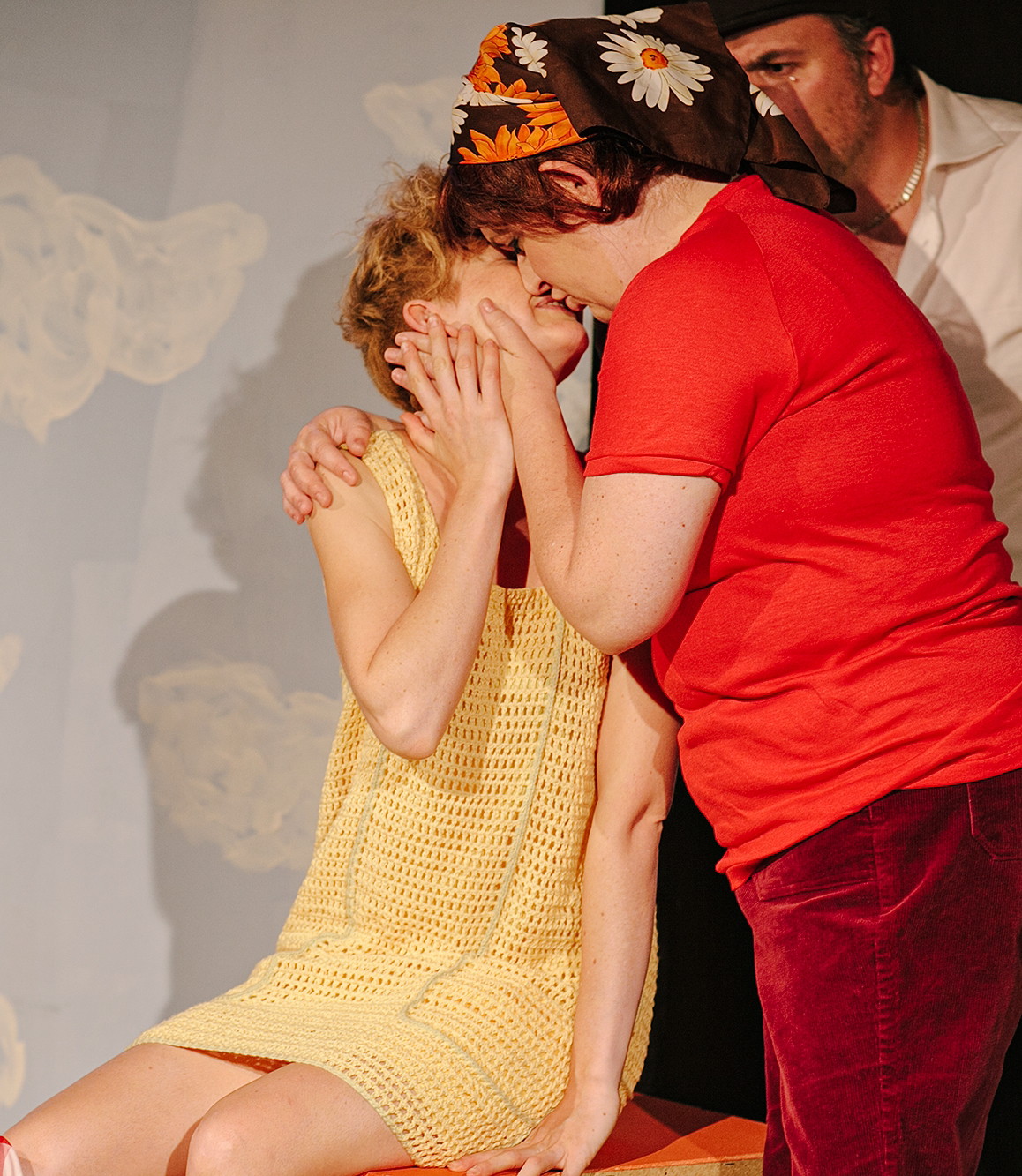
Alison Lyssa’s play was first presented thirty years ago. It’s witty, poetic and rich with allusion. Like some of Dario Fo’s work, it uses farce to explore serious issues, with an emotional impact that’s unexpected, and all the more powerful for that.

Sarah Vickery’s production is set in an almost cartoon-like early 80’s Sydney (except it’s painfully recognizable; I was there.) The production begins with video footage of some of the casually sexist ads of the time. We like to think we’ve moved on.

Despite some opening night hiccups (it being the first night in front of an audience) the cast do well. John Michael Burdon’s presentation of a range of patriarchal figures is highly amusing, but the pick is his all-too-familiar Kurt, Theenie’s bullying brother. Faran Martin gives a beautifully poignant portrayal of his wife; meek, dutiful and utterly lost.

Ali Aitken and Leo Domingan are Theenie’s parents. Their larger-than-Life presentations of smaller-than-Life lives should be (for all of us who live in our lounge rooms) cause for self examination.

Karoline O’Sullivan plays Theenie and Emma Louise her lover Axis, and they’re the emotional centre of the work. O’Sullivan gives a perfectly pitched journey. Louise’s anger tempered by affection is very watchable, and suggestive of a battle we must all face.

In Theenie’s battle, she must also face the law.

I’m fond of misquoting Shelley: “Dramatists are the unacknowledged legislators of the world.” Being a theatre practitioner myself, I guess I like to do this because it’s all very romantic. And completely self serving. There are REAL legislators, and we elect them, and we must keep them accountable. We MUST make our legal system a just one.

The joy of this play is its wonderfully radical sense that we can shape things. If the play has dated, it’s only because some of us have given up on this ideal. Or, from complacency and privilege, never held it in the first place.

Funny and deeply moving, this is exhilarating theatre. It doesn’t merely say ‘this is what the world is’; it asks ‘what do we want the world to be?’

Veronica Kaye


Pinball by Alison Lyssa

at TAP Gallery until 28 Feb

http://www.tapgallery.org.au/pinball-11-28th-february-2014/