A Butcher of Distinction

9 May

You’ve got to be cruel to be kind. Kind of weird, that is.

Cruelty is the vice par excellence of our society. It has not always been thought such an evil. The medievals routinely used it to ‘purify’ souls.

Yet for us moderns, cruelty’s just plain sick.

But still it remains.

And so every progressive talks of how we must diminish it.

And so we desperately try to explain its causes.

A Butcher of Distinction by Rob Hayes is a very rich night of theatre; very funny, and deeply thought provoking.

It explores the sources of cruelty.

Is it simply that ‘they do evil who have evil done to them’?

Or does cruelty stem from a more deep seated lack of empathy? Is there an almost institutionalized damming of our ability to see others as completely human? Are we living through an Ice Age of the imagination, that leaves us frozen in our isolation, unable to truly connect?

Photo by Lucy Parakhina

Photo by Lucy Parakhina

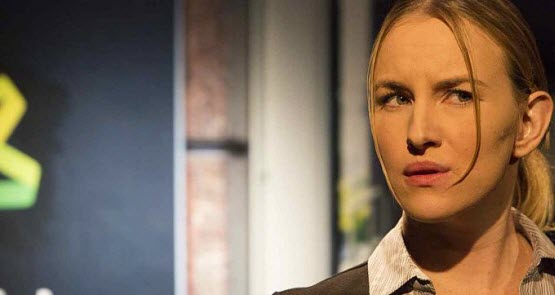
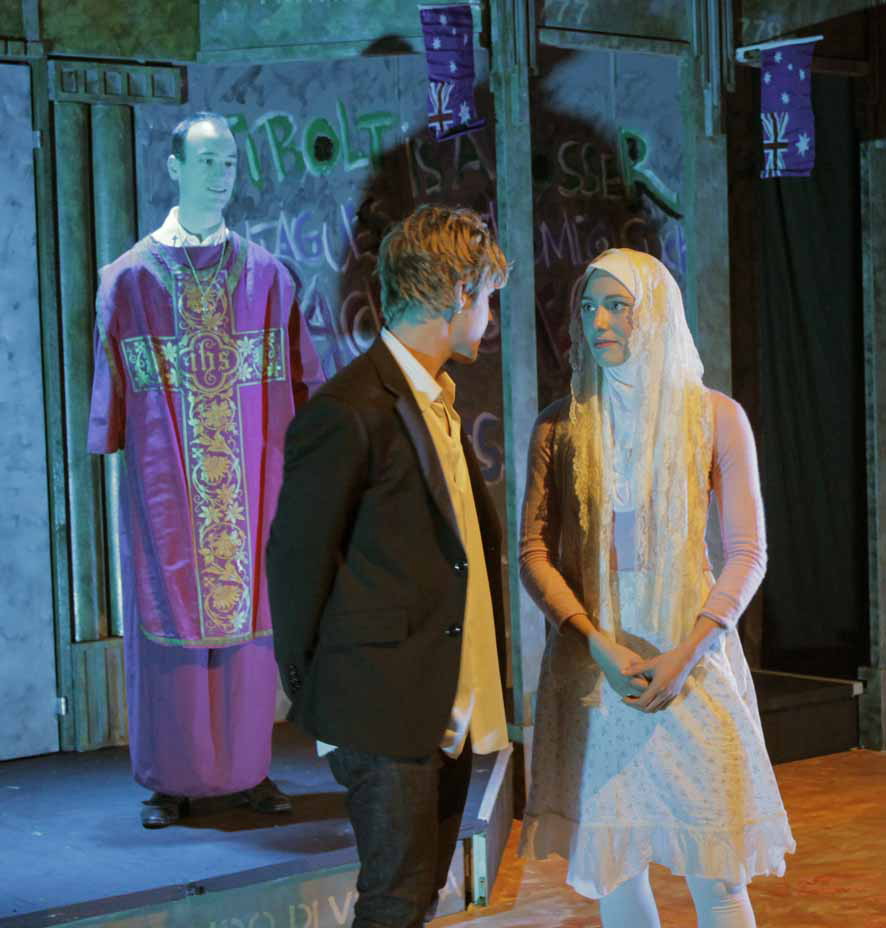
Teddy, played brilliantly by Paul Hooper, is a rough tough pimp. To him, people are commodities. The play also asks ‘What are the consequences of this attitude?’

This is dark, dark comedy, directed dazzlingly by James Dalton. His cast (Liam Nunan, Heath Ivey-Law and Paul Hooper) deliver top performances; sharp, precise and bitingly funny.

Which brings me to my final point; if cruelty is such a burning issue in our society, it must be presented on our stages. But how is this best done?

A Butcher of Distinction is not a piece of naturalism. (Would we want it to be?)

But what can humour do with such emotionally charged situations as the ones presented in this play?

Laughter sparks us to think. It makes us glory and delight in our ability to connect.

And in connection is the death of cruelty.

Veronica Kaye

A Butcher of Distinction by Rob Hayes

Old 505 Theatre til 26th May

http://venue505.com/theatre

4000 Miles

7 May

Bad plays are hyperbole. Good plays are metaphor. (And, yes, generalizations are annoying.)

And the best metaphors are underplayed. They’re not allegories, but something more subtle and gentle.

We say plays are good

– and this one is. Very. And the production is superb. The cast is uniformly brilliant. And Anthony Skuse, once again, has shown he’s a magnificent director. As an example, the pacing of this piece is enough to make you fall in love with time. Like Philip Rouse’s The Ham Funeral, I’d see this production again purely to enjoy the director’s work; which is, of course, a ridiculous thing to say –

but, anyway, we often say plays are good, without saying how they were good for us.

I don’t mean on what personal basis we judge them to be good, but rather what good they do us.

Good plays help us. We leave the theatre richer than we entered it.

4000-Miles-Hero_EVENTPAGE_0

4000 Miles is a play that offers the gift of tolerance.

Tolerance is sometimes devalued as a virtue; as though it was the poor little cousin of Love. Tolerance seems somehow less passionate, less committed, less generous. But watch four brilliant actors (Diana McLean, Stephen Multari, Eloise Snape and Aileen Huynh) create characters who gently navigate their differences, and Tolerance becomes Love’s twin.

I began by praising metaphor. The old argument is that good plays, by taking a specific situation and presenting them simply, honestly and unadorned, are suggestive of much wider issues.

Amy Herzog’s play is beautifully rich in this type of metaphor.

But it’s also rich in another type, more literary, but subtle. I won’t discuss most of these for fear of spoilers, but I will mention one.

Diana McLean plays Vera, Leo’s grandmother. Vera is what she calls a political progressive. (Just to hear those words on an Australian stage is a delight!) Vera is ageing; she is losing her hearing, she is losing her memory. Sometimes she doesn’t have the words for things, for her political ideas.

But Vera still tries to find them. And still tries to act on them.

And that task isn’t just Vera’s.

Veronica Kaye

4000 Miles by Amy Herzog

until 18 May

http://www.atyp.com.au/under-the-wharf/productions/4000-miles

The Ham Funeral

5 May

Several Australians have won the Nobel Prize, though Patrick White is our only recipient in the frivolous category of Literature.

Alfred Nobel reputedly instituted the prize to assuage the guilt complex he developed after inventing a type of explosive.

Ironically, this play is dynamite.

The Ham Funeral puts the fun back into funeral.

This is incredibly rich theatre. Enjoy the first viewing, and then come back for more.

Phillip Rouse’s director’s eye is magical. The cast is wonderful. Lucy Miller and Rob Baird give extraordinary performances, evoking an eternal battle.

That battle is the one between flesh and thought.

Photo by Bob Seary

Photo by Bob Seary

“Thinking never kept anyone alive,” I probably misquote from the play.

Of course, the issue is whether such a battle is real or not. Why do we forever contrast the mental and the physical? I suspect it’s a lazy, unnecessary division. (And I suspect it’s the soul who’s experienced only scant pleasure in the one who would assert there was no pleasure in the other.)

Perhaps the perceived battle is a result of this insight: pleasures of the flesh seem honest. They are honestly self-serving. Great sex is great sex is great sex is…..

Pleasures of the mind often pretend to be more noble. ‘This is the Truth’ we tell ourselves, and don’t stop to question whether such a ‘Truth’ might simply be one that serves our own interests.

And hence arises the healthy, and deeply stupid, distrust of thought.

Veronica Kaye

The Ham Funeral

at New Theatre til 25 May

http://newtheatre.org.au/

Lenny Bruce: 13 Daze Un-Dug in Sydney 1962

30 Apr

I don’t write reviews. I write what people call responses. And I think Lenny Bruce would have liked that. He was never one to stick to the script.

Lenny didn’t do what comedians call a ‘routine’.  He just jammed away. He was a free thinker, and this informed the way he performed.

Photo by Marnya Rothe

Photo by Marnya Rothe

And I really enjoyed how this also informed Benito Di Fonzo’s Lenny Bruce: 13 Daze Un-Dug in Sydney 1962.

Playful, energetic, discursive – jazz like – this is entertaining, thought provoking theatre.

Lucinda Gleeson’s production is engaging and the cast is terrific. Sam Haft as Lenny is sensational.

But hang on, this is sounding awfully like a review……

So let’s jam.

What did this production make me think about?

Not the old Sydney that ‘undug’ Lenny. (Nostalgia is so yesterday.)

Not the new Sydney that will smugly congratulate itself on how far it’s come.

What this show made me think about was Lenny’s iconoclastic spirit.

Are we so very different from the puritanical audiences that he shocked in 1962?

What are the topics we won’t touch now?

What are the topics that would make us run someone out of town now?

The society of the early 60’s used the concept of decency to dismiss what it was too afraid to explore.

Now, we employ a knowing world weariness.

If we don’t want to think about something – say, the massive inequalities in wealth that still exist on our planet, or the way we squander our lives of unparalleled privilege by amassing superannuation – we now roll our eyes and say that it’s been said before.

And then continue to live in exactly the same way.

And that would have made Lenny say, ‘Fuck you!’

But he’s no longer here.

So it’s up to us.

Veronica Kaye

Lenny Bruce: 13 Daze Un-Dug in Sydney 1962

by Benito Di Fonzo

Bondi Pavilion til 4 May

http://rocksurfers.org/lenny/

Theatre and Theology

29 Mar

Easter_breads 2

In the Gospel according to Andrew Lloyd Webber and Tim Rice, Judas wails:

“Jesus!!!

You’ve started to believe the things they say of you,

You really do believe this talk of God is true.

And all the good you’ve done will soon be swept away,

You’ve begun to matter more than the things you say!!!”

which pretty well sums up many a modern attitude to Christianity.

It’s the ethical teachings of Jesus that are the important part, not the ontology. And these ethical teachings can be distilled down to we should be nice to each other – and we hardly need Christianity to tell us that.

I find the dismissal of the ontological fascinating, not because I believe Jesus of Nazareth was the incarnation of the divine, but because of what it suggests about our culture.

And I want to explore what it suggests about our theatre culture, in particular.

I don’t write theatre reviews, but rather what I call responses. I bang on about what the plays say – at least, what they say to me. I’m interested in their ethics, so to speak.

But what about their ontology, so to speak, their attitude to being?

We give this little thought, just as we give little thought to the claims made about Jesus.  In fact, like the claims about Jesus, we’re not even sure what we’re being asked to accept.

The ontological claim made about Jesus is that he was both human and divine.

What is the ontological claim made about theatre?

That it represents some aspect of reality. What we see on stage is meant, on some level, to reflect an aspect of human existence.

This might seem obvious. After all, it’s why we can admire a juggler, but despite her obvious skill, won’t consider her work to be theatre.

So, by making theatre, we’re saying something about the nature of existence.

A piece of theatre says existence is like this.

Or it’s like that.

Today, I don’t want to quibble about the this or that.

I just want to point out that theatre is always saying existence is like something.

And what’s the word that keeps repeating in this formula?

Existence is like….

What enormous weight is being carried by that one little word – like.

My Easter mystery.

Veronica Kaye

The Credeaux Canvas

25 Mar

A captivating tale, performed beautifully; what more could you ask for?

But naturalism in theatre is perfectly positioned for even more: the exploration of some pretty big questions.

Naturalism takes as its fundamental premise that there’s a Truth, and so no form is more suited to the exploration of “what is true?”

And The Credeaux Canvas by Keith Bunin does this in a way that’s utterly entertaining and entirely accessible. Funny and very moving, it’s an exquisitely crafted piece that asks ‘what is real?’

What is real art?

What is real love?

Director Byron Kaye’s production is simple and engaging. The performances he elicits from his cast are wonderful. The shifting relationships between lovers Amelia (Kitty Hopwood) and Jamie (Richard Cornally) and artist Winston (Alex Shore) are marvelously realized. Jennie Dibley, as Tess Anderson Rose, the art dealer they’re attempting to con, delivers a strong portrait of a surprisingly complex woman.

smlprod15

(A philosophical digression: the worm at the heart of naturalism is its desire to look backwards, to say ‘this is a record of the world’. But it ain’t over til it’s over, and so no record can ever be complete. Naturalism ignores the unpredictability pregnant in Time. This makes its theatrical incarnations only the more fascinating, as theatre is wedded to presenting change. And so theatrical naturalism is committed to saying that it’s change we could have seen coming all along. So, in one sense, no change at all.)

The fascination of The Credeaux Canvas is that it subverts naturalism in another way. It reminds us that reality, Truth, is a made thing. We don’t just discover the truth, we create it. We don’t just witness reality, we love it or hate it. We are not outsiders. We are in it and of it.

The Credeaux Canvas offers insights into why we attempt to capture Life at all. And it reminds us why it’s such an magnificently alluring fool’s errand.

Veronica Kaye

The Credeaux Canvas 

at TAP Gallery til 6 April

http://www.tapgallery.org.au/2013/02/sure-foot-productions-presents-the-credeaux-canvas-from-20th-march-2013-to-6th-april-201/

Knowing Your Stuff

23 Mar

Recently I  inadvertently called Martin McDonagh Mark McDonagh.

It was a silly mistake and one I shouldn’t have made. I was appreciative of being corrected.

What interested me was that because of this dumb mistake  I was accused of “not knowing my stuff”.

At this point, I’m supposed to list my qualifications. The 4 years I spent at NIDA. The Masters degree I have from RADA. The Phd I’m working on at Julliard.

Then I’m supposed to mention all the well known people I’ve worked with and the ground breaking critically acclaimed projects I’ve done.

But I won’t do any of this.

I have absolutely NO experience.

And I have absolutely NO qualifications to write about theatre.

NONE WHATSOEVER.

Except what I share with the rest of the human race.

Veronica Kaye

The Pillowman

23 Mar

It’s funny what we’ll laugh at. Context has a lot to do with it. I usually don’t find torture and the murder of children especially amusing.

But in the context of a finely produced, thought provoking play, I apparently do.

Director Luke Rogers’ production of Martin McDonagh’s play is a top night of theatre. The cast is uniformly excellent.

The Pillowman promo Web (1)

The Pillowman explores storytelling. Katurian is being interrogated about his fiction. What drives him to tell stories? What are the consequences of listening to them?

The answer is a rather vicious circle. It’s what the world inflicts on us that drives us to create stories. And our stories, in turn, affect how we see the world, and what we inflict on it.

In The Pillowman, all of the characters write stories, tell stories, or eagerly listen to them – with, admittedly, some pretty dreadful consequences.

The play presents us as a story driven species.

And that’s a story we’ve been telling ourselves quite a bit lately. It’s the idea behind much  of post-war European philosophy and contemporary American pragmatism.

Of course, it’s not the only story we can tell ourselves.

I often think that the difference between conservatives and progressives is summed up in their attitudes to narrative.

The progressives acknowledge that we tell ourselves stories, all the time. And they tell the tale that all stories are equal.

The conservatives assert there’s only one story, but argue about which one it is. And prefer to call it The Truth.

I tell myself I’m a progressive. It’s a story that boosts my ego.

But, after 140 minutes of high stakes storytelling, The Pillowman left me feeling that perhaps I’m neither progressive or conservative. It left me feeling that maybe there is something to Zen Buddhism and the ideas of Simone Weil. It left me feeling that perhaps we need to learn to shut the f*#*# up.

This is not a criticism. You gotta pay a play that’s utterly absorbing in performance and deeply troubling in the days that follow.

But The Pillowman did make me question the value of stories. It made me feel that perhaps we need to learn to stop the chatter, that maybe we need to learn to be quiet, and wait.

Veronica Kaye

The Pillowman

at New Theatre til 13 April

http://www.newtheatre.org.au/

Doing it yourself

3 Mar

It is a truth universally acknowledged, that whenever a playwright writes a good play, she will be vigorously pursued by prestigious theatre companies.

“My dear Mr Bennet,” said his lady to him one day, “have you heard that Prestigious Theatre Company has a new artistic director?”

Mr Bennet replied he had not.

“Apparently,” returned she, “he is very interested in new Australian work.”

Mr Bennet remained silent. His wife took this as invitation to continue.

“Interested in new Australian work! What a fine thing for our girls!”

“How so? How can it affect them?”

“Mr Bennet, how can you be so tiresome? You know they are all playwrights. This new artistic director will no doubt want to produce their plays.”

Mr Bennet returned to his book.

“Now I’m the first to admit,” continued Mrs Bennet, “I find Lizzy’s plays a little confusing. Other people find them amusing, but to my mind, she never seems to be saying what she really means.”

“It’s referred to as irony,” Mr Bennet stated flatly.

“I know that!” replied Mrs Bennett.

“Of course you do, dear” said Mr Bennet, even more flatly.

Satisfied, Mrs Bennet continued. “And Mary’s plays are so wordy, and I can’t quite understand them, but they’re very clever, I’m sure. And Lydia’s plays are skittish, the work of an immature artist, but they were good enough for Short and Sweet. And Jane, quiet unassuming Jane; she’s always done the right thing. Who wouldn’t want to produce her plays?”

– from the manuscript of the (unpublished) Jane Austen novel Approval and Validation 

Sometimes you just gotta to do it yourself .

You can write a damn good play and it still mightn’t get produced.

Maybe it’s political. And I don’t mean who owes who, or who’s competing with who, or even who’s sleeping with who. I mean political.

Every play is an attempt to convince the audience to see the world in a particular way. Every play is an attempt to affect the world. Your plays will be put on by people who share your vision of the world. And, if there already are a whole lot of people who share your vision, you probably wouldn’t have bothered writing the play in the first place.

So be prepared to do it yourself. And be proud of it.

Veronica Kaye

Cat on a Hot Tin Roof

24 Feb

It’s difficult to say anything intelligent about sex. Fortunately, it’s easy to say something interesting.

Is that just the way we’re made?

To prepare for a Tennessee Williams’ play, I drank a bottle and a half of bourbon, imagined men’s eyes boring through my clothes, and had my date rip open his shirt while yelling ‘VERONICAAAA!!!!’

It must have worked, because I enjoyed Simon Stone’s production of Cat on a Hot Tin Roof.

I enjoyed the performances, especially Alan Dukes as Gooper and Lynette Curran as Big Mama.

I enjoyed the staging, with the turntable working both as a source of humour and tension.

I went away with plenty to think about. Like, how am I going to get me one of those turntables?

The world of Williams is one in which people are driven by animal passions, find that difficult to accept, and so lie to themselves.

This myth accounts for much of the popularity of Williams (that, and the fact he writes like angel.)

It’s a myth that well serves the needs of contemporary Australia. It tells us that we don’t have to live ethical lives. Or, more precisely, that the only moral demand upon us is the one to be truthful. We’re allowed to selfish. In fact, it’s natural.  The only crime is to pretend it’s not the way things are meant to be.

I’m probably talking in ridiculously general terms. (Perhaps I’m being passionately inaccurate.) But this myth is the meta-myth of the plays – the assumptions about  life so intrinsic to the work, that go so deep, that we have difficulty recognising them. Is this what makes  a great playwright? Someone who writes so well that we take their vision of life to be the thing itself?

Of course, in 1955, when it premiered, this play may have been valued for very different reasons. For example, its acceptance of homosexuality was probably groundbreaking. And who could pretend that issue has been resolved?

And let me use that idea to further illustrate my point. If we truly were the passionate creatures that inhabit the Williams’ world, why does it takes so long to resolve issues of obvious injustice? We are yet to legalise homosexual marriage. So many of us are supposedly passionate about it. Yet what have we personally done about it?

That is why the myth is attractive. We use it to tell ourselves that our self obsession is exciting, that as we pay our mortgages and perfect our Pad Thais we’re doing something thrilling.

We’re not.

Let us be truly passionate.

Veronica Kaye

Cat on a Hot Tin Roof

Belvoir, then Theatre Royal, til April 21

http://belvoir.com.au/