Tag Archives: Anton Chekhov

Three Sisters

10 Feb

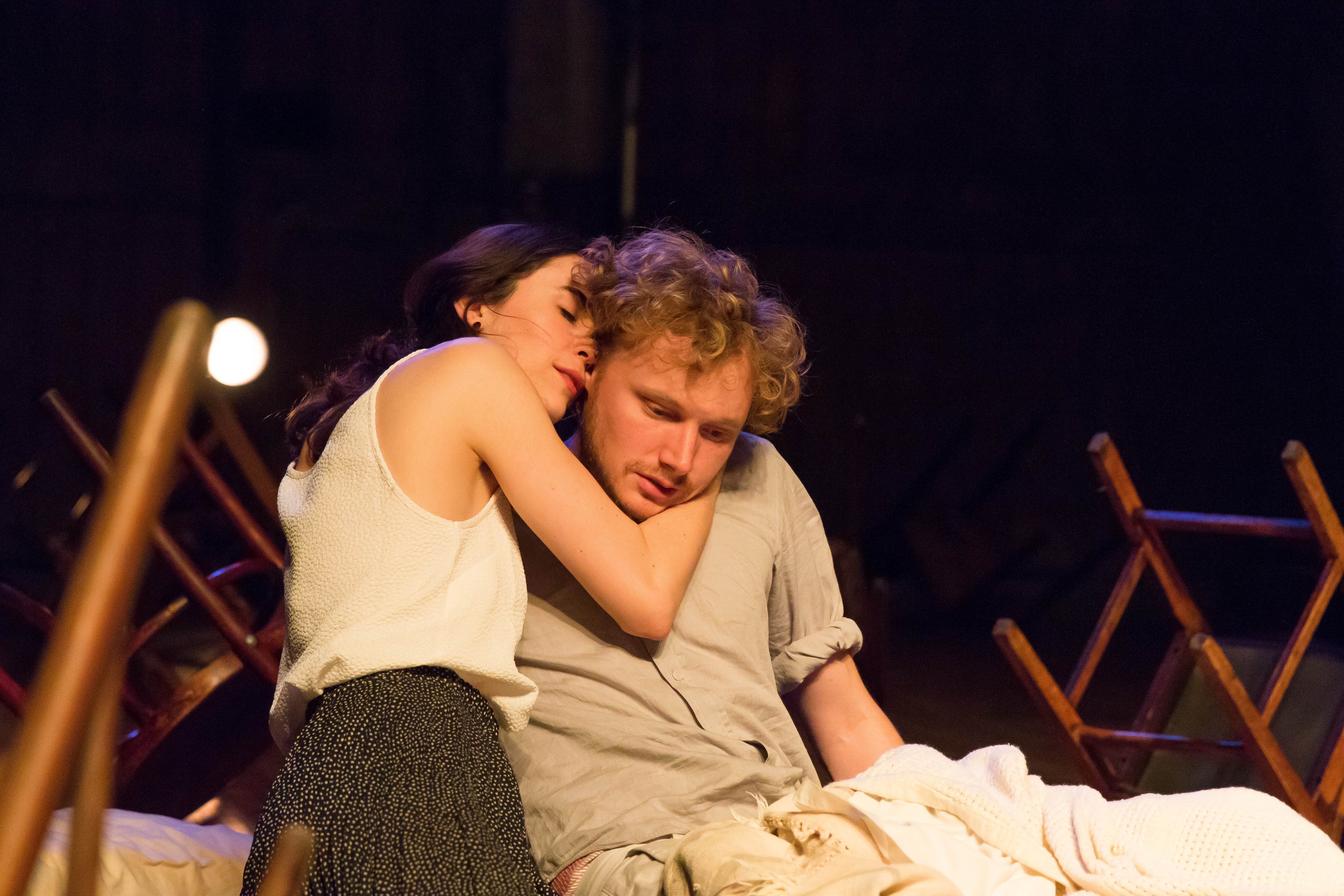
This is a fine production of a classic.

Director Victor Kalka has gathered a talented ensemble, and they give riveting performances.

There’s a fascinating tension between a simple truthfulness and the theatricality of created humour. (Though I’m not sure that a certain curtain-call gag doesn’t give too sharp a pull to one end of that tense tightrope.)

Kalka adapts Chekhov’s play. A few minor characters are cut and some of the subtleties of the plot are made more apparent, but the key alteration is the transference of the action to the present. (Though the word action takes on a different, deeper meaning when applied to a play by Chekhov.)

You could be critical of the decision to modernise the setting, arguing that many of the characters’ problems – Why can’t I be with who I love? Why must I live here? –  would simply evaporate in a society in which change has become so easy that it’s expected, normalised and, in an if-you-can’t-stop-it-you-may-as-well-embrace-it sort of desperation, even lauded.  

But what Kalka’s adaptation does is ensure the play is not read solely as a portrait of one particular decadent society.

It’s natural for us to read Chekhov through a sociological lens. After all, just sixteen years after Three Sisters was first produced came the epoch changing Revolution, sweeping into the dust bin of History the privileged lethargy of the old regime. And then, dominating the 20th Century, came the tension between that new Russia and the so-called free world.

But Chekhov didn’t know all that. Perhaps he saw the writing on the wall … but a solely historical, sociological approach to his work discounts the miracle that occurs on stage. The play itself is a revolution. It takes the inherently undramatic experiences of boredom and enervation – and turns them into an utterly watchable piece of theatre.*

Is lethargy being indicted? Perhaps. More importantly, it’s being acknowledged. A brilliant light is being shone down into the shadowy grey recesses of the human condition. Our current zeitgeist glibly pounces on inaction, equating it with complicity, and with a cavalier disregard for complexity, even conflates silence with violence. (If I were Satan, I’d be proud to have invented that slogan.) But Chekhov’s play reminds us, that sometimes, a mysterious, invisible weight holds an individual down; that for some inexpressible reason what we would do inexplicably remains undone. It’s a compassionate vision, reminding us that all those who don’t act or speak as we wish might be something other than enemies.

Modernising the setting – placing the characters in a world in which their problems should be more easily overcome but for some reason still aren’t – invites us to look beyond easy externals and shallow judgements. Kalka’s adaptation of Three Sisters draws to the fore the revolutionary aspect of Chekhov’s deeply humane art and, with rich poignancy, the excellent cast portray that eternal dance desire has with disappointment.

Paul Gilchrist

Three Sisters by Anton Chekhov, in a new version by Victor Kalka

presented by Virginia Plain

performed by Matthew Abotomey, Meg Bennetts, Alex Bryant-Smith, Nicola Denton, Barry French, Sarah Greenwood, Jessie Lancaster, Alice Livingstone, Ciaran O’Riordan, Mason Phoumirath, and Joseph Tanti

at Flight Path Theatre until Sat 15 Feb

flightpaththeatre.org

Image by Samuel Webster

*I think I might have borrowed this idea from Richard Gilman.

Uncle Vanya

1 Aug

This is a classic play; it’s very funny and deeply humane.

Directed by Mark Kilmurry, this is the second production of the play I’ve seen this year. I’d happily see it again.

Chekhov follows the usual comic trope of outsiders disrupting the stable world of convention. (Think Benedict and Don John arriving in Messina in Much Ado.) Chekhov’s twist is that the interlopers don’t energise the original inhabitants, they enervate them.

Professor Serebryakov and his young wife, Yelena, have come to live at the family estate, and they bring with them indolence. Vanya realises it’s contagious, but can’t remain immune.

Though written in late 19th century Russia, the play is provocatively relevant. It juxtaposes two questions our society continues to wrestle with: Who am I? versus What is to be done? Vanya thinks he’s a failure, that his life has been a waste. Understandably, he’d like to blame others. But is this really the way forward?

Joanna Murray-Smith’s adaption retains the original setting (there’s a samovar, there are peasants) but the language is our modern vernacular, allowing Chekhov’s brilliance to shine.

Under Kilmurry’s direction, a terrific cast honour Chekhov’s famed honesty and truthfulness.

Out of the crooked timber of humanity, Chekhov creates a confronting beauty. Everyone is unfortunate, flawed and foolish – and still utterly lovable. (Even the pompous old professor, played wonderfully by David Lynch; his awkward, explanation-requiring, Gogol joke is comic gold.) Everyone’s in love with the wrong person. No one’s advice is quite right for anyone else. I don’t think this is a spoiler, but proceed with this paragraph at your own risk. Sonya’s beautiful final speech might be right for her, but can it really mean that much for her Uncle Vanya? But he accepts it, in silence; it’s what his niece can bring to the table, and if he has grown at all through the events of the play, he’s learnt to listen without criticism.  

Yalin Ozucelik as Vanya offers an irresistible figure of both hilarity and pathos. Chantelle Jamieson as Yelena initially plays indolence in the key of annoyance, a surprising choice, but one which pays off magnificently, delivering a second act of intensely moving vulnerability. Tim Walter, the visiting doctor who sets the women’s hearts afire, beautifully balances charm and dissolution. Abbey Morgan as Sonya offers a performance that is gloriously natural, an encapsulation of the Chekhovian genius; humanity in its unadorned simplicity, in its labyrinthine complexity, in its troubled passage through the sea of time, guided by hope and threatened by despair.

Paul Gilchrist

Uncle Vanya by Anton Chekhov, adapted by Joanna Murray-Smith

at Ensemble until 31 August

ensemble.com.au

Image by Prudence Upton

Uncle Vanya

25 Apr

I’ve always loved the play and, directed by Charlotte De Wit, this production is utterly mesmerising.

It’s simple and extraordinarily beautiful. Chekhov and Stanislavski (who directed the first production in 1899) were part of the great reaction against the hyperbole of 19th century melodrama. They valued truthfulness above all things.

And this production is gloriously faithful to that vision.

The cast inhabit their roles with a naturalness that’s a joy to witness and which, even now, remains a challenge to complacent assumptions about what it is to act.

Mike Booth is magnificent as Vanya. It’s a performance I’d happily see again and again. Vanya feels he has swallowed a lie and wasted his life, and Booth’s portrayal is so deeply moving because he makes it appear so honest.

Similarly, Marigold Pazar is brilliant as Yelena. The young wife of an aged academic, Yelena finds her life boring, and Pazar presents the role perfectly because she does not push. Indolence infuses both her voice and her movements, and so her character does not so much claim boredom, as embody it – ironically making Pazar’s performance absolutely scintillating.

Mikhail is in love with the married Yelena. Tristan Mckinnon plays beautifully the tension between desire and despair. The triumph of Chekhov, and of this production and this particular performance, is that we can judge the characters if we wish, but the invitation is simply to observe.   

Sonya is in love with Mikhail. Her love both enriches her and pains her. (Chekhov looks at life unflinchingly.) Maike Strichow’s portrait wonderfully captures both Sonya’s joy and her suffering.

Chekhov called his plays comedies, and without straining for laughs, this production is very funny. It’s the humour of recognition.

Annie Baker’s adaptation of the original wisely retains the traditional setting but allows the characters to speak in a modern vernacular, making that recognition inescapable.

I’ve yet to discuss the meaning of the play (unusual for an armchair philosopher like myself.) This reticence is partly because the method (yes, that method) employed to convey the play’s meaning is so persuasive that it becomes the meaning. Of course, the play is a meditation on being “infected by uselessness”. Chekhov’s comedy follows the traditional trope of an ordered world disrupted by interlopers, but he turns this trope on its head by having the newcomers represent not action and vibrancy but rather inaction and indolence. Our heroes and heroines must strive to cure themselves of this infection.

But it’s the sheer truthfulness of the portrayal that makes this such a rich, intensely humane piece of the theatre.

Paul Gilchrist

Uncle Vanya by Anton Chekhov, adapted by Annie Baker

produced by HER Productions

at Flow Studios until April 27

www.herproductions.com.au

Platonov

10 Nov

People desiring but never acting.

Chekhov’s plays usually have me thinking about cowardice.

And one evening I will finally muster the courage to just get up half way through the first act and walk out.

Of course, I’m joking.

Platonov is early Chekhov, and more happens in it than usual for the master. (Perhaps too much. And there’s an atypical focus on one character; a young man and his relationships with women. Which I could patronizingly and erroneously suggest is typical of young male heterosexual writers.)

But I don’t want to overstate any of this. This is fascinating theatre, and not just because it offers an insight into the masterpieces that were to come later.

The language of Anthony Skuse’s adaptation is beautifully pitched. Grounded in the late nineteenth century origins of the play, it still speaks with a contemporary living voice.

Photo by Matthew Neville

Photo by Matthew Neville

But the primary joy of this production is the performances. Skuse has gathered an extraordinary group of actors and has created a space in which the entire cast create mesmerizing work.

I’ll mention only four. (It’s a fourteen hander. See it for a master class in acting.)

Charlie Garber gives us a thoroughly watchable Platonov. Part charisma, part moral outrage, part self loathing, it’s all leavened with just a sprinkle of humour. Many of the female characters love him, and I suspect so will the audience. As his simple, gentle wife, Matilda Ridgway is heartbreakingly phenomenal. Suzanne Pereira as Anna gives us dignity at odds with desire, and it’s a deeply moving portrait. Geraldine Hakewill plays Sofya with a tense stillness, an intriguing balance between empowerment and bewilderment.

It’s a big play, but I’ll end with reference to a single moment.

Platonov snaps “What God do you serve? What God do any of us serve?” It’s Chekhov’s challenge. Is this (and the plays that follow) an indictment of particular individuals or of an entire society?

We are flawed. The world is flawed. But do we make the world or does the world make us? This is the gloriously humane tension in Chekhov’s vision. It’s what makes him such a compelling dramatist. And it’s what this production captures so wonderfully.

Veronica Kaye


Platonov by Anton Chekhov

directed & adapted by Anthony Skuse

presented by Mophead & Catnip Productions

ATYP, Studio One til 22 Nov

http://www.atyp.com.au/