Tag Archives: Three Sisters

Three Sisters

23 Apr

“With love to lead the way, I’ve found more clouds of gray / Than any Russian play could guarantee”

So go the lyrics of the Gershwin classic But Not for Me.

You can only assume it’s a reference to Chekhov.

The Russian playwright’s meditation on melancholy – and whether love (or work) is its cause or its cure – is also a classic.

Can you really claim to be educated in modern theatre if you haven’t seen Chekhov’s big four: The Cherry Orchard, The Seagull, Uncle Vanya and Three Sisters?

This production by Last Waltz gives you the opportunity to fulfil part of the course requirements with only a three hour commitment (including interval.)

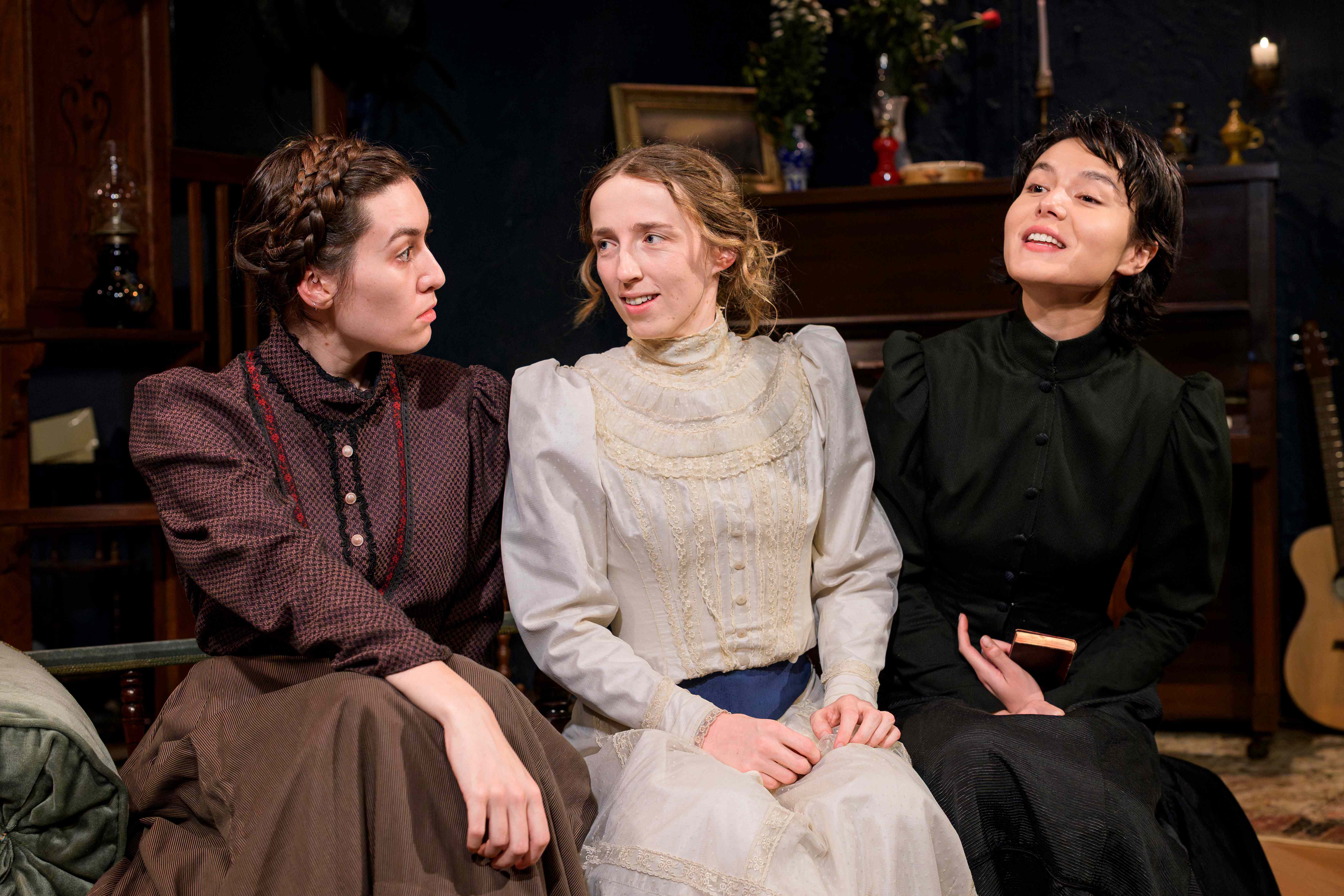
The translation by Laurence Senelick retains the original setting, and the design team under director Clara Voda effectively evoke the world of pre-Revolutionary Russia.

Chekhov is rightfully famed for the truthfulness of his work. And this production is true to that – in a rather provocative way. Vocal performances sometimes push to a realism that repudiates any assumption that art is a finely crafted thing: sometimes actors are too soft or too loud or too giggly. (Life, though, is all these things.) Occasionally, dialogue seems ad libbed, which may be indicative of a complete immersion in the reality of the characters, or it might just be ad libbing.

These bold choices encouraged me to consider the value of the original play.  If we value Chekhov because he is truthful, it’s not because he presents an accurate representation of the human condition. It’s difficult to relate to these self-indulgent middle-class whingers. (Just go to Moscow, for God’s sake!) If we were ever meant to relate to their plight, then I suspect that time has passed (at least for me) and Chekhov can be safely dropped from the (fictitious & facetious) curriculum.  

But I don’t think representing the human condition is what Chekhov really does. Instead, he gives us human behaviour, warts and all. And that’s the gift of this production.

Paul Gilchrist

Three Sisters by Anton Chekhov (based on a translation by Laurence Senelick)

presented by Last Waltz Productions,

at the Old Fitz until May 9.

oldfitztheatre.com.au

Image by Robert Miniter

Three Sisters

10 Feb

This is a fine production of a classic.

Director Victor Kalka has gathered a talented ensemble, and they give riveting performances.

There’s a fascinating tension between a simple truthfulness and the theatricality of created humour. (Though I’m not sure that a certain curtain-call gag doesn’t give too sharp a pull to one end of that tense tightrope.)

Kalka adapts Chekhov’s play. A few minor characters are cut and some of the subtleties of the plot are made more apparent, but the key alteration is the transference of the action to the present. (Though the word action takes on a different, deeper meaning when applied to a play by Chekhov.)

You could be critical of the decision to modernise the setting, arguing that many of the characters’ problems – Why can’t I be with who I love? Why must I live here? –  would simply evaporate in a society in which change has become so easy that it’s expected, normalised and, in an if-you-can’t-stop-it-you-may-as-well-embrace-it sort of desperation, even lauded.  

But what Kalka’s adaptation does is ensure the play is not read solely as a portrait of one particular decadent society.

It’s natural for us to read Chekhov through a sociological lens. After all, just sixteen years after Three Sisters was first produced came the epoch changing Revolution, sweeping into the dust bin of History the privileged lethargy of the old regime. And then, dominating the 20th Century, came the tension between that new Russia and the so-called free world.

But Chekhov didn’t know all that. Perhaps he saw the writing on the wall … but a solely historical, sociological approach to his work discounts the miracle that occurs on stage. The play itself is a revolution. It takes the inherently undramatic experiences of boredom and enervation – and turns them into an utterly watchable piece of theatre.*

Is lethargy being indicted? Perhaps. More importantly, it’s being acknowledged. A brilliant light is being shone down into the shadowy grey recesses of the human condition. Our current zeitgeist glibly pounces on inaction, equating it with complicity, and with a cavalier disregard for complexity, even conflates silence with violence. (If I were Satan, I’d be proud to have invented that slogan.) But Chekhov’s play reminds us, that sometimes, a mysterious, invisible weight holds an individual down; that for some inexpressible reason what we would do inexplicably remains undone. It’s a compassionate vision, reminding us that all those who don’t act or speak as we wish might be something other than enemies.

Modernising the setting – placing the characters in a world in which their problems should be more easily overcome but for some reason still aren’t – invites us to look beyond easy externals and shallow judgements. Kalka’s adaptation of Three Sisters draws to the fore the revolutionary aspect of Chekhov’s deeply humane art and, with rich poignancy, the excellent cast portray that eternal dance desire has with disappointment.

Paul Gilchrist

Three Sisters by Anton Chekhov, in a new version by Victor Kalka

presented by Virginia Plain

performed by Matthew Abotomey, Meg Bennetts, Alex Bryant-Smith, Nicola Denton, Barry French, Sarah Greenwood, Jessie Lancaster, Alice Livingstone, Ciaran O’Riordan, Mason Phoumirath, and Joseph Tanti

at Flight Path Theatre until Sat 15 Feb

flightpaththeatre.org

Image by Samuel Webster

*I think I might have borrowed this idea from Richard Gilman.