On the way to the theatre, my plus one asked if we were seeing a new play. I replied Yes, that considering the title, it must’ve been written at least post-1687, the year Isaac Newton published Philosophiae Naturalis Principia Mathematica.
A joke like that doesn’t belong in Bradford Elmore’s Gravity; his play is genuinely funny.
But there’s a connection. Elmore presents characters who are intelligent – and this is the surprise for an Australian play – they can read! And they do.
Not that the piece is overly cerebral. Far from it. It’s just that the characters in Gravity have an active interest in the written word – and actually discuss it!
Christopher and Heather have a love of literature and David has a fascination with astronomy.
And all this isn’t gratuitous, a case of a playwright choosing to focus on some bizarre corner of society in order to present a gritty new angle, or an example of a dramatist claiming to give voice to some neglected minority.
The literature and astronomy operate as motifs that give the play a wonderfully rich texture. But to discuss that, I must first outline the play’s basic scenario.
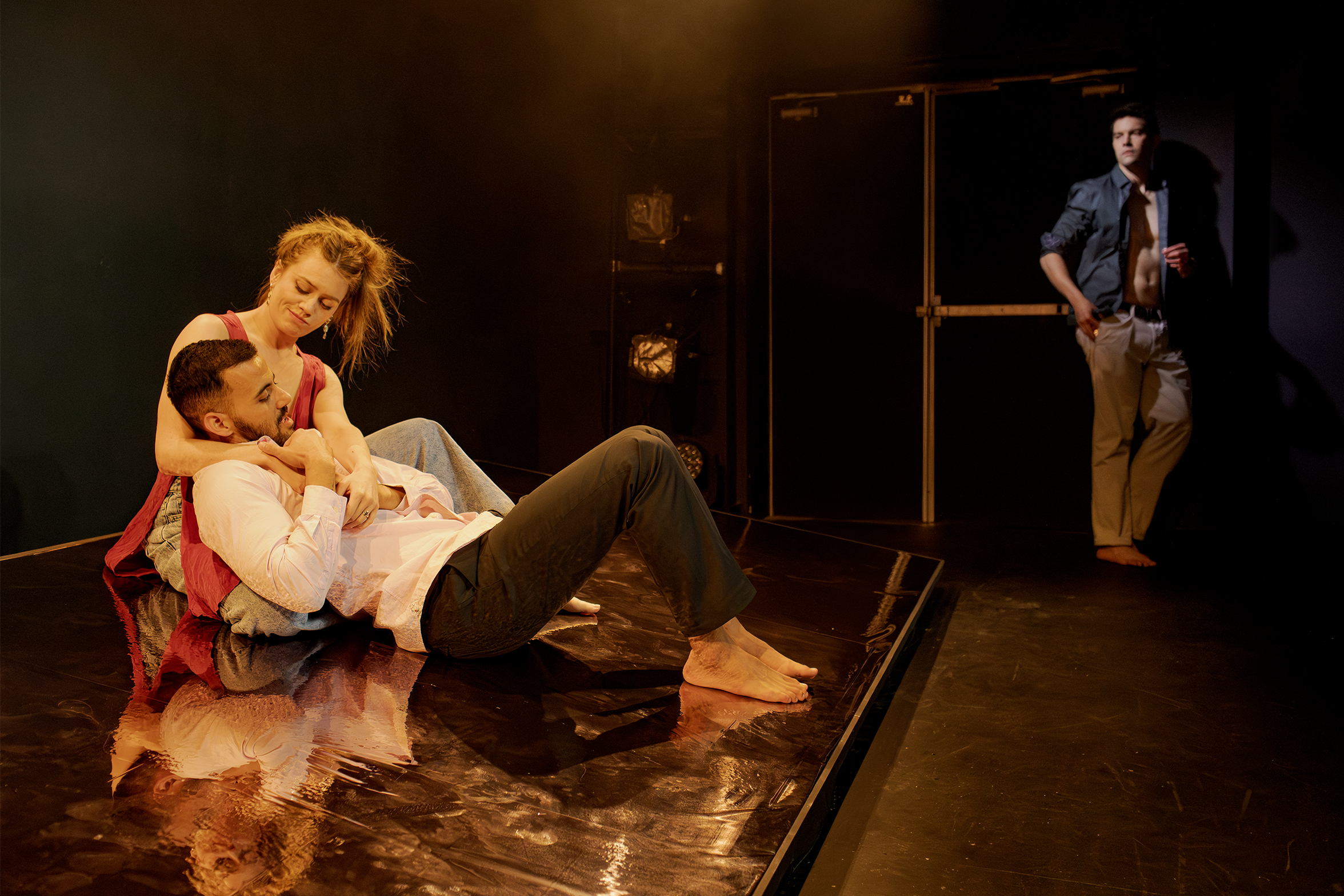
Christopher (Wesley Senna Cortes) and Heather (Annabelle Kablean) have been married for ten years, and he feels he still loves her. But he has now also fallen in love with David (Drew Wilson). How can this be resolved?
Back to the motifs.
David’s interest in astronomy allows consideration of opposing forces, of the difficulty of orbiting two bodies simultaneously, of the danger of being torn apart. But it also posits balance, the possibility of a smooth, untroubled, eternal motion (the type we imagine is enjoyed by the stars.) The relevance to the play’s scenario is beautifully thought-provoking.
Heather and Christopher’s interest in literature allows musings on narrative, and how we’ll stick to things, despite the emotional pain, because we need to know how it turns out. As a play about the challenges of fidelity, the connection is clear. Discussions of literature also facilitate some playful games about preference, of the Austen-or-Dickens, Tolstoy-or-Dostoevsky type. I’ve made up these examples, but the mischievous premise behind these sort of games – that loving one somehow excludes loving the other – is central to the play’s exploration of relationships.
Anthony Skuse directs and designs, and in this deliciously simple space there’s a gorgeous flow to the movement. Skuse also elicits fine performances from his cast, who make the humour crackle and the heart cry.
Whether you ultimately find the conclusion of the piece satisfying will probably hinge on your willingness to watch it devolve from the higher stakes of dramedy to the easy cheerfulness of rom-com. But I suspect satisfaction might also depend on your own values and emotional experience; what you consider Love, and what you consider Truthful. (Though, if your sole aim in visiting the theatre is to see a reflection of yourself, a visit to the aptly named vanity in your bathroom would suffice. Embrace doubt and surprise; they’re some of the artform’s greatest gifts.)
Paul Gilchrist
Gravity by Bradford Elmore,
produced by Rogue Projects,
at The Loading Dock, Qtopia until 29 Nov
Image by Phil Erbacher
 Theatre Red