Tag Archives: The Loading Dock

The Art of Storm-Whistling

29 Jun

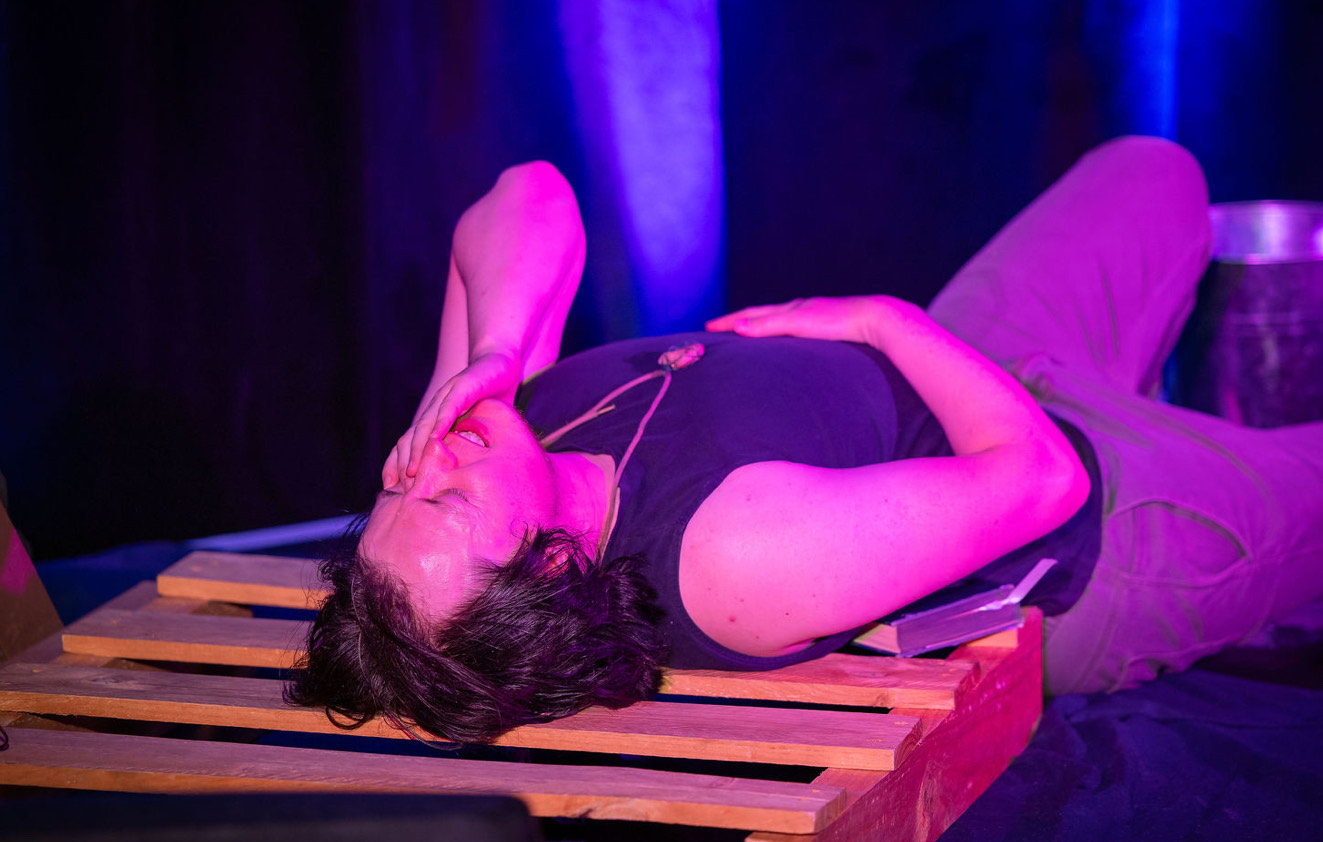
Written and performed by Tom Robins, this is a wonderful little fringe show – ambitious, evocative and magical. 

The protagonist, John, tells of his maritime journey to find out what has happened to his favourite uncle, Max.

John and Max had been close, the black sheep in the family, the two individuals who didn’t fit into the small, ordered lives of the rest. Max had told John some extraordinary stories about his sea journeys. He’d asked John if he believed them – and the answer had been a resounding Yes!

Many of Max’s stories are sourced from maritime legend. In fact, Max has left, as a sort of guide, a book of such tales. In the tales told by Max to John – and by John to us – are sirens, selkies, kelpies – and the Lighthouse. Max has found the Lighthouse, and John feels he is called to follow. Like all great myths, the Lighthouse is ambiguous, inviting multiple interpretations. Is it Death? Is it the place of Enlightenment? Is it where all our many stories converge? Or is it the place from which all our stories derive?

Simply and beautifully staged, the piece is a thrilling invitation to embrace the power of story.

Its intriguing and provocative energy derives from two tensions.

Firstly, stories are everywhere. They’re the sea in which we swim; without them, we’d be as fish thrown upon the sand. Stories are this rich, life-giving medium because they forever mix, in a surging ocean of ideas. Stories inform each other. There are no entirely original tales – and that binds us all together. But – and this is the tension – each of us must find our own stories. The fish might be in the sea, it might be of the sea, but it is not the sea. To have Life is to have movement of your own, not to be at the mercy of every tide, every current. (This extended metaphor is mine, not Robins’. I hope, that by being inspired by someone else to make its own way, it exemplifies the generously wise vision his piece shares with us.)

The second tension is that between story and reality. Some people might argue that what we call reality is just one more story. But Robins’ story features a hagstone: that is, a stone with a naturally occurring hole, one which – when peered through – enables the viewer to see beyond all disguises and illusions…to reality. This tension between story and reality runs through the entire piece, just as it runs through the entirety of postmodernity. In the world in which we live, we know that any desire to reduce the human experience to mere facts is dehumanising, counter to a flourishing diversity. But at the same time, we suspect that the utter denial of facts can pave the way to atrocities, of both the figurative and literal kinds.

Robins presents John’s story in an easy, utterly watchable manner. Occasionally, I felt a clash between the character’s casual colloquialism and the grand, poetic vision of the piece – but I can’t deny that The Art of Storm-Whistling is a joyous gift.

Paul Gilchrist

The Art of Storm-Whistling by Tom Robins

Presented by Curious Roach Collective, as part of Pride Fest

At The Loading Dock, Qtopia, until 30 June

qtopiasydney.com.au

Image by Photos By Jamois

Gravity

20 Nov

On the way to the theatre, my plus one asked if we were seeing a new play. I replied Yes, that considering the title, it must’ve been written at least post-1687, the year Isaac Newton published Philosophiae Naturalis Principia Mathematica.

A joke like that doesn’t belong in Bradford Elmore’s Gravity; his play is genuinely funny.

But there’s a connection. Elmore presents characters who are intelligent – and this is the surprise for an Australian play – they can read! And they do.

Not that the piece is overly cerebral. Far from it. It’s just that the characters in Gravity have an active interest in the written word – and actually discuss it!

Christopher and Heather have a love of literature and David has a fascination with astronomy.

And all this isn’t gratuitous, a case of a playwright choosing to focus on some bizarre corner of society in order to present a gritty new angle, or an example of a dramatist claiming to give voice to some neglected minority.

The literature and astronomy operate as motifs that give the play a wonderfully rich texture. But to discuss that, I must first outline the play’s basic scenario.

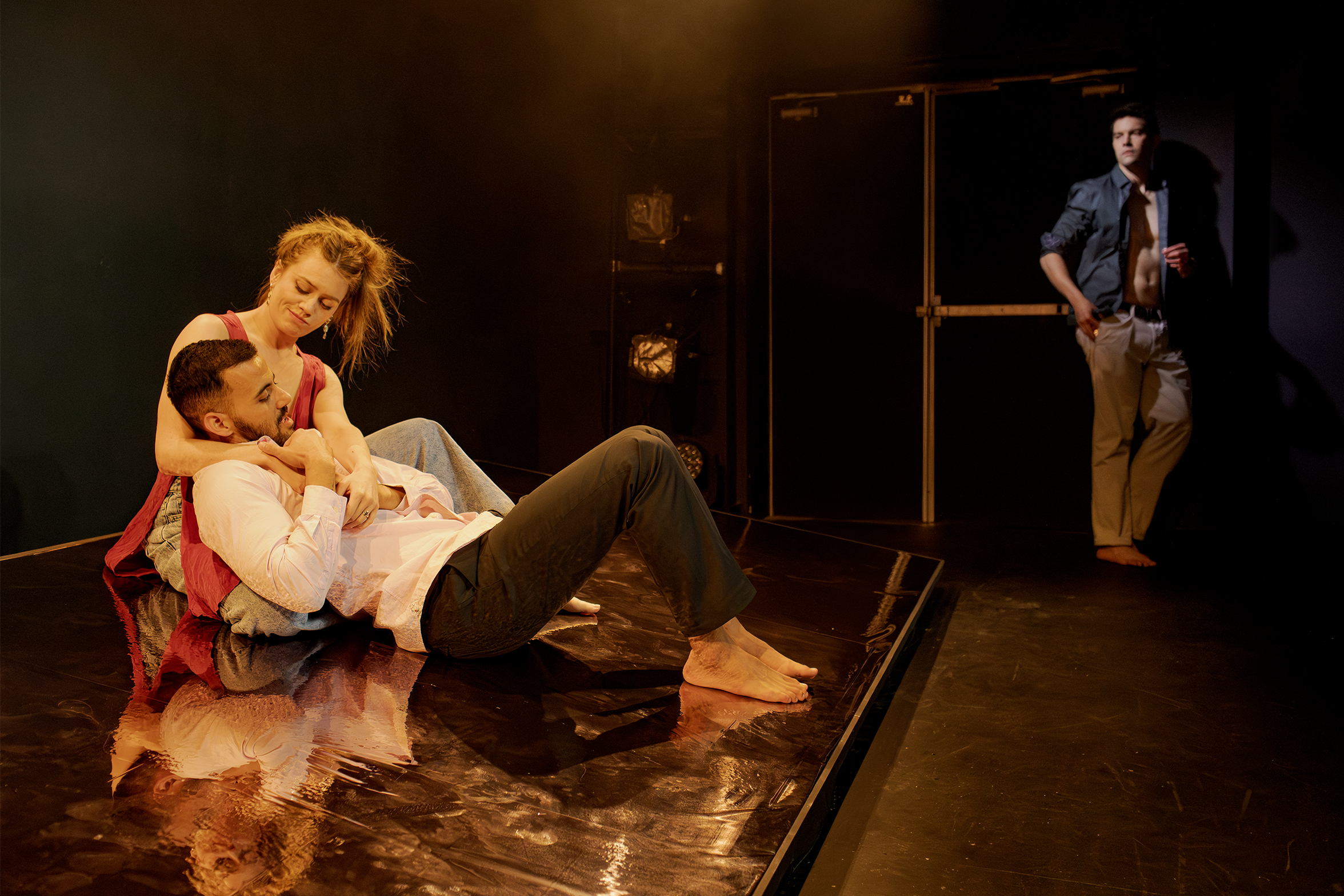
Christopher (Wesley Senna Cortes) and Heather (Annabelle Kablean) have been married for ten years, and he feels he still loves her. But he has now also fallen in love with David (Drew Wilson). How can this be resolved?

Back to the motifs.

David’s interest in astronomy allows consideration of opposing forces, of the difficulty of orbiting two bodies simultaneously, of the danger of being torn apart. But it also posits balance, the possibility of a smooth, untroubled, eternal motion (the type we imagine is enjoyed by the stars.) The relevance to the play’s scenario is beautifully thought-provoking.

Heather and Christopher’s interest in literature allows musings on narrative, and how we’ll stick to things, despite the emotional pain, because we need to know how it turns out. As a play about the challenges of fidelity, the connection is clear.  Discussions of literature also facilitate some playful games about preference, of the Austen-or-Dickens, Tolstoy-or-Dostoevsky type. I’ve made up these examples, but the mischievous premise behind these sort of games – that loving one somehow excludes loving the other – is central to the play’s exploration of relationships.

Anthony Skuse directs and designs, and in this deliciously simple space there’s a gorgeous flow to the movement. Skuse also elicits fine performances from his cast, who make the humour crackle and the heart cry.

Whether you ultimately find the conclusion of the piece satisfying will probably hinge on your willingness to watch it devolve from the higher stakes of dramedy to the easy cheerfulness of rom-com. But I suspect satisfaction might also depend on your own values and emotional experience; what you consider Love, and what you consider Truthful. (Though, if your sole aim in visiting the theatre is to see a reflection of yourself, a visit to the aptly named vanity in your bathroom would suffice. Embrace doubt and surprise; they’re some of the artform’s greatest gifts.)

Paul Gilchrist

Gravity by Bradford Elmore,

produced by Rogue Projects,

at The Loading Dock, Qtopia until 29 Nov

qtopiasydney.com.au

Image by Phil Erbacher

Heaven

19 May

This is a beautiful play, beautifully presented.

Written by Irish writer Eugene O’Brien, it tells the story of a middle-aged couple at a crisis point, and it does so with humour and insight.

Kate Gaul’s direction is wonderfully simple, unaffected in a way that allows the brilliance of the writing and performance to shine.

The piece is constructed from two intertwining monologues. Husband and wife Mal and Mairead attend a family wedding. The couple seem to get on well, but they’re never shown speaking to each other because each is in the process of exploring something that will challenge their relationship. Fitting the setting, that challenge is sexual.

Mairead has met an old flame, the man with whom, in her twenties, she had the best sex of her life. Mal is confronting his repressed homosexual desires.

The title? Heaven? Do they both seek a joy that will utterly transcend their merely comfortable relationship? Have both become aware that Eternity fast approaches, with its mysterious, unsatisfying promise of either oblivion or pleasures of a less certain nature?  

In contrast to the metaphysical connotations of the title, both characters use very physical metaphors to express their needs and doubts, underlining that they’re far from finished with this plane of existence. She asks is this where my 50 years has lead? He wonders whether he has the courage to enter the world below, the lower dimension.

Because of my peculiar (and un-Australian) penchant for digging into metaphor, I should make clear that the play is not in any way religious (except what it has in common with all serious philosophies: an awareness of the tension between our inner lives and our outward relationships.)

This is, however, modern Ireland, and the hand of Catholicism is still heavy. Mairead tells of going to England for an abortion. Mal’s sexual fantasies are couched in the language of his desire for Jesus, effectively suggesting the complexity of his emotional situation, its guilt and its passion.

As the couple, Lucy Miller and Noel Hodda are absolutely superb.

Miller’s Mairead is gloriously tough. She doesn’t edit her speech. She’s a proud playground bully. She’s utterly disdainful of her daughter’s choice of partner. Reflecting on the death of her abusive father, she hisses that cancer sometimes takes the right ones. She’s deeply sensual and unafraid to fulfill her needs. Yet, she never speaks a word against Mal. It’s a magnificently rounded portrait, strength sparring with uncertainty, delivered with captivating power.

Hodda’s Mal is gentler, softer – desirous of the direction Mairead gives his life. Hodda plays the humour of the-dag-who-dares with consummate skill, but also marvellously portrays the internal battle between desire and doubt.

It’s a temptation with a production like this to be so taken by the skill of the makers that you forget the meaning, that (to mangle Yeats) you fall in love with the dancers, and forget the dance. But this production – an exploration of the tension between our inner and outer worlds, epitomised in its presentation of a marriage under threat – achieves the perfect marriage between artistry and Art.   

Paul Gilchrist

Heaven by Eugene O’Brien

Presented by Bitchen Wolf

At the Loading Dock Qtopia, until May 31

qtopiasydney.com.au

Image by Alex Vaughan

They Will Be Kings

27 Feb

Despite being a delightful device for the creation of joy, running through this piece is a melancholic sense that the scene is less welcoming of drag kings than it has been – or, more importantly, might be.

And, judging by this production, that’s a real pity.

This is a thoroughly entertaining hour, and a magical celebration of life’s richness.

Directed by Kaz Therese and written by Therese & Danica Lani in collaboration with the cast, it’s part-sharing and part-performance.

The four cast members begin by asking each other to name a world famous drag king. They come up with few contenders. (Though the suggestion of Joan of Arc is marvellous food for thought; as one cast member says, the Maid of Orleans definitely would have been a they.)  

In amusing and affecting anecdotes, the cast members share personal stories of the joy of being a drag king. They also perform some of their own routines. As “Chase Cocks”, Chris McAllister delivers some terrific stand up, replete with some needle-sharp one-liners that puncture all parochiality. As “Jim Junkie”, Becks Blake performs a hilarious movement piece, playfully both burlesquing and saluting masculine swagger. Danica Lani as “Dario di Bello” presents a glorious lip-synced pop duo and dance number, in which the performer brilliantly takes both the (conventional) male and female roles. Angel Tan as “Fine China” offers a moving personal sharing, accompanied by themselves on a very evocative violin.

We’re told You can be any gender you want to be. And this is a golden reminder that life is larger than lethargy and fear might make it.

We’re told There are different masculinities (and even as a supposed straight cis-guy, that’s encouraging; I admit, as I limped home after the show with my bad back, I did try to put on a bit of a swagger.)

Though I present as a theatre critic, I identify as a philosopher – and I find the performative aspect of personal identities absolutely invigorating.

There are prejudices in our culture asserting that conscious performance is indicative of inauthenticity. However, WB Yeats (with his dramatist’s hat on) points out that performance is vital for a full life. For example, performance is the fundamental element of an ethical life. To act ethically is to act in a way different to our first, unthinking impulses. Goodness is something we perform.

But, what if you are accused of not being good? That there is something problematic about your identity? Essentialism becomes an understandable temptation: I was born this way, you respond.

No doubt true.

But like all our truths, only a partial one.

We are creatures of time; it’s the element in which we exist. And, as Catherine of Siena would say, The fish is in the sea, and the sea is in the fish. We’re not independent of time; we don’t swim through it immutable and unchanging. Not only with salt does the ocean permeate all, but with its very openness. We only ever know who we are incompletely, because who we are contains also who we might be.

And not merely who we become; that’s just a more sophisticated form of essentialism. The joy of the dance is not found only in its final step.

Embrace the play, the potential, the delicious possibilities….

Yeats (this time with his poet’s hat on) asks of essentialism How can we know the dancer from the dance? And the subtext is clear Why do we need to?

They Will Be Kings is life affirming and enriching, and wonderful fun!  

Paul Gilchrist

They Will be Kings by Kaz Therese & Danica Lani in collaboration with the cast,

presented by WEREWOLF & KINGS OF JOY,

at The Loading Dock, Qtopia,

until 28 Feb

qtopiasydney.com.au