Tag Archives: Fingerless Theatre

As You Like It

10 Mar

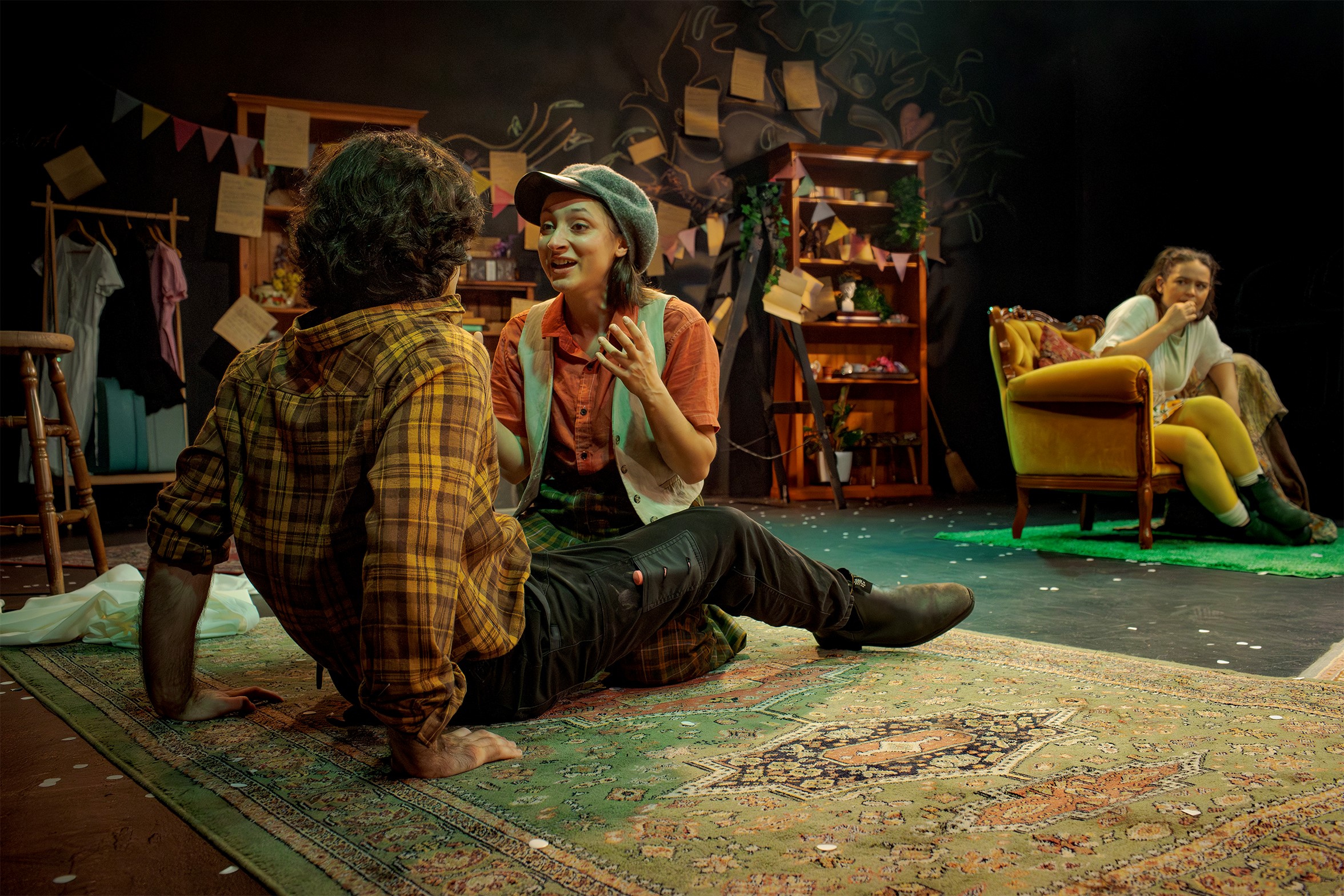
Directed by Alex Kendall Robson, this is a marvellous presentation of a Shakespearean classic.

Full disclosure: As You Like It is one of my favourite Shakespearean plays, and its protagonist, Rosalind, is certainly my favourite Shakespearean heroine.

Rosalind is whip-smart but no fool. (With such a penchant for paradox, might I wear motley?) What I mean is that Rosalind is witty but humble; she entertains no hubristic dreams that her intelligence makes her superior to the world and its grand forces. This being a romantic comedy, the grand force is Love. Rosalind accepts Love’s power – but knows that this power does not automatically grant romantic Love pre-eminence in the human experience.

Rosalind might have said Love is the silliest of the serious things. Instead Shakespeare gives her lines like these: 

Men have died from time to time and worms have eaten them, but not for love.

Love is merely a madness, and, I tell you, deserves as well a dark house and a whip as madmen do; and the reason why they are not so punished and cured is that the lunacy is so ordinary that the whippers are in love too.

Shakespeare gifts us a heroine who is both bubbly and balanced, who both feels and thinks.

Jade Fuda’s portrayal of Rosalind is absolutely brilliant. And I found it a wonderfully fresh interpretation: more giggly and more fraught than customary, and this tender vulnerability, coupled with Fuda’s total command of the wit, makes her portrayal of Rosalind extraordinarily rich.

As You Like It is one of my favourites for other reasons. It includes one of my favourite scenes in the whole of English drama, the one in which Celia accepts exile rather than part from Rosalind. In a play centring on romantic Love, here’s a shining example of a different type of love: friendship. It’s a scene that always brings tears to my eyes, and played here by Fuda and Larissa Turton as Celia it did so again.   

The play also features some of Shakespeare’s greatest poetry.

And this our life, exempt from public haunt,
Finds tongues in trees, books in the running brooks,
Sermons in stones, and good in everything.

So says the Duchess, exiled to the Forest of Arden by her tyrannical sister. The two roles are doubled superbly by Sonya Kerr in a performance that excels both physically and vocally, and with glorious authority juxtaposes compassion and cruelty.

All the world’s a stage,
And all the men and women merely players

So says the melancholy Jaques. Sure, this most famous of lines could simply be read as a case of professional myopia: if Shakespeare had been a footballer he might have said All the world’s a game; or if he had been a risk assessor, All the world’s an accident waiting to happen; or a fisherman, All the world smells of fish. But Shakespeare the dramatist captured something of Life’s bewildering, and perhaps unbearable, lightness – the sense that it all deeply matters, but at the same time, it all doesn’t matter that much. Kendall Robson plays Jaques with splendid humour and a show-stopping poignancy.

O, how bitter a thing it is to look into happiness through another man’s eyes!

So says Orlando, in a stinging moment when it seems his brother has secured love but he never will. Traditionally, Orlando is a challenging role; lover of the effervescent Rosalind, there’s always the danger he may not seem worthy of her, a smaller man than Love’s grand game of hide-and-seek in which he is a prime participant. But here, Pat Mandziy creates a magnificent Orlando, a beautiful balance of confusion and charisma.  

So, as I suggested, a play of unparalleled poetry. (And I think we get almost the whole thing!) The entire ensemble is exemplary; with a mastery of the Elizabethan language and a complete commitment to comic exuberance, we’re invited to a world of delight.

Paul Gilchrist

As You Like It by William Shakespeare

presented by Fingerless Theatre

at Flight Path Theatre until March 14

flightpaththeatre.org

Image by Phil Erbacher

Ophelia Thinks Harder

26 Mar

This is high energy feminist fun (with a few scenes that are less fun and more confronting.)

Written by Jean Betts in 1993, it’s an appropriation of Shakespeare’s Hamlet, one that places Ophelia centre stage.

Ophelia has feelings for Hamlet, but she can’t pretend he’s not utterly obnoxious. Her father and her brother are far too interested in her virginity. And Gertrude offers unwanted advice about how to live as a woman in a man’s world. (Don’t think too much.)

Betts cleverly weaves elements of the original text into her version of the story. With only a little tweaking, Ophelia gets all Hamlet’s major soliloquys, and they work magnificently. (Though I have to say I was less excited by the interpolation of so many lines from the other plays and the sonnets. Fortunately, my eyes no longer make that clicking sound when they roll. But what I found tiresome, others will find erudite and inventive.)

There’s also an appropriation of a poem by A E Housman, which is intriguing, and anachronistic (though that can hardly matter in a play like this.) It’s a brave writer who puts her words alongside the Bard and possibly the last great popular poet (that is, before modernism alienated the average reader.) But Betts definitely holds her own, and sometimes left me feeling I’d prefer more of her and less of them.

Alex Kendall Robson directs a terrific cast, and the key note is vitality. This is a wise decision; few people come out of a production of Hamlet wishing it were longer. (To stay or not to stay has been pondered at many an intermission. This version, at 150 mins including interval, keeps its engine at full throttle to keep us engaged.)

Brea Macey is superb as Ophelia – but I’ll get back to that.

Shaw Cameron as Hamlet is deliciously brutal, offering an engrossing portrait of the worst of privilege and entitlement. His physicality, especially, is a highlight, being both enthralling and threatening (as hinted in my first paragraph.)

Lucy Miller as Gertrude is a delight. Having accepted the misogyny of her society, the Queen has adopted a transgressive Machiavellianism that makes the character captivating. Many audience members have waited a long, long, long time to see the closet scene with this Gertrude.

Eleni Cassimatis as Ophelia’s maid servant gives the piece a poignant gravity, a terrible, galvanizing awareness of the dangers of this patriarchal world.

Pat Mandziy as Horatio offers a male character beyond the myopic, self-obsession of the other men, and both his performance and his text is crucial for the humane, richness of the work.

I started this article with the bland assertion that this is a feminist piece. Perhaps it occasionally overplays this element. The set is dominated by a painting of the Virgin Mary, and discussion of the history of the Church’s attitude to women gets a lot of stage time, a curious decision considering its all placed in the world of the Elizabethan playwright who was perhaps the most secular (admittedly, in a very religious society.) And this historical focus emphasises the academic. I’m not in a position to comment on whether contemporary women feel the challenges they currently face become more surmountable with the aid of a history lesson, especially one going back to Aristotle, Aquinas and the (aptly named) Church Fathers. I’ve written before that theory has little place in theatre, the form being more suited to the dreadful messiness of human reality than theory’s seductive simplicity.

Having said all that, by positing the protagonist’s problem in sociological or cultural terms, she must respond (at least partially) in kind. The result is that Ophelia has not only an emotional journey, but an intellectual one. 

But the rub is, her response to the theoretical language in which her problems are explained is not to simply regurgitate that language but rather to consider and test how it might inform her life. That is, she thinks – and I, for one, am thrilled to see a thinking character on the Australian stage.

Macey’s Ophelia is glorious, expressing beautifully the conflict between her self-doubt and her fundamental sense of dignity as a person. Macey powerfully presents Ophelia’s growing awareness that, for all her enervating inconsistencies, she deserves more agency than she’s permitted. Betts does well not to make Ophelia some kind of virago; the play is classic bildungsroman, a genre far better fitted to the dramatic form than any platform for slogan sprouting heroines. In the open-ended nature of the conclusion of Ophelia’s journey, there’s a splendid, invigorating optimism.

We know what we are, but know not what we may be.

Paul Gilchrist

Ophelia Thinks Harder by Jean Betts

Presented by Fingerless Theatre, in association with bAKEHOUSE Theatre

At KXT until 29 March

http://kingsxtheatre.com

Image by Phil Erbacher