Tag Archives: Flight Path Theatre

Cock

17 May

With a title like this, it will come as no surprise to anyone that this play has similarities to a Jane Austen novel.

To start with, it has a tight focus on the success or failure of a romantic relationship.

But like an Austen novel, this focus is deceptive; Mike Bartlett’s finely crafted interrogation of what seems a garden variety experience opens up to a much deeper consideration of what it is to be human.

The scenario is simple: John has been in a relationship with a man (M), but now he has fallen for a woman (W). Who gets to keep him?

Casey Moon-Watton’s wonderfully clever set suitably evokes a boxing ring. It also gives the actors nowhere to hide –  and this highlights their splendidly precise performances.

Darrin Redgate’s direction is superb; his use of space almost ballet-like in its beauty.

Andrew Lindqvist as M plays magnificently that very challenging of paradoxes: the amiable grump. However, it’s his revelation of the vulnerability in that character which is the performance’s most extraordinary achievement.  

Grace Stamna’s W is a delight. Beginning as a glorious breath of fresh air blowing through the staleness of John’s life, it’s fascinating to watch that energy transform to flinty determination.

As John’s father, Richard Cotter produces brilliant comic work; his character weighing into crucial philosophical arguments armed with nothing more than a good heart.

John is a tough role to play. Vacillation, hesitation and indecision are not the most admirable, or indeed watchable, of human qualities. (Who hasn’t hoorayed when Hamlet finally gets poked with that poison-tipped sword?) It’s hard to be heroic when you’re busy shilly-shallying. But Stephen Schofield as John pulls it off. It’s a miraculous performance, eliciting from the audience empathy and offering them that most poisoned-tipped of swords: self-recognition.

Earlier I mentioned both philosophical issues and the play’s deep consideration of what it is to human – but don’t get the impression it’s all too heavy. In fact, it’s a very funny piece of theatre that (like Austen’s work) is a close kissing-cousin to sit-com. But the simple story digs into a treacherous fracture line in our culture. As one of the characters suggests, the labelling of straight and gay has undoubtedly aided the extension of human rights. (And I’d extrapolate that observation to every other demographic moniker currently in fashion.)

But – and this is a big but – labelling is a legal fiction. People are always more than labels. When should we let them go?

Paul Gilchrist

Cock by Mike Bartlett

at Flight Path Theatre until 18 May

www.flightpaththeatre.org

Cowboy Mouth

28 Mar

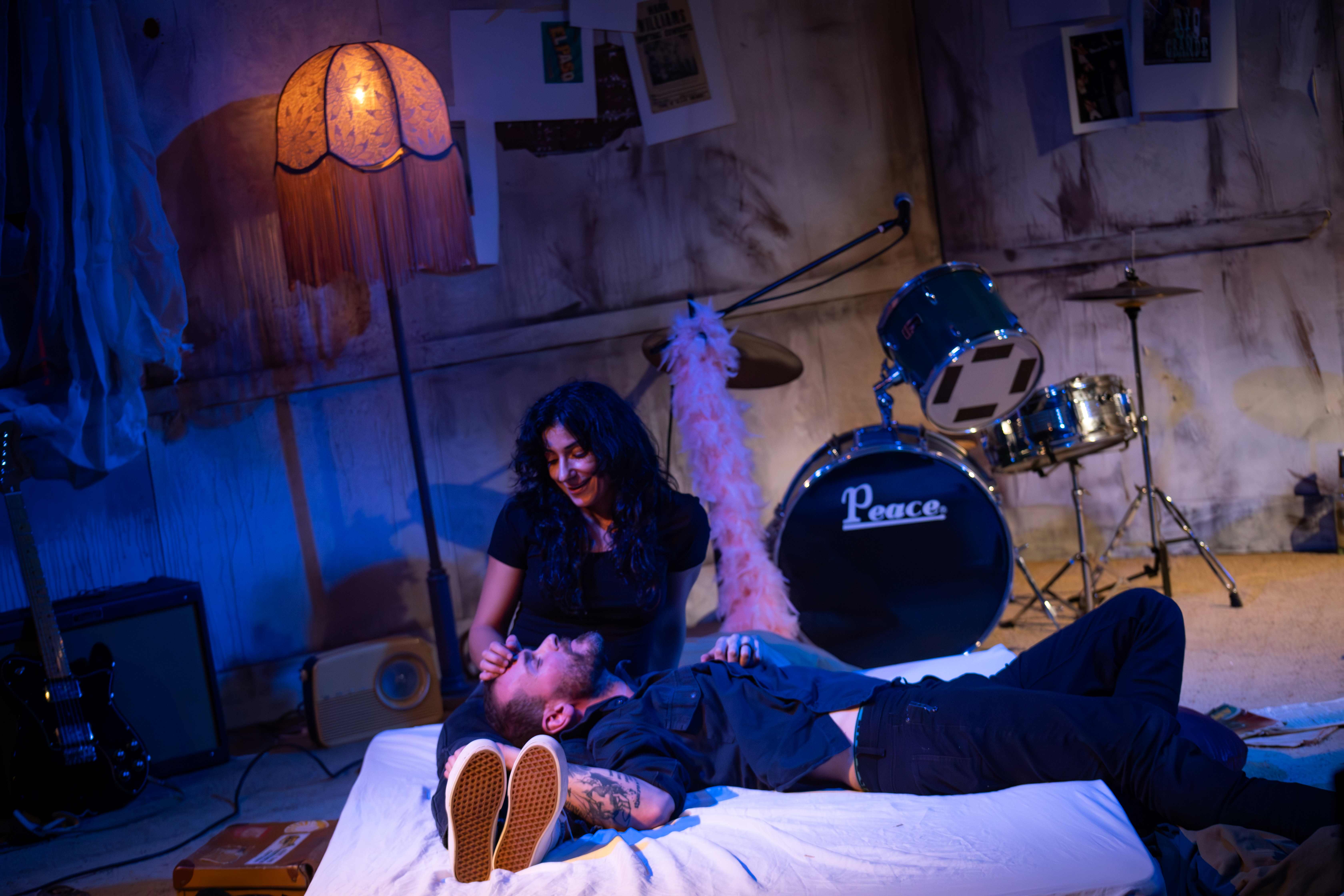
Slim’s left his wife and kid for Cavale. She’s going to help him become a rock and roll god. It’s not obvious how.

First produced in 1971, Sam Shepard and Patti Smith’s Cowboy Mouth invites us into a world of dreams and desperation.

We’re somewhere in southwestern USA, in a room that’s seen better days (evocatively designed by Saz Watson.) The couple argue and make up, and argue and make up, and for a while this world seems distant, a vignette of reckless wretchedness. And then the script blossoms into beauty.

Cavale explains the need for a saviour. Not for the music industry, but for the human soul. The old religious forms no longer suffice, yet the spiritual hunger remains, deep and real. (What Australian play would say this? Has our country, insipid, sunburnt and stolen, seduced us into a pose of eyes firmly down? If so, why is it different in America?)

Saints can be found in all walks of life, Cavale says. It has to do with purity of purpose. Dylan might have been the saviour, as might Jagger, but no…. perhaps it’s Slim.

There’s a sprinkling of references to Yeats – the treading on of dreams, the beast slouching towards Bethlehem – and all this enriches a script that already bubbles hot with poetry, lava-like, frightening and fascinating.

And under Anna Houston’s direction, the cast bring it to the boil. Natassa Zoe and Austin Hayden as the couple are gloriously vibrant, but also achingly vulnerable. From their wonderfully raw physicality to their command of monologues both melancholic and mesmerising, the show is a thrilling 50 minutes of theatre.   

And there’s a cameo from Watson, which the spoiler rule probably relegates to critical silence. But let me say this: it’s a very funny, very disturbing meditation on what it might actually be to be saved.

Paul Gilchrist

Cowboy Mouth by Sam Shepard and Patti Smith

at Flight Path Theatre until 30 March

flightpaththeatre.org

The Ghost Writer

12 Mar

Directed by Jane Angharad, Ross Mueller’s The Ghost Writer is a tight, clever thriller. It’s a meditation on Truth, not so much what it is, but what we do with it.

Brihanna’s daughter has been murdered. She wants to write a book about it.

To make that happen, publisher Robert employs a ghost writer.

Whether the pun in the title is provocative or naff depends on … taste.

The danger haunting all work that borrows from the thriller genre is that their representations of the horrible can appear heartless. Are these representations there to mourn the bewildering misery of existence, or merely to sharpen the story?   

A lot of people love this type of sharpness and, with some good performances and an evocative set (by James Smithers), this story has real bite.  

But it’s not a bite to my taste.

Brihanna (Emma Dalton) claims she knows who killed her daughter. Since the murder remains unsolved, you might think this a point of interest … and Brihanna’s claim is considered, briefly, and then disappears into the background until the conclusion of the play. Stories that withhold information foster curiosity not empathy. There’s been a lot of these type of stories since the invention of crime fiction. They invite us to guess, not to grow. They humanise us as much as a crossword puzzle might. They are the sudokus of the soul.

You might counter that thrillers are not about feelings, but thought.

But thrillers have abstract ideas in the way superheroes have capes: they’re obvious, they flap around a lot, but you’re not really sure why they’re there. (Answer: They provide the illusion of flight.)

Here the abstract idea is Truth, and that cape flaps around in quite an eye-catching manner.

There’s a sexual relationship between the writer (Mel Day) and an employee of the public prosecutor (Shan-Ree Tan). Apart from being extraordinarily coincidental, the relationship is also oddly anonymous. The couple have been sharing a bed but not personal information, not even their names.

The prosecutor has eschewed truth in another way. He has knowingly charged an innocent man with murder, giving in to pressure from a government keen to assert its credentials on crime before an election. Tan gives a fine performance as the man who knows he could have done better. The scenario itself has a whiff of the American about it, where district attorneys are elected. I won’t be so naïve as to suggest that our public servants don’t cop pressure from elected representatives, but how many Australians would alter their vote according to the arrest of a single murder suspect? (In our wide, flat land, justice is a chimera, and only the hip pocket is real. Recently, 240 years of injustice towards our indigenous people failed to impact a vote. But, it could be argued, my example only further supports the premise of the scenario.)

Other characters are also presented as having scant regard for the truth. Robert the publisher is driven by sales. Mark Langham excels in the satirical portrait of the ruthless businessman, allowing it to grow subtly, until it overshadows the more gentle humour which introduced the character as a playful rogue and confused father.

And the motif of truth returns again with Brihanna’s remarkable claim that she saw Jesus take her child to the afterlife. One character asks Do you believe Brihanna saw Jesus take the child? It’s an odd way of putting it. Perhaps if it were Do you believe Jesus took the child? it might be more to the point. Or, better still, Do you believe Brihanna believes she saw Jesus take the child? None of this is unpacked, perhaps for the best. Unless you lived in Galilee in the first century of the Common Era, seeing Jesus would surely be an experience of the inner life, and the play believes in external facts. Perhaps all plays must, even when those facts are bizarre, and the last line of this play certainly is a conversation starter, or stopper, depending on…taste.

But taste is not Truth. (In every production, the least convincing performance is always the one by the critic attempting the role of Teller-of-the-Truth.)

See this taut, taunting, teasing piece for yourself.

Paul Gilchrist

The Ghost Writer by Ross Mueller

produced by Crying Chair Theatre in association with Secret House

at Flight Path Theatre until 16 March

www.flightpaththeatre.org/

Image by Braiden Toko

The Strong Charmion

20 Jan

This is a thrilling piece of theatre.

I have to admit, I love a historical drama. Much of the focus in contemporary theatre is on sharing our stories and giving voice to particular communities, phraseology that creates the impression that theatre is merely a type of reportage.

But historical drama is clearly not reportage: the artists creating any drama that is set in a distant historical period were simply not there! No matter how much research has been done, we know the artists are making things up, are being thrown back onto fiction, and that’s a delightful thing. Fiction can be a glorious invitation to the audience to engage, to enjoy, to flourish, rather than merely be informed. (I’m aware I’m giving little weight to the fact that theatre that shares our stories or gives voice might be offering representations of particular lives to people who have never before seen their lives represented on stage. Of course theatre can do this, and I hope it continues to do so. But it’s not all theatre does, or all it might do.)      

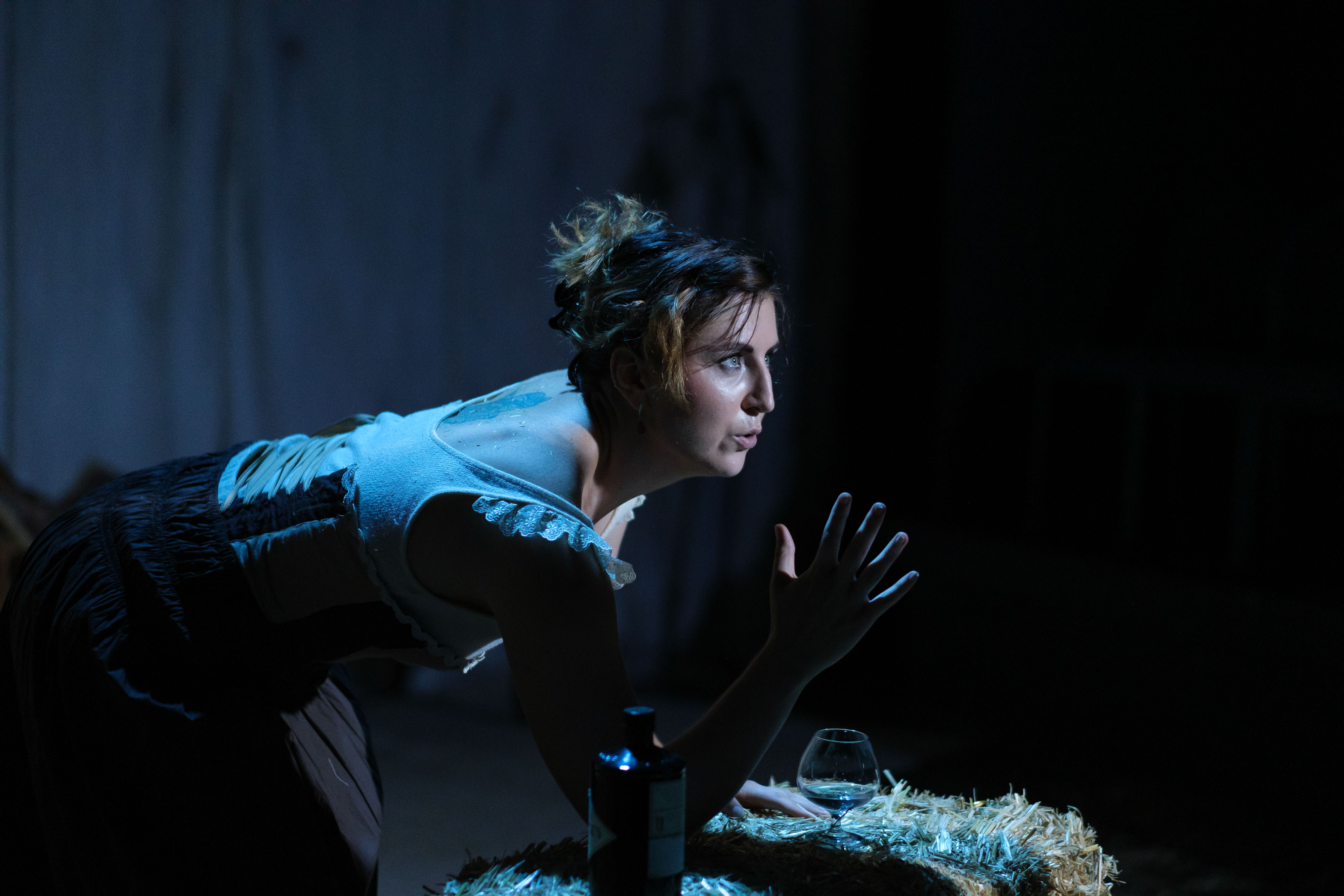
The Strong Charmion by Chloe Lethlean Higson is set in a circus in the 1920’s. Circuses traditionally present the unconventional. They are the orient of normalcy, defining what is expected, and acceptable, by displaying what is not. They operate both as freak show and as pressure valve; they offer both the titillation of the bizarre and relief from the banal. Lethlean Higson has chosen the perfect setting for her exploration of both repressive social mores and the intoxicating potential for growth. Bella Saltearn’s set and Catherine Mai’s lighting design are wonderfully evocative of the shadows and squalor from which new visions of life ultimately burst forth to find the light.    

Rosalie Whitewood (Gabrielle Bowen) is The Strong Charmion, a woman of unconventional strength. She refuses to be small, she refuses to be physically vulnerable. She is one of several characters who challenge traditional visions of femininity. Her family and friends (Emily Crow, Niky Markovic and Alyssa Peters) question chastity, marriage and reductive visions of gender. Their tales are told with both humour and poignancy.

In this, its first showing, the production suffers from a few issues. On opening night, gremlins played havoc with the tech, making changeovers between scenes awkward and slow – but these demons will no doubt be exorcised as the run continues. (These tech gremlins were probably also why it took me so long to appreciate that some of the scenes were flashbacks. Or at least I’m blaming them; it might be just that I’m stupid.) The script could do with a little fleshing out; these characters are fascinating – and I’d love them to say more. I also wonder whether the piece is served by the doubling that means the male experience is not granted a fullness approximating that of the female and non-binary characters; if we better comprehend the battle, more sweetly we savour the victory.

There’s an absolutely terrific story here and I hope it gets the chance to grow further.

Lethlean Higson was the recipient of the 2023 Katie Lees Fellowship, and once again this brilliant initiative by Flight Path Theatre has added something of value to the Sydney theatre scene.  

Paul Gilchrist

The Strong Charmion by Chloe Lethlean Higson

Flight Path Theatre until Jan 27

flightpaththeatre.org

Image by Clare Hawley

Losing It

14 Nov

(in which I write an absurdly complicated and self-indulgent response to a simply beautiful piece)

There’s something gloriously familiar about this show. This is partly because it presents a genuine slice of Sydney life: a woman waiting at the Bank Hotel for a Tinder date. It’s also familiar because a one woman show about dating follows a tried and tested path.

But Megan Bennetts does something special with this one.

Bennetts has an extraordinary stage presence, and the character she creates, Emma, is utterly adorable. Bennetts’ script is clever and superbly structured, and with the guidance of director Nisrine Amine, she executes both the verbal and physical comedy brilliantly. Let me unpack both of these.

Bennett’s vocal performance is wonderful. Tell a tale of the modern woman drinking alone in a pub and it’s oh so easy to fall into the dull, stereotypical vocal patterns of the ladette: brutality masquerading as confidence, aggression impersonating autonomy. Bennetts instead allows the humour to be grounded in natural rhythms of speech, unforced, subtle, and far funnier for that.

Her physicality is first-rate. Moments of drunkenness are played magnificently, with hints of Emma’s inebriation mischievously showing through despite the character’s best attempts to disguise them. And the flashback to Emma as a backpack wielding school girl is gold.

Now, apart from outlining the scenario in the broadest terms, I’ve avoided discussing what the show is about.  Without spoilers, I can say that it explores one of the greatest tensions in human experience: sexuality versus individuality.

Though sexuality is so important for how we see ourselves, it cares nothing for us. It’s a blind, brute force. It’s as though we’re some flimsy chime and it’s all the winds of the wide world. In the collision of the two something beautiful can occur, but it seems we’re more suited to zephyrs than cyclones, and yet the earth’s great diurnal journey fuels more fury than fluff. Bennett’s script interprets the grand clash between sexuality and individuality as a battle with social expectations, and that’s indubitably true (and probably more suited to the dramatic form than my audacious metaphors.) Despite what the world says, Emma must decide what matters for herself.

I began this response by suggesting Losing It follows a well-trodden path – but with a crucial caveat. To explain myself, a diversion. Reductionists will tell us sexuality is all about reproduction. But in the human experience, reproduction is an inaccurate term; in so far as it guarantees Life’s continuance, sexuality ensures not reproduction, not replication, but rather diversity, both genetically and socially. That’s sexuality’s function. (Evolution could have simply chosen cloning, which it has for a number of species.) Sexuality’s raison d’être is to have us not eternally tread the same path. To consider sex this way is to begin to question convention.  And now one final crazy metaphor (building on my previous motif of sex as a primal force): Sexuality is the ocean in which swims the fish of individuality. Sexuality is as broad and deep as the sea, and for the fish there’s no escape – but there also are no defined paths, only endless possibilities.

It’s the offering of this vision of glorious variety that makes Bennetts’ work special.  

And I must emphasise, Losing It has none of the ridiculous density of my response; it’s fun, wise and splendidly Life-affirming.

The script was developed through the Katie Lees Fellowship, an initiative encouraging young women in art, and commemorating a beautiful soul.

Paul Gilchrist

Losing It by Megan Bennetts

At Flight Path Theatre until 18 November

flightpaththeatre.org

Image by Robert Catto

Dazza & Horse Play

31 Oct

This evening of two short plays is part of the Everything But The Kitchen Sink Festival.

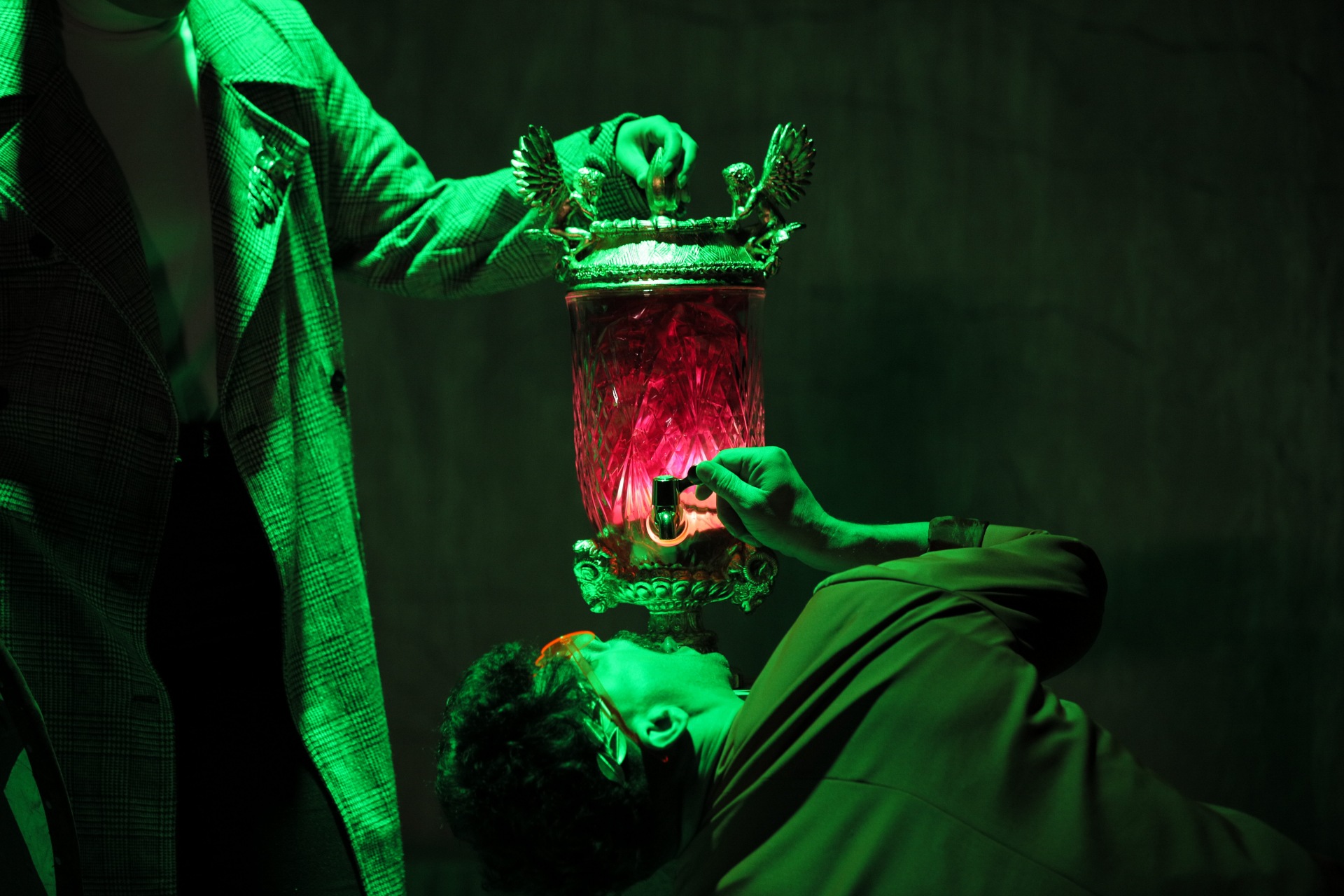
The first show, Dazza, written and performed by Frankie Fearce, is seriously top class satire. It’s a beautiful, measured criticism of the parochial Australian male, focusing especially on his attitudes to gender identity. “You’re one of those pronoun people, aren’t ya?” Dazza says to an unexpected visitor to his local. Fearce’s writing is wonderfully sharp, and the rhythms of the vernacular are spot on.

Like all top rate satire, there’s little hyperbole, just a commitment to truth. Garden variety satire criticises. Great satire portrays. If the artist tells us the character is flawed we might choose to read it all as a comment about the artist themselves. However, if it’s we who decide the character is flawed, the criticism appears indubitable.

The beauty of the portrait is that Dazza refuses to consider that he might be closed-minded, which is, of course, the epitome of closed-mindedness. Dazza is a good bloke in a world that’s certain he is one, and that’s the very problem.

The change from the introductory scene where Fearce plays themselves (I guess) to where they play Dazza is a piece of theatrical magic. It was also a feast for thought: the change in the audience was utterly electrifying. We had been witnessing a person give testimony of their lived experience and the vibe was definitely supportive. Then came the change, and suddenly we were confronted with the delicious, dangerous lie that is fiction and, in addition to abundant laughter, there was a shifting in seats, an intake of breathe, a palpable uncertainty.  It was as though we had been in a church and now we were in a theatre. The experience clarified for me why I prefer performance to personal testimony: when someone genuinely shares, only a dickhead (such as Dazza) is not supportive; when someone performs we feel little moral necessity to respond to the character in any fixed way, and so it is we who are encouraged to be genuine.   

The second show of the evening is Horse Play. It’s a clever title for a clever show. Zoe Tomaras directs a fun sitcom, devised and written by the team (Nat Knowles, Sophea Op, Angela Johnston, Linda Chong, Georgia Drewe and Tomaras.) Five soldiers (men, of course) wait inside the Trojan horse. Sometime in the night they will slip out and open the city gates … and the rest is known. (And told in its full horror by Euripides in his The Women of Troy.)

In this tale, the men just wait. It’s Waiting for Godot in togas. (Ok, not togas, but you get the point.) It’s a wonderful set up which the team doesn’t so much use to discuss war as masculinity. The very gifted comic cast present the male characters as being unable to transcend the puerility of teenagers (a criticism which dovetails well with who is often left to do the fighting of wars.) There are dick and masturbation jokes aplenty and homosexual curiosity masquerades unconvincingly as homophobia.  There’s also a playful exploration of how we attempt to fill time until the big moment, whatever that big moment might be (which is the family connection to Godot.) To portray characters who are bored is always risky, but Tomaras deals with it astutely. The piece is not presented in real time but is offered in multiple brief scenes, moreish slices of experience, cute skits cut and served to us by the dimming and raising of lights, a directorial choice which functions as an effective laugh track.  

If I’ve made it all seem merely wacky fun, the concluding scene of Horse Play throws down the gauntlet. It powerfully reminds us that those we find most laughable might be just that because of the infantilizing impact of the trauma that they face, and that we ignore. Euripides followed a tragedy with satyr; here we have something that poignantly approximates the reverse.    

These two short shows exhibit the inspiring wildness that makes the Everything but the Kitchen Sink Festival a terrific addition to the Sydney theatre scene.

Paul Gilchrist

Dazza by Frankie Fearce

Horse Play by Nat Knowles, Sophea Op, Angela Johnston, Linda Chong, Georgia Drewe and Zoe Tomaras

Part of the Everything But The Kitchen Sink Festival at Flight Path Theatre until Nov 4

www.flightpaththeatre.org

Images by Toby Blome

Cate Fucking Blanchett

22 Sep

Before this show, the writer asked that I be “brutal” in my review. She was joking. Receiving an unfavourable review is equivalent to being savaged by a sponge. But, more to the point, a review that does not shy away from the supposedly honest but harsh truth is usually one written by someone with only a passing acquaintance with Truth. (My fleeting impressions are hardly handed down from heaven, especially in a world where fewer and fewer of us believe there’s a heaven from which they could be handed.)

As you can see, the meta route is available to us all, playwrights and reviewers both, and I suspect it will always leave some audiences dissatisfied. (If two footballers must stop playing in order to argue the rules, the least they could do, for our entertainment, is decide their differences with their fists.)

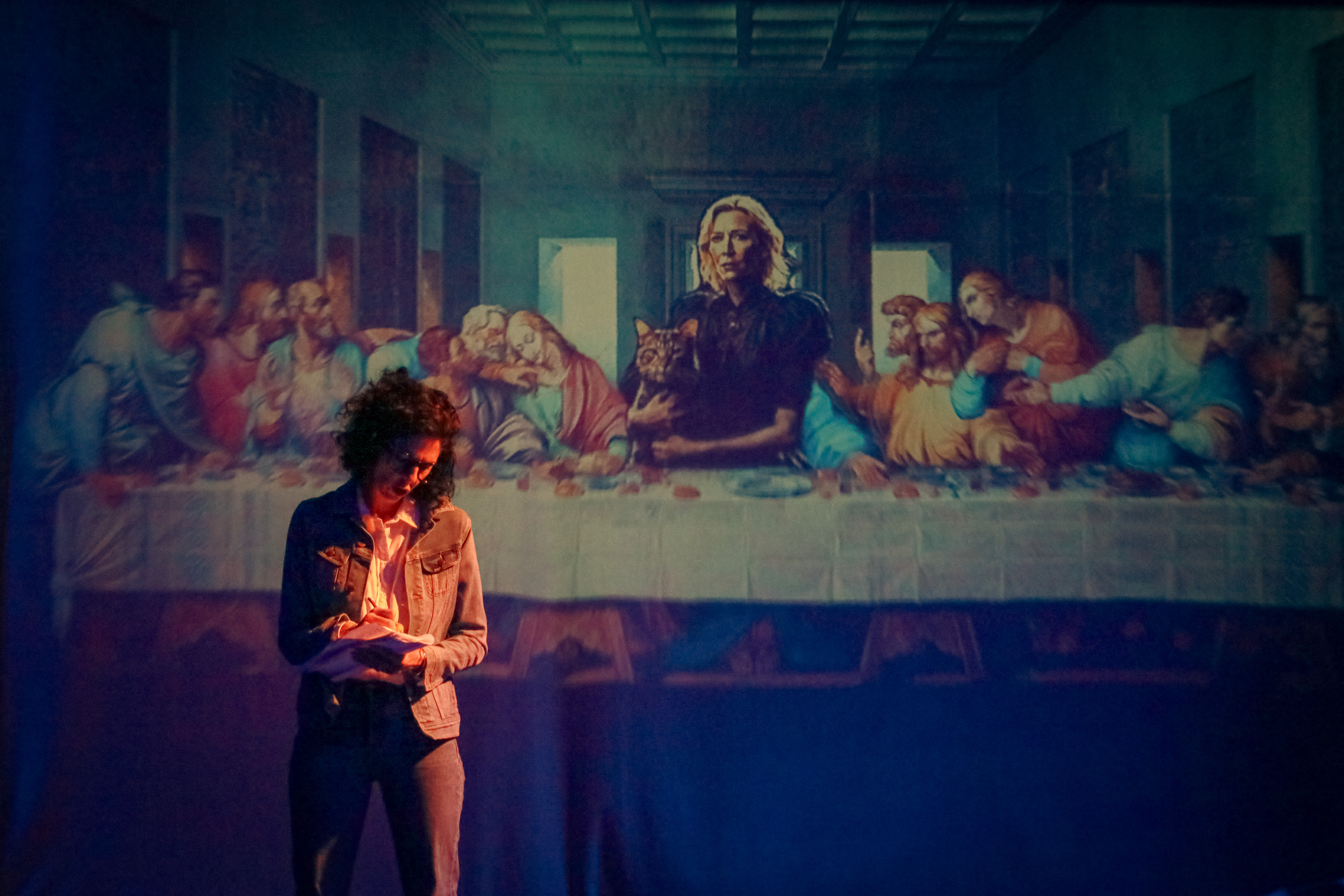
But Cate Fucking Blanchett by Karolina Ristevski is a piece of meta-theatricality that does satisfy; it’s extremely funny and enormously clever, a teasing invitation to consider the nature of theatre itself.

One of the characters is a writer. She has written a play about her family, and they argue about whether they are an appropriate source for her inspiration. And, in that play she has written about her family, they argue about the very same thing.

Meta-theatricality is a dangerous game; play that card and have you thrown away your chance to evoke empathy? Perhaps. Sometimes the wisest thing is to push on, which is what this piece does, allowing a play within a play to become another play within another play.  (Analogy: You see your partner in the act of applying lipstick. This might make her beauty appear a façade, or it could be an erotically charged moment. Does Performance hide Truth? Does it reveal Truth? Or is it the only Truth?)

In addition to the meta-theatricality, another element of this magnificently rich script is the plotline in which the writer donates eggs to her sister so she can have another child. I give you something; you develop it; it’s no longer mine – an allegory of the creative process.

The play is beautifully directed by Ristevski herself.  And her cast is absolutely terrific. Melissa Jones, Lana Morgan and Angela Johnston as the three sisters offer performances of comic brilliance. John Michael Narres give an exceptional turn as a fast talking doctor (and as a fast talking actor playing a fast talking doctor …. you get the drift.) As the writer observing the play being performed, both Kate Bookallil and Josie Waller deliciously capture the inevitable tension between the creative dream and the stage reality. And Siobhan Lawless’ cameo as chairperson in the mock Q and A post-show is played with a wonderfully deliberate obtuseness to the absurd.

And what about Cate? She wasn’t present on the night I attended. But there were several hilarious imitations. (Jones’ shot was glorious; gorgeously balanced between replication and parody, perfectly suiting the production’s goal.)

So why is Cate referred to at all? She is to play one of the sisters if (when?) the play (within a play…) is picked up by a major company. It’s a divine conceit; a reminder that despite all our talk of Truth within theatre, the subtext is often the pursuit of Fame.

Paul Gilchrist

Cate Fucking Blanchett by Karolina Ristevski

At Flight Path Theatre as part of the Sydney Fringe

Until 23 September

sydneyfringe.com

The Approach

27 Aug

It’s like the old gag:

My brother thinks he’s a chicken.

Then you should get him put away.

I would – but I need the eggs.

Written by Irish playwright Mark O’Rowe, and first produced in 2018, The Approach is about relationships. This might seem an absurdly naïve thing to say; after all, isn’t that what all drama is about, it being the artform best suited to exploring how we relate to each other?

But this work is fascinating in its seeming simplicity and focus. Through only a series of tete-a-tete conversations between friends, it forefronts our desire for human connections, despite the pathetic inadequacy of so many of these connections. It’s La Rochefoucauld, without the exuberance he derived from cynicism. The relationships portrayed in The Approach are filled with grievances, resentments, dishonesties and envies, and are maintained by characters who struggle for self-awareness, and who would probably choose to live without these relationships if they could.

Some people might suggest this is simple Truth; theatre at its most beautifully realistic. Perhaps. I’m not sure calling it Truth isn’t merely the romanticisation of garden variety misery. But, if it is, who am I to complain about how others cope?

It’s a finely wrought play, eighty minutes of tight, engaging writing. Director Deborah Jones keeps the production splendidly sparse, allowing her excellent cast to shine.  It’s a joy to witness Linda Nicholls-Gidley, Lindsey Chapman and Sarah Jane Starr present these characters, like watching sunlight glimmer through the discarded pieces of a broken stained glass window. I use this ostentatious simile deliberately: the play presents a world in which individuals have seemingly lost the ability to look up.  There’s one particularly poignant motif: a fourth character, who we never meet, who climbed a nearby mountain and lit a fire. In rich ambiguity, this serves as both a powerful image of troubled flight, and of the desperate need to go beyond.

Paul Gilchrist

The Approach by Mark O’Rowe

At Flight Path Theatre until Sept 2

https://www.flightpaththeatre.org/

Image by Abraham de Souza

Teenage Dick

22 Jul

Teenage Dick by Mike Lew is a brilliant play and director Dan Graham’s production is superb.

Lew takes elements of Shakespeare’s treatment of Richard III and places the action in a modern American high school.

Like Shakespeare’s Richard, Lew’s protagonist has a disability that pushes him to the periphery. Both characters respond by focusing on the pursuit of power. Shakespeare was clearly exploiting the Elizabethan fascination with the Machiavellian villain, and Lew’s play makes that explicit: the students are asked to discuss The Prince. Is it better to be feared than loved?

Dean Nash as Richard is absolutely magnificent, a mesmerising stage presence. (I suspect Richard Burbage, the original Richard in Shakespeare’s company, would be thrilled by what Nash does.) Graham provides Nash with a wonderful supporting cast. Chloe Ho as Anne Margaret offers a deeply moving portrait of vulnerability. Rocco Forrester is terrific as the self-obsessed school jock, Eddie. Holly-Jane Cohle’s Buck is gloriously no-nonsense wit.  Amy Victoria Brooks, in a performance both hilarious and disturbing, nails the hapless teacher, Miss York.

The character names evoke Shakespeare’s play and, if you’re familiar with the Elizabethan text, the conversation between this play and the earlier one is intriguing. But no knowledge of Shakespeare is required.

This is an extraordinarily timely play. We live in an era in which some of us so passionately strive to right previously unacknowledged injustices that we valorise rage and grant ourselves moral holidays. Richard desperately wants power because he’s so denied it, but are the means he chooses defensible? Are they even effective? This play does what theatre is made to do: honestly present the fracture lines in our vision of Life.

Shakespeare called his play a tragedy. Lew’s extraordinarily powerful final scene leaves us asking if his is too.

Paul Gilchrist

Teenage Dick by Mike Lew

Presented by Flight Path Theatre & Divergent Theatre Collective

At Flight Path until 5 August

flightpaththeatre.org

Image by Andrea Magpulong

Ladybird Ladybird

3 Jul

Though fiction, this is theatre that bears witness. (Of course, all theatre does – in a way – but it’s not all that it does.)

But bearing witness is certainly a focus of contemporary theatre making. We’re keen to present what we believe are under-represented voices.  

Ladybird Ladybird by Linda Nicholls-Gidley bears witness to the often unacknowledged suffering of many women, both before they give birth and after. In powerful images and in script built from deeply affecting monologues and insightfully sharp dialogue, we’re presented pain both physical and mental.

Director Anthony Skuse and designer Henriette Gabreal give the characters a simple, stark, stepped stage. There’s nowhere to hide; there’s only climbing to do – an almost Sisyphean image of pain unending.

Supported by a very capable cast (Leilani Loau, Danielle Stamolous and Silvana Lorenzo de Shute), Nicholls-Gidley’s performance as the protagonist, Veronica, is brilliant. Her control of both the language and physicality is outstanding. Veronica’s suffering elicits tears and offers no consolation.

Absent from the stage is Veronica’s husband. This absence highlights his personal culpability, but also functions as a potent symbol of the patriarchy’s deliberate obtuseness regarding the challenges of motherhood.  

But another provocative consequence of Nicholls-Gidley’s decision to people her story with solely female characters is to challenge any superficial faith in the sisterhood. Veronica’s mother and supposed friends oscillate between making narrow unsympathetic judgements and offering glib unwanted advice. It’s the brutality of this portrait that gives the piece a soul-stretching veracity, that asks us – all of us – to listen more closely, more openly, to the people in our lives.

And theatre that does that, has done a wonderful thing.

Paul Gilchrist

Ladybird Ladybird by Linda Nicholls-Gidley

Produced by Vox Theatre

at Flight Path Theatre until 15 July

flightpaththeatre.org

Image by Becky Matthews