Tag Archives: Flight Path Theatre

Dazza & Horse Play

31 Oct

This evening of two short plays is part of the Everything But The Kitchen Sink Festival.

The first show, Dazza, written and performed by Frankie Fearce, is seriously top class satire. It’s a beautiful, measured criticism of the parochial Australian male, focusing especially on his attitudes to gender identity. “You’re one of those pronoun people, aren’t ya?” Dazza says to an unexpected visitor to his local. Fearce’s writing is wonderfully sharp, and the rhythms of the vernacular are spot on.

Like all top rate satire, there’s little hyperbole, just a commitment to truth. Garden variety satire criticises. Great satire portrays. If the artist tells us the character is flawed we might choose to read it all as a comment about the artist themselves. However, if it’s we who decide the character is flawed, the criticism appears indubitable.

The beauty of the portrait is that Dazza refuses to consider that he might be closed-minded, which is, of course, the epitome of closed-mindedness. Dazza is a good bloke in a world that’s certain he is one, and that’s the very problem.

The change from the introductory scene where Fearce plays themselves (I guess) to where they play Dazza is a piece of theatrical magic. It was also a feast for thought: the change in the audience was utterly electrifying. We had been witnessing a person give testimony of their lived experience and the vibe was definitely supportive. Then came the change, and suddenly we were confronted with the delicious, dangerous lie that is fiction and, in addition to abundant laughter, there was a shifting in seats, an intake of breathe, a palpable uncertainty.  It was as though we had been in a church and now we were in a theatre. The experience clarified for me why I prefer performance to personal testimony: when someone genuinely shares, only a dickhead (such as Dazza) is not supportive; when someone performs we feel little moral necessity to respond to the character in any fixed way, and so it is we who are encouraged to be genuine.   

The second show of the evening is Horse Play. It’s a clever title for a clever show. Zoe Tomaras directs a fun sitcom, devised and written by the team (Nat Knowles, Sophea Op, Angela Johnston, Linda Chong, Georgia Drewe and Tomaras.) Five soldiers (men, of course) wait inside the Trojan horse. Sometime in the night they will slip out and open the city gates … and the rest is known. (And told in its full horror by Euripides in his The Women of Troy.)

In this tale, the men just wait. It’s Waiting for Godot in togas. (Ok, not togas, but you get the point.) It’s a wonderful set up which the team doesn’t so much use to discuss war as masculinity. The very gifted comic cast present the male characters as being unable to transcend the puerility of teenagers (a criticism which dovetails well with who is often left to do the fighting of wars.) There are dick and masturbation jokes aplenty and homosexual curiosity masquerades unconvincingly as homophobia.  There’s also a playful exploration of how we attempt to fill time until the big moment, whatever that big moment might be (which is the family connection to Godot.) To portray characters who are bored is always risky, but Tomaras deals with it astutely. The piece is not presented in real time but is offered in multiple brief scenes, moreish slices of experience, cute skits cut and served to us by the dimming and raising of lights, a directorial choice which functions as an effective laugh track.  

If I’ve made it all seem merely wacky fun, the concluding scene of Horse Play throws down the gauntlet. It powerfully reminds us that those we find most laughable might be just that because of the infantilizing impact of the trauma that they face, and that we ignore. Euripides followed a tragedy with satyr; here we have something that poignantly approximates the reverse.    

These two short shows exhibit the inspiring wildness that makes the Everything but the Kitchen Sink Festival a terrific addition to the Sydney theatre scene.

Paul Gilchrist

Dazza by Frankie Fearce

Horse Play by Nat Knowles, Sophea Op, Angela Johnston, Linda Chong, Georgia Drewe and Zoe Tomaras

Part of the Everything But The Kitchen Sink Festival at Flight Path Theatre until Nov 4

www.flightpaththeatre.org

Images by Toby Blome

Cate Fucking Blanchett

22 Sep

Before this show, the writer asked that I be “brutal” in my review. She was joking. Receiving an unfavourable review is equivalent to being savaged by a sponge. But, more to the point, a review that does not shy away from the supposedly honest but harsh truth is usually one written by someone with only a passing acquaintance with Truth. (My fleeting impressions are hardly handed down from heaven, especially in a world where fewer and fewer of us believe there’s a heaven from which they could be handed.)

As you can see, the meta route is available to us all, playwrights and reviewers both, and I suspect it will always leave some audiences dissatisfied. (If two footballers must stop playing in order to argue the rules, the least they could do, for our entertainment, is decide their differences with their fists.)

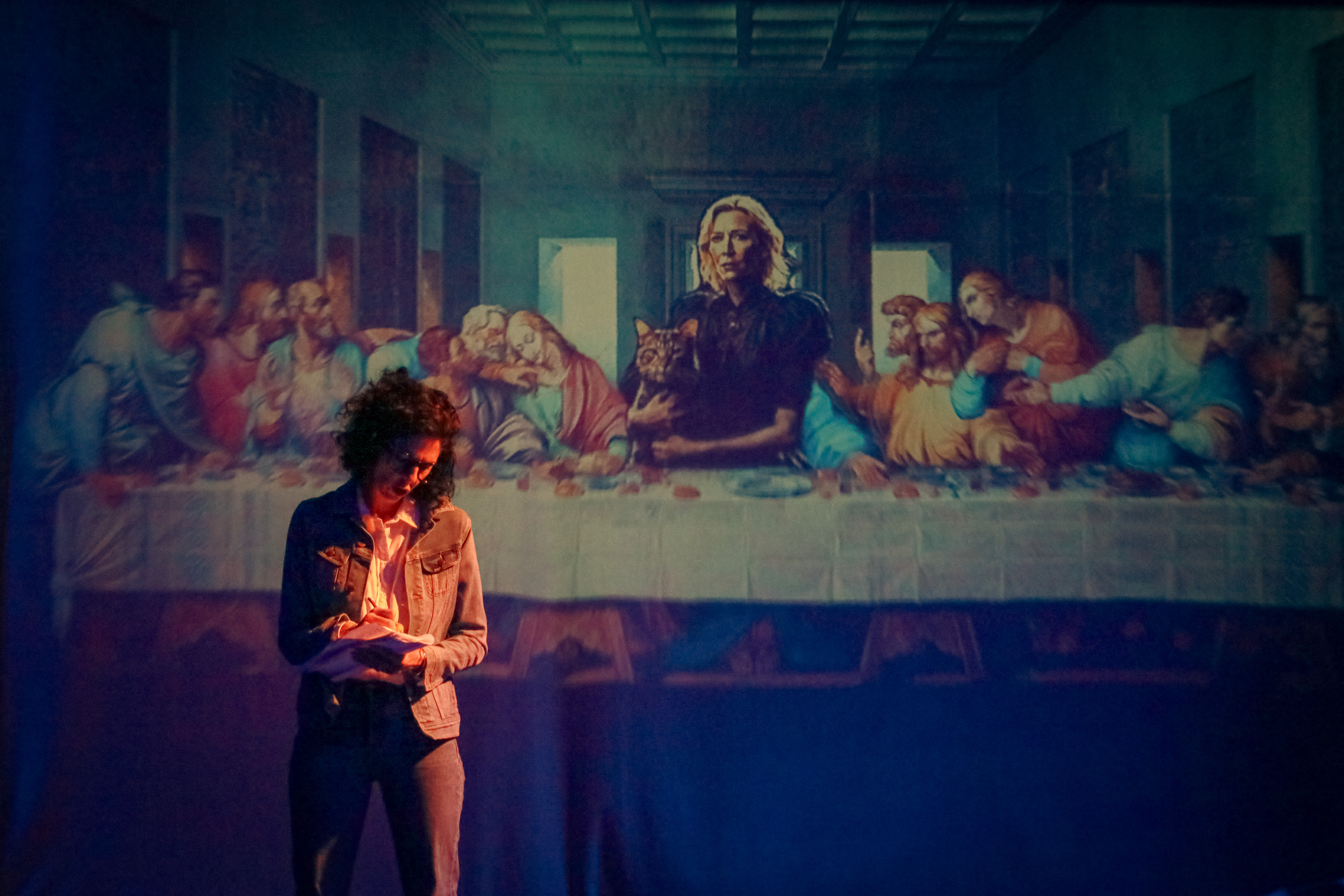
But Cate Fucking Blanchett by Karolina Ristevski is a piece of meta-theatricality that does satisfy; it’s extremely funny and enormously clever, a teasing invitation to consider the nature of theatre itself.

One of the characters is a writer. She has written a play about her family, and they argue about whether they are an appropriate source for her inspiration. And, in that play she has written about her family, they argue about the very same thing.

Meta-theatricality is a dangerous game; play that card and have you thrown away your chance to evoke empathy? Perhaps. Sometimes the wisest thing is to push on, which is what this piece does, allowing a play within a play to become another play within another play.  (Analogy: You see your partner in the act of applying lipstick. This might make her beauty appear a façade, or it could be an erotically charged moment. Does Performance hide Truth? Does it reveal Truth? Or is it the only Truth?)

In addition to the meta-theatricality, another element of this magnificently rich script is the plotline in which the writer donates eggs to her sister so she can have another child. I give you something; you develop it; it’s no longer mine – an allegory of the creative process.

The play is beautifully directed by Ristevski herself.  And her cast is absolutely terrific. Melissa Jones, Lana Morgan and Angela Johnston as the three sisters offer performances of comic brilliance. John Michael Narres give an exceptional turn as a fast talking doctor (and as a fast talking actor playing a fast talking doctor …. you get the drift.) As the writer observing the play being performed, both Kate Bookallil and Josie Waller deliciously capture the inevitable tension between the creative dream and the stage reality. And Siobhan Lawless’ cameo as chairperson in the mock Q and A post-show is played with a wonderfully deliberate obtuseness to the absurd.

And what about Cate? She wasn’t present on the night I attended. But there were several hilarious imitations. (Jones’ shot was glorious; gorgeously balanced between replication and parody, perfectly suiting the production’s goal.)

So why is Cate referred to at all? She is to play one of the sisters if (when?) the play (within a play…) is picked up by a major company. It’s a divine conceit; a reminder that despite all our talk of Truth within theatre, the subtext is often the pursuit of Fame.

Paul Gilchrist

Cate Fucking Blanchett by Karolina Ristevski

At Flight Path Theatre as part of the Sydney Fringe

Until 23 September

sydneyfringe.com

The Approach

27 Aug

It’s like the old gag:

My brother thinks he’s a chicken.

Then you should get him put away.

I would – but I need the eggs.

Written by Irish playwright Mark O’Rowe, and first produced in 2018, The Approach is about relationships. This might seem an absurdly naïve thing to say; after all, isn’t that what all drama is about, it being the artform best suited to exploring how we relate to each other?

But this work is fascinating in its seeming simplicity and focus. Through only a series of tete-a-tete conversations between friends, it forefronts our desire for human connections, despite the pathetic inadequacy of so many of these connections. It’s La Rochefoucauld, without the exuberance he derived from cynicism. The relationships portrayed in The Approach are filled with grievances, resentments, dishonesties and envies, and are maintained by characters who struggle for self-awareness, and who would probably choose to live without these relationships if they could.

Some people might suggest this is simple Truth; theatre at its most beautifully realistic. Perhaps. I’m not sure calling it Truth isn’t merely the romanticisation of garden variety misery. But, if it is, who am I to complain about how others cope?

It’s a finely wrought play, eighty minutes of tight, engaging writing. Director Deborah Jones keeps the production splendidly sparse, allowing her excellent cast to shine.  It’s a joy to witness Linda Nicholls-Gidley, Lindsey Chapman and Sarah Jane Starr present these characters, like watching sunlight glimmer through the discarded pieces of a broken stained glass window. I use this ostentatious simile deliberately: the play presents a world in which individuals have seemingly lost the ability to look up.  There’s one particularly poignant motif: a fourth character, who we never meet, who climbed a nearby mountain and lit a fire. In rich ambiguity, this serves as both a powerful image of troubled flight, and of the desperate need to go beyond.

Paul Gilchrist

The Approach by Mark O’Rowe

At Flight Path Theatre until Sept 2

https://www.flightpaththeatre.org/

Image by Abraham de Souza

Teenage Dick

22 Jul

Teenage Dick by Mike Lew is a brilliant play and director Dan Graham’s production is superb.

Lew takes elements of Shakespeare’s treatment of Richard III and places the action in a modern American high school.

Like Shakespeare’s Richard, Lew’s protagonist has a disability that pushes him to the periphery. Both characters respond by focusing on the pursuit of power. Shakespeare was clearly exploiting the Elizabethan fascination with the Machiavellian villain, and Lew’s play makes that explicit: the students are asked to discuss The Prince. Is it better to be feared than loved?

Dean Nash as Richard is absolutely magnificent, a mesmerising stage presence. (I suspect Richard Burbage, the original Richard in Shakespeare’s company, would be thrilled by what Nash does.) Graham provides Nash with a wonderful supporting cast. Chloe Ho as Anne Margaret offers a deeply moving portrait of vulnerability. Rocco Forrester is terrific as the self-obsessed school jock, Eddie. Holly-Jane Cohle’s Buck is gloriously no-nonsense wit.  Amy Victoria Brooks, in a performance both hilarious and disturbing, nails the hapless teacher, Miss York.

The character names evoke Shakespeare’s play and, if you’re familiar with the Elizabethan text, the conversation between this play and the earlier one is intriguing. But no knowledge of Shakespeare is required.

This is an extraordinarily timely play. We live in an era in which some of us so passionately strive to right previously unacknowledged injustices that we valorise rage and grant ourselves moral holidays. Richard desperately wants power because he’s so denied it, but are the means he chooses defensible? Are they even effective? This play does what theatre is made to do: honestly present the fracture lines in our vision of Life.

Shakespeare called his play a tragedy. Lew’s extraordinarily powerful final scene leaves us asking if his is too.

Paul Gilchrist

Teenage Dick by Mike Lew

Presented by Flight Path Theatre & Divergent Theatre Collective

At Flight Path until 5 August

flightpaththeatre.org

Image by Andrea Magpulong

Ladybird Ladybird

3 Jul

Though fiction, this is theatre that bears witness. (Of course, all theatre does – in a way – but it’s not all that it does.)

But bearing witness is certainly a focus of contemporary theatre making. We’re keen to present what we believe are under-represented voices.  

Ladybird Ladybird by Linda Nicholls-Gidley bears witness to the often unacknowledged suffering of many women, both before they give birth and after. In powerful images and in script built from deeply affecting monologues and insightfully sharp dialogue, we’re presented pain both physical and mental.

Director Anthony Skuse and designer Henriette Gabreal give the characters a simple, stark, stepped stage. There’s nowhere to hide; there’s only climbing to do – an almost Sisyphean image of pain unending.

Supported by a very capable cast (Leilani Loau, Danielle Stamolous and Silvana Lorenzo de Shute), Nicholls-Gidley’s performance as the protagonist, Veronica, is brilliant. Her control of both the language and physicality is outstanding. Veronica’s suffering elicits tears and offers no consolation.

Absent from the stage is Veronica’s husband. This absence highlights his personal culpability, but also functions as a potent symbol of the patriarchy’s deliberate obtuseness regarding the challenges of motherhood.  

But another provocative consequence of Nicholls-Gidley’s decision to people her story with solely female characters is to challenge any superficial faith in the sisterhood. Veronica’s mother and supposed friends oscillate between making narrow unsympathetic judgements and offering glib unwanted advice. It’s the brutality of this portrait that gives the piece a soul-stretching veracity, that asks us – all of us – to listen more closely, more openly, to the people in our lives.

And theatre that does that, has done a wonderful thing.

Paul Gilchrist

Ladybird Ladybird by Linda Nicholls-Gidley

Produced by Vox Theatre

at Flight Path Theatre until 15 July

flightpaththeatre.org

Image by Becky Matthews 

Rabbits on a Red Planet

18 Jun

Rabbits on a Red Planet (book by Andy Leonard and Irving Gregory, score by Ryley Gillen) is a sci-fi satirical musical. It’s wonderful to see a new Australian musical on stage. Congratulations to the producing company and Flight Path Theatre.

Following environmental degradation (and possibly other hijinks), giant mutant rabbits are wreaking havoc across the planet. In response, and in the hope of big profits, tech billionaire Rob Muskas (Leonard) funds the alteration of the Martian environment to enable human habitation. Light and fun, the piece satirises a range of intertwined contemporary issues: the appalling impact of colonialism; the bull-headedness of both conspiracy theorists and those who deny crises; the lack of empathy for those seeking safety; environmental irresponsibility; and the self-seeking nature of capitalist ambition. In all this, there are some good laughs and valid points.

Gillen’s score is entertaining, and “King of Mars” (performed by the ensemble with Leonard as lead) is particularly catchy. Isabella Kohout and Jenna Wooley have exceptionally beautiful voices.

Having so many elements, musicals are an especially ambitious form of theatre, and in this production the lyrics and the dialogue – both content and delivery – could do with some sharpening.

But theatre is not space flight; when you get it wrong, no-one dies.

We just don’t get to visit new worlds.

(So, I guess, theatre is like space flight.)

Paul Gilchrist

Rabbits on a Red Planet (book by Andy Leonard and Irving Gregory, and score by Ryley Gillen)

at Flight Path Theatre until 24 June

www.flightpaththeatre.org

Image by Anthony Stone

In This Light

15 Nov

This is big, bold storytelling.

Spanning generations and continents, Noel Hodda’s In This Light is a grand tale of longing and reconciliation. It’s a wonderful addition to that most glorious of theatre traditions – the honest acknowledgement of the pains of life, paired with the promise that beauty is still possible.


Occasionally there are challenges in the stage logistics demanded by such a substantial story, but Des James has put together a brilliant cast. Still raw from the agonising death of an elderly parent, Sandra and Chris must confront again questions of what makes a worthwhile life – and Sophie Gregg and David Adlam play the siblings with a grippingly truthful mixture of warmth and desperation. Tom Cossettini is Peter, an Australian abroad, where he meets French woman, Camille, played by Omray Kupeli. The portrayal of these young lovers is utterly charming. (And it’s always a delight to hear a language other than English on stage.) David Woodland plays an artist living in rural Australia in isolation– until he gets an expected visitor. Woodland presents an absorbing fusion of frustration and acceptance, a sparkling miniature of the play’s vision of the human condition. Similarly, Kate Bookalil plays a woman whose past won’t let go, and her portrayal of a soul that has felt the cold touch of steel is inspiring.    

Standing before Van Gough’s Wheatfield with Crows, one character asks “What do the crows mean?” My answer? Texture; a profound awareness of the competing currents within Life – for that’s the deeply honest and compassionate vision this play offers.

Paul Gilchrist

In This Light by Noel Hodda

Flight Path Theatre until Nov 19

www.flightpaththeatre.org  

Image by Robert Catto

Chain Play

23 Sep

A chain play is created by a team of writers. Each writer drafts one scene, having read only the scene that directly precedes hers. Obviously, no-one expects the resultant script to be a paragon of textual integrity. Chain plays are a type of theatre game; and therein lies the key word – game.

This Chain Play by Slanted Theatre is a riotous celebration of Asian-Australian theatrical talent. The writing is sharp and funny, and the performances are mischievously exuberant.

Chain Play actually consists of two distinct works, each written according to the chain play methodology.

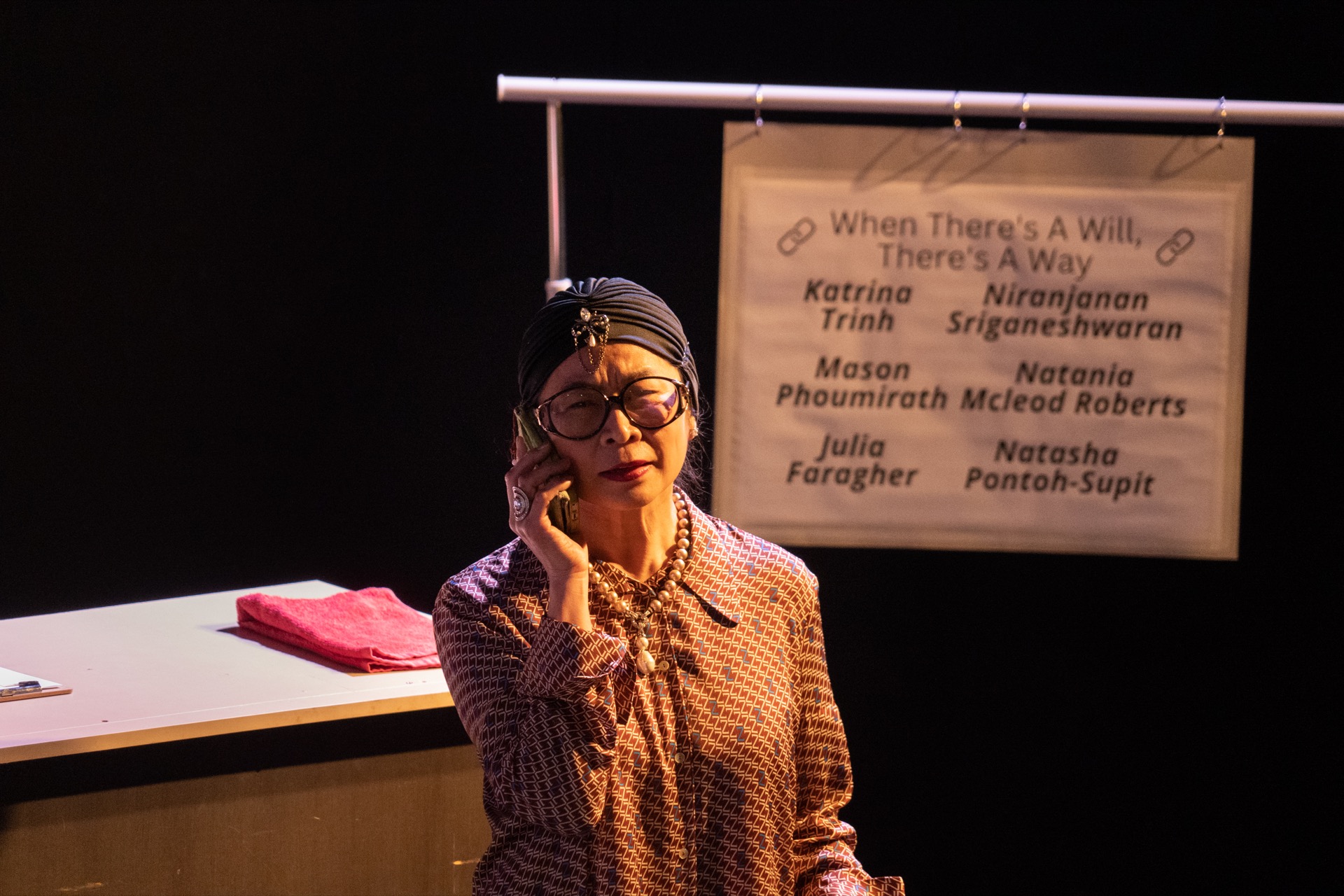
Where There’s a Will There’s a Way is written by Katrina Trinh, Mason Phoumirath, Julia Faragher, Niranjan Sriganeshwaran, Natasha Pontoh-Supit and Natania McLeod Roberts, and is directed by Katie Ord. It lands in the genre of sit-com, with plenty of great one liners and characters that are the Asian-Australian cousins of those in Commedia.

Susan Ling Young in Where There’s a Will There’s a Way

How Asian are You? written by Matt Bostock, Alan Fang, Grace Hu, Christina Kim, Eezu Tan and Simone Wang, and directed by Sammy Jing, is more conceptual.  Each scene digs into assumptions about Asian-Australian identity, and does so in ways that are both hilarious and poignant. (I’d like to see this type of digging continue in the Sydney theatre scene, digging deeper and deeper to see what we might find ……hopefully gold, and not just some gaping big hole.)

And, to conclude, a possibly utterly irrelevant philosophical digression: every play ever written is part of a chain play. We write informed by what is directly before us, sometimes only vaguely conscious of where we fit into the larger arc of history. And what we write then goes on to inform our near contemporaries, contributing to the intellectual and emotional environment to which they respond. Every playwright suffers from an inevitable myopia. Perhaps that’s no great tragedy; after all, if you can see too much further ahead than your audience, you’re not a prophet, you’re just irrelevant.

But a chain play, for all its playful nonsense, reminds us that we not only have to deal with the social environment in which we find ourselves, but we must also leave something for those who follow.   

Paul Gilchrist

Chain Play by Slanted Theatre

at Flight Path Theatre as part of the Sydney Fringe until Sept 24

https://sydneyfringe.com/events/chain-play/

Image by Aaron Cornelius

Labyrinth

23 Aug

This production is inspiring for its sheer energy and effort.

Beth Steel’s play, first produced in 2016, is set in the 1980’s. It’s the story of a crash: the over lending by American banks to Latin American countries, and the dreadful consequences.

It’s tempting to say this particular production is about finance and furniture removal; this epic play has many scenes, many locations and, as a result, changeovers make up a significant part of the action. Director Margaret Thanos, movement director Diana Paolo Alvarado, and a spirited cast handle these with aplomb. It all becomes a magnificent spectacle – which is thrilling to the degree to which one classes oneself as a spectator or as an audience member. But the time that must have gone into building and rehearsing these changeovers is mind blowing, and throws the gauntlet out to other theatre makers.

The tile is odd. Is it ironic? Few plays would be more obvious in their meaning: greed is bad. Some may feel it’s a story that doesn’t especially need to be heard (and judging by the soundscape that played through some of the scenes this might be a view shared by the creative team.)

Performances are truly exuberant, and generally effective. Matt Abotomey as the protagonist, John, is eminently watchable, embodying with bold physicality and emotional power the literary trope of the man seduced by power. Angus Evans and Brendan Miles both evoke the frightening obtusity of the privileged. Camila Ponte Alvarez’s Grace, a journalist who flags the wanton irresponsibility of the American lenders, is a wonderful portrait of intelligence and sanity in a small, crazy world. Tasha O’Brien and Rachael Colquhoun-Fairweather produce some comic magic.

I implied earlier that the story was an obvious one. Perhaps that’s a criticism. Or perhaps it’s not. That injustice is as familiar as dirt, as dust, simply urges on us fresh ways to shake off our complacency.

And both play and production give it a good hard shake.

Paul Gilchrist

Labyrinth by Beth Steel

Flight Path Theatre until Sept 3

www.flightpaththeatre.org

Image by Clare Hawley

Ugly Love

19 Jul

Writer director Lucy Matthews’ musical Ugly Love consists of a fine collection of songs, performed by a very tight band and some wonderful vocalists.

And it’s original. And it’s about sex.

But, for all its newness and sexiness, Ugly Love is deliberately grounded in middle-class ordinary. Jess is a teacher. Sam is a lawyer. They are married. They live in Newtown. They are not happy.

They decide to try an open relationship: an entirely rational option considering their exclusive relationship is based on bickering about who should put out the garbage. Intimacy has become him flossing in front of her – so looking elsewhere has an obvious appeal…..

… as long as it remains only physical – which raises the first of the play’s tantalising questions about sex.

What is the difference between physical involvement and emotional involvement? For many of us, the default assumption is that the two are different, and that it is possible to separate them – but then we’re not surprised, at all, if something that begins as only physical morphs into the emotional. This is what happens for Jess; she becomes emotionally involved with another woman. Why do we assume the categories physical and emotional are meaningful when the boundary between them is so very permeable? And what emotions do we expect to be excluded from encounters supposedly exclusively physical? Perhaps sex that is only physical is simply bad sex. And, if so, the persistence of the category suggests there’s a hell of a lot of bad sex out there.

(And before I’m drawn back inevitably to sex, I best talk about the cast and creatives. Performances are rich and satisfying. LJ Wilson and Lincoln Elliott present a poignant portrait of a conventional couple, simultaneously attracted and repelled by the world they’ve accepted. Cypriana Singh as Lola offers an invigorating vivacity, tempered by a sorrowful awareness that verve is not always enough. Likewise, Madelaine Osborn’s portrait of the wisecracking Maddi is movingly shaded with hints of darkness. The design by Kate Beere appears to effortlessly lift a black box theatre into an arena in which suburbia battles fantasia – what is versus what could be – and the lighting by James Wallis, in its contrast between the simple and the shimmering, magnificently evokes small lives imagining more.)

Now, that other question about sex. Is it possible, in the full knowledge of all concerned, to have sexual or romantic relationships with several people at the same time? (The corollary, of course, is why would you want to?) Though characters in the play attempt to have polyamorous relationships, no one is represented as doing this entirely happily. But that creative choice, far from dismissing the possibility of polyamory, represents the experience truthfully (warts and all: ugly love).

Which brings me back to ordinariness. At the heart of Matthews’ thought-provoking musical is a thrilling rejection of the ordinary, the predictable, the socially expected, the socially accepted. In making her characters inhabit a world so very ordinary, Matthews invites us to dream a world beyond.

Paul Gilchrist

Ugly Love by Lucy Matthews

Flight Path Theatre until July 23

https://www.flightpaththeatre.org/

Image by Katje Ford