Tag Archives: Flow Studios

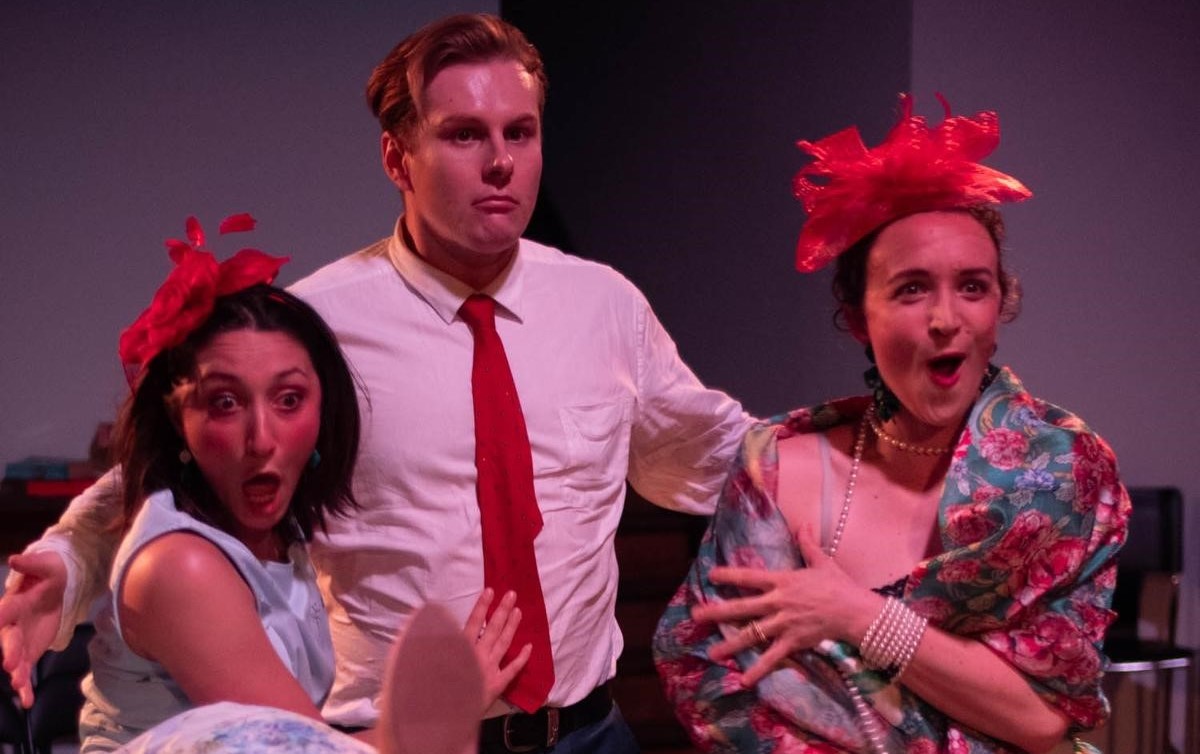
A Behanding in Spokane

10 Oct

Twenty-five years ago, Carmichael’s hand was cut off. He’s been searching for it ever since.

This is a black comedy by Martin McDonagh, the writer of The Beauty Queen of Leenane, The Cripple of Inishmaan and The Pillow Man.

First presented in 2010, it’s the first of McDonagh’s plays set in America. 

75 minutes long, the action plays out (almost) in real time. Two grifters have come to Carmichael’s motel room, hoping to sell him a hand – which may or not be his.

It’s tremendous fun, with great laugh-out-loud lines. Directed by Kai Paynter, we’re treated to hilarious high-energy performances. (There were a few tiny hiccups, in vocal work and in staging, but I did see a preview.)

As the grifters, Cynthia Taylu and Alexander W. Hunter have a very amusing bickering repartee and both deliver terrific portrayals of comic fear.

As a motel employee, Christopher Northall is wonderfully quirky, a true loose cannon, brazenly outside usual motivations and empathies.

As Carmichael, James Yeargain brilliantly captures the character’s heartless determination, a frightening brutality which reaps enormous comic rewards when he falls into petty quibbles with the other characters.

But with the avalanche of politically incorrect language and suggestions of extreme violence, what’s it all about?

Crazed determination? Carmichael has been looking for his (unusable) hand for a long, long time.  

Crazed consistency? On the phone, Carmichael’s mother questions whether he can legitimately claim to be racist if he finds women of colour sexually attractive. And the motel employee hangs on to a resentment which the current horrific circumstances should render utterly irrelevant.

Or perhaps, like many black comedies, it’s more about clearing the air.

Black comedies often seem untruthful – some people dismiss them as such – but they function as an invitation to break free from the spell of language and artistic representation. (A critic with even more authority than me has warned of the danger of bewitchment by our own creations, commanding “Thou shalt not make unto thee any graven image….”)

Through their mischievous and vicious exuberance, comedies like this refuse to be confused with the real thing. They remind us that our words, and the worlds they conjure, are not actually reality – certainly not in its totality – and that spirit of cheeky rebellion is gloriously liberating.

Paul Gilchrist

A Behanding in Spokane by Martin McDonagh

Presented by The Americas, A Theatre Co, in association with Beartiger Productions

At Schell Medical Corp (Flow Studios 88) until 12 October

theamericas.beartigerproductions.com

Image by Lola Carlton

The Lotto Line

3 Apr

This is seriously committed crazy.

Written by John Tsakiris, and directed by Megan Heferen and Tsakiris, The Lotto Line presents five people waiting in line to buy tickets in a lottery. They don’t seem interested in winning. Once the outlet closes, they wait for it to reopen. Time stops.

Absurdist theatre is a funny form. Some would say that it doesn’t so much reflect Life’s meaninglessness as actively add to it.

And it’s a brave team who presents a play in which Time stops. Of course, theatre reviewers are never catty or petty, but if they were, it’d be one hell of a temptation.

And perhaps only a youthful team could produce a play in which the halting of Time – the having to Wait – is presented as a fundamental human experience.

That’s what absurdism does: in convention-shattering ways, it tries to express something about the human condition. It’s transgressive spirit means that it especially values innovation (in fact, some commentators might suggest that the only thing absurdist plays have in common is that they’re all longer than they need to be.)

To suggest a formula, absurdism is where the Theatre of Audacity (I can’t believe you’re doing that!) combines with the Theatre of Authenticity (I totally believe what you’re doing.) It’s an absolutely explosive mixture.

I’ve already suggested I struggled to connect with the authenticity of this piece, but neither my personal limitations nor my impatience with decoding should get in the way of discussing its audacity.

In terms of physicality, performances are super tight. The choreographed movement that suggests these characters are slaves to routine is wonderfully executed. Jess Spies as the Lotto Master is a terrific counterpoint, engendering a swaggering superiority.

When those who Wait individualise themselves from the group, there’s more skilled comedy. Larissa Turton’s gruff crazy cat lady is splendid. Holly Mazzola’s clever, particular and prematurely middle-aged woman is a masterclass in focus. Jonathon Nicola’s petulant pedant is engaging fun. As Mr Horner, James Thomasson balances well the eternal battle between frustration and hope. Megan Heferen’s imperious, supercilious Ms Atkins drives much of the piece.

On occasions, there could be more care with vocal work. There were moments when I was afraid I’d be reduced to recommending this show to only enthusiasts of screeching. And, unfortunately, some of the mischievous linguistic humour was lost in delivery. But there’s a neat trick where characters swap vocal styles, and Turton and Mazzola pull it off with aplomb.

The Lotto Line is a playful puzzle, a nonsensical 90 minutes, an invitation to laugh.

Paul Gilchrist

The Lotto Line by John Tsakiris

Presented by Studio Five Productions

At Flow Studios until 12 April

events.humanitix.com/the-lotto-line

Image by Patrick Phillips

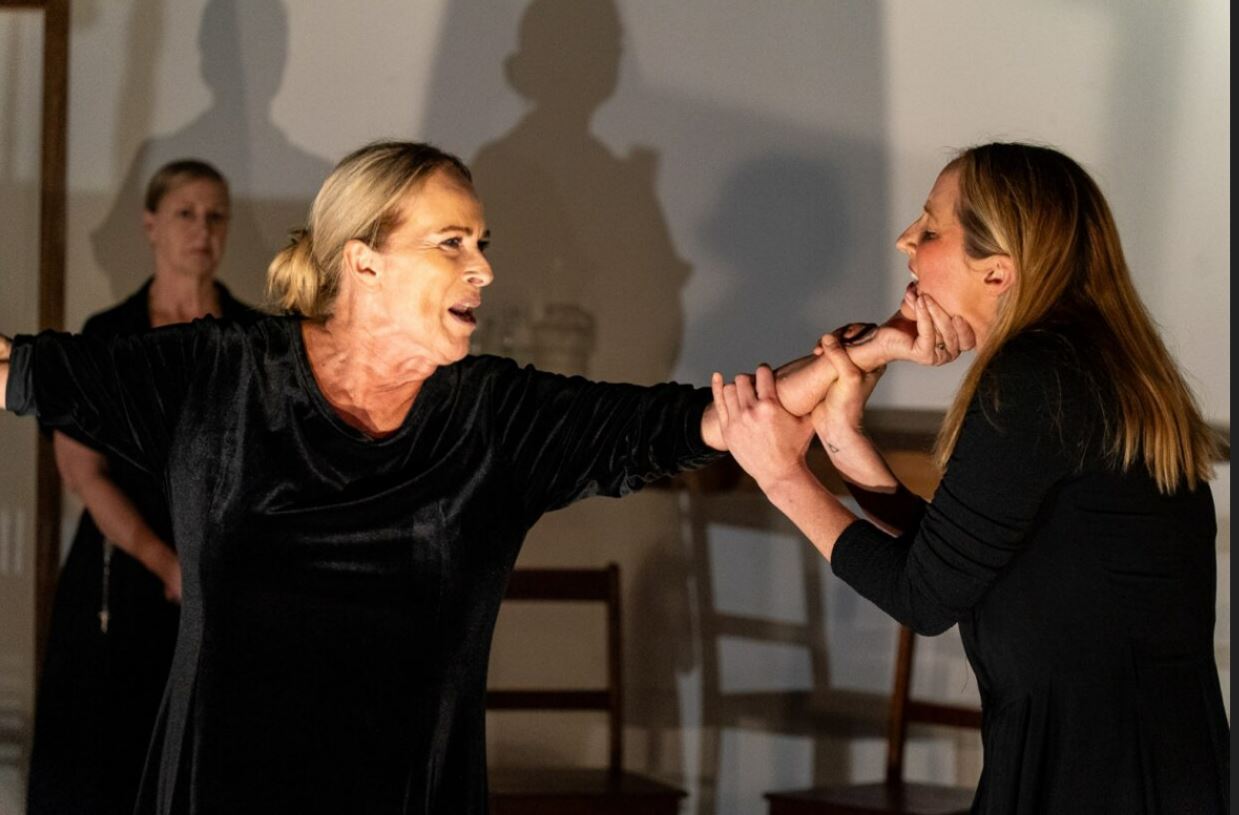
The House of Bernarda Alba

11 Nov

This is a terrific production of a fascinating play.

Written in the mid-1930’s, the last work by the great Spanish playwright Federico García Lorca, it features only female characters.

After her husband dies, Bernarda, matriarch of the family, insists her five unmarried daughters mourn in the ultra-traditional way. Prohibited from engaging with the wider world, prisoners of patriarchal standards, the household of women live an overwrought, claustrophobic existence.

But eldest daughter Angustias is still permitted to speak to her suitor, Pepe, a man whom we never see or hear. The problem is that she is not the only member of the household with feelings for Pepe.

Previously, I’ve expressed doubts about the efficacy of plays that purport to indict injustice but show only the victims. I know and support what drives this creative fashion, but the resultant work often feels lopsided, unintentionally granting the perpetrators a moral leave pass.

Despite being set in a patriarchy but presenting only women, Lorca’s play avoids these pitfalls. He was an extraordinary playwright, but I suspect freedom from the later theoretical apparatus of second wave feminism might have helped. This type of theory serves a necessary purpose, but not always one useful in the theatre. Sometimes, we can be so soaked in the simplicity of theory – as against the dreadful messiness of human reality – that we represent injustice as though it was merely the result of a few poor or selfish decisions at the last staff meeting. The value of the dramatic form is that it can acknowledge that problems are deep and painfully complex.

In Lorca’s play, women are presented as finding men irresistibly attractive, despite – or perhaps even because of – their brutish behaviour. It evokes for me God’s punishment of Eve in Genesis: “Your longing will be for your husband, and he will dominate you.”   

And, in Lorca’s play, it’s the matriarch who’s the main enforcer of oppression. Now, the idea that individual women will betray the sisterhood to further their own power is not unheard of, but is this what Bernarda is doing? Does she really perceive any alternative?

One of her daughters cries To be born a woman is the worst punishment in the world. She doesn’t offer any corollary. She doesn’t suggest that being a woman is a punishment in this particular time and place, but if only we were to raise our children differently, or if only we were to spend more money on public awareness campaigns, or if only we were to adopt a gender quota in the entertainment sector… No, it’s a cry of eternal despair. And, in the play, this sense of terrible inevitability is further emphasised by the fate of one woman who breaks the seemingly everlasting laws governing female behaviour: no human being discovers and reveals her crime, but rather the dogs of the street. It is as though the blind forces of the universe itself will punish transgressions.

But all this doesn’t mean female oppression is inevitable. What a play represents and what a play invites are not the same thing. It’s one of the weaknesses of our current theatre culture to conflate the two. We’ve come to feel that theatre should represent a situation, tell us what to think about it, and then tell us what to do about it. The churches are all empty, because everyone who wants to preach is in theatre. But theatre that imitates a sermon, or can be reduced to a slogan, is not worth either the time or the ticket price.

It might seem odd to suggest a play with such a bleak vision is invigorating, but a deeply affecting portrait of the human experience like this production is an inspirational invitation to make the world better – and this is the rub – because we’re not being told to do so. Give the audience something to do, and they will love you for it. Less is more.

Director Kim Hardwick’s approach to the whole production follows this maxim, and the result is theatrical brilliance. Set and lighting are minimal, but the use of the space is majestic, a place for a script and a cast that are both superb to shine. An utterly mesmerising languidness, effectively expressing the enervation of oppression, provides the perfect detonation zone for the explosions of tension that come.    

Sarah Chadwick as Bernarda is magnificent, a frightening portrait of a cold heart and an iron will. Linda Nicholls-Gidley as Poncia, her housekeeper, offers a gloriously complex depiction: resentful in servitude, exulting in the little power she has, gleeful in her expression of earthy desire, and fearful in her awareness of the trouble ahead. Romney Hamilton as Angustias wonderfully captures the petulance and insecurity of privilege in a world where it is so very scarce. Teodora Matović is marvellous as the sister pushed from weary despair to sudden and dangerous desperation. Estelle Davis as youngest sister Adela portrays youthful passion and defiance in all its tragic poignancy.

Paul Gilchrist

The House of Bernarda Alba by Federico García Lorca, in a translation by Barry Nielsen.

Presented by Frantic Muse.

At Flow Studios until 17 November

franticmuse.com.au

Image by Holly Mae Steane Price

Uncle Vanya

25 Apr

I’ve always loved the play and, directed by Charlotte De Wit, this production is utterly mesmerising.

It’s simple and extraordinarily beautiful. Chekhov and Stanislavski (who directed the first production in 1899) were part of the great reaction against the hyperbole of 19th century melodrama. They valued truthfulness above all things.

And this production is gloriously faithful to that vision.

The cast inhabit their roles with a naturalness that’s a joy to witness and which, even now, remains a challenge to complacent assumptions about what it is to act.

Mike Booth is magnificent as Vanya. It’s a performance I’d happily see again and again. Vanya feels he has swallowed a lie and wasted his life, and Booth’s portrayal is so deeply moving because he makes it appear so honest.

Similarly, Marigold Pazar is brilliant as Yelena. The young wife of an aged academic, Yelena finds her life boring, and Pazar presents the role perfectly because she does not push. Indolence infuses both her voice and her movements, and so her character does not so much claim boredom, as embody it – ironically making Pazar’s performance absolutely scintillating.

Mikhail is in love with the married Yelena. Tristan Mckinnon plays beautifully the tension between desire and despair. The triumph of Chekhov, and of this production and this particular performance, is that we can judge the characters if we wish, but the invitation is simply to observe.   

Sonya is in love with Mikhail. Her love both enriches her and pains her. (Chekhov looks at life unflinchingly.) Maike Strichow’s portrait wonderfully captures both Sonya’s joy and her suffering.

Chekhov called his plays comedies, and without straining for laughs, this production is very funny. It’s the humour of recognition.

Annie Baker’s adaptation of the original wisely retains the traditional setting but allows the characters to speak in a modern vernacular, making that recognition inescapable.

I’ve yet to discuss the meaning of the play (unusual for an armchair philosopher like myself.) This reticence is partly because the method (yes, that method) employed to convey the play’s meaning is so persuasive that it becomes the meaning. Of course, the play is a meditation on being “infected by uselessness”. Chekhov’s comedy follows the traditional trope of an ordered world disrupted by interlopers, but he turns this trope on its head by having the newcomers represent not action and vibrancy but rather inaction and indolence. Our heroes and heroines must strive to cure themselves of this infection.

But it’s the sheer truthfulness of the portrayal that makes this such a rich, intensely humane piece of the theatre.

Paul Gilchrist

Uncle Vanya by Anton Chekhov, adapted by Annie Baker

produced by HER Productions

at Flow Studios until April 27

www.herproductions.com.au

The Government Inspector

9 Dec

This is big, bold, ambitious theatre.

Gogol wrote the original in 1836, as a satire targeting the abuse of power. Director Alex Kendall Robson’s adaptation retains the Russian setting but updates the language. (The theme requires no updating.)

Anachronistic liberties are taken (references to Tolstoy, Chekhov, Rasputin and that quintessentially Russian pop group, Boney M) but all these add to the fun.

Gogol’s play is a classic tale of mistaken identity. The authorities in a provincial town mistake wandering scoundrel Khlestakov for a government inspector. Knowing their conduct has been corrupt, they’re terrified, and do all they can to placate Khlestakov. There are gags galore at the expense of the greedy and the status obsessed.   

Robson presents the show in the round, which puts pressure on a cast already a little challenged by the echoey acoustics of the venue, but the physical use of the space is splendid. Performances are explosively energetic, and include a fascinating range of acting choices. There’s some highly stylised movement, in set pieces by the entire cast, and in choices fundamental to the portrayal of certain characters. Raechyl French and Jade Fuda, as mother and daughter of the town mayor, move in a closely choreographed manner that might evoke a formal 19th century dance, appropriately symbolic of their fixation with class, but also hinting at the restrictions experienced by women in a patriarchy. (Incidentally, their ribald linguistic humour is suggestively naughty, but also suggestive of desire infantilised by oppression.) Jack Elliot Mitchell as the Post Master also uses hyper-realistic movement, a sort of languid slide and sensual pose, and aided by a vocal delivery that luxuriates in every syllable and so maximises the bawdy, a terrific portrait of pleasure seeking decadence is achieved. Lib Campbell as Khlestakov struts and pouts and throws herself around, wonderfully embodying a childish self-obsession.  

Other actors create their characters with less fireworks, but with equal impact. Sonya Kerr lets the language do the lifting and shines in her razor sharp portrayal of the cold hearted Chairperson of the Mayoral Advisory Board on Matters of Charity, Humanity and Philanthropy. Shaw Cameron’s Mayor is also magnificent. A public man, everyman’s friend until you’re not, Cameron plays it big, garrulous and greedy, but informed by the vision of the ever practical politician, the portrait retains the truth that gives real edge to its satirical teeth. Similarly, Mitchell Frederick Stewart as the Police Commissioner is brilliant, his understated, matter-of-fact delivery perfectly encapsulating the entitlement that perpetuates systemic corruption.

Paul Gilchrist

The Government Inspector by Nikolai Gogol, adapted by Alex Kendall Robson

Flow Studios until December 9

fingerlesstheatre.wordpress.com/

Image by Tim Hope

Tis a Pity She’s A Whore

8 Nov

This is big, bold and bloody. (FYI one of those thanked on the program is a butcher.)

John Ford’s tragedy was written sometime in the 1620’s and initially enjoyed popularity. However, it dropped out of favour for several hundred years, and has only being revived since the 20th Century. It’s an absolutely terrific play, but its presentation of incest has discomforted many audiences.

Some critics have claimed it virtually condones the act, but you only have to do a body count to appreciate that Ford believed that such behaviour might end rather messily.

The taboo against incest is almost universal (though some of the Ancient Egyptian pharaohs gave it red hot go.) It’s a curious prohibition; if it’s between consenting adults (as it is in this play) and if there is no chance of conception (not as it is in this play) it can be difficult to explain exactly why we find it problematic. The more ethically adventurous might question if it actually is – though seeing this production, and realising that the act involves the incestuous lovers sharing a raw egg, its repulsiveness becomes plain. Excluding that odd touch, and some rather patchy lighting, this is a thoroughly thrilling production.

Flow Studios, with its clear playing space, balcony and simple décor featuring exposed wood, almost evokes a Jacobean or Caroline theatre. Director Harry Reid uses the space beautifully and elicits from his cast high-energy performances and a glorious commitment to the bloodiness. 

The lovers are brother and sister, and the actors deserve respect for taking on such confrontational roles. But it’s not just about shock; the siblings are performed with a fascinating richness.  Bayley Prendergast’s Giovanni is a single-minded selfish school boy academic, not above lying to his sister, clever but not wise. (You could argue he lacks even common sense; bed a healthy young woman without using effective contraception and the consequences are both damnable and predictable.) Olivia Hall-Smith’s Annabelle is less bull-headed than her brother, and so is buffeted by storms that appear only partly of her making. She’s giddily delighted when a secret desire is miraculously fulfilled, and terrified of hell fire and fearful for her life when the balloon bursts.

Annabella’s maid, Putana, is a descendant of Juliet’s nurse – vulgar and dispensing terrible advice – and Claudia Schnier wonderfully captures the character’s earthiness and glib devotion to hedonism. Putana’s turning of a blind eye to the potential consequences of her mistress’ actions gives her ultimate fate a horrific aptness.

Isabella Williams as Hippolito, a lover scorned, is powerfully waspish, and her masqued dance is a highlight, an extraordinary piece of movement.

Vasquez, the servant of Soranzo, who Annabella eventually marries, is a creation indicative of Ford’s genius, and Clay Crighton plays all the twists and turns of the character with consummate skill.  Utterly unscrupulous, Vasquez is in the tradition of the Machiavellian villain, a distant cousin of Iago – but what makes him so fascinating is that his apparent amorality is not driven by self-interest but rather by devotion to his master. In a play in which the focus is often perceived as the giving in to desire, it’s a thought-provoking subversion, an exciting addition to this beautiful, blood-splattered journey into the dark chambers of the human heart.

Paul Gilchrist

Tis a Pity She’s a Whore by John Ford

Flow Studios until 13 Nov

https://www.trybooking.com/events/landing/972696