Tag Archives: Hamlet

Ophelia Thinks Harder

26 Mar

This is high energy feminist fun (with a few scenes that are less fun and more confronting.)

Written by Jean Betts in 1993, it’s an appropriation of Shakespeare’s Hamlet, one that places Ophelia centre stage.

Ophelia has feelings for Hamlet, but she can’t pretend he’s not utterly obnoxious. Her father and her brother are far too interested in her virginity. And Gertrude offers unwanted advice about how to live as a woman in a man’s world. (Don’t think too much.)

Betts cleverly weaves elements of the original text into her version of the story. With only a little tweaking, Ophelia gets all Hamlet’s major soliloquys, and they work magnificently. (Though I have to say I was less excited by the interpolation of so many lines from the other plays and the sonnets. Fortunately, my eyes no longer make that clicking sound when they roll. But what I found tiresome, others will find erudite and inventive.)

There’s also an appropriation of a poem by A E Housman, which is intriguing, and anachronistic (though that can hardly matter in a play like this.) It’s a brave writer who puts her words alongside the Bard and possibly the last great popular poet (that is, before modernism alienated the average reader.) But Betts definitely holds her own, and sometimes left me feeling I’d prefer more of her and less of them.

Alex Kendall Robson directs a terrific cast, and the key note is vitality. This is a wise decision; few people come out of a production of Hamlet wishing it were longer. (To stay or not to stay has been pondered at many an intermission. This version, at 150 mins including interval, keeps its engine at full throttle to keep us engaged.)

Brea Macey is superb as Ophelia – but I’ll get back to that.

Shaw Cameron as Hamlet is deliciously brutal, offering an engrossing portrait of the worst of privilege and entitlement. His physicality, especially, is a highlight, being both enthralling and threatening (as hinted in my first paragraph.)

Lucy Miller as Gertrude is a delight. Having accepted the misogyny of her society, the Queen has adopted a transgressive Machiavellianism that makes the character captivating. Many audience members have waited a long, long, long time to see the closet scene with this Gertrude.

Eleni Cassimatis as Ophelia’s maid servant gives the piece a poignant gravity, a terrible, galvanizing awareness of the dangers of this patriarchal world.

Pat Mandziy as Horatio offers a male character beyond the myopic, self-obsession of the other men, and both his performance and his text is crucial for the humane, richness of the work.

I started this article with the bland assertion that this is a feminist piece. Perhaps it occasionally overplays this element. The set is dominated by a painting of the Virgin Mary, and discussion of the history of the Church’s attitude to women gets a lot of stage time, a curious decision considering its all placed in the world of the Elizabethan playwright who was perhaps the most secular (admittedly, in a very religious society.) And this historical focus emphasises the academic. I’m not in a position to comment on whether contemporary women feel the challenges they currently face become more surmountable with the aid of a history lesson, especially one going back to Aristotle, Aquinas and the (aptly named) Church Fathers. I’ve written before that theory has little place in theatre, the form being more suited to the dreadful messiness of human reality than theory’s seductive simplicity.

Having said all that, by positing the protagonist’s problem in sociological or cultural terms, she must respond (at least partially) in kind. The result is that Ophelia has not only an emotional journey, but an intellectual one. 

But the rub is, her response to the theoretical language in which her problems are explained is not to simply regurgitate that language but rather to consider and test how it might inform her life. That is, she thinks – and I, for one, am thrilled to see a thinking character on the Australian stage.

Macey’s Ophelia is glorious, expressing beautifully the conflict between her self-doubt and her fundamental sense of dignity as a person. Macey powerfully presents Ophelia’s growing awareness that, for all her enervating inconsistencies, she deserves more agency than she’s permitted. Betts does well not to make Ophelia some kind of virago; the play is classic bildungsroman, a genre far better fitted to the dramatic form than any platform for slogan sprouting heroines. In the open-ended nature of the conclusion of Ophelia’s journey, there’s a splendid, invigorating optimism.

We know what we are, but know not what we may be.

Paul Gilchrist

Ophelia Thinks Harder by Jean Betts

Presented by Fingerless Theatre, in association with bAKEHOUSE Theatre

At KXT until 29 March

http://kingsxtheatre.com

Image by Phil Erbacher

Hamlet Camp

17 Jan

This is a fun night of theatre, one we’re privileged to share with three contemporary legends as they muse on the dramatic form.

It’s also a tantalising potpourri.

It begins with Toby Schmitz, Brendan Cowell and Ewen Leslie each performing a self-written monologue. Schmitz’s monologue is about an actor currently working in a second-hand book store in Newtown; still a purveyor of art, but in rather reduced circumstances: tale teller now retailer. Cowell’s monologue explores how the actor’s life of perpetual rootlessness impacts their relationship with material objects. Leslie’s presents the journey of an out-of-his-depth child TV actor to maturity as a lover of the craft. Each monologue is richly poetic and very funny.

Are they autobiographical? Sort of. I guess. I don’t know. Truth is certainly tempered by poetic licence and the hyperbolic needs of humour. I did take away the sense that the character being presented in each piece was a moderately successful actor. What a disparate, contradictory, explosive mix of words that is! It also operates as a suitable tonal introduction to the madcap comedy that follows.

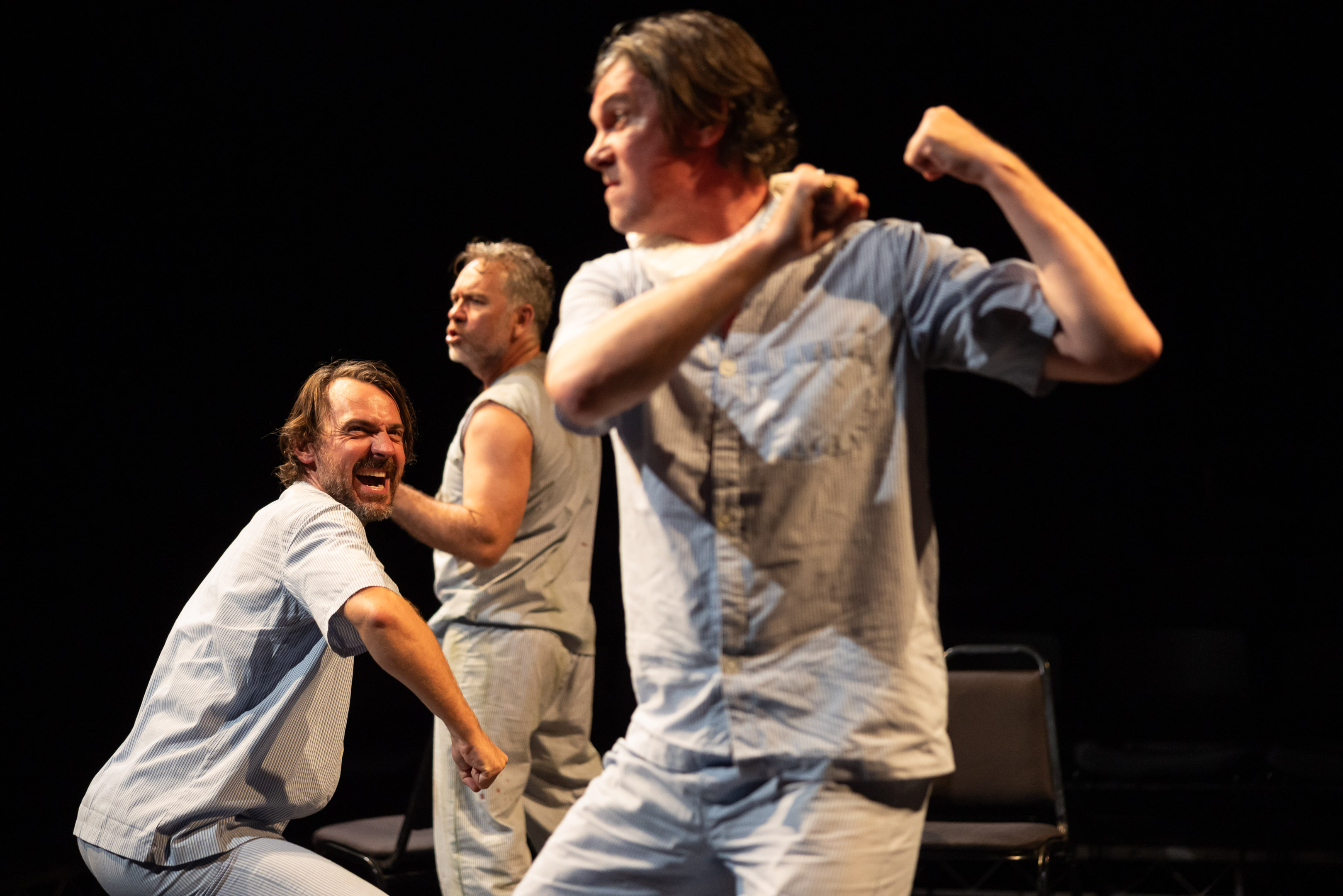
That’s because – after Claudia Haines-Cappeau’s beautifully evocative dance as Ophelia – there comes the title piece, an extended skit in which three actors who’ve played Hamlet are now going through rehab. It’s written by Schmitz, Cowell and Leslie, three actors who’ve played Hamlet and are now…

If the monologues might be autobiographical, the skit certainly isn’t – at least not if read as realism. It is, however, a puckish peep into the weirdly overwhelming experience that playing the Dane apparently is. As suggested, the play’s the thing.

Or can rehab help them realise that it’s just a thing? One thing among many.

The skit is terrifically amusing, a wonderful opportunity for three great comic actors to strut their stuff. It sparkles with insights into what it is to be a performer. (There are plenty of in-jokes about particular past productions, and these are marvellously mischievous, but they don’t dominate.) Frustration is expressed at directors and their determination to own a play by imposing some bizarre idiosyncratic vision. As one recovering Hamlet says, I’d love a director to say ‘Let’s just do the play.’ Also grumbled about are reviewers. Cowell’s character is disturbed that one reviewer described his Hamlet as mercurial. This observation hints at the sensitivity of performers, but it also left me wondering if the greatest tragedy in theatre is not Hamlet, but that reviews are taken seriously.

Another provocative observation is that we romanticise Hamlet, which I took to mean we overvalue both the character and the performance of that character. One of the sessions at the rehab centre is entitled Offstage Women. It seems to refer to the play’s representation of women and how Hamlet himself mistreats them. It also refers, I think, to how male actors lost in the role mistreat the women in their own lives. I make no comment about the impact playing the famous protagonist might have on an actor’s personal relationships, but I find fascinating the suggestion that audiences are asked to admire Hamlet. Perhaps an actor needs to find that connection, but as an audience member I’m more than happy to dislike a protagonist or, more precisely, to hold such a personal response to a character in abeyance. (Perhaps, like the suspension of disbelief, it’s the key to a mature appreciation of fiction.) Take Macbeth and, to a lesser degree, Lear: the achievement of these tragedies is that we’re presented a monster yet, beneath all, we still see their humanity. (I admit this probably doesn’t accurately describe what’s happening in, say, Othello or Romeo & Juliet – so perhaps there are audience members out there who do actually like Hamlet as a person.)

That’s the joy of Hamlet Camp, it’s a deliciously playful invitation to thought.  

Paul Gilchrist

Hamlet Camp by Brendan Cowell, Ewen Leslie and Toby Schmitz

Presented by Carriageworks and Modern Convict

At Carriageworks until 25 Jan

carriageworks.com.au

Image by Daniel Boud

Hamlet

4 Dec

Famous plays have baggage. They have a past. Which is, of course, what makes them interesting to a lot of people.

Having been produced so many times, each new production can end up feeling like a commentary on previous productions. (It’s one of the reasons I like new work. I don’t like to see that much theatre about theatre.)

When you produce Hamlet, a reasonable percentage of audience members will ask ‘Is this about Hamlet or Hamlet?’

Montague Basement’s adaption of Hamlet is a snappy, engaging 90-minute, five-character version. We lose (to name a few) Gertrude, Laertes, Fortinbras, Rosencrantz , Guildenstern and the players. Ophelia and Gertrude are melded and the result is curious. Horatio, Laertes, Rosencrantz and Guilderstern are combined and the result is intriguing. And the structure is altered; there aren’t just cuts, there are also rearrangements. And the end………..

If you’re familiar with the text the changes are massive, and ultimately stimulating. Do they simply make the play easier to perform? Or is there a method……… I won’t say to the madness (because friends who weren’t familiar with the play very much enjoyed it. And I’ll add that a woman in the foyer said it was the funniest Hamlet she’d seen.)

Hamlet MB Program-7314

Performances are high quality. Patrick Morrow as Polonius is very funny. Christian Byers as Hamlet is antic, energetic and highly watchable. Lulu Howes as Ophelia is terrific (especially considering the challenging decision to have her witness her father’s death, and then alone on stage descend into madness and commit suicide in a handful of minutes.)

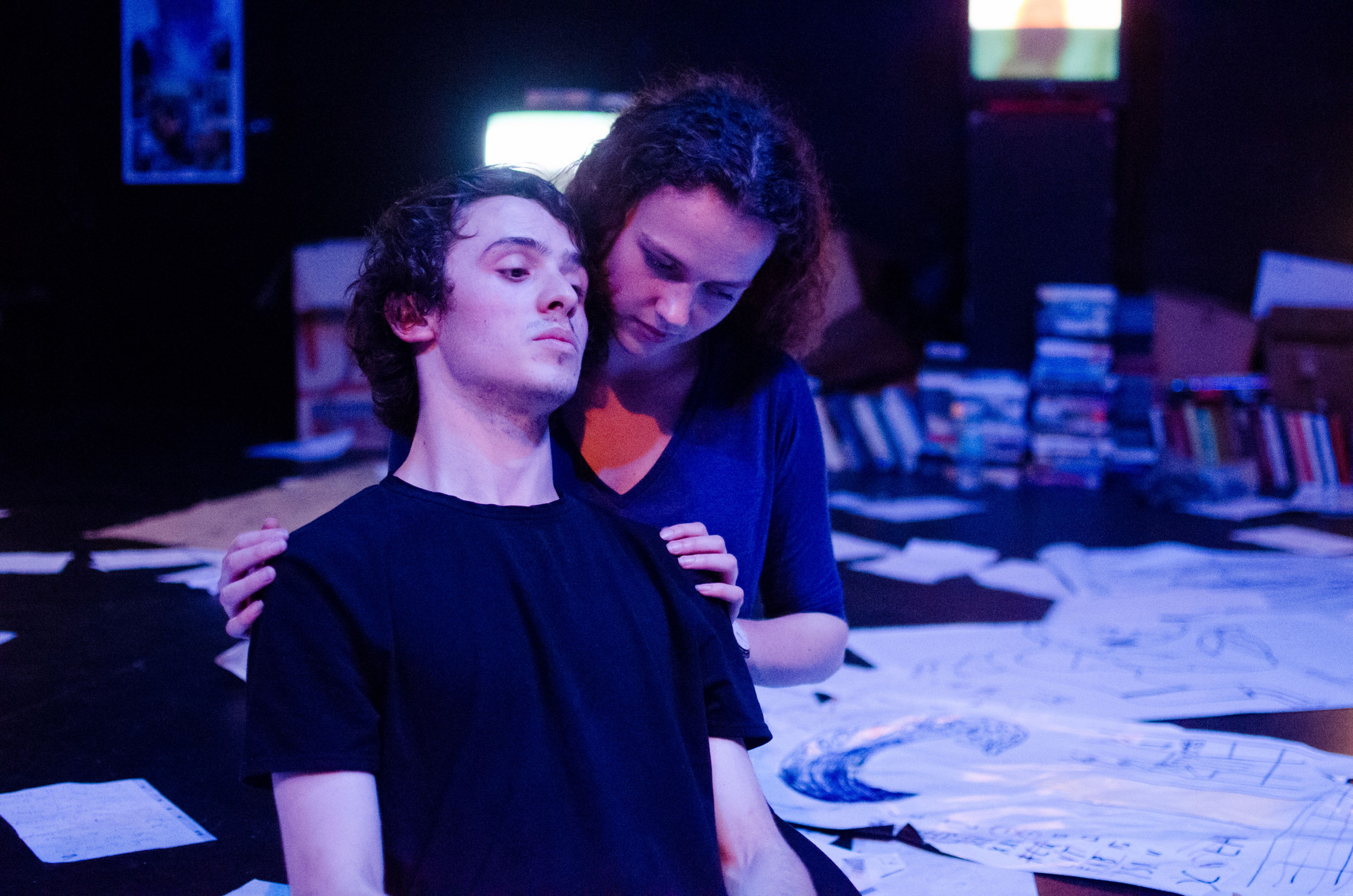
Director Saro Lusty-Cavallari’s set, with its TV screens and strewn paper, suggests both a teenager’s bedroom and the weight of the thousands of previous productions.

I did miss Laertes and Fortinbras, who are such foils to Hamlet. (The latter especially lifts the play into the political realm; “madness in great ones must not unwatched go”). I did miss Gertrude (especially her response to the lost Ophelia; “I will not speak with her.”) And, most of all, I missed……… but, of course, talking this way only highlights the power of text, and the beguiling allure of the past.

Veronica Kaye

Hamlet by William Shakespeare (sort of)

PACT til Sat 5 Dec

tix and info here