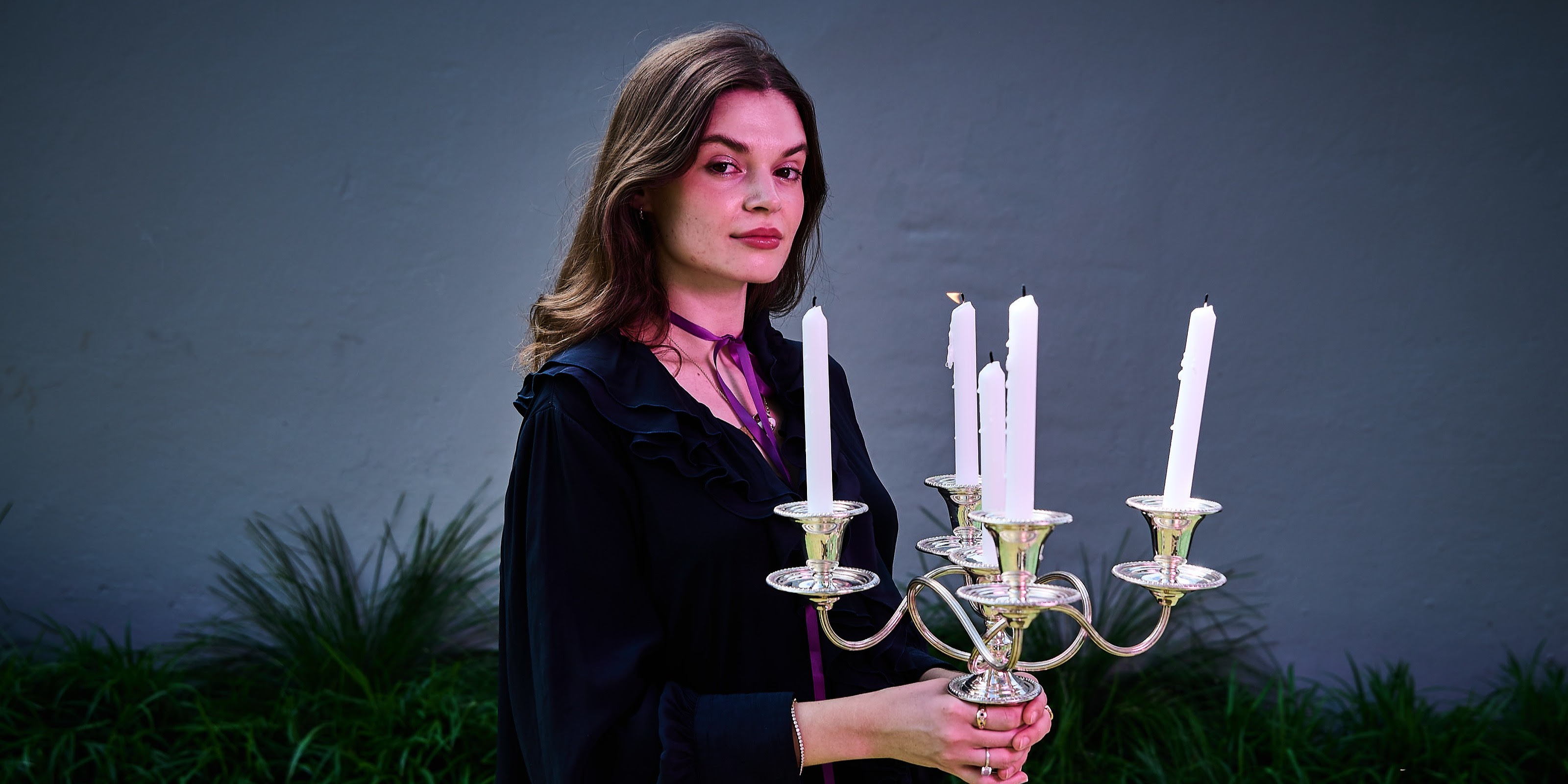
This is a work of craziness and true comic commitment.
Set in the late nineteenth century, it tells the story of a family of women intent on summoning a spirit via a séance.
I call it a story – and for the show’s 50 minute duration, the plot works very effectively – but it’s really just a fast moving vehicle for some humorous hijinks.
It’s a three hander, written by Fia Morrison, and performed by Morrison, and her co-collaborators Alison Cooper and Georgia Condon.
There’s a lot of doubling, and this adds to the show’s enormous verve.
All three performers display great physicality, and Morrison herself excels in the type of magical facial expression that’s gloriously hyperbolic and glowing with mischievous energy. (Rather than the Theatre of Authenticity, this is the Theatre of Audacity, inviting an audience response of I can’t believe you’re actually doing that!)
All three performers have thrilling, distinctive vocal styles, and use these to mine and shine the comic nuance of Morrison’s lively script. Cooper is particularly adept at the throwaway gag. (Admittedly, at times, I lost lines from all three actors, but in a show like this, that’s always a risk courted for the sake of sheer exuberance.)
The historical setting makes sense of the focus on seances and the supernatural. The world weariness of fin de siècle society, with its rejection of traditional religion and its growing awareness of the inadequacy of any substitutes, encouraged the most audacious of spiritual experiments.
But the setting also facilitates key aspects of the show’s humour and impact.
Somewhere in the last hundred years or so, the acting fraternity has developed a way of portraying (faux) late Victorian and Edwardian historical characters, one epitomised by a thoroughly declarative vocal style. (It’s one of the styles employed in this production.) Where does it come from? Perhaps it’s our shared response to amateur theatre’s penchant for quaint old drawing-room dramas. Or perhaps, more broadly, it’s modernism’s response to the era that preceded it. Virginia Woolf famously quipped “on or about December 1910, human character changed”. But from wherever the trope derives, the declarative style we routinely give to historical characters is a delightful and deliberate denial of their inner life. And in this consciously comic erasure of psychological complexity, the performers themselves gift us a playfully subversive reminder of genuine human vitality.
Paul Gilchrist
Mummy, I’m Scared by Fia Morrison
Morrison was mentored by Mish Grigor, and the piece is presented as part of ArtsLab: Reverb, a program from Shopfront Arts that showcases the talents of emerging artists.
Until 12 April at Shopfront
shopfront.org.au (for tix and full program)
 Theatre Red