Tag Archives: New Ghosts Theatre Company

Born on a Thursday

5 Dec

This is a homage, dusted with nostalgia.

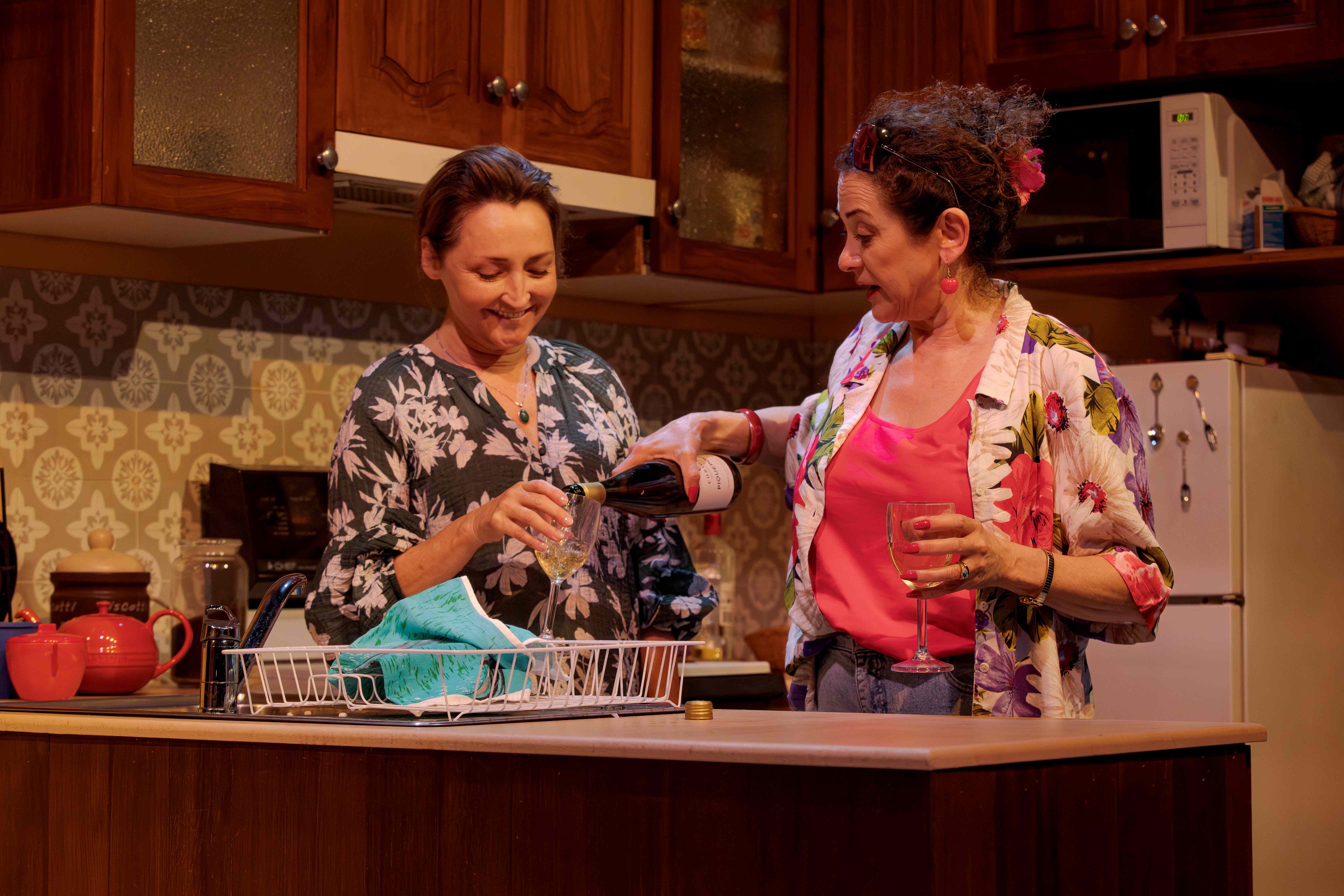
Written by Jack Kearney, Born on a Thursday is set in the late 90’s in western Sydney, and tells the story of single mum Ingrid. Her son, Isaac, has been left mentally incapacitated by a rugby league injury. Her daughter, April, has unexpectedly returned home after a long period of silent absence.  

The pace is gentle, akin to a glacier, whose majestic, barely perceptible movement is only apparent through the occasional violent smashing of things.

It’s also a story built from the withholding of information. Why has April come home now? What actually happened to Isaac? Who was their father? Perhaps this builds suspense; perhaps it reflects the laconic, emotional reticence of the working class. Despite the piece’s length, a lot of these questions ultimately aren’t clearly answered, or when they are, these answers no longer really seem to matter. We’ve moved on, and are witnessing the power of resilience and the wondrous birth of hope. Despite the suggestion of sentimentality that warmly infuses the piece, it’s this sense of moving on that grants it verisimilitude. Not that the characters deliberately or consciously move on, not that we’re being glibly instructed we should leave the past behind – rather we’re being reminded that Life, whatever it is, is something that runs in only one direction.

Director Lucy Clements elicits excellent performances from her cast. As April, Sofia Nolan portrays an eminently watchable tension between fragility and strength. As Isaac, Owen Hasluck captures frustrated bewilderment sparring with youthful energy. James Lugton, as the loyal neighbour Howard, gives us a wonderful portrait of gentle, patient persistence. Deborah Galanos, as the wine guzzling Estelle, is hilarious: brash, assertive, yet delightfully changeable. As Ingrid, Sharon Millerchip moves fascinatingly from a no-nonsense coldness to the surprise of joy, the reward for tenacity and its unexpected twin, hope.

Thursday’s child may have far to go, but distance isn’t everything.    

Paul Gilchrist

Born on a Thursday by Jack Kearney

presented by New Ghosts Theatre Company and Old Fitz Theatre,

at the Old Fitz until 14 Dec

oldfitztheatre.com.au

Image by Phil Erbacher

Love

14 Mar

This is a fine production of a brilliant script. First performed in 2005, Love by Patricia Cornelius presents a love triangle between Annie, Tanya and Lorenzo.

Annie is a sex worker. Tanya and Lorenzo live off her earnings and, in exchange, give her what she needs. They give her affection, and protection. The only thing Tanya and Lorenzo seem to have in common, apart from a desire for Annie, is the demand that she continues to work and bring in the cash. Between Annie’s two lovers, we’re tempted to trust Tanya more, but we don’t automatically assume she’s morally superior to Lorenzo – and that’s indicative of the wonderful richness of the script.

Cornelius has a wonderful ear for the vernacular. These down-and-out characters speak in the highly-modal, subtlety-free assertions, repetitions and retractions which are the linguistic province of society’s rejects. In particular, Lorenzo’s ethical statements display the binary certainty of one only too familiar with perpetual reprimand. Cornelius offers the poetry of the underclass, of the inarticulate, and in its unflinching truthfulness, these characters are granted the dignity we too often deny their real life counterparts.

Director Megan Sampson elicits admirable performances from the cast.

Izzy Williams as Annie is poignantly vulnerable and naive, but tempers these qualities with a hunger for life that enhances the pathos of her situation.

Georgia-Paige Theodos as Tanya powerfully evokes the toughness and isolation of a woman marginalised for being who she is.

Rhys Johnson as Lorenzo is gloriously high energy, part puppy, part crocodile.

We’re presented a nuanced psychological portrait of each character, and an evocation of the fraught world in which they inhabit. It’s one of brutality, sometimes unthinking, sometimes not. The characters show little awareness of wider sociological or political issues; their marginalisation is so complete that they seem almost incapable of viewing themselves as victims. Only rarely is the myopia of their narrow world transcended: once, in Lorenzo’s cruel taunting of Tanya that society has a place for him, but refuses one to her; and in the final moments of the play, when Annie tries to make sense of what they are, in imagery that’s as surprising as it is sad.

Paul Gilchrist

Love by Patricia Cornelius

presented by New Ghosts Theatre Company,

at the Old Fitz until 21 March

oldfitztheatre.com.au

Image by Patrick Phillips

Iphigenia in Splott

14 Mar

Apparently, this is based on an “enduring” Greek myth, but whatever that myth is, it hasn’t endured in my myopic world.

But, unquestionably, Iphigenia in Splott is one of those gritty, working class British plays that Australian theatre loves. Effie has a drinking problem. And she’s aggressive, in the way those who have substance abuse problems, or are marginalised, sometimes are. She tells us about a couple of months in her life, and challenges us to see her as a someone of value.

In this colossal monologue, directed beautifully by Lucy Clements, Meg Clarke plays Effie, and does so wonderfully, finding the humour and sharing the heartbreak.

On the most obvious level, the piece is a powerful plea for empathy, a passionate and engaging reminder that the person you might want to avoid on the street is a person all the same. Effie acknowledges that this can be difficult, joking that she’s sometimes herself uncertain about her boyfriend’s claim to full humanity.

The piece also floats the idea that Effie’s problems are societal, that she is somehow representative of those who have suffered because of political mismanagement.

Written by Welsh playwright Gary Owen, it was first produced in Britain a decade ago, and perhaps it’s outgrown its origin. This is not a criticism of the piece per se, but a reminder, that like Greek myths, stories belong to their context. Effie talks a lot about “cuts”, and I can guess at the sort of policies she means, but the piece doesn’t give the background to assess whether these “cuts” are the result of hardhearted corruption, or were simply unavoidable. No doubt, it would’ve been far clearer to an audience in Cardiff in 2015.

Ultimately, Effie gives the impression that someone else is to blame for her situation, and that’s why she’s angry. But we’re also shown her making poor choices, and she herself criticises her boyfriend for complaining about all the shit on the street, turds he hasn’t picked up after his own dog.

It can be a mistake with a piece like this to assume the sole character is a truth-teller, some sort of Greek oracle. Drama works on the dynamic that no character has such a monopoly; that’s the form’s deeply humane vision. Only in the shallowest of drama is one character wholly right and the others wholly wrong. Monologue is no different. We’re not being asked if what Effie says is the Truth, but why it might be the Truth for her – that’s how we grant her the personhood she demands, and so deserves. (And, no, I’m not saying we don’t have a responsibility to help the marginalised, but am suggesting we shouldn’t confuse political engagement with simplistic readings of the dramatic form.)

Some audience members might thrill to Effie’s final dark, threatening statement, but it’s not some clarion call to action, but rather an expression of who she is, in all her pained bewilderment. If she is an oracle at all, she is in the way oracles enduringly are: their predictions will come to pass, but in ways far more disturbing and tragic than we can imagine.

Paul Gilchrist

Iphigenia in Splott by Gary Owen

Presented by New Ghosts Theatre Company

At Old Fitz Theatre until 22 March

http://oldfitztheatre.com.au

Image by Phil Erbacher   

sitting, screaming

3 Oct

This is a fine piece of theatre; it’s beautifully written and superbly presented.

Written by Madelaine Nunn and directed by Lucy Clements, it’s the story of Sam, a teenage school girl navigating what is (hopefully) the worse moments of her life. Dad has cancer and so mum has forgotten her. Her friendship circle has proven fragile. Sam is fraught and alone. Then a teacher, Mr David, begins to pay attention.

Nunn’s script is brilliantly crafted. Danger is hinted at gradually. Animal imagery lurks ominously amongst the everyday. Near Sam’s house, the ocean looms in the dark – loud, enormous, unceasing.

Sam’s teenage vernacular is pitch perfect. She has the glorious energy of youth and it’s frightening naivete.

It’s an one-actor show and performer Clare Hughes is absolutely extraordinary. Her Sam is utterly real, a spellbinding balance of brashness and vulnerability. Hughes (or is it Sam?) also evokes all the other characters; with a slight change of voice, a subtle physicality, she becomes each of the people in this young woman’s troubled world: her mother, the school counsellor, her best friend, her sick father, a gaggle of teenage girls, the loud mouth school boy – and Mr David. It’s a virtuoso performance.

Elsewhere I’ve written about the silencing of male voices in stories that indict misogyny. It’s an understandable response to the seemingly endless bellow of the patriarchy, but sometimes it can leave the female characters in a theatrical world in which their suffering seems oddly nebulous and ungrounded. By inadvertently questioning their grievances, it’s a creative decision that ironically can gaslight the very characters it aims to truthfully represent.

Nunn’s script is a thrillingly inventive response to this dilemma. Because Sam voices everyone in her world, it evokes her dreadful isolation but it also emphasises her power.  Mr David and the dickhead schoolboy are heard, their brutality is noted, but this is Sam’s story, and in its telling she embodies the courage that can slay the beast.

And, in having Sam voice everyone, the piece also magically positions her for a life-altering shock. Characters she gently mocks, who elicit parody and perpetual eyerolling, burst into unexpected fullness as she discovers genuine solidarity and sisterhood. It’s deeply moving and intensely inspiring.  

Paul Gilchrist

sitting, screaming by Madelaine Nunn

presented by New Ghosts Theatre Company

at Old Fitzroy Theatre until Oct 5

oldfitztheatre.com.au

Image by Phil Erbacher