Tag Archives: Gary Owen

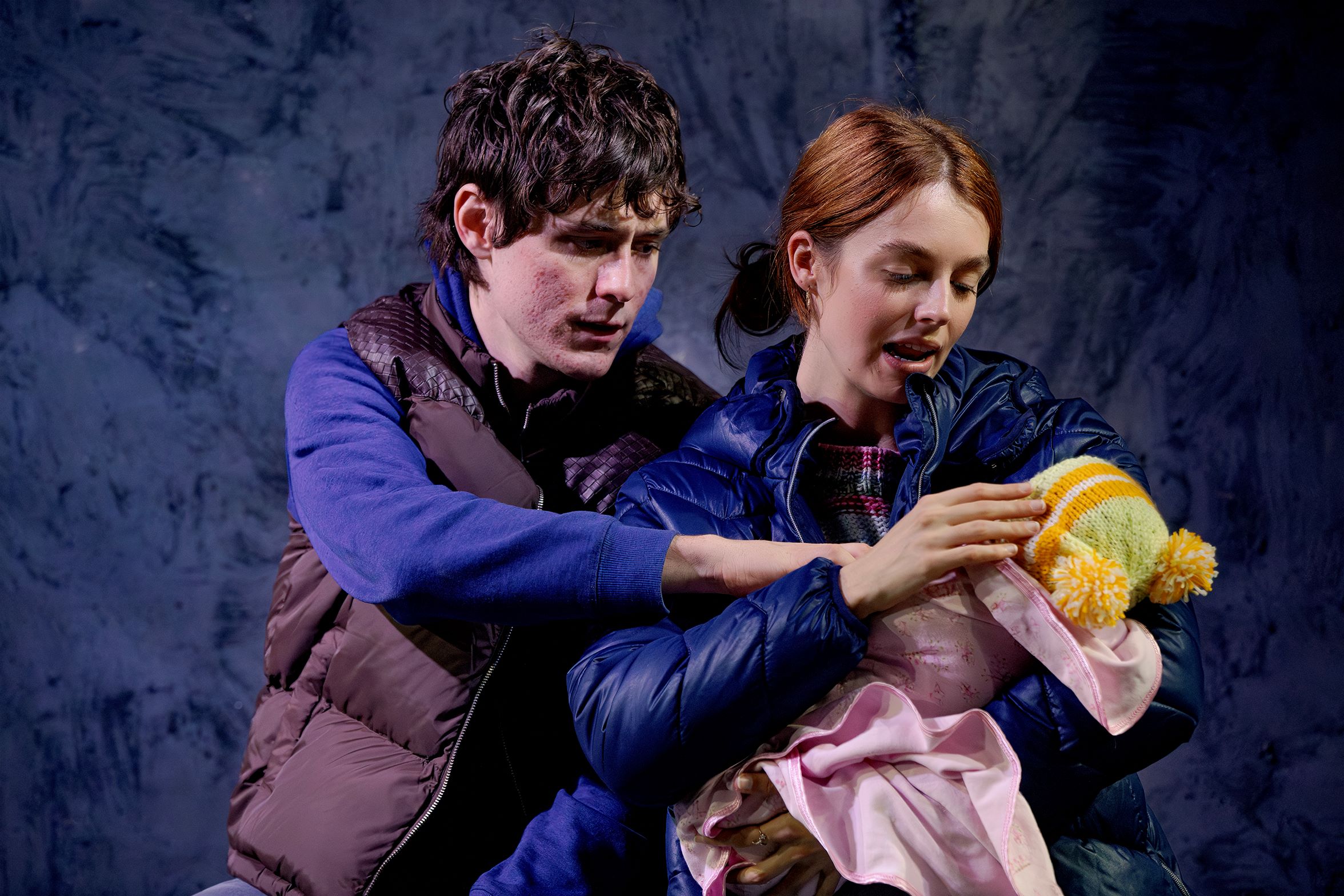
Romeo and Julie

18 May

This is a very funny and extraordinarily heart-warming love story.

Of course, the title tells us it will be some sort of love story. (Though no one in the play comments on the uncanny similarity between the characters’ names and those of their iconic forebears.)

Shakespeare’s play is a tale of star-crossed lovers (though it’s rarely described as ‘very funny and extraordinarily heart-warming.’) In what way are the two lovers in Gary Owen’s play star-crossed?

Well, Julie is academically gifted and from a upper-working class family.

Romeo is academically challenged and is an eighteen year old single dad with an alcoholic mother.

Julie will probably get into Cambridge and study physics.

Romeo didn’t finish school and can barely read.

Estelle Davis as Julie and Alex Kirwan as Romeo are absolutely superb. Both the attraction and the tension between the couple is evoked gently and with such attention to detail that their relationship feels utterly real. (And that verisimilitude is quite an achievement – because true love has always been where flat reality loses its recognisable solidity and evaporates into ethereality, taking flight as fairy dust.)

As Julie’s mother and father, Linda Nicholls-Gidley and Christopher Stollery are terrific, revealing the multifarious manifestations of parental devotion. Nicholls-Gidley perfectly encapsulates a spiky concern. Stollery offers a moving portrait of love as seemingly soft as water and, ultimately, just as unrelenting.

Claudia Barrie excels as both director and performer. As Romeo’s mother, she finds playful humour in the character, while still projecting the self-protecting hardness of the wounded soul.

It’s unlike me to have said so little about the script so far. Usually that’s a sign I didn’t like it much; my policy always being, if you can’t say something nice, say something about French Existentialism.

But Owen’s script is beautifully structured and his dialogue sparkles with truth.

And there are two motifs I’d like to consider.

The first is the Theory of Everything that Julie hopes to discover when she is a physicist. A Theory of Everything would be one that reconciles relativity with quantum mechanics, a theory that harmonises what works with the big with what works for the small. But, as one of the characters asserts, the small can be the big. In a play about parenthood, can there be a better description of that awesome, aching responsibility?

The other motif is class consciousness. The class difference between the lovers and their respective families certainly exists, but there’s a greater divide. There’s the world all these characters inhabit and then there’s the world of the wealthy and those who go to Oxbridge. Owen’s treatment of this divide at the end of the play is especially provocative. I suspect some audience members may choose the offered option of a feel good sentimentality. But, in this story of aspiration, something else is offered as well, something far less comforting: some stinging questions about the source of our values and the strength of our loyalties.

Paul Gilchrist

Romeo and Julie by Gary Owen

presented by Mad March Hare Theatre Company, in association with bAKEHOUSE Theatre Company,

at KXT on Broadway until 23 May

kingsxtheatre.com

Image by Phil Erbacher

Iphigenia in Splott

14 Mar

Apparently, this is based on an “enduring” Greek myth, but whatever that myth is, it hasn’t endured in my myopic world.

But, unquestionably, Iphigenia in Splott is one of those gritty, working class British plays that Australian theatre loves. Effie has a drinking problem. And she’s aggressive, in the way those who have substance abuse problems, or are marginalised, sometimes are. She tells us about a couple of months in her life, and challenges us to see her as a someone of value.

In this colossal monologue, directed beautifully by Lucy Clements, Meg Clarke plays Effie, and does so wonderfully, finding the humour and sharing the heartbreak.

On the most obvious level, the piece is a powerful plea for empathy, a passionate and engaging reminder that the person you might want to avoid on the street is a person all the same. Effie acknowledges that this can be difficult, joking that she’s sometimes herself uncertain about her boyfriend’s claim to full humanity.

The piece also floats the idea that Effie’s problems are societal, that she is somehow representative of those who have suffered because of political mismanagement.

Written by Welsh playwright Gary Owen, it was first produced in Britain a decade ago, and perhaps it’s outgrown its origin. This is not a criticism of the piece per se, but a reminder, that like Greek myths, stories belong to their context. Effie talks a lot about “cuts”, and I can guess at the sort of policies she means, but the piece doesn’t give the background to assess whether these “cuts” are the result of hardhearted corruption, or were simply unavoidable. No doubt, it would’ve been far clearer to an audience in Cardiff in 2015.

Ultimately, Effie gives the impression that someone else is to blame for her situation, and that’s why she’s angry. But we’re also shown her making poor choices, and she herself criticises her boyfriend for complaining about all the shit on the street, turds he hasn’t picked up after his own dog.

It can be a mistake with a piece like this to assume the sole character is a truth-teller, some sort of Greek oracle. Drama works on the dynamic that no character has such a monopoly; that’s the form’s deeply humane vision. Only in the shallowest of drama is one character wholly right and the others wholly wrong. Monologue is no different. We’re not being asked if what Effie says is the Truth, but why it might be the Truth for her – that’s how we grant her the personhood she demands, and so deserves. (And, no, I’m not saying we don’t have a responsibility to help the marginalised, but am suggesting we shouldn’t confuse political engagement with simplistic readings of the dramatic form.)

Some audience members might thrill to Effie’s final dark, threatening statement, but it’s not some clarion call to action, but rather an expression of who she is, in all her pained bewilderment. If she is an oracle at all, she is in the way oracles enduringly are: their predictions will come to pass, but in ways far more disturbing and tragic than we can imagine.

Paul Gilchrist

Iphigenia in Splott by Gary Owen

Presented by New Ghosts Theatre Company

At Old Fitz Theatre until 22 March

http://oldfitztheatre.com.au

Image by Phil Erbacher