Tag Archives: Old Fitzroy Theatre

Tick, Tick… Boom!

23 Jul

We pursue personal success until we find something of actual value to do with our lives.

In Tick, Tick… Boom! by Jonathan Larson, the protagonist wants to be a successful Broadway composer. The tick, tick he hears is time ticking away until the boom of his 30th birthday. With the stakes so very low, only certain audiences will find this set-up emotionally engaging.

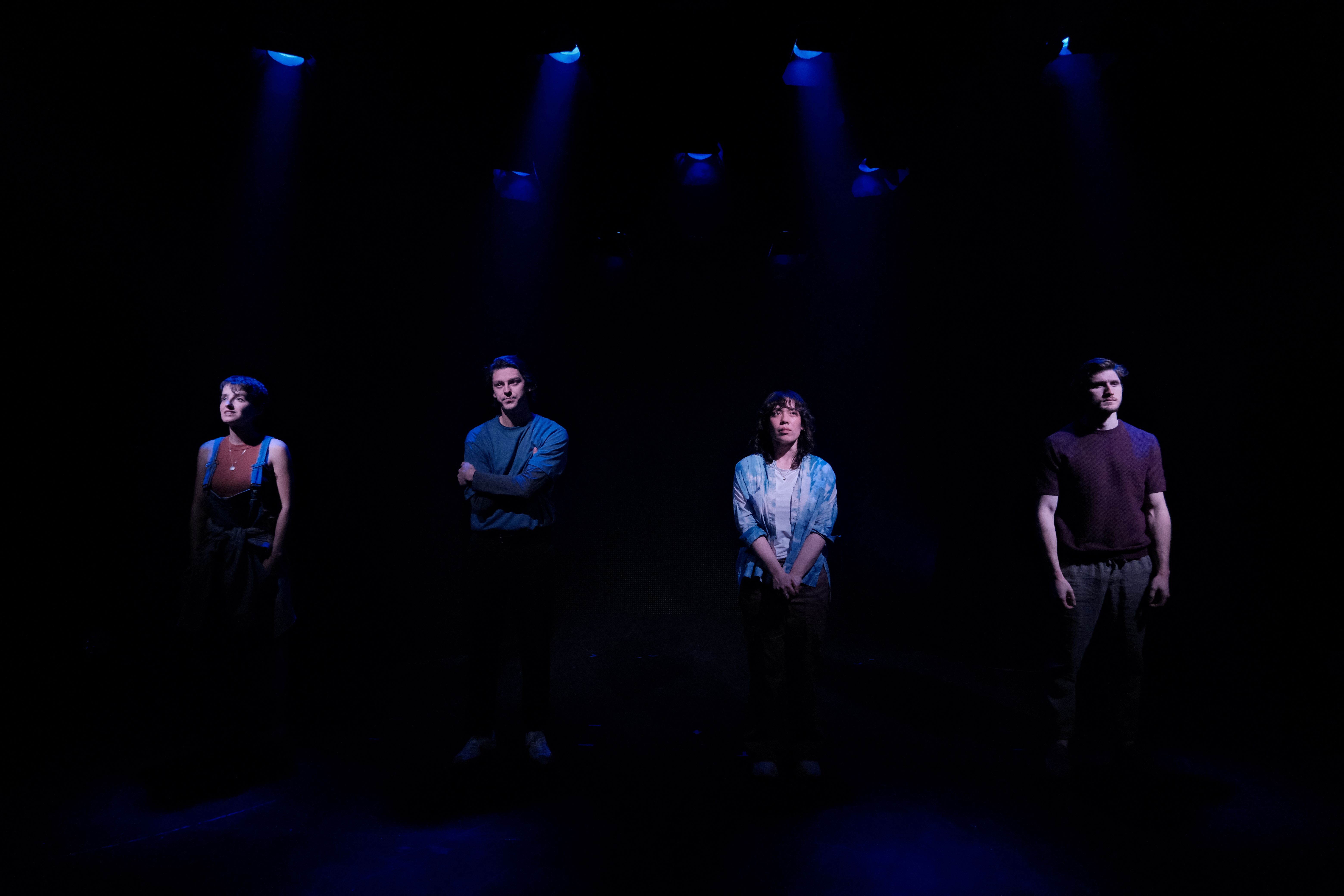
But it’s a musical, so the story’s not really why we’re here. And it’s a micro-musical: cast of three, band of three, all in the cosy environment of the Old Fitz. The fact that such a genre even exists is a delight, and this production, directed by Kurtis Laing, does serious hardcore delight.

Larson’s music is good fun and, under the musical direction of Iris Wu, the band is super tight. (Volume issues meant that occasionally I couldn’t make out the lyrics. But, extrapolating from my earlier comments about the show’s thematic concerns, I’m not sure that’s much of a problem.)   

Performances by Brodie Masini, Tessa Olsson, Hamish Wells are wonderful, both vocally and physically. With the aid of movement director Juliette Coleman, Laing’s use of space is superb – it’s both beautiful and bubbling with energy. Accidentally open the door to the theatre from the pub outside and it’d seem as though you’d sprung the lid of a jack-in-the-box; unexpectedly jumping out at you would be a deliberate, orchestrated exuberance.

I try to respond to theatre in a way that suggests the producing company hasn’t simply outsourced the writing of their marketing copy to me. I try to look at dramatic structure and consider the overall meaning of the piece. It’s not an approach particularly suited to a show like this. It’d be the equivalent of attempting a dramaturgical analysis of sunlight on sea spray. (Excepting, of course, that this particular evanescent sparkle is the result of considerable artistic talent.)

Paul Gilchrist

Tick, Tick… Boom! by Jonathan Larson

At Old Fitz until 26 July, as a late night show

oldfitztheatre.com.au

Image by Robert Miniter  

Cut Chilli

12 Jul

Despite its serious theme, this has a sitcom structure and depth.

Jamie (Ariyan Sharma) was born in Sri Lanka and was adopted by a white Australian couple. Now, prompted by his girlfriend, he wonders whether he was stolen rather than saved.

The play works on some very clear dichotomies: young versus old; global majority versus white. However, there are unities: everyone’s comfortably middle class, and everyone’s subject to the same mercilessly shallow characterisation.

Writer Chenturan Aran has thrown the cast an extraordinary challenge – which they gleefully accept.

Let me consider two examples.

Noel Hodda plays Jeff, Jamie’s adopted uncle. Jeff’s the sort of jovial middle-aged man who is casually racist and who invariably bores or offends by riding hard his hobby horse that political correctness has gone too far. To find a watchable humanity in this character is quite an achievement.

Kelsey Jeanell plays Zahra, Jamie’s girlfriend. Zahra has a podcast called Decolonialise (?) and studies Critical Race Theory (CRT). She offers a wildly misleading definition of CRT – race is a social construct that deliberately perpetuates oppression. This assertion about the plague of racism is undeniably correct, but the form of CRT that Zahra acts out left me feeling it was, in fact, the disease it purports to diagnose. Zahra constantly tells everyone else that what they say and do is wrong. It’s breathtakingly self-righteous. (Perhaps I’m just pretending it’s parody – but it’s such a tragically impoverished vision of an ethical life that I can’t help myself.) It’s a feat to keep an audience onboard with a character like this and Jeanell is to be commended.

The play hinges on the question Who am I? It’s a question that currently predominates in our theatres. (I’m guessing the question What is to be done? has been made redundant by the superhuman apolitical certainty of characters like Zahra.)

In some ways, there’s an intriguing conservativism about the whole thing. It focuses on an origin story and it’s deeply conscious of the past. But, as Zahra reminds us, one reason we can’t be oblivious to the past is that trauma is handed down through the generations. And dismissals of history are appropriately given short shrift. Jamie’s adoption mother (played with a terrific unsettling ethereal facileness by Susie Lindeman) says You can’t change the past – and it’s a statement which impresses with both its obvious truth and its disturbing glibness. Similarly, her spiritual practice of radical presence (presentness?) is little more than an euphemism for moral irresponsibility.

The script could do with a trim. However, as an invitation to consider how we might build a better world, it’s wonderfully provocative.

Paul Gilchrist

Cut Chilli by Chenturan Aran

at Old Fitzroy until 27 July

oldfitztheatre.com.au

Image by Phil Erbacher

King James

17 Jun

This is a wonderful production of a wonderful play.

It’s also one of the funniest, most joyous, serious plays I’ve seen.

I mean this: though grounded in realism, the territory explored by Rajiv Joseph’s King James is exuberance.

Two men become friends through a shared enthusiasm for the Cleveland Cavaliers and its star player LeBron James. These men need each other, but no relationship remains static or fixed.

It’s sometimes suggested that male friendships are shallow because they consist of two men looking in a similar direction rather than at each other. But there’s something to be said for not staring too closely at the other person. After all, there is no essential truth to see. The assertion I know you completely is not love; it’s control. All of us change, and any attempt to definitively sum up or categorise an individual is misguided. Each of us is more a happening than a thing. The essential you is just a careless, or convenient, construct.

The scene in which Joseph has the issue of race raise its ugly head is a masterclass in this type of richness in dramatic writing. To witness these two extremely likable characters tear at each other is heart-rending. In any play, the conflict can represent a wider cultural tension, but if we don’t feel it in all its irreducible messiness in the actual characters, if we read it solely as a critique of society, what’s the real takeaway? That individuals are of little value. The glory of theatre is that it’s fundamentally existential; it knows that Life is what happens to you while you’re otherwise occupied maintaining some grand narrative. (There was a logical consistency in the Puritan dislike of theatre. They understood what it had in common with the Prince of Darkness; like the Devil, Life is in the details.)

Directed by Bali Padda, the performances by Aaron Glenane and Tinashe Mangwana are brilliant. They portray beautifully characters who are gorgeously vulnerable, the desire for an ongoing relationship carefully and doggedly navigating friendship’s envies, awkwardnesses and sensitivities. This wary gentleness is brought into glorious relief by tremendous bursts of jubilant energy (including one extraordinarily fun scene change.) Designer Ian Kanik does a terrific job creating the play’s two settings in the Old Fitz space (and filling them with some oddly specific, but absolutely, crucial props.)

Joseph’s dialogue is superb. The affectionate raillery between the two men is pitch perfect. Who is the G.O.A.T? Michael Jordan or LeBron James? And equally delightful are the hyperbolic expressions of fanatic admiration. The claim that James is capable of teleportation nails the glee with which sports fans manage to find glimmers in a world where others see only triggers.

But, no, don’t worry. You don’t need to know anything about basketball. You don’t even need to like sport.

The joy of this show is utterly infectious.  

Paul Gilchrist

King James by Rajiv Joseph

at The Old Fitz until Jun 29

oldfitztheatre.com.au

Image by Daniel Asher Smith

No Love Songs For Lady Basses

15 Jun

This is a beautiful show.

It’s an autobiographical sharing. We’re currently seeing a lot of this form on our stages. I’ve previously expressed curiosity that this major shift in our theatrical language seems to be going unnoticed. I don’t mean these sort of pieces aren’t getting positive responses. (Usually they do, and usually they should.) What I mean is that the common perspective on what’s happening in our theatres is partly erroneous. The popular position could be summed up like this: Until recently, only certain privileged groups have been permitted to tell their stories on our stages; other groups have not, and now it’s their turn. This is a perfectly valid historical statement, but it slips in, unnoticed as it were, the assumption that theatre is traditionally autobiographical.  

Written and performed by Sheanna Parker Russon, No Love Songs For Lady Basses tells of her journey to accept she is a woman and how that has been received in the show business industry. Because that industry sees its role as storytelling, this show becomes, among other things, her story about her story. It’s this explicit awareness that makes the show insightful, wise and very funny.

Her conversations with a straight, middle-aged, cis male director are a comic delight – and only partly because he’s reduced to a sock puppet.

The songs are superb. Written by Lillian M. Hearne, they’re replete with gorgeous melodies. The lyrics by Parker Russon are both hilarious and moving. Accompanied by Hearne and Aisling Bermingham, Parker Russon’s performance of them is magical.

Director Cassie Hamilton helps Parker Russon navigate the whole fourth-wall-down-meta-theatricality of the thing in a way that allows humour and honesty to co-exist, and to nourish each other.

When Parker Russon speaks of the challenges facing the trans community you’d have to have a hard heart to feel we shouldn’t do better. But there’s a mindful paucity of rage. She gently jokes that her supposedly non-woke approach makes her more appealing to conservatives and the politically timid, but she’s right. Just as we’ve unconsciously come to assume theatre is autobiographical, we’ve come to assume anger equates with a commitment to change. It doesn’t. Anger is a perfectly understandable response to injustice, but it’s not the perfect tool for ending it.   

The inner voice that tells Parker Russon she is a woman also tells her to be nice to herself. It’s indicative of the spirit that infuses this piece, a glorious generous-heartedness.

Paul Gilchrist

No Love Songs For Lady Basses by Sheanna Parker Russon

At Old Fitz, as a Late Show, until 16 June

oldfitztheatre.com.au

Image by Jamie James

Isolde & Tristan

9 May

If you’re familiar with the legend, you’ll know it’s usually told as a tale of passionate romantic or sexual love. You’ll also know that the names in the title are usually presented in the reverse order. It’s a clue.

In this version by Esther Vilar, Tristan transports Isolde by boat to the man she will marry, Marke, King of Cornwall. The marriage is political; it will supposedly cement peace between warring Britain and Ireland. Trouble is, the conflict’s been long and dirty, and apart from anything else, Tristan has killed Isolde’s previous betrothed.

But isn’t desire wild and irrepressible? That’s the usual point of the legend. Tristan and Isolde become lovers. Don’t tell Marke.

Vilar’s version of the story is the most satisfying dramaturgically I’ve seen, and her carefully structured script forefronts the politics.

It fits: the two islands off the European mainland have had a long, horrible history.

And, though love is universal, so are cruelty and revenge and hate and resentment and fury and retaliation and retribution. Director Damien Ryan and designer Bernadette Ryan highlight the perpetuity of these human experiences by an inspired use of costumes and props; the play begins grounded in what appears a medieval world but, gradually, modern anachronisms slip in, and by the conclusion we can’t pretend this is merely a barbarism we’ve outgrown.

All the action occurs on the boat, and set designer Tom Bannerman has achieved the extraordinary by making this work in the Old Fitz space.

Opera singer Octavia Barron Martin and pianist Justin Leong accompany the performance, creating a theatrical world of magic, emotion and true grandeur.

Ryan’s cast are magnificent.

Tom Wilson as Tristan plays his character’s arc with wonderful subtlety; it’s fascinating to watch the incremental movement from distant superiority to passionate engagement.

Sean O’Shea’s Marke is brilliant. Pompous, ineffectual, self-conscious, it’s an hilarious and painfully insightful portrait of the privileged middle-aged man.

Isolde is the toughest part. Both boldness and reflection, impetuosity and calculation must exist simultaneously, and these tensions must be suggested to the audience while believably going unnoticed or disregarded by the other characters. Emma Wright is absolutely superb as she navigates the complexities of this role.

So, that reversal of the names in the title? What sort of subversion is going on there? I wish I could write more, but the spoiler rule is so named because it always spoils my argument. (Reviewers might have the last word, but we don’t really get to write about the last scene.) Does the title hint at a subversion of the patriarchy? Or does it, in effect, suggest that and even more – a subversion of a bigger, better, more beautiful dream? I think so; after all, that’s what great drama does.

Paul Gilchrist

Isolde & Tristan by Esther Vilar

at Old Fitzroy theatre until June 1

oldfitztheatre.com.au

Image by Kate Williams

Sotoba Komachi 

13 Apr

This is a beautiful play, wonderfully presented.

Despite being only 45 mins in length, it’s fantastically rich.

Written in the early 1950’s by Yukio Mishima, and inspired by traditional Japanese Noh theatre, it’s a meditation on time, ageing and beauty.

A young poet meets a 99 year old woman in a park, late at night. The opening sequence, which juxtaposes the ancient woman collecting cigarette butts with young lovers seeking the ephemeral pleasures of sexuality, brilliantly introduces the play’s concerns.

Though sourced from the Japanese, the play reminds me of Thomas Browne’s Urn Burial, and all those artists of the European late medieval and renaissance eras who knew that Death underpins Life, that Change grants meaning to Constancy. Think those shadowy still life paintings juxtaposing flowers and skulls. It’s not morbidity, but honesty … and the Truth will set us free. It’s a privilege to see a piece like this in our anglophile Australian theatre, to be shown how another culture has discovered similar treasures.

Susan Ling Young is magnificent, in one instant an aged woman, in another the young woman of eighty years earlier.

Wern Mak is utterly compelling, delicately balancing the cynicism of the disappointed young man with the wonder of the poet learning to see unexpected beauty.

Director Jeremi Campese pitches the piece perfectly between humour and suspense, and aided by choreographer Artemis Alfonzetti, complements the simple lucid language with heartbreakingly graceful movement. The scene in which the entire cast dance – at a ball eighty years gone but eternally present – is theatrical gold.

Paul Gilchrist

Sotoba Komachi by Yukio Mishima

at Old Fitz, as a late night show, until 13 April

www.oldfitztheatre.com.au

Image by Karl Elbourne

Bengal Tiger at the Baghdad Zoo

20 Apr

This play by Rajiv Joseph premiered in the US in 2009 and won the Pulitzer in 2010.

Bengal Tiger at the Baghdad Zoo is beautifully rich and multi-leveled. (Intriguingly, the program note tells us we will ‘get no answers’. A warning? An assurance?)

Set in 2003 in Iraq, it’s not naturalism. It’s got talking animals. And ghosts. And talking animal ghosts.

Poetically, it’s fascinating. The line by line level is engagingly colloquial and profane (fuck yeah bitch!), but take a step back and there are evocative recurring motifs. Ghosts that symbolize trauma and guilt. Odd golden objects that reflect skewed values. A zoo that suggests lives lived too small or simply wasted (‘Zoo is hell’). Hands, whole and broken, that are emblematic of our ability to both build and destroy. Talk of God that represents the quest for both ultimate meaning and culpability. And the tiger itself? The nature of violence and the awesome mystery of the created world. (Tyger, Tyger burning bright?) This cluster of motifs invites speculation about the links between creation and destruction, consequences and responsibility.

Maggie Dence in BENGAL TIGER AT THE BAGHDAD ZOO (c) Kate Williams

Photo by Kate Williams

Director Claudia Barrie’s production is powerful theatre, visually and linguistically exciting. The entire cast is terrific. Maggie Dence as the tiger is gloriously imperious; her imposing presence injects the character’s existential angst with a fascinating, and very funny, tension. Josh Anderson and Stephen Multari, as American soldiers, amusingly and movingly capture their characters’ inability to deal with the complexity of the situation, and their complicity.  Andrew Lindqvist plays an Iraqi translator and one time gardener and topiarist, a creator of hedge animals in a tyrant’s garden (‘God likes gardens.’) He gives a sensitive portrayal of a gentle, intelligent man, a foil to the invading foreigners, and an example of one more poor soul caught up in Big History. Tyler De Nawi as Saddam’s twisted son is charismatic and dangerous.

Isabel Hudson’s masks*, aided in their impact by mask coach and performer Aanisa Vylet, are a highlight. They create a world that is half-dream, half-nightmare. They’re a reminder that Creation, artistic and divine, has elements of both. For what is Creation, but a dominance that only ends with a frightening, fraught letting go?

Paul Gilchrist


Bengal Tiger at the Baghdad Zoo by Rajiv Joseph

at the Old Fitz til 6 May

tix and info here


*created from templates provided by Wintercroft Masks.

Binary Stars and Best Lives

30 Mar

What stories do we tell ourselves? Living in a pluralistic society, we’re well aware there’s more than one possible narrative.

It’s a choice, of course. Samantha Hill’s charmingly eclectic Binary Stars and Best Lives outlines some of the many, many options. There are indigenous stories, Ancient Greek myths, astrophysics, particle physics, New Age mantras, and the Aussie Everyman banter of the TV presenter.

How do you choose? The play amusingly suggests some stories are problematic. The Ancient Greek myth that explains the creation of the constellation the Pleiades is clearly misogynistic. But other narratives can be more insidious, promising personal empowerment but delivering a crippling sense of isolation and guilt. (For example, a mantra that says You can achieve anything if only you try quickly turns on its user and becomes You haven’t achieved so it must be your fault.) In choosing our narratives, we must choose wisely.

But there’s also a political battle for the control of the narrative. Tell yourself whatever story you like in your head, but we’re creatures of culture, and must live in a social world. The play explores several examples of this tussle to control the story. Cleverly subverting the Uncertainty Principle, any fascination with the indeterminate nature of particle reality takes on a wholly different importance when discussed by Schrödinger’s cat herself. In a similar exploration of hegemony, Babe understands that her troubled relationship with her TV celebrity husband will be discussed publicly, but knows only too well which of the two of them has the greater power to shape the way events are perceived.

redline3

Babe, and her world of domestic violence, is an echo of the current main stage production at the Old Fitz, Crimes of the Heart. And that’s an aspect of the New Fitz program of which this play is a part: contemporary Australian writers responding to existing works. I’m not quite sure what to make of the idea: is compulsory intertextuality simply an acceptance of the realities of the cultural landscape? Or is it an attempt to control the narrative*?

Whatever the case, the Old Fitz has provided a space for the cast and creatives behind Binary Stars and Best Lives to make a fun and thought-provoking new work.

Paul Gilchrist


Binary Stars and Best Lives by Samantha Hill

Directed by Michael Abercromby

at the Old Fitz til 8 April

tix and info here


*which is why I write about theatre.

Crimes of the Heart

22 Mar

This is a heart-warming comedy.

Though, I do declare, it took me some time to pick the tone. Which is sort of weird, since I usually find any play in which the actors speak in an accent other than their own rather funny. (Maybe I’m just a country hick.)

Crimes of the Heart by Beth Henley is set in the South of the USA. It was first produced in 1979 and it won the Pulitzer in 1981.

It’s the story of three sisters facing one hell of a bad day.

CRIMES OF THE HEART (c) Rupert Reid

Photo by Rupert Reid

Director Janine Watson’s production has class. The set by Jonathan Hindmarsh looks terrific. The cast are great fun to watch, creating kooky, vivacious, engaging characters.

Some would call these characters Larger-than-Life, but I find the phrase rather parochial; Life is plenty big enough to fit all we can ever throw at it.

The phrase a ‘bad day’ is also problematic, but in this case because it’s a vast understatement. On this particular day, Babe (Renae Small) has just shot her husband and faces prison. Her glamorous sister Meg (Amanda McGregor) returns home at the news and is forced to admit her show biz pretensions are a fraud. And Lenny (Laura Pike), plain, simple, strong Lenny, who’s stayed at home to care for their ailing grandfather, has just turned 30, and no one’s noticed. And hovering behind all this is the dreadful knowledge that their mother took her own life in this very house – because of a ‘bad day’.

Yes, it is a comedy; funny, feel good, and like all of the best comedy, with a vision of Life not to be laughed at.

For what’s the solution to bad days? Just keep having more of them, and acknowledge you’re not alone in it.

Paul Gilchrist


Crimes of the Heart by Beth Henley

at Old Fitz til 8 April

Info and tix  here

Are We Awake?

6 Mar

This is part of the New Fitz program; the idea being that the Old Fitz will commission Australian dramatists to write responses to each of their main stage works. Are We Awake? is notionally a response to David Hare’s The Judas Kiss. Having missed opening, I haven’t been able to get along to Hare’s play, and since it’s been 18 years since I’ve seen it, I have little sense of what dialogue might be going on between the two pieces. I doubt it matters.

Are We Awake? by Charles O’Grady is a beautiful stand-alone new work. I congratulate Redline and PlayWriting Australia for making it happen.

It’s the story of two lovers, directed with a powerful simplicity by Sean Hawkins and played magnificently by Daniel Monks and Aleks Mikic. The lovers face a test that is common, though not commonly staged: one of them is disabled and in poor health.

are-we-awake

The play is built on the question of What is Love?
Is it sharing or is it caring?
Is love the sharing with a partner of Life’s most joyous moments? Or is it the caring that becomes necessary when your partner faces Life’s challenges? (Or is that just a false dichotomy, the collapse of which heralds the arrival of real love?)

Are We Awake? is a small gem, a tender exploration of some awfully big questions.

Paul Gilchrist


Are We Awake? by Charles O’Grady

At the Old Fitz til 11 March

Tix and info here