Tag Archives: Qtopia

Occasional Combustible Disaster

5 Aug

This is great fun and seriously thought-provoking.

It’s also incredibly difficult to write about without breaking the spoiler rule.

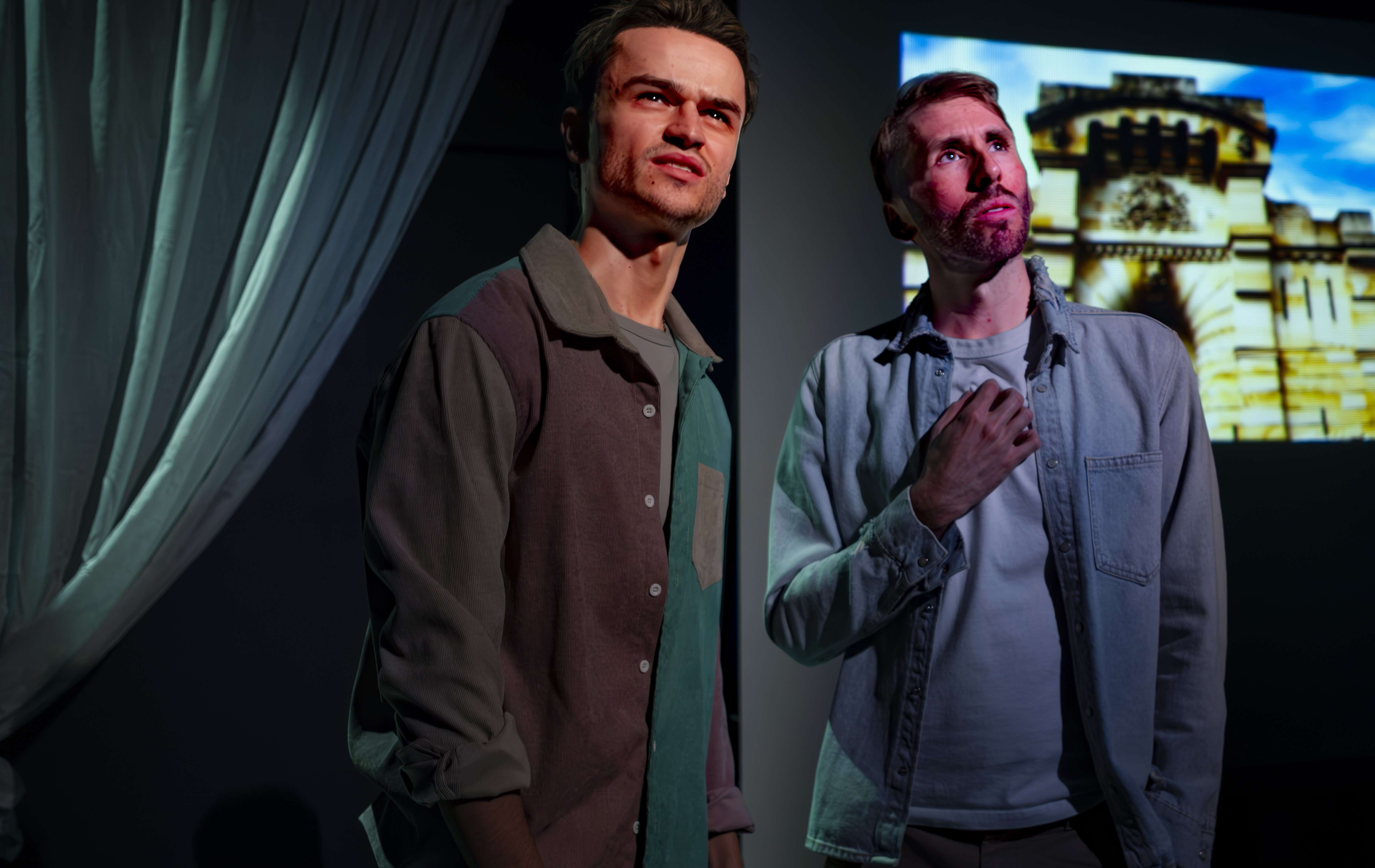
Freddy is finishing his HSC and is about to turn eighteen. Liv, his sibling, has come home from overseas to help him celebrate. But his parents, Beth and Jim, are worried about Freddy’s behaviour – though it’s not like they have everything worked out themselves.

None of that is spoiler material, but the very kernel of the piece is dependent on the withholding of information. The nature of Freddy’s problem is only fully clarified at the play’s resolution. Stories that withhold information have dangers: some audience members clock what’s going on immediately and lose interest, others only understand in the final moments and so become frustrated long before that.

Written by Daniel Cottier and directed by Benjamin Brockman, this piece avoids these pitfalls by its humour, deeply humane vision and wonderful performances.

Nicholas Cradock’s Freddy is a moving portrait of a troubled soul. Nyx Calder as Liv delivers sharp one liners marvellously, but also gives a rich characterisation of caring sibling and angry child. Hester van der Vyver as Beth and Richard Hillair as Jim are hilarious as they work the satire of early middle-aged myopia, but when things get genuinely confronting, they subtlety move to truthful performances of perplexed but heartfelt concern. When the full extent of Freddy’s pain is revealed, van der Vyver’s reaction of bewildered vulnerability is absolutely magnificent  

I don’t think I’m giving away too much to say Freddy has mental health issues.

Voice over is used to suggest Freddy suffers from intrusive thoughts. It’s a bold decision. Drama always struggles to present the inner experience of its characters. We guess at a character’s inner world from their words and actions, but as in Life, we can’t really get inside. The Elizabethans invented the soliloquy to try to solve the problem – but it’s only a partial solution, privileging a character’s deliberate, articulated thoughts rather than the ever-changing whirlwind of interiority. The VO powerfully underlines that Freddy is a victim of thoughts he can’t control, but each time it’s used it threatens to pull us out of the world of the play. Why can we hear his voices while his Mum, Dad and sibling can’t? (Yes, I know, the characters don’t hear the soundscape either – but then none of them do.) This VO technique has been used in other productions to create humour – it sets up that expectation – but I was glad it wasn’t employed that way here. What Cottier is exploring is too important for that.

Freddy can’t control his thoughts – and control is a theme that weaves through the piece.

Consider his parents. Mum wants to control Freddy’s study habits and places unneeded pressure on him by repeatedly asserting he will be school dux. Dad wants Freddy to leave his room, to get out and do stereotypical-straight-male-teenager-sort-of-things. Like Mum’s demands, it’s good-natured, but it highlights that teenagers must perpetually navigate parental expectations.

And the younger generation don’t get off unscathed. There’s a poke at their desire to control in the quip They care about everything, that’s why they’re all so depressed.

Chilled Liv seems able to transcend the temptation of control, but even they, in the inevitable argument with Mum about personal pronouns, falls back on But I want you to call me that!

So, what about the focus of the piece? Freddy’s condition? Is this also ultimately about seeking control? His cure obviously is; he needs to get back control of his own thoughts.

But what about the condition itself? Is there an element of control-seeking in his behaviour? On the simplest level, I don’t think this play says so; it’s too beautifully empathetic. But its presentation of poor teenage Freddy’s suffering is so powerful that it becomes apparent that his desire to keep it all to himself is part of what prevents him finding relief.

The piece is a gorgeously gentle, generous-spirited reminder to talk about it, to seek help.

Paul Gilchrist

Occasional Combustible Disaster by Daniel Cottier

At the Loading Dock, Qtopia, until 10 Aug.

qtopiasydney.com.au

Image by Phil Erbacher

Shook

20 May

First produced in 2019 in London, Shook by Samuel Bailey is set in an institution for youth offenders and focusses on the experience of three of the inmates.

The three have in common the fact they are fathers – or soon will be – and they share classes aimed at preparing them for this responsibility.

It’s an inspired choice by Bailey. It raises the disturbing and galvanising spectre that the underclass status of these youths is an inherited one and will be passed on to their children. It effectively conveys that their traumatised lives have ill prepared them for concerns beyond themselves. It highlights their vulnerability, stuck inside when there’s somewhere much more important to be. And, most of all, it reminds us that these young people, though rejected by society, are still one with the common human experience.

It’s a terrific script, brimming with humour and heart, and in this production, directed by Emma Whitehead, the performances are absolutely superb.

Malek Domköc as Riyad, one time gang member, beautifully balances the ominous with a blossoming maturity.

Isaac Harley as Jonjo, the troubled newcomer, delivers his character arc magnificently. The glimmers of transcendence of trauma that Jonjo achieves are presented with a gradualness that is gloriously truthful.

Edyll Ismail plays the social worker who must prepare these young people for the future. Ismail perfectly portrays the inner conflict so often experienced by those working in institutions charged with remedying institutional problems: genuine concern is twinned with a patience that is a close cousin to despair.  

Louis Regan as Cain sets the stage alight with a brilliant high-energy performance, one of the most exciting I’ve seen for a while. His Cain suffers from ADHD, and bounces between intimidation, bravado, humour and a deeply affecting vulnerability.  

Paul Gilchrist

Shook by Samuel Bailey

at the Substation, Qtopia until June 5

qtopiasydney.com.au/performances/

Image by Becky Matthews

Toy Symphony

22 Apr

The Loading Dock Theatre is a brilliant addition to the Sydney scene.

I was privileged to see the first show produced there, Michael Gow’s Toy Symphony, presented by Ad Astra.

The play was first produced in 2007 at Belvoir. It tells the story of Roland, a famous playwright suffering writer’s block (though don’t you dare use that phrase in front of him.)

There are three curious aspects to the play.

The first is that it’s almost theatre in the first person. I’m not suggesting it’s autobiographical (who knows?) but it’s fascinating that the focus is so firmly on one central character. And this is highlighted by the fact that good chunks of the play appear to be this protagonist’s personal memories. Furthermore, the protagonist’s problem is quite particular: can he continue to write theatre? (Admittedly, anything of concern to any individual should be of interest to a truly cosmopolitan person. That Gow assumes his audience consists of such broadminded people is a beautifully generous-hearted vision.)

Another curious aspect of the play is its structure. This production was two and a half hours (including intermission) and there are scenes which left me wondering why they were there. They’re interesting in themselves, but I was uncertain of their purpose or value in the play as a whole. Why do we get a scene explaining copyright law? Why are the childhood memories of Como Primary School so thorough? Why do we get a lengthy monologue in which Roland tells an unseen character what he said at his mother’s funeral? These vignettes further suggest the play’s affinity with autobiography, a form which acknowledges that the entire truth of a life can never be told, but that certain select moments will be its best intimation. The truth is clearly outside the text, not inside. This is probably true of all theatre, but to vastly varying degrees. Some plays seem to deliberately ask us to judge whether they’re a fair representation of reality (or, increasingly, they simply assert they are.) Other plays focus instead on drawing us into their world, inviting us to go for the ride. Toy Symphony is the first type, because the vignette form means the world of the play is inherently fractured and incomplete, but the challenge for us is that the truth being represented seems so especially precise, and potentially personal, that it’s difficult for us to judge the representation’s success.

The final intriguing aspect of the play is a recurring conceit. As a child, Roland can conjure people. He thinks of them, and they appear – but not to his mind’s eye alone, to everyone else as well. On one level, this is a literalisation of what playwrights do when they create characters … but the conceit resists such easy interpretation. If it’s meant to suggest the potential creative power of playwrights, you might respond that surely the play itself is an attempt to display this power, and so the conceit begs the fundamental question of realist theatre. (It’s as though a carpenter made a table out of little tables in order to clarify what she can do.) As a result, the play feels like a shot fired in a very Australian culture war, part of that battle in which artists desperately feel they must justify their own existence.

Clearly, this play sent me off into the night with a bundle of questions – exactly what I want from theatre.

Director Michelle Carey deals with this provocative play by presenting it with boundless energy.  Gregory J Wilken as Roland gives a performance that’s vibrant and always engaging; juxtaposing the wide-eyed child with the jaded artist. The supporting cast matches his energy, bouncing between realistic portrayals of adult professionals to theatrically enthusiastic children. Let me cherry pick some favourites. Wendi Lanham is eminently watchable as Roland’s therapist. Felix Jarvis as Daniel, an actor in training, gives a wonderful portrait of that youthful mix of confidence and insecurity. Bernadette Pryde is mesmerising in her evocation of the gentle, good humoured primary school teacher. Sam Webb as the school yard bully is suitably both intense and dense, and John Michael Narres’ school principal is deliciously meanspirited.

It was a pleasure to see this piece in an exciting new venue.

Paul Gilchrist

Toy Symphony by Michael Gow

at the Loading Dock Theatre, Qtopia, until 27 April

qtopiasydney.com.au/performances/  

Image by Bojan Bozic