It’s the summer of 1912, and Marie Curie’s good friend and colleague Hertha Ayrton invites her to England to escape the scandal that threatens to destroy her.
Curie has had an affair with a married man, and so now she’s not only a two time Nobel laureate, but also a home-wrecker. The second of these monikers, it would seem, trumps the first. (It can be difficult to believe the misogynistic, hypocritical rage directed at Curie. Or it should be. Unfortunately, history proffers too many examples.)
The wonder of Lauren Gunderson’s play is – that with a focus on this one brief historical moment, and with only two characters – she creates something of incredible beauty and richness.
The critique of the patriarchy is suitably sharp, but even more stimulating is the representation of the complexity of female relationships.
Firstly, there’s a depth to their experience of men. Institutionally, socially, at large, men are unjust: fearful little soulless moustached marionettes, incapable of granting women equality. But on a personal level, both women, now widows, have had husbands who were the best of humankind. William Ayrton called his wife BG (beautiful genius) and Pierre Curie refused a Nobel Prize unless it was shared with his wife. Even Paul, the married man who Curie loves, for all his vacillation, offers an undeniable joy. And it’s worth noting that Ayrton has taken her first name from a poem by a man: “Hertha” by Algernon Swinbourne. His poem, she says, gave her the courage to believe in her own worth as a woman.
And secondly – for those concerned the play might not pass the Bechdel Test – (it does, with flying colours) – the friendship between the two woman themselves is portraited brilliantly. There’s fierce loyalty and honest admiration. There’s shared humour (and whisky) and the glory of two top class minds in conversation. But there’s also an unspoken (delightful and light-touched) homoeroticism. And there’s an argy-bargy that sails awfully close to bullying. Ayrton asserts that Curie is strong, is resilient, can transcend the scandal – but she asserts it just a little too often. Curie is wounded. She doesn’t know who she is anymore, and being told you’re an otherworldly goddess, when you’re feeling so very human, is akin to erasure.
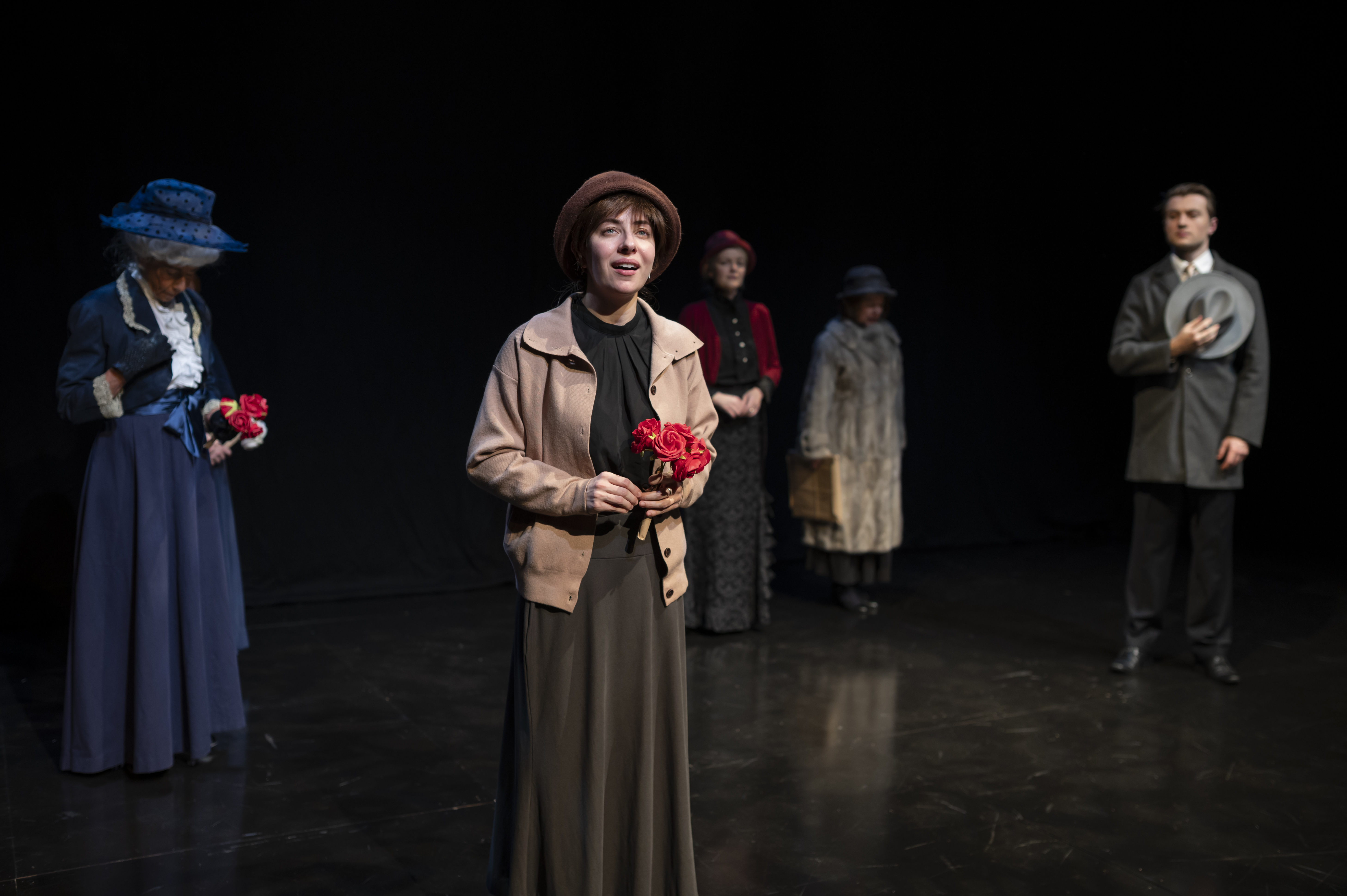
Directed by Liesel Badorrek, Gabrielle Scawthorn and Rebecca Massey give utterly engaging performances. They play each note of Gunderson’s script with a meticulous awareness of its possibilities, bringing to the fore both the delicious humour and the deep humanity. Scawthorn’s Curie is a terrific portrait of power in pain, fraught but ever able to inspire awe. Massey’s Ayrton is beautiful bustle, fire-hearted affection, and no nonsense determination. On a stripped back stage, the physicality of the actors is paramount, and these two are extraordinary: powerfully embodying both suffering and exultation.
(This is probably the time to mention design. James Browne provides a raised transparent podium, which can be encircled by a transparent curtain. It’s spare but layered, aligning with a script that presents a seemingly single, simple historical moment only to reveal its complexity. The choices of lighting designer Verity Hampson and projection designer Cameron Smith wonderfully evoke this complexity – as well as the unseen physical forces that these two scientists explored.)
I was saying Curie is feeling so very human – with all the vulnerabilities and vagaries that entails. And that’s why Gunderson chooses this moment to set her play. Gender tensions might be crucial to the piece, but so is another tension: that between the supposed objectivity of science and the unavoidable subjectivity of the people who work in it. Curie says she loves science, but not scientists. Both women muse on the fact that proof is real, but recognition is political.
And just as the tension between the sexes is represented with a humane richness, so is this tension between knowledge and its knowers. The women’s belief in inviolable proof is undercut by their greatest conflict. The spoiler rule prevents me giving detail about the moment, but the tension is one in which scientific findings are disputed, where two passionate, intelligent women debate when – and if – knowledge can ever become complete. Truth maybe immutable, but Science remains an all too human endeavour.
Constructed from such vital tensions, and presented with such mastery, Ensemble’s production of The Half-Life of Marie Curie is superb theatre.
Paul Gilchrist
The Half-Life of Marie Curie by Lauren Gunderson
at Ensemble Theatre until 12 July
Image by Prudence Upton