Tag Archives: Riverside

Mr Red Light

11 Jul

A group of innocent people are held hostage for an hour and a half, which is coincidentally also the story being told on stage. (Thus would I seriously begin my review, if I were to accept my role in the grand tradition of theatre criticism, a role that posits my superiority to the storytellers. But I won’t – for reasons that will become apparent by the end of my response.)

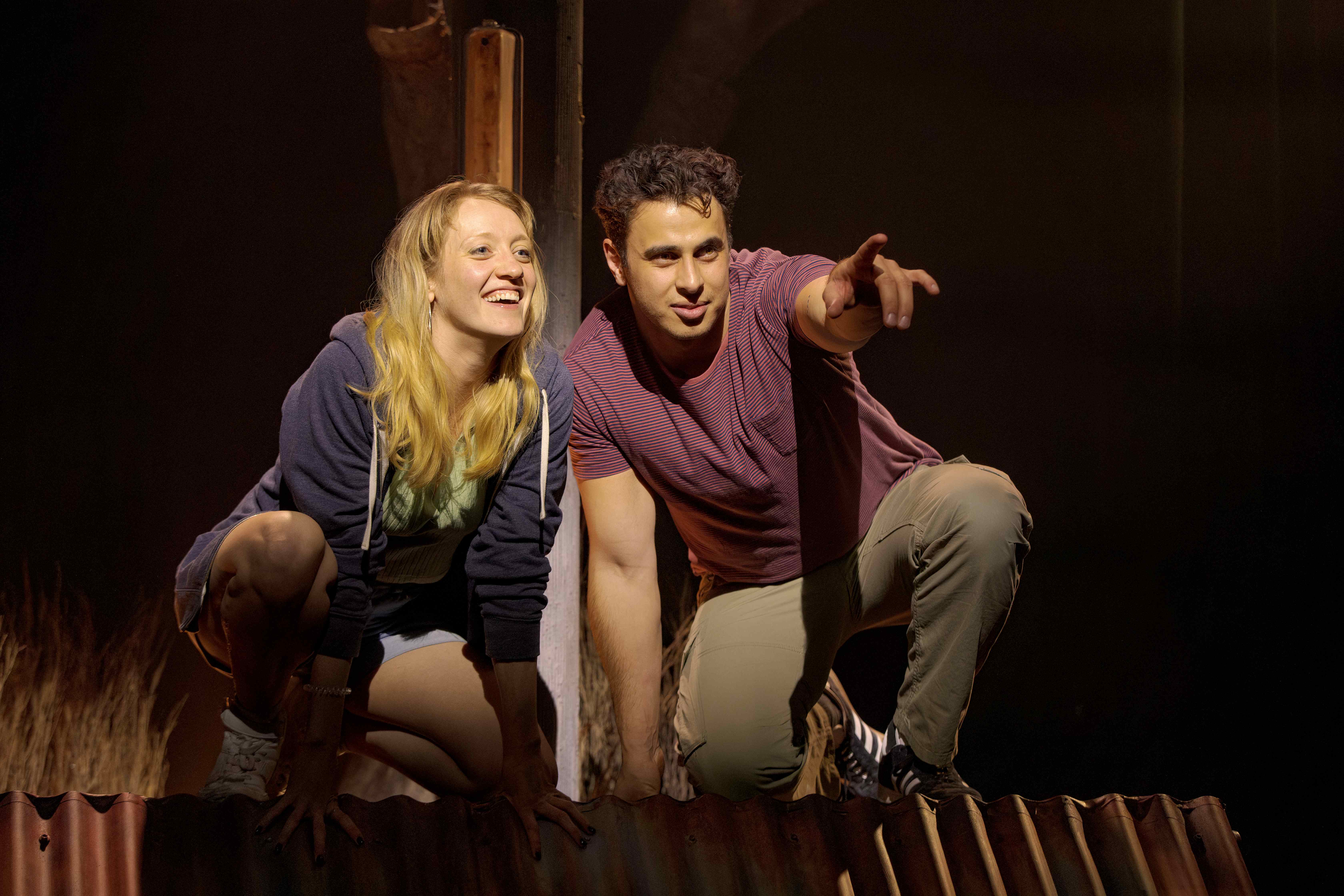
After a failed attempted to rob a bank, Mr Red Light ends up in the Joker’s Pies store next door.

Despite a gun being waved around for the entirety of the show, the vision is comic and the key word wacky. There’s fun wordplay, set-based visual gags and very committed slapstick humour.

Written by Carl Bland (with Peter Bland and Peta Rutter) the play is absurdist or surrealist in intent, with the incredible scenario serving to invite thought about the human condition.

Dramatists love the trick of offering their characters no possibility of escape (and audiences go along with it because – as I’ve suggested – it often mirrors their own experience of being in a theatre.) But it’s a trick that demands careful consideration of the physicality of the performances; it’s inevitable that close proximity will have to reflect both intimacy and antipathy, and in so far as this genre is a distant cousin of naturalism, there’s enormous pressure to get the pacing right to make this all appear, if not believable, then at least somehow related to reality.

This production is certainly a giggle generator, but it suffers from an imprecision in the physical humour which is matched by a lack of rigour in the linguistic performances. And though the set by Andrew Foster impresses, some of the visual puns seem gratuitous. 

The plot plays out in real time, but texture is created by breaks into flashbacks, imagined scenarios and surprising perspectives.

This suggests the aspect of the human condition being explored is our ability to tell stories. Stories are shelter one character says. But not when they’re merely ever-repeated internal monologues: that sort of unexamined private narrative only prevents us experiencing Life’s fullness. Two of the characters have succumbed to the habit of telling themselves the story that they’re perpetually unlucky. (Always hitting red lights.) Another tells herself a constant narrative of guilt. We are storytelling creatures, but it’s only when we share those stories that their magic becomes apparent. It’s only when we sit around the fire and share with others the journey we’ve survived that stories perform their miracle: the transformation of disparate individuals into a close-knit community.

The unlikely conclusion of this piece is a hyperbolic assertion of this magical ability of stories. And though I feel this production struggles to cast that spell, it’s indubitably a joyful celebration of why theatre matters.

Paul Gilchrist

Mr Red Light by Carl Bland (with Peter Bland and Peta Rutter)

Presented by Nightsong

At Riverside Theatres until 12 July

riversideparramatta.com.au

Image supplied

The Bridal Lament

24 Jan

Loss shakes us out of the complacency of the Present, like a sudden change of speed on a train reminds us that we’ve been in motion all the while.

Rainbow Chan’s song cycle tells us of the bridal laments of the women of the Weitou people – an artistic ritual that has now passed, as have the arranged marriages that inspired them.

For Weitou women, the leaving of the house of their girlhood and the marriage to a man they did not know seemed like a type of death. (The husband-to-be was referred to as the King of Hell.) Chan sings these traditional laments in their original language, Weitouhua, and does so with extraordinary poignancy and beauty. Subtitles invite us into their evocative imagery, a world in which connections with nature were strong, and where vulnerability and ephemerality are granted meaning by being attributes of universals that transcend any individual life.

Chan guides us through the rituals of the bride-to-be, but intersperses her tour of the past with anecdotes of her own personal history as a child migrant to Australia, with particular focus on her mother, a Weitou women.

Juxtaposed with the historical laments are (what I take to be) Chan’s own wonderful compositions, contemporary songs with beguiling electro-pop and traditional influences. They give voice to the experience of a modern woman, one facing challenges both different and similar to those of her ancestors.

Directed by Tessa Leong, this is all effectively bound together by some very lush lighting and projected video graphics, creating a theatrical experience that is spellbinding.

(On rare moments, it felt a little over-produced: the traditional music, the original compositions and the visuals all propelled into an excess of richness by the need to cohere. The singularly most wondrous moment of the performance is when Chan sings a cappella a lament she has written herself, inspired by the traditional pieces. Stripped back, the sorrow is even more heart-rending. But, of course, this emotive impact was a consequence of the sudden contrast, and so only made possible by the creative decisions I’ve just questioned.)

Remarkably absent from the piece is a bland criticism of the custom of the arranged marriage, the sort of denunciation of the past that does little but feed the contemporary desire for definitive moral superiority. But neither are the arranged marriages romanticised; they’re presented, as they were probably experienced, as a brute force, as inexorable as Death.

The Bridal Lament is a fascinating piece of theatre; Chan effectively combines a personal sharing with a wider exploration of her cultural heritage, in a way that attains to universality.

Ultimately the piece is about grief and its natural place in the human condition. The traditional bridal laments themselves are stylised grief and that, in addition to their intrinsic beauty, is their value. That grief can be stylised tells us we are not alone in feeling it. This is the solace the laments offer, union with all who mourn.

Chan suggests that when she sings the traditional laments she feels at one with all the women before her. And when she visited Lung Yeuk Tau village, as an Australian who didn’t speak the language, the old grandmothers placed a villager’s hat on her head and claimed her as one of their own.    

Time takes much from us, but it gifts us the Past. We can’t live there, but it’s from what we make our Dreams – and they fuel our Future.

Paul Gilchrist

The Bridal Lament by Rainbow Chan

Presented by Riverside Theatres and Contemporary Asian Australian Performance

Supported by Sydney Festival

At Riverside Theatres 23–26 January

riversideparramatta.com.au

Creator, Lead Artist & Performer Rainbow Chan 陳雋然

Director Tessa Leong

Choreographic Consultants Amrita Hepi and Victoria Hunt

Video Design Rel Pham

Set Design Al Joel and Emily Borghi

Costume Design Al Joel

Lighting Concept Govin Ruben

Lighting Realisers Susie Henderson and Sam Read

Cultural Consultant & Narrator Irene Cheung 張翠屏

Video Programmer Daniel Herten

Yoga Play

25 Oct

This is a piece of dramatic bliss.

It presents as sitcom spiced with satire, but appearances are deceiving. (Or should that be illusory?)

Multinational company Jojomon makes yoga clothes – and an extraordinary amount of money. But there’s a scandal, and now they have an authenticity problem. Profits are diving.

How can they fake authenticity?

Clearly, companies that make serious cash out of any spiritual tradition are perfect for a poke, as is anyone more interested in sculpting their body than nurturing their soul. The West’s appropriation of the Eastern practice of yoga is an exemplar of how capitalism can so impoverish the invaluable that it becomes obscenely valuable.

Playwright Dipika Guha creates terrific comic characters and director Mina Morita has a brilliant cast that pitch them perfectly. Joan the CEO is fully cognisant of the discord between corporate culture and new age platitudes, and Andrea Moor superbly portrays the tensions between patience, puzzlement and pressure. Thomas Larkin is magnificent as the company owner who refers to customers as family, and then treats them with the appropriate disdain. (And there’s some beautiful and unexpected doubling here). Nat Jobe and Jemwel Danao are a sensationally funny duo, playing employees who speak the new age language fluently, and almost believe it. Camila Ponte Alvarez as the LA yoga instructor who’s all gratitude, bliss and namaste – until you cross her – is absolutely hilarious.

It’s a wonderfully fun night of theatre. But I said it was dramatic bliss – because there’s more.

In addition to sitcom and social satire, there’s surprising depth. Gently and playfully, the piece explores two of the most crucial issues facing our society.

The first is sociological and centres on assumptions about identity. By creating characters of multiple ethnicities who are exploiting the practice of yoga, Guha puts cultural appropriation firmly on the table. We talk a lot about cultural appropriation these days, but at the heart of the concept are some rather odd assumptions. I’m not denying the concept has validity; I’m just suggesting we’d all gain from the sort of interrogation this very clever play provokes.

On a cultural level, what does my biological heritage entitle me to? What do I actually mean when I refer to my culture? Do I own it?

What, exactly, does culture include? (Culture is one of the most nebulous words in my language that I don’t own.) When is something a cultural tradition and when is it just a fashion? How fixed is culture? And is it possible to have tensions within a culture? If someone of, say, Indian biological heritage holds a particular value, does that value then automatically become Indian culture? Or are a certain number of Indians required to hold that value for it to pass muster? How many?

And what does my culture demand of me? If I reject elements of my culture, does that mean I’m a bad custodian? Or does it mean I’m a mature self-actualised individual?

And if elements of my culture enhance joy, why would I prevent others from sharing in it? (Unless, of course, the joy I’m talking about is defined solely as a financial gain that would be lessened if the market was saturated. And if that’s our default way of looking at cultural appropriation, it only goes to show how capitalist materialism has been appropriated by everyone.)

The second crucial issue the play addresses is psychological, and also centres on identity. Drawing on traditional Hindu beliefs (ones shared with many mystic traditions) the play asks several of its characters to consider the nature of the Self. In our globalised world, we’re perpetually bombarded by loud, outside voices. For safety’s sake, we’ve come to define ourselves quite narrowly. Or, perhaps more accurately, we’ve come to define ourselves quite emphatically. But every definition is predicated on exclusion. In asserting I am this, I’m asserting I’m not something else. What are we losing by our adherence to this safety strategy of the Self? What would happen if we didn’t define ourselves at all? If we let go of our insistence on borders, on divisions?

The play deals with all this in a gorgeously light way, and is as joyful as an invitation to the eternal cosmic dance.

Paul Gilchrist

Yoga Play by Dipika Guha

Presented by National Theatre of Parramatta & La Boite Theatre

At Riverside until 26 October

riversideparramatta.com.au

Image by Phil Erbacher

Karim

29 Jul

There aren’t enough plays entitled Karim in Australian theatre. (And, of course, there are far too many called Gavin or Ian or Kylie or Kevin.)

It’s intriguing that James Elazzi’s play is named after the one character: it feels a lot like an ensemble piece. Karim (played with an easy watchable stage presence by Youssef Sabet) doesn’t dominate the production in the way, say, Macbeth or Hamlet or even Miss Julie dominate theirs. In fact, Karim’s plot line is balanced with Beth’s (played with an engaging mix of energy and fragility by Alex Malone). Both are trying to break free from the dominance of their parents.

Beth’s mum (Jane Phegan) is an addict. Karim’s dad (Andrew Cutcliffe) just seems unreasonably determined his son sticks around. Both Phegan and Cutcliffe give performances of focussed intensity.

They all live in Tahmoor (97 kms down the highway from the CBD) and both families are doing it tough. The play begins with Karim and his father garbage picking, and we soon learn they make most of their cash working on market garden farms. They’re behind in their rent and when evicted, fall back on the generosity of neighbour Abdul (George Kanaan).

Abdul is also of Lebanese heritage. Unlike Karim – who was born here, as was his father, and his grandfather before him – Abdul fled the civil war. Before calamity engulfed his nation, he played the oud in the Lebanese Symphony Orchestra.  

Karim becomes fascinated with the man and his instrument. I would’ve like to know more about both these fascinations. Is Karim’s obsession with the instrument to be explained by his Lebanese heritage? And, as Abdul begins teaching him, is blood also sufficient to explain his unexpectedly mercurial proficiency? I’d also like to know why a 23 year old gay man wouldn’t avail himself of the $7.23 Opal ticket to the city, the gay capital of the Southern Hemisphere, instead of falling for a much, much older man. (Yes, reasons are offered, but I was left unconvinced – which I acknowledge is a standard of dramatic criticism that will leave many dissatisfied.)

By portraying what are commonly termed marginalised characters, a play like this seems to ask to be valued in terms of its authenticity. (Of course, you could people a play with such characters and be aiming for something entirely different.)

But this is a simple story, a gentle invitation to spend time with characters whose humanity urges us, softly but firmly, to consider the very nature of that experience.  

Paul Gilchrist

Karim by James Elazzi

At Riverside until Aug 3

riversideparramatta.com.au

Image by Philip Erbacher

Girl Band

21 May

Directed by Lucy Clements, Girl Band by Katy Warner is a wonderful satire on the music industry and pop culture – but it’s also a poignant exploration of power.

It’s 1994 and The Sensation Girls are on the cusp. Orchestrated by the ever unseen Darren and Craig, they’re a line up to inspire young women (and to make a heap of money, though not for the Girls themselves.) In one song, each of the group introduces themselves: “I’m smart! I’m sexy! I’m strong! I’m smiley! I’m sassy!” For young women, it’s no doubt an invaluable lesson in self-esteem (and stereotyping, and alliteration.)

With composition by Zoe Rinkel and lyrics by Warner, the production also beautifully skewers the music produced by manufactured groups.  “Boy Crazy” not only doesn’t pass the Bechdel test; its inane repetition ensures it can’t pass the Goldfish test. “I’m boy crazy. Boy crazy. I’m boy….” You know the rest.  Wisely, we’re not asked to listen to the entire song.

Similarly, the choreography by Amy Hack captures brilliantly the double standards of this musical genre. The lyrics of “Maybe” suggest a sweet uncertainty about the singer’s romantic interest, but the hilarious pseudo-sexy choreography leaves little doubt.

The play is set in the rehearsal room as the five group members prepare for a big industry showcase. Chaya Ocampo as Jade gives a terrific comic performance as a show business character whose “I’m smart!” is deliciously and unconsciously ironic. Jade Fuda and Meg Clarke as lovers capture the tensions created by management’s homophobic insistence on secrecy. LJ Wilson as MJ sings “I’m smiley!” while being delightfully not. MJ’s smarting because previous lead Didi has left and the vacated role has gone to new girl, Kiki. Of course, that’s not her real name, just another imposition from above. Kiki or Kathleen (played with magical exuberance by Madeline Marie Dona) is going to shake things up. Why can’t the girls have more creative control?

And so it comes down to power. Becky is the group’s choreographer, and Hack is magnificent in the role. While very funny, it’s simultaneously a deliberately disturbing portrait of complicity. Becky is reluctant to make waves, and there’s much more to management’s malevolence than just a cynical commitment to inauthenticity.

And that’s where the play’s exploration of power becomes particularly provocative. Our workplace can create misery in many ways, but are all those ways related? The slippery slope argument will always appear most convincing to those who have known real fear.

Paul Gilchrist

Girl Band by Katy Warner

at Riverside until 27 May

riversideparramatta.com.au

Image by Phil Erbacher

Relativity

16 May

In one of my favourite cartoons, two dogs walk down the street and one complains to the other “It’s always ‘good dog’, never ‘great dog’.”

I was reminded of this comment on parsimony and praise as I watched Relativity by Mark St. Germain.

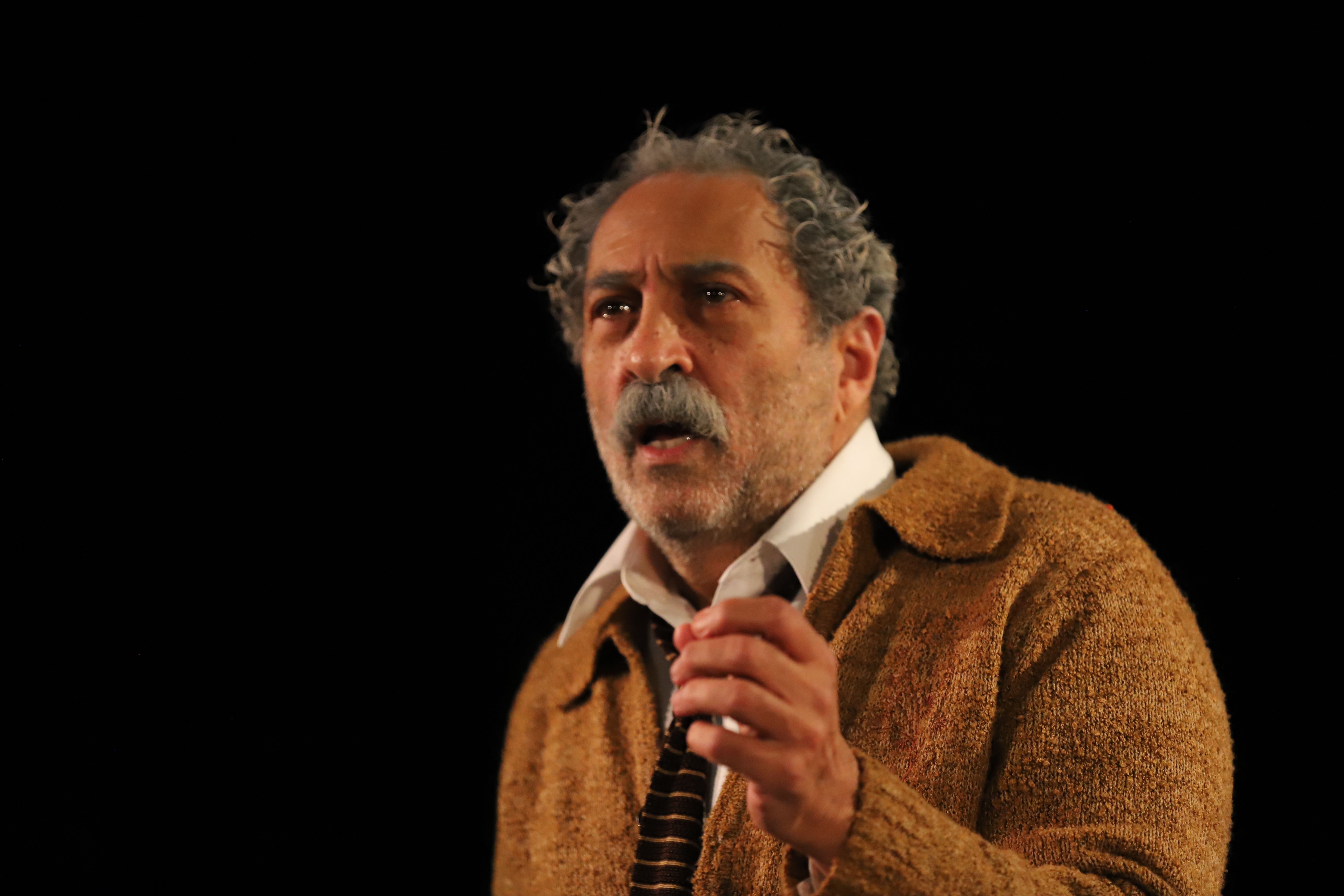
Not surprisingly, the play’s about Albert Einstein, though the title might be more than just a reference to his most famous theory.

The play explicitly asks “To be a great man, do you have to be a good one?” In the context of the story – Einstein receiving a surprise visitor to whom he is intimately and somewhat awkwardly related – the positing of this question so openly tells us that psychological veracity is not what’s being valued here.

So it’s a play of ideas? Well, the play’s fundamental question is an odd one. “To be a great man, do you have to be a good one?” ‘Great’? What does that actually mean? Does it mean ‘exceptionally good’? But that would beg the question. Or does ‘greatness’ simply mean to be held in high-esteem for reasons other than ethics? In which case, why connect greatness and goodness at all?

Discussions of greatness are often mere valorisations of celebrity. But, if instead, the fundamental question being asked is about the nature of goodness, then the play deals with this enormously complex issue rather obliquely. (This Einstein says Hitler was evil while an adulterer is not – a distinction you don’t need to be Einstein to make.)

What if I let go my philosophical pretensions, and see the play as just a historical portrait? This means I’m being asked to care if the actual Einstein was a good man or not, and that still presupposes a fascination with celebrity (and it’s not going to make any difference to the physics.) And another thing; since what’s portrayed is a private and presumably imagined conversation, can it be taken as an accurate representation of the man? In this play, Einstein says that thirty years of an average person’s life is not as valuable as a great work of art. Did the real man say anything like that?

Clearly, the play is thought-provoking.

It’s a three hander and director Johann Walraven elicits utterly watchable performances from his cast.  Nicholas Papademetriou as Einstein is a beautiful mixture of gentle-hearted humour and a laser sharp intellect. Nisrine Amine as his surprise visitor wonderfully tempers bewilderment at Einstein’s complexity and a cold anger at his self-absorption. Alison Chambers as Einstein’s housekeeper, and lover, is delightfully amusing when she’s manipulating him, and deeply poignant when the power relations are less clear.

Paul Gilchrist

Relativity by Mark St. Germain

at Riverside Parramatta from 10 – 13 May

riversideparramatta.com.au

Image by Iain Cox

Ulster American

10 Jun

Some productions are so good that any written response bubbles into the evanescence of superlatives. This is one such production. Director Shane Anthony, Riverside and Outhouse Theatre are all deserve dousing in sparkling froth.

An actor, director and writer meet the night before rehearsals begin. They discuss art and its importance. David Ireland’s script is intelligent, bold, and brilliant fun. There are more one liners than dog turds in an leash-free zone, and the characters are so beautifully drawn that sketch cartoon blooms into full blown animation.

Jeremy Water’s Jay is an Oscar winning actor, self-important and ignorant. Brian Meegan’s Leigh is a director in the time honoured tradition: excessively polite, in the manner of an attendant in a lunatic asylum; the type you ultimately realise is no attendant at all, but rather one more deluded inmate. Harriet Gordon-Anderson as Ruth the writer has that steely (self)determination that makes writers the most unwanted people in theatre. All three performances are absolutely superb.

This is a play about Thought and Honesty in theatre, and so, of course, Truth. And when Jay finally pulls out his Truth for all to see (no, it’s not THAT, but it may well as be) the triviality of that truth becomes apparent.

What do we think is important in art? Stanislavsky’s famous warning was right.

But be also warned: this is a comedy of gasps. If opera is the artform in which things too silly to say are sung, this is the artform in which things too taboo to say out loud are …. well, said out loud. Violence, sexual assault, those sort of misterdemeanours (yes, I made that word up… I think). It’s difficult to imagine a living culture without an artform that serves this purpose. If we are to set boundaries, if we’re to think boundaries are necessary at all, we must be aware of what lies on their far side. If we don’t, our boundaries are not shared decisions, but rather merely the victory of fear, or worse, the stratagems of power.

So this very funny play is important.

We need comedies this dark to let the light in.

Veronica Kaye

Ulster American by David Ireland

at Riverside until 11 June riversideparramatta.com.au

then Seymour Centre until 18 June seymourcentre.com

Image by Richard Farland

The Age of Bones

28 Mar

And your taxes are paying for it.

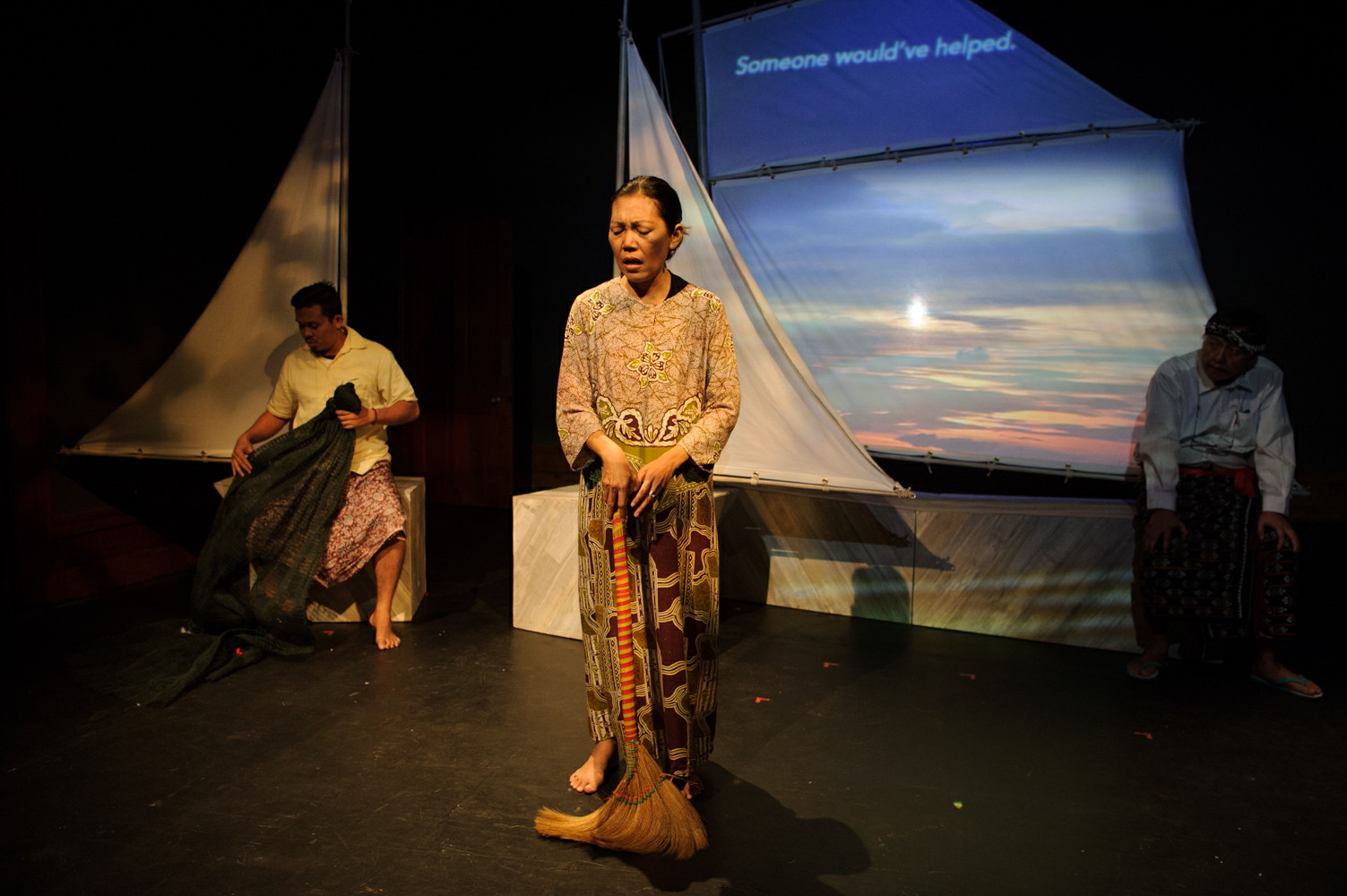
An Indonesian man points directly at the audience.

His comment is simple and powerful; at least 60 Indonesian minors have been jailed in Australia for working on asylum seeker boats.

This injustice is the focus of Sandra Thibodeaux’s play. It tells the story of fifteen-year-old Ikan (Imam Setia Hagi) who finds himself imprisoned here, a foreign country. The Australian authorities seemingly make little attempt to contact his family, and his parents (Imas Sobariah and Budi Laksana) are grief stricken at his disappearance.

Age of Bones

The lost boy, of course, is Down Under, and this allows for a brilliant conceit: Ikan doesn’t languish in a cell, rather we see him beneath the ocean, surrounded by an array of bewildering sea creatures, brought to life by extraordinary puppetry (I Made Gunanta and I Wayan Sira) and performance (including Kadek Hobman as a very Aussie hammerhead, loutish yet not incapable of kindness.) This world beneath the sea suggests both the greatest fears of a fishing-based culture, and the absolute absurdity of Ikan’s predicament.

Created through collaboration between artists from the two countries, The Age of Bones is a thrilling mix of English and Indonesian (with the latter translated in surtitles.) Projection, puppetry, and set that’s a wonderful evocation of a sailing boat, make for a visually stunning production.

Working with Thibodeaux’s beautiful play, directors Iswadi Pratama and Alex Galeazzi have created a piece that is amusing, engaging and challenging.

Great theatre confronts its audience, asking crucial questions. The Age of Bones asks have we lost our way?

Paul Gilchrist


The Age of Bones by Sandra Thibodeaux

Riverside Theatre, Parramatta

Produced by Performing Lines / Satu Bulan / Teater Satu

This production has closed in Parramatta, but plays in Darwin 30 March to 9 April.

Tix and info here

Waiting for Godot

4 Mar

Waiting for Godot is a seminal theatrical text for many reasons, not the least being that it has inspired two of my favourite critical quips:

“a play in which nothing happens, twice” wrote Vivian Mercer.

And, from a critic I haven’t been able to trace, “Waiting for Godot is a play that would be vastly improved by the addition, on page 2, of the stage direction Enter Godot.

It could be suggested that the play does not so much assert that Life is dull and meaningless as against actively make it so.

Photo by Petros Ktenas

Photo by Petros Ktenas

Because precious little happens in the play, critics have often searched overly long for meaning.

I think it’s just a mood piece. Perhaps that mood could be described as a type of playful pessimism.

And such a mood clearly speaks to many, many people. Directly in front of me in the audience was a young woman wearing a Year 12 jersey. The caption printed on the back?  ‘Bored’ – with the ‘o’ replaced by a smiley face.

And this production by the Riverside Lyric Ensemble is certainly good fun. With a quality cast, director Cameron Malcher presents an entertaining show. Errol Henderson and David Attrill play Estragon and Vladimir with humour and just the right touch of poignancy. Pozzo (Erica Brennan) and Lucky (Clive Hobson) are utterly engaging. Brennan has great fun with Pozzo’s imperious nature. And Hobson makes Lucky’s monologue the show stealer it’s meant to be.

The staging is simple and beautiful. The play has powerful imagery (the tree, the boots, Pozzo’s rope – or is it Lucky’s?) and this imagery is allowed to do its magic.

When first produced, Waiting for Godot was seen as something very new, and for this reason it’s been considered ground breaking. And, theatrically, it is.

But in many ways, it’s one of the final gasps of a dying world view. The play’s sense that Life is depressingly without meaning is strangely quaint, based on the assumption that Life should come with its purpose pre-packaged.

Old gods die hard. 🙂

Veronica Kaye

Waiting for Godot by Samuel Beckett

Riverside Parramatta until 7 March

http://riversideparramatta.com.au/show/waiting-for-godot-2/