Tag Archives: Rogue Projects

Gravity

20 Nov

On the way to the theatre, my plus one asked if we were seeing a new play. I replied Yes, that considering the title, it must’ve been written at least post-1687, the year Isaac Newton published Philosophiae Naturalis Principia Mathematica.

A joke like that doesn’t belong in Bradford Elmore’s Gravity; his play is genuinely funny.

But there’s a connection. Elmore presents characters who are intelligent – and this is the surprise for an Australian play – they can read! And they do.

Not that the piece is overly cerebral. Far from it. It’s just that the characters in Gravity have an active interest in the written word – and actually discuss it!

Christopher and Heather have a love of literature and David has a fascination with astronomy.

And all this isn’t gratuitous, a case of a playwright choosing to focus on some bizarre corner of society in order to present a gritty new angle, or an example of a dramatist claiming to give voice to some neglected minority.

The literature and astronomy operate as motifs that give the play a wonderfully rich texture. But to discuss that, I must first outline the play’s basic scenario.

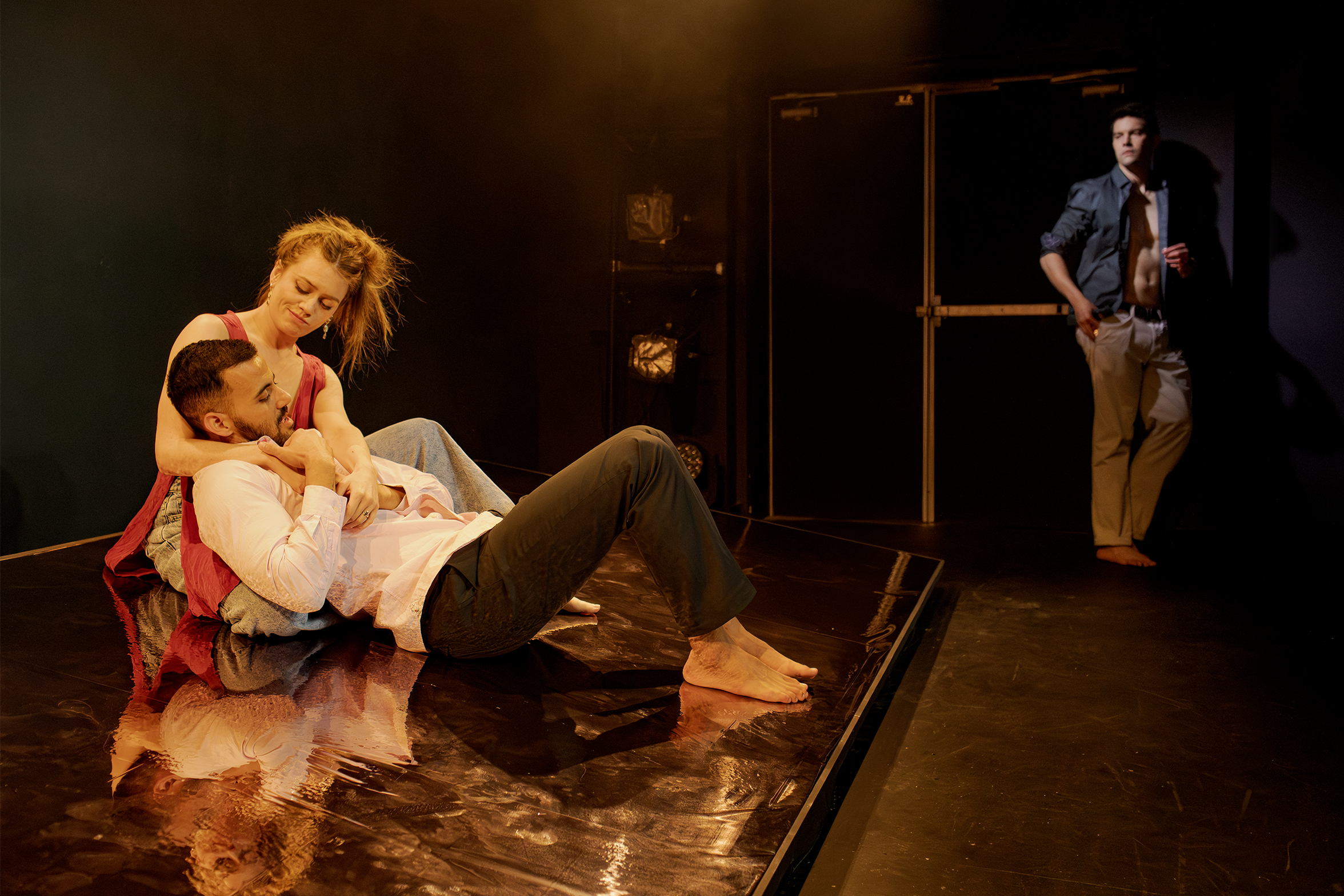
Christopher (Wesley Senna Cortes) and Heather (Annabelle Kablean) have been married for ten years, and he feels he still loves her. But he has now also fallen in love with David (Drew Wilson). How can this be resolved?

Back to the motifs.

David’s interest in astronomy allows consideration of opposing forces, of the difficulty of orbiting two bodies simultaneously, of the danger of being torn apart. But it also posits balance, the possibility of a smooth, untroubled, eternal motion (the type we imagine is enjoyed by the stars.) The relevance to the play’s scenario is beautifully thought-provoking.

Heather and Christopher’s interest in literature allows musings on narrative, and how we’ll stick to things, despite the emotional pain, because we need to know how it turns out. As a play about the challenges of fidelity, the connection is clear.  Discussions of literature also facilitate some playful games about preference, of the Austen-or-Dickens, Tolstoy-or-Dostoevsky type. I’ve made up these examples, but the mischievous premise behind these sort of games – that loving one somehow excludes loving the other – is central to the play’s exploration of relationships.

Anthony Skuse directs and designs, and in this deliciously simple space there’s a gorgeous flow to the movement. Skuse also elicits fine performances from his cast, who make the humour crackle and the heart cry.

Whether you ultimately find the conclusion of the piece satisfying will probably hinge on your willingness to watch it devolve from the higher stakes of dramedy to the easy cheerfulness of rom-com. But I suspect satisfaction might also depend on your own values and emotional experience; what you consider Love, and what you consider Truthful. (Though, if your sole aim in visiting the theatre is to see a reflection of yourself, a visit to the aptly named vanity in your bathroom would suffice. Embrace doubt and surprise; they’re some of the artform’s greatest gifts.)

Paul Gilchrist

Gravity by Bradford Elmore,

produced by Rogue Projects,

at The Loading Dock, Qtopia until 29 Nov

qtopiasydney.com.au

Image by Phil Erbacher

The Female of the Species

8 Nov

The dramatist is the natural enemy of the theorist. Whereas the dramatist delights in the presentation of multiple voices, the theorist subsumes all voices to their singular vision of the world.

In The Female of the Species, Joanna Murray-Smith gives us Margot Mason, a provocateur feminist in the tradition of, say, Germaine Greer or Clementine Ford. To simultaneously poke and praise this type of personality has been in the literary zeitgeist since at least John Irving’s novel The World According to Garp in the late 70’s. But the dramatic form is perfect for reminding us of the vitality of complexity in the face of soul-shrinking reductionism. And, by choosing the particular genre of farce, Murray-Smith gives us something quite special.

Farce is one of the most difficult of genres to perform, especially a piece like this – one which invites high energy physicality but also requires close attention to the witty, erudite dialogue. With a terrific cast directed by Erica Lovell, this production pulls it off, giving us a hilarious, thought-provoking evening of theatre.

Murray-Smith’s protagonist is a superb creation, an incendiary combination of social warrior and self-interest. She’s played brilliantly by Lucy Miller, who gives the character gravitas, scorn and passion (the last of these transcending the temptation to present intellectuals as mere pedants, obsessed with verbal precision.) 

Margot proudly owns the moniker provocateur. She’s certainly provoked Molly, a young student who turns up uninvited to her country house. Jade Fuda is wonderful as Molly, positioning her beautifully between vulnerability and determination. Molly points out that Margot’s published works contradict each other, that she’s just seeking attention. The celebrity writer is unfazed. Her books are not commandments for Life, they’re invitations to thought. (This is despite her deep contempt for her daughter’s more conventional life choices. Lib Campbell plays the utterly exhausted young mother of three in suitable, gorgeous hyperbole.)    

But back to the play’s interrogation of the provocateur. One of the great questions of the intellectual life is Should you only write the Truth? Anyone with any intellectual humility appreciates that a truly serious commitment to Truth might condemn you to silence. But what would that gain? So you compromise. You tell yourself you’ll write the Truth as it appears to you, limited and flawed though that will inevitably be. It’s what you have to offer to the conversation, another stick among many thrown onto the communal fire. But if it’s the conversation, the fire, that’s important, what does it matter what you throw into the mix? After all, the deliberately inflammatory might just shake things up, make the fire burn that bit more fiercely, push back the darkness a little further, hold back the cold a little longer…

Which leads me to another great tension in the intellectual life, that between followers and leaders. We’re in awe of those who can express things neatly, who can tie up the world’s loose ends with some all-encompassing theory. But to mistake what they say for Truth is to confuse the small solidity of the stick with the dangerous vitality of the fire. Hold on too tightly to that dried out old piece of wood and watch the desiccated hollowness spread up your arm and wither your whole life.

Murray-Smith gives Margot a chain of books with curious catchy titles. Her most famous is The Cerebral Vagina, but listen closely for her most recent title. She’s toying with The Female of the Species, but in the play’s closing moments she comes up with another title, one that is gloriously provocative.

I started by suggesting farce is extremely difficult. It’s difficult because it makes so little effort at truthfulness. Instead, it asks us to revel in its very artificiality. And it’s this delightful artificiality that makes farce an ideal vehicle for the examination of the artificiality of our grand narratives. We enjoy them so, but they’re not Life.  

Paul Gilchrist

The Female of the Species by Joanna Murray-Smith

Presented by Rogue Projects

At Old Fitz until 23 November

oldfitztheatre.com.au

Image by Noni Carroll