Tag Archives: Space Jump Theatre

Contest

23 Mar

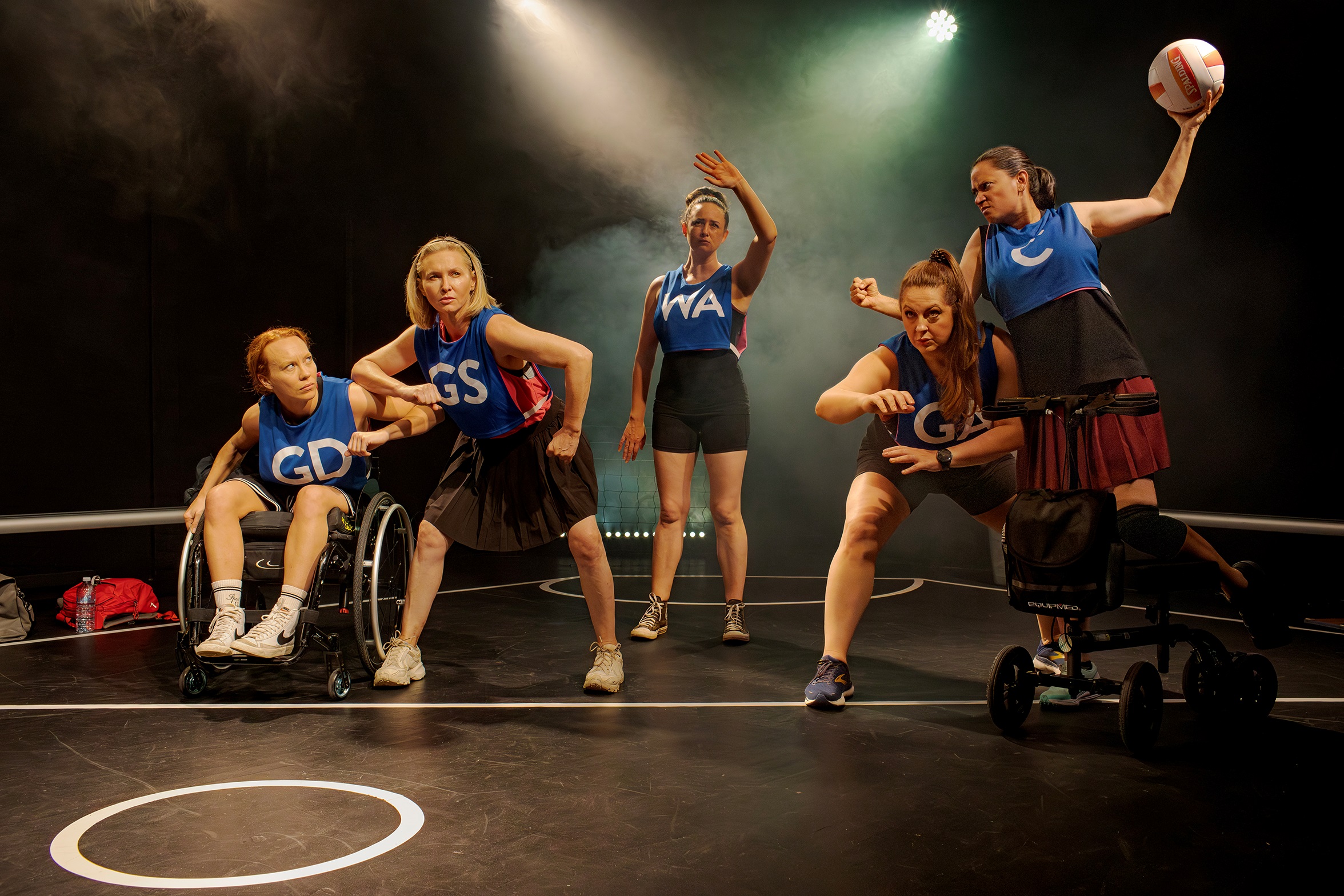
Five rather different women meet to play netball. The focus is not so much on plot as character. (We’re not being asked to care who wins a game.)

You could read the piece as a representation of the female experience; the sort of piece with the raison d’etre of bearing witness.

And, if you do read it that way, you have very good reason. After all, over millennia, too much theatre has represented the lives and values of men, and this sort of piece seems an appropriate response.

The reason I’m not suggesting that it’s my reading of Emilie Collyer’s Contest is because I think it’s more dramatically thrilling than that. (When we say too many plays represent the male experience, we often make the mistake of thinking that was their conscious purpose. If it had been, the theatre created would never have had the cultural impact we rightfully complain that it’s had.)

Contest is thrilling, not because of its reportage, but because of its metaphors.

The metaphors are provocative, and threefold.

Firstly, we’re presented a team. Are we ever really a team? Do we pursue shared goals? Or are all our relationships purely transactional? And, if they are, of what are we robbing ourselves?

Secondly, the team plays in a competition. Is Life a competition? Is it really a zero-sum game, one in which my gain necessitates your loss? And, since so little of Life is actually played out on any field where comparisons could be made – our inner lives, for example – what’s the impact of our focus on competition? What is being erased?

Thirdly, it’s a sporting competition. Since sport is physical, we’re asked to what degree do we see ourselves as our bodies? There’ s probably no Life without the physical body, but there’s so much of Life in which we are unconscious of the body. How do we get the balance right?

I’ve outlined these metaphors without reference to the female experience, partly because I’m not in a position to evaluate their veracity or efficacy, and partly because the excitement of this piece of theatre derives not from being a representation, but from being an invitation. (As the above questions assert.)

Under the leadership of director Kirsty Semaan, the creative team make bold choices.     

The soundscape by Charlotte Leamon is suitably tension-creating (though sometimes in performance it challenges the actors’ vocal work.)

The simple evocation of a court by designer Jason Lowe gives the performers a fitting place to play. (It would’ve been great to see the physicality pushed even more; netballers can really throw.)

Semaan elicits good work from her cast. Willa King effectively reveals the tension between authority and waning power. Emma Monk presents well the annoyance of being reduced to an inspiring anecdote. As the over-pleaser, Suz Mawer is both amusing and affecting. Lana Morgan gives a disquieting portrait of almost existential enervation. Melissa Jones takes a character who is almost resolutely shallow, and successfully unpacks her to give us a portrayal of subtlety and poignancy.

Paul Gilchrist

Contest by Emilie Collyer

presented by Space Jump Theatre Company

at Flight Path Theatre until March 28

flightpaththeatre.org

Image by Yarno Rolling

Two Hearts

20 Mar

Romance is such a garden variety human experience that we often forget its potentially wondrous result.

(Or, to slightly misquote Chesterfield, the pleasure is momentary, the position ridiculous, and the consequence damnable.)

Written by Laura Lethlean and directed by Kirsty Semaan, Two Hearts tells the story of Him (Yarno Rohling) meeting Her (Danette Potgieter), and of what follows.

Throughout, the couple are shadowed by It (Lisa Hanssens).

For a while, it’s a guessing game as to what (or who) It is. I suspect some audience members might find this frustrating or dissatisfying, but not as frustrating or dissatisfying as when they realise the answer. You could suggest that the answer to the question of who is It? begs the fundamental question of the play.  (I’m attempting to avoid breaking the spoiler rule, so forgive me for being so vague. When a play risks so much on one dramatic trick, it seems poor form to reveal the nature of that trick in a review; a bit like revealing who did it in a whodunnit.)

But, perhaps the fundamental question of the play lies elsewhere (away from the issue I’m not naming, the issue that’s both very current and also universal, the issue I suspect many audience members will have very decided attitudes regarding, attitudes which will remain unchanged by this play.)

Perhaps, rather, the fundamental question is how do we navigate memory and regret, how do we construct a narrative of our lives? Though some scenes between the couple are played in naturalistic dialogue, many are played in a manner that suggest both the woman and the man are recalling events and trying to determine the truth of that moment. Sometimes the characters will play out the actions of the scene while seemingly remaining in their own internal worlds, trying to recall (or assert) how it all actually occurred. For example, the couple sit down and He says something like We were sitting next to each other and this is juxtaposed with Her reflection (rather than Her response), something like We sat far apart. This motif of reflection on the past is furthered by scenes in which It asks the man and woman, separately, about decisions made during the relationship. Combined with a sometimes heightened poetic language, and a muted but expressive lighting design (Jasmin Borsovsky), and a movingly melancholic sound design (Charlotte Leamon), we get the sense of two individuals grappling with a great mystery, the passing of Time and all the loss that entails.

Potgieter and Rohling as the young couple are wonderfully believable, both in their initial excitement as the romance blossoms, and in their growing frustration as it threatens to fade. The differences between the two lovers are subtly portrayed in both script and performance.

The character She is gently performative – I want people to like me – and perhaps a little more selfish – a friend has said to her You are the happiest person I know, because you are the most selfish. Both despite these flaws, and through them, Potgieter beautifully creates a character who we like and who we pity (which is probably the most suitable response we can have to any other person.)

In contrast to Her, He is more genuine, perhaps a little simpler. He dreams of being a musician but is self-deprecating enough to realise it is unlikely to happen. Rohling’s presentation of the character brims with warmth, and as things begin to go wrong in the relationship, his portrayal of a sad, anguished bewilderment is superb.

As It, Hanssens has the oddest of roles – but pulls it off with aplomb. With both movement and voice, she effectively evokes something passionless yet present, something uncomplicated yet curious, something without skin in the game, but that watches eternally. (There’s an infinite pathos in a figure who stands always at the bank, as the river of Time slides endlessly by.) To use the body in a way that suggests the soul is a remarkable achievement.

Two Hearts is a piece that is as gently disconcerting as it is softly beautiful.

Paul Gilchrist

Two Hearts by Laura Lethlean

presented by Space Jump Theatre

at Flight Path Theatre until March 29

http://flightpaththeatre.org

Image by Philip Erbacher