Tag Archives: The Greek Theatre

Samson

5 Oct

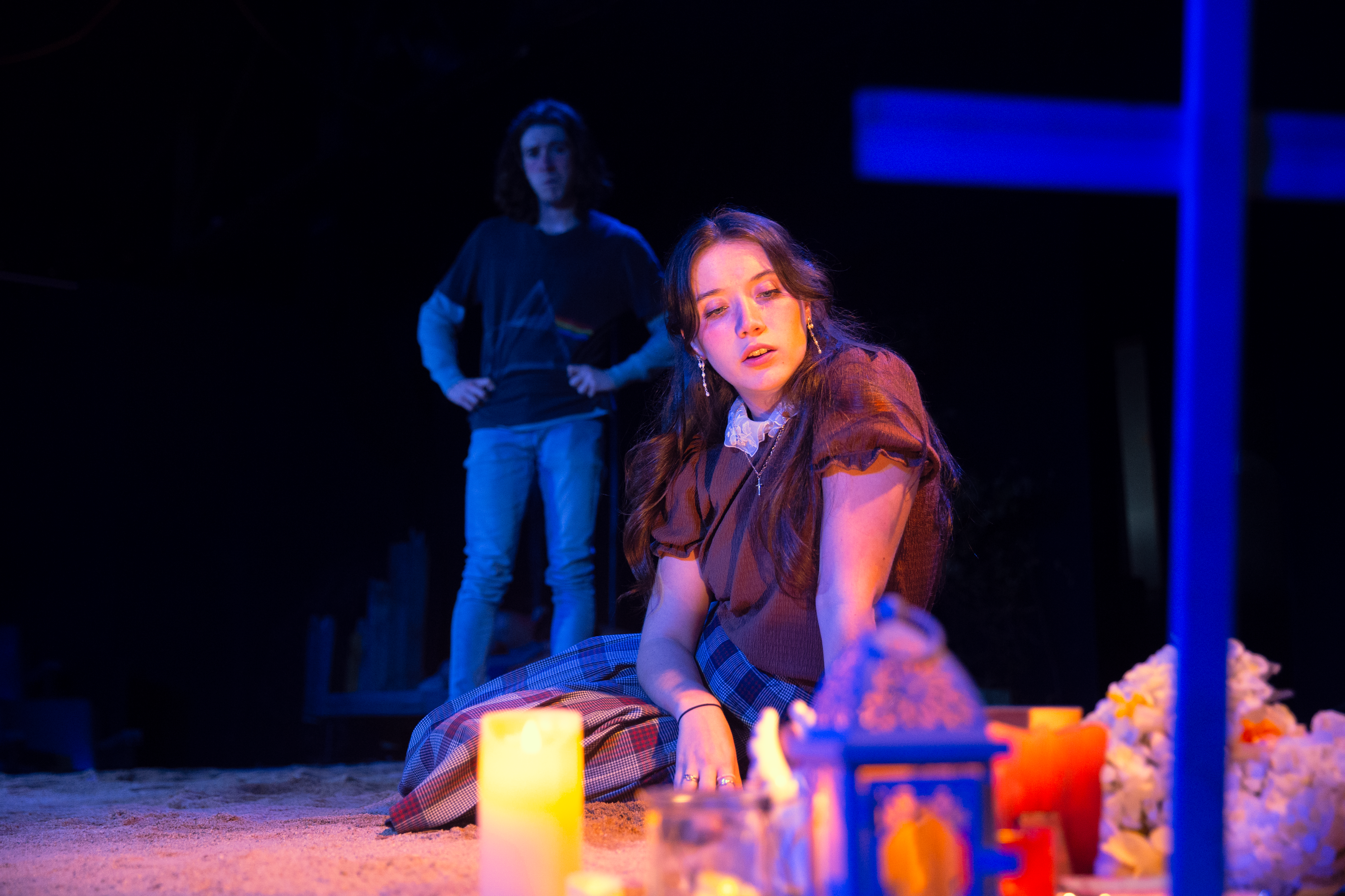
This is the first production by Luminar Theatre Company. Debuts are always thrilling, a sign of a vibrant scene and a promise of things to come.

Samson by Julia-Rose Lewis was first produced at Downstairs Belvoir in 2015.  I probably saw it; it’s reminiscent of a lot of new Australian plays from the time.

Set in a country town, it presents four teenagers dealing with grief.

It was Lewis’ first play and it throws down plenty of challenges for a director and their cast. It has a large number of short scenes. None of the characters seem to have sufficient dialogue. Some ideas are repeated too often (I need to get out of this town!) while others are left tantalisingly, or frustratingly, oblique (the recurring motif of burning.)

No one over twenty is given any stage time nor, it seems, has much impact on the lives of the characters we do see. I find this odd. What I take to be the themes of the piece – grief, guilt and metaphysical speculation – are experienced by everyone, not only teenagers. It could be argued that the piece’s purpose is to present a snap-shot of rural youth, but if so, why choose a moment in which they are confronted by problems that are so universal? Perhaps it all operates as a metaphor: the characters’ immaturity symbolising the inadequacy of us all in the face of Life’s grand questions.

Having suggested the play is an odd creature, one which some will find flawed while others will find powerfully resonant, what about this production? How does it deal with the challenges presented?

Director Chloe Callow and her design team use the space well. Sound design by Rhiannon Jean, lighting design by Julian Dunne and set design by Max Shaw effectively evoke a world of lost souls, tantalisingly suggestive of the gothic, but never giving in to the temptation to give that genre full rein – the character’s problems are genuinely existential, but aren’t soaked in a sensationalism that would reduce them to the rousing rather than the real.  

Callow also helps her eminently watchable cast (Samuel Ireland, Henry Lopez Lopez, Ava Jones and Jean) find the appropriate and always engaging tension between the characters’ natural youthful energy and the bewildering enervation of their loss.

Perhaps it would’ve been better for the company to choose a script in which the cast were asked to play characters of their own ages. But, even still, there are wonderful moments: of exuberant humour and lively physicality, and of honestly portrayed suffering and gentle commitment to the craft of truth-telling.

I look forward to seeing more from Luminar.

Paul Gilchrist

Samson by Julia-Rose Lewis

Produced by Luminar Theatre Company

At The Greek Theatre, Marrickville

Until Oct 11

Image by Simon Pearce
Conscience

19 Jul

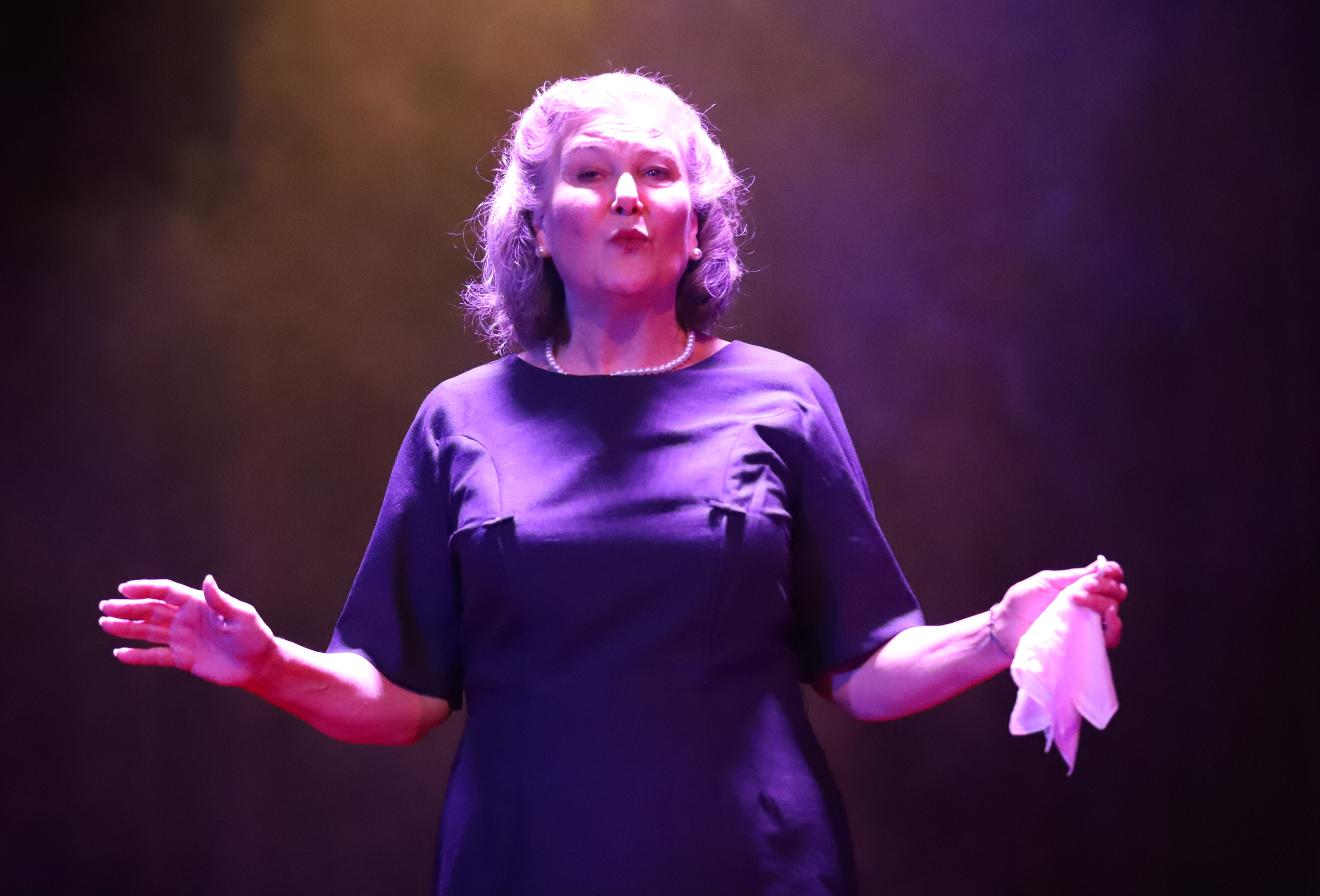
This is a fine piece of provocative political theatre.

Written by Joe DiPietro and first produced in 2020, Conscience tells the story of American Republican Senator Margaret Chase Smith in her battle against McCarthyism. 

The Greek Theatre can be a challenging stage on which to play, but director Madeleine Stedman uses the space superbly, giving the production a beautiful flow (the type seen in quality performances of Shakespearean drama.) Stedman also elicits some excellent performances from her cast. Alison Chambers as Margaret Chase Smith gives us the iconic symbol of moral integrity, but richly shades that symbol with the warmth of human weakness. As Smith’s assistant, Matthew Abotomey offers a brilliant portrait of determination and fierce intelligence when they’re pitifully tainted with (undeserved) shame. Ben Dewstow as Joe McCarthy plays the buffoon splendidly, presenting both the self-interest and the sleaze that makes this variety of clownish laughability so politically dangerous. McCarthy’s assistant, Jean Kerr, has probably the largest character arc, and Jordan Thompson’s performance is mesmerising, a heart-rending journey of seduction and corruption. 

The play raises some fascinating questions.

Firstly, there are questions concerning the nature of historical drama. Directors are often asked Why this play now? And playwrights are asked Why this story now? Why tell a tale that’s set 70 years ago? To answer, Relevance is usually trotted out – as if Truth and Beauty were insufficient justification for a work of art. (It’s the equivalent of choosing a minor hobgoblin to defend Two of the Persons of the Divine Trinity.) The script of Conscience has a firm sense of its own relevance, with McCarthy portrayed as a type of Trump. History does not repeat, as Mark Twain may have said, but it does rhyme. However, as every part-time poet knows, chase the rhyme and you lose the sense. There are times this script left me wanting to know more about the historical McCarthy and less about the implied similarity to Trump. I refer to Relevance as a hobgoblin because, when many commentators say a play is relevant, they only mean that it’s telling whatever story is currently being told by the media. And when that story is Trump, you might feel you don’t need to hear it again.  (To misquote a critic greater than, I asked for bread and you gave me stones.)

The second set of questions raised by the play concerns politics. The play left me thinking about the word conscience in relation to what might be called the political sphere of life. The title pulls no punches. Margaret Chase Smith followed her conscience in opposing McCarthy and the play portrays this as admirable. The play suggests many other people did not follow their consciences and that was reprehensible. But what impact did Smith’s actions ultimately have? How did her following of her conscience impact 1950’s America? The spoiler rule means I can’t unpack this line of thought further – but see the play, and ask yourself the same question.

It’s a common trope to assert, when someone chooses political actions different to our own, that they have silenced their conscience. It’s also a convenient trope – because it neglects to consider whether that other person ever really shared our values in the first place. Conscience is a private thing, and (talk to any priest who has heard confession) a rather complex and varied thing. What one person considers shameless compromise another embraces as unavoidable pragmatism. I’m making no comment about the historical individuals who didn’t stand up to McCarthy or about Smith’s attitude to them; it’s just that the play left me wondering whether the word conscience is really at home in the political sphere of life. Maybe home is where it belongs, keeping us from sleep in the small hours of the morning, as we stand solitary judge on our own souls. Only I know my own conscience. Everyone else can only guess at it – and why they should bother when there’s a better world to build is beyond me.

It’s through these invitations to thought that I feel the play achieves Relevance (and not because of that media-mimicking minor demon.) It’s relevant because it asks us to consider the Third Person of my imagined Divine Trinity – Goodness.

How do we personally manifest Goodness? And how can we encourage Goodness in others? Do people become Good by being told they are Bad? Are people only Good when they align with our vision of Goodness? How is individual Goodness related to a Good society?

As you can see, the play invites some awfully good questions.

Paul Gilchrist

Conscience by Joe DiPietro

Presented by Joining the Dots Theatre

At The Greek Theatre, Marrickville until July 26

joiningthedotstheatre.com.au

Image by Iain Cox Photography

The Department of Family Values

26 Aug

Written by Jon Glass and directed by Garreth Cruikshank, this is an enjoyable social satire.

Set in contemporary Australia, it interrogates the relationships within a privileged family.

Rebecca (Alexandra O’Brien) is a corporate lawyer and her husband Oliver (Barret Griffin) is a writer who suffers from the luxury of writer’s block. Their daughter Chloe (Rhiannon Jean) has won a place at Oxford, studying Comparative Literature.

Of these familial relationships, only that between father and daughter appears amiable.

Several factors add to the tension. Chloe has hooked up with a new guy, Josh (Angus Farrand) and as boyfriends go, it would probably be better if he did. Simultaneously supporting the family and having their own expectations are longtime friends Mark (Cruikshank) and his terminally ill partner Anne (Sally Williams).

For the most part, the characters are selfish and/or stupid, and so are alternatively amusing or pathos-inducing. There are some terrific one liners, but I was uncertain whether I was watching a comedy or a drama – a result of both the writing and the performance choices. At times too slow for comedy and at others too hyperbolic for drama, the work exists in a disturbing liminal space, one wonderfully appropriate for eliciting discomfort in an audience whose world is possibly not too dissimilar from that of the characters. (Adherence to the conventions of genre is one way we guide our audience through a production, but a single-minded insistence on these conventions is also how we attempt to tame the revitalising wildness of the theatrical experience.)

The final scene tries to do too much: too quickly solving dilemmas which were, admittedly, never sufficiently fleshed out. However, in its emphasis on reconciliation, the piece takes part in the grand tradition of comedy, while also challenging us to find room in our reality for this golden but oft forgotten value.  

Paul Gilchrist

The Department of Family Values by Jon Glass

The Greek Theatre

21st to 24 Aug (This run has been completed)

Image by Garreth Cruikshank

Haircuts

16 Apr

Recently a friend suggested to me that there were too many positive reviews being written in Sydney. I found this a curious statement.

If it’s true, one can only ask ‘Why?’

Here’s some possible explanations:

Perhaps reviewers are just writing irresponsibly in order to secure free tickets. (To shows they don’t like?)

Perhaps reviewers just enjoy status. (I’m reluctant to despair of human nature so easily.)

Perhaps the standard of theatre in Sydney is, in fact, improving. (In comparison to what?)

Perhaps the current crop of reviewers and my friend simply don’t share the same aesthetic values.

Let me expand a little on this idea.

I go to the theatre because I enjoy the art form. What I enjoy most is its fundamental duality. It puts into conflict multiple voices, yet these multiple voices are orchestrated by the one artist, the writer. (Of course, I’m talking about script based work, and I don’t want to undervalue the collaborative nature of theatre.)

Haircuts 076

Take Haircuts, directed simply and beautifully by Lex Marinos and performed by a very skilled cast. Written by Con Nats, the show is built on a contrast between two different fathers (John Derum and Adam Hatzimanolis). Fascinating tensions arise. Old wisdom versus new business sense. Parents versus children. Words versus silence.

But these tensions, these multiple voices, build a cohesive universe, and in Nat’s universe, the essential aspect is that human relationships are fractious. The pain of this is intriguingly explored through humour. Broadly, this humour comes in two forms. It’s either gladiatorial, as characters trade insults. Or it’s based on gender or ethnic stereotypes, as characters try to come to terms with the ineffable mystery of the Other.  This vision of life – of a world of damaged human beings desperate to make connections – is what makes Nats an interesting and valuable voice on the Sydney theatre scene.

Veronica Kaye

Haircuts by Con Nats

The Greek Theatre til 26 April

http://www.trybooking.com/Booking/BookingEventSummary.aspx?eid=117988

http://conats.wix.com/haircuts