The Glass Menagerie was first produced in 1944, and it launched Tennessee Williams’ career.
This slightly amended version is a poignant meditation on dreams, memory, and regrets.
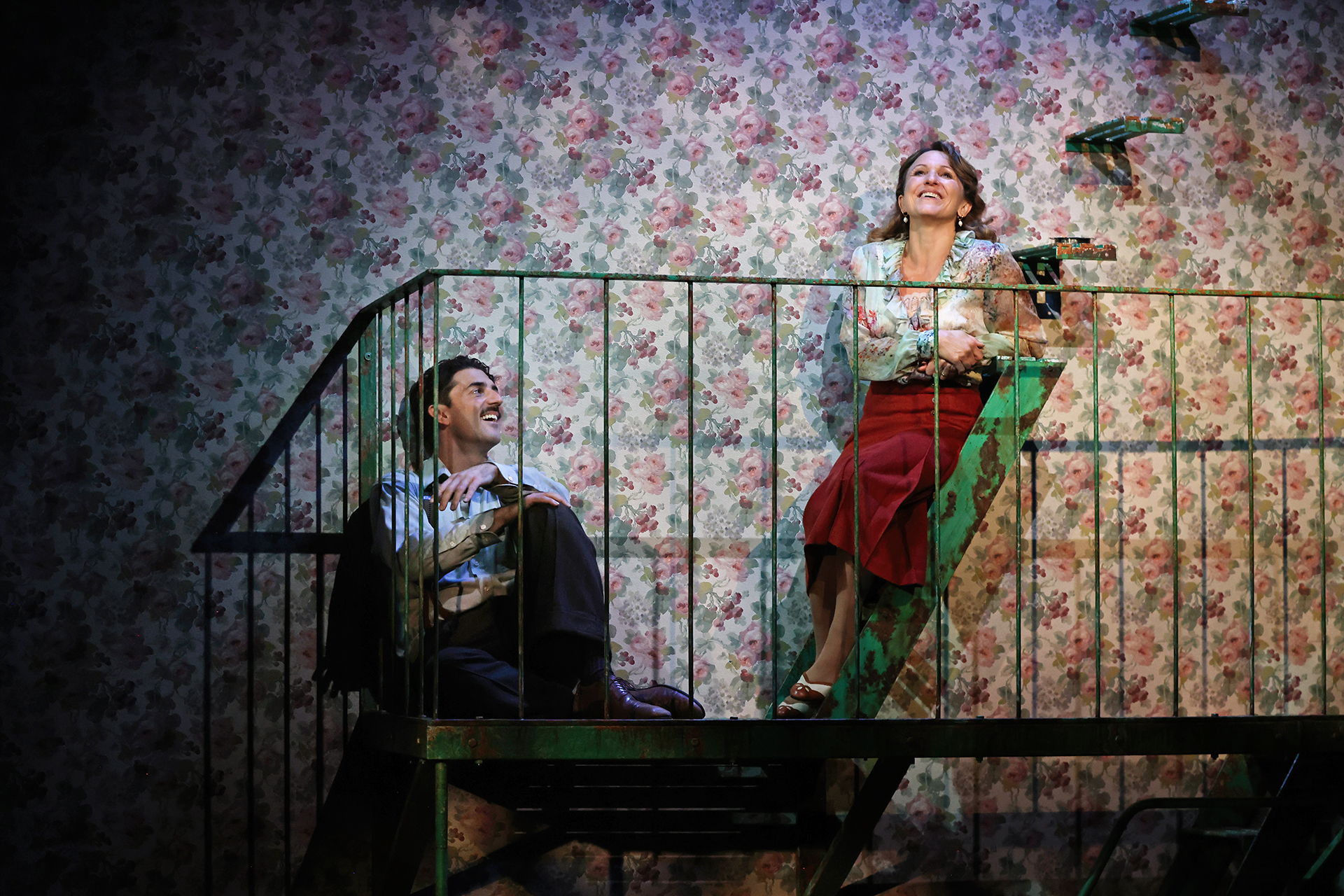
Blazey Best is absolutely magnificent as Amanda, matriarch of a small house, evoking both laughter and pathos as she presents the fading southern belle, all attitudes, airs and … anguish. Once, in a single afternoon, she had seventeen gentleman callers. Now she worries for her daughter Laura, who has no gentleman callers at all.
Laura has a slight defect in her leg, but suffers more from her crippling shyness. Her life has reduced to playing records and tending her ornamental glass menagerie. Bridie McKim is brilliant as Laura, portraying perfectly her painfully overwhelming self-consciousness, while still finding those heartrending moments where hope glimmers through.
Tom, Laura’s brother, chafes under the responsibility he has to his fatherless family, and can barely endure his banal warehouse job. He also narrates the play, stepping out of the action to muse on the distance between mundanity and magic, between the average life and the adventurous one. Tom is a partially autobiographical creation; he dreams of being a writer, and his family situation is not unlike that of Williams’ youth. Danny Ball is mesmerising in the role, capturing both Tom’s energy and his desperation.
Tom also rankles under his mother’s insistence he find his sister a beau. The tyranny of women snaps back Amanda, with scathing satire.
He brings Jim to dinner.
Tom Rodgers offers a splendid portrait of Jim, bubbling and brimming with naïve enthusiasm. His scene with McKim’s fraught Laura is dramatic gold.
Liesel Badorrek’s production is a wonderful opportunity to see a classic of the American stage.
Romance is such a garden variety human experience that we often forget its potentially wondrous result.
(Or, to slightly misquote Chesterfield, the pleasure is momentary, the position ridiculous, and the consequence damnable.)
Written by Laura Lethlean and directed by Kirsty Semaan, Two Hearts tells the story of Him (Yarno Rohling) meeting Her (Danette Potgieter), and of what follows.
Throughout, the couple are shadowed by It (Lisa Hanssens).
For a while, it’s a guessing game as to what (or who) It is. I suspect some audience members might find this frustrating or dissatisfying, but not as frustrating or dissatisfying as when they realise the answer. You could suggest that the answer to the question of who is It? begs the fundamental question of the play. (I’m attempting to avoid breaking the spoiler rule, so forgive me for being so vague. When a play risks so much on one dramatic trick, it seems poor form to reveal the nature of that trick in a review; a bit like revealing who did it in a whodunnit.)
But, perhaps the fundamental question of the play lies elsewhere (away from the issue I’m not naming, the issue that’s both very current and also universal, the issue I suspect many audience members will have very decided attitudes regarding, attitudes which will remain unchanged by this play.)
Perhaps, rather, the fundamental question is how do we navigate memory and regret, how do we construct a narrative of our lives? Though some scenes between the couple are played in naturalistic dialogue, many are played in a manner that suggest both the woman and the man are recalling events and trying to determine the truth of that moment. Sometimes the characters will play out the actions of the scene while seemingly remaining in their own internal worlds, trying to recall (or assert) how it all actually occurred. For example, the couple sit down and He says something like We were sitting next to each other and this is juxtaposed with Her reflection (rather than Her response), something like We sat far apart. This motif of reflection on the past is furthered by scenes in which It asks the man and woman, separately, about decisions made during the relationship. Combined with a sometimes heightened poetic language, and a muted but expressive lighting design (Jasmin Borsovsky), and a movingly melancholic sound design (Charlotte Leamon), we get the sense of two individuals grappling with a great mystery, the passing of Time and all the loss that entails.
Potgieter and Rohling as the young couple are wonderfully believable, both in their initial excitement as the romance blossoms, and in their growing frustration as it threatens to fade. The differences between the two lovers are subtly portrayed in both script and performance.
The character She is gently performative – I want people to like me – and perhaps a little more selfish – a friend has said to her You are the happiest person I know, because you are the most selfish. Both despite these flaws, and through them, Potgieter beautifully creates a character who we like and who we pity (which is probably the most suitable response we can have to any other person.)
In contrast to Her, He is more genuine, perhaps a little simpler. He dreams of being a musician but is self-deprecating enough to realise it is unlikely to happen. Rohling’s presentation of the character brims with warmth, and as things begin to go wrong in the relationship, his portrayal of a sad, anguished bewilderment is superb.
As It, Hanssens has the oddest of roles – but pulls it off with aplomb. With both movement and voice, she effectively evokes something passionless yet present, something uncomplicated yet curious, something without skin in the game, but that watches eternally. (There’s an infinite pathos in a figure who stands always at the bank, as the river of Time slides endlessly by.) To use the body in a way that suggests the soul is a remarkable achievement.
Two Hearts is a piece that is as gently disconcerting as it is softly beautiful.
This is a micro-musical: two performers, accompanied by a musician on key board – whole thing 80 minutes long.
Apparently, it’s inspired by the life experiences of song writer, Kyle Falconer, and one of the writers of the book, Laura Wilde. (The other writer is Johnny McKnight, and the piece is directed by Andrew Panton and Tashi Gore.)
As the title suggests, it’s a relationship story, but not your conventional one. This is no romance ending with And Reader, I married him. A baby is born in the third scene.
How do Lana and Jess navigate this new arrival?
Hint: it’s not a baby bliss story.
Firstly, I’ll be shallow and sharp.
Neither character is particularly charming. They’re incredibly judgemental, criticising her mother, the women at play group, and even a guy who wears socks (or doesn’t wear socks?) with a particular type of shoe. A lot of things are shite. A lot of emotions are punctuated with fuck. And we hear about her vag, her tits, and the need to shit while giving birth.
Despite referring to themselves as the DreamTeam, Lana and Jess never seem particularly close, and this is emphasised by the structure of the piece, in which each often sings alone, or talks directly to the audience about the other.
And they constantly refer to the baby as the Little Man, suggesting they haven’t really got their heads around the fact he’s a child, and the enormity of their new responsibilities. (And it left me wondering if they would’ve referred to a female child as the Little Woman.)
They’re really just oversized adolescents who need to grow up.
But, as I suggested, I’m being sharp and shallow.
To respond in this manner to dramatic characters is to deny the sophistication of the dramatic form.
Let me dig deeper.
There’s hints of a troubled prehistory. One of the early songs, musing on their future as parents, expresses the hope they don’t become monsters. This begs a backstory we’re never told, this pathos-inducing hope betraying unacknowledged darknesses in their own pasts, and effectively establishing how self-unaware these characters are.
But I’m still sticking to the surface, the spoiler rule holding me back – but the need for content warning, and a more genuine assessment are pushing me forward.
It’s story of postnatal depression.
And that can hit any woman. Charming or not. Self-aware or not. And it does, with a dreadful, often unrecognised, frequency.
No Love Songs’ raw portrayal of the pain of this experience is wonderfully honest (and transcends all the other chip-on-the-shoulder type of supposed honesty that otherwise pervades the piece, the type that automatically equates Telling it how it is with ugliness, and seems unable to do anything but assume that there actually is Away it is.)
Keegan Joyce and Lucy Maunder give terrific portrayals of these challenging characters. Accomplished musical performers, they present the songs beautifully, and the dialogue with skill. The jokes work, and the suffering is heartrending.
Falconer’s songs are engaging and the music is splendidly produced (though I did wonder whether an arrangement beyond synthesiser keyboard and acoustic guitar might have been interestingly edgy.) It was a joy to hear every word (except, perhaps, when Lana was rhymed with trauma.)
The piece is billed as a modern love story. It’s an intriguing piece of code, one best deciphered as a comment on what this story is comfortable exploring, as against suggesting this story is concerned with particularly modern aspects of love. Because these things have always happened and hopefully, in bravely speaking of them, those who suffer can find the support they deserve.
Paul Gilchrist
No Love Songs by Kyle Falconer, Laura Wilde and Johnny McKnight,
In the war between the generations, the final result is inevitable. All that’s in doubt is what the victors will learn from the vanquished, before they too ultimately join the ranks of the defeated.
Jack Holden’s Cruise was first performed in 2021 in London. A young gay man works at a phone help line. An older man calls, and is disgruntled to be answered by such an inexperienced responder. Already annoyed at one of the older gay men working at the centre, the young man is taken aback. The tension between the generations is established.
This is a 90 minute monologue, with Fraser Morrison playing an astounding number of characters. Morrison’s control of voice and movement is superb. It’s an absolutely extraordinary performance. (And credit must also go to his terrific support team: director Sean Landis, accent coach Linda Nicholls-Gidley and movement director Jeremy Lloyd.)
The basic set up of the piece is that the older man tells the younger man his personal history, of his time in Soho in the 1980’s. It’s parties and promiscuity, dancing and drugs, and true love… and true love’s awful nemesis. There’s oodles of charm, plenty of humour, and at the dawning of that cruelly indiscriminate plague, distress, dread, and soul-deep sorrow.
As an outsider to this world – I spent the 80’s not in dance clubs but in libraries – a piece like this is a beautiful gift. To witness a community in the process of building itself, to observe it openly constructing its history, is a wonderful privilege. (Self-indulgent digression: While in those libraries, I was learning about love in a way very different to that of the characters in Cruise, reading the history of mysticism, first in Christianity, then in Judaism, then Islam and then from further east. So, History and Love – where the lesson is that Eternity is in love with the productions of Time, to quote William Blake.)
And that’s the glorious wisdom of this piece: by knowing our history, by knowing the sorrows and solaces of those who came before, we gain the strength to step into the future. And what’s more, knowing our place in Time is the best preparation for the joys which seem to transcend it.
Paul Gilchrist
Cruise by Jack Holden
presented by Fruit Box Theatre in association with bAKEHOUSE Theatre Company
It’s probably the most abridged version of this play you’ll see outside a school incursion.
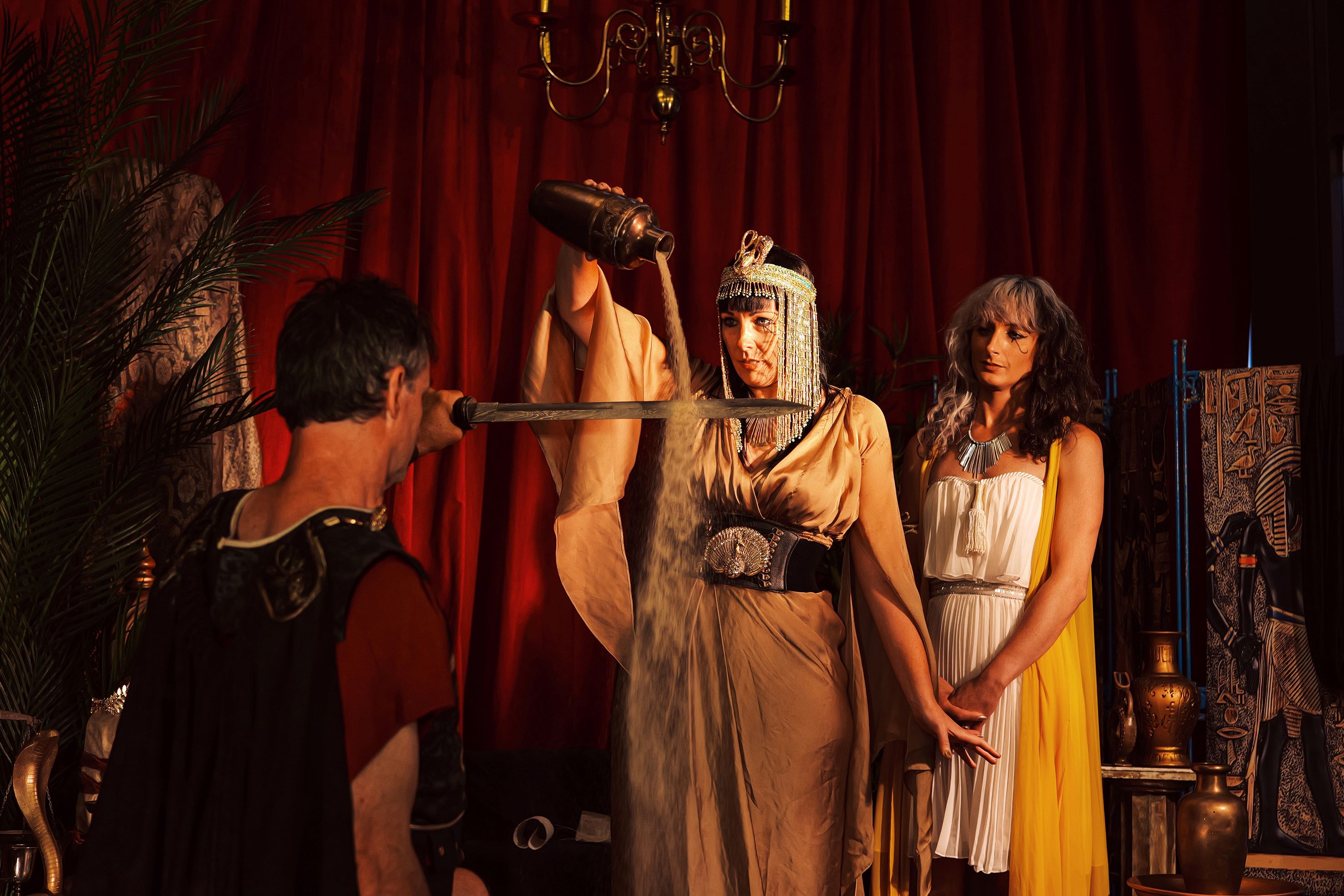
It’s all performed by three actors: Charles Mayer as Antony, Jo Bloom as Cleopatra, and Charley Allanah as everybody else (or at least everybody else who isn’t cut.) Performances are bold and spirited. For reasons that will become more apparent later in my response, design focuses on costume, and these by Letitia Hodgkinson are beautifully lavish.
There’s also a narrator or guide, a role taken by Nathan Meola. He almost gets as much stage time as Shakespeare, though far fewer words. He appears to be adlibbing. He speaks very slowly and quietly, as though he’s speaking to the guests at a spiritual retreat. We’re thanked for the journey each of us has made to get to the theatre, and it’s acknowledged that the journey may have been difficult. (There’s even talk of snow.) We’re asked several times if we feel safe, and at each repetition I feel a little less so. His speaking style is a curious mix of condescension and coercion, made all the more disconcerting by the very convincing illusion that it’s not a created dramatic character being performed. He asserts that we humans are not immune to stories and, for a moment, I question my own humanity – until I recall that he’s ignoring a rather vital point: the power of a story depends on how well it’s told. This narrator recaps what we’ve seen and tells us what we’re about to see – which may seem superfluous, even to those unfamiliar with the play. He also assumes we’re deeply affected by the performance. (In our current theatre scene, in which there’s far too much of telling audiences what to think, it’s refreshing to be told what to feel.)
The marketing describes the production as immersive – which can mean a lot of different things, but here means you may not get a seat. We’re needlessly shuffled back and forth between the foyer (where there aren’t enough seats) and the theatre (where there are plenty.) These changes of location, and the narrator, have a slowing effect, but the whole thing is only 90 mins, including interval.
Shakespeare’s play is reduced to the story of two people going through a dark night of the soul to find eternal love, or divine love, or some such thing. (At least that’s what the narrator tells us is happening.) The political tensions and the grand clash of civilizations are given little space. This reduction enhances the sense the play is being used as a vehicle for a certain New Age philosophy.
So is it “Shakespeare”?
That’s an absurdly conservative question, based on some disturbing essentialist assumptions. But I’ll answer it anyway.
On one level – a particularly academic one – the answer is No. Shakespeare and his contemporaries dragged theatre away from being what was almost a religious ritual, with narratives dominated by religious perspectives. They moved the artform away from the traditional Mystery play. These Elizabethans still acknowledged that spiritual experiences existed (in a way that, say, Jane Austen seemingly does not) – but they viewed those experiences as part of the wider human experience, not necessarily as its key. To be essentialist, they were humanists.
But, soaked in Renaissance humanism, Shakespeare was not an essentialist. He looked at the world with humility and wonder, and I suspect he wouldn’t dismiss a production like this, but would ever so gently chastise those who might. After all, as his most famous creation says, “There are more things in heaven and earth than dreamt of in your philosophy… “
This is a rom-com. Yes, I know Shakespeare made this sort of thing work, with his poetry and multiple storylines, but it’s a genre I don’t usually enjoy, and one I don’t think particularly suited to theatre.
But, written by Dax Carnay with Aleks Vujicic, Chasing Dick is utterly charming.
A father (Jason Jefferies) and a son (Chris Colley) have both fallen for Dick (Carnay), a trans woman.
Directed by James Lau and Carnay, the performance style is a sort of naïve naturalism, and the characters created are warm and very likeable. Carnay, in particular, is a gifted comic actor.
The result is a show that’s cute, funny, and wonderfully effervescent.
But it’s not just bubbles; there’s some invigorating tensions that give the piece a glorious richness.
Firstly, there’s a fascinating dual narrative in regard to Dick’s backstory. At one point, her Filipino culture is described as conservatively intolerant of her identity, retrograde in comparison to a more open Australia. In another telling, her original culture appears warmly accepting. Is the character indulging in revisionism? If so, it’s a penetrating portrait of the psychological complexity of migration. Or, are the competing narratives indicative of the inescapable contrast between our anxieties and reality? She feared coming out, but was then happily surprised? If so, it’s an insight into abuse’s inevitable and insidious ability to warp our world view; a single snarl erases a thousand smiles, and can hold us back from so many more.
Secondly, there’s a moving interrogation of the trope of the Manic Pixie Dream Girl (MPDG). The MPDG is a female character who sometimes pops up in romantic comedy, a woman of transgressive energy but no apparent interiority, a woman whose sole purpose appears to be aiding the male characters’ growth. Both father and son fall under Dick’s vivacious spell, but she complains You see me, but you haven’t listened to me! She refuses to be reduced to a fetish; she demands to be recognised as a full human being. But, at the same time as rejecting the dehumanising elements of the MPDG, the positive aspects of the trope are retained. Dick does encourage the men to mature. A cynic might reject the lessons these characters are asked to learn as mere psychobabble – of the Tennyson-inspired Better to have loved and lost variety. However, romance might be the silliest of the serious things, but in a world in which the silliest people seem to have gained control of the most serious things, lessons of acceptance, openness and the importance of genuine love have definitely not lost their vitality.
Thirdly, the play offers a transformative exploration of reductive thinking. Confronted by his unexpected feelings for Dick, the elder of her devotees wants to know What am I now? It’s a powerful poke at conservativism. (I, for one, wanted to scream from my seat Why do you NEED a label?) And yet, in a play that positions us to question the oversimplification of labels, Dick says very clearly I am a woman.
And it’s a truly beautiful moment.
The current fashion in our theatre is to be overtly political, to be direct, didactic – and dull. We like to tell our audience what to think. One way we do this is by loudly asserting the rights of marginalised peoples. Jeremy Bentham famously suggested that any talk of rights was nothing more than nonsense on stilts, meaning it was just airy-fairy fancifulness, rights ultimately being guaranteed nowhere and underwritten by nothing. Inadvertently (perhaps) Bentham’s dismissive metaphor highlights the appeal of the language of rights – after all, everyone does stop to watch a person walking on stilts – though he was correct in suggesting it’s not usually a sight that has a life-altering emotional impact.
But when Carnay as Dick asserts I am a woman, she is not speaking the language of rights, she is not furthering an agenda, she is not repeating the party line. She’s being far more radical than that – she is being honest.
I’m not completely dismissing theatre with political attitude, but a piece like this is an invaluable reminder of how we might best connect with our audiences. It is openness that breeds openness, and I suspect many more hearts are melted by sincerity than ever are by slogans. If justice is to stand, it will stand strongest when built on the knowledge of our shared humanity.
I have a confession to make: my title will probably be the most interesting thing about this article.
Deliberately titillating, that provocative word confessions is really no more than a sad attempt to disguise the fact that this will be just one more article written by me about me.
I usually write theatre reviews and, as everyone knows, reviews tell you more about the reviewer than the show. (After all, no matter what show I go to see, I’m always there. It’s this inevitability – rather than the quality of the work – that explains why so many reviewers become jaded.)
So, if this is just another article about me, why write it at all?
It recently occurred to me, that as of last year, I’ve written as many reviews about other people’s shows as I’ve had reviews written about my own shows. So, I guess, I’m in a weirdly privileged position.
Dear Theatre-maker, I know your love-hate relationship with reviewers, and I think I can offer some insight. (Or, if not, at least I’ve harnessed another opportunity to write about myself.)
Dear Theatre-maker, these are the things I must confess:
I’m excited every single time you send me an invitation to a show.
I don’t especially like to go to your opening night.
I like to bring a plus one.
I know what I write is not very important, certainly not as important as what you write.
I’m aware that everything I write is sloppy. I’d like to take more time and write for posterity, but I know that posterity doesn’t buy tickets. (What I write is mere fish wrap, hence the above image.)
I’m not trying to market your show, but I know you are. So, if I like your show, I’ll include a line or two you can use as a pull-out quote.
I dislike the idea of grading or comparing productions.
I’m not trying to make you famous. (I’m not trying to make me famous. It’s with great reluctance that my reviews have a byline. I’d prefer not to include my name at the conclusion of what I write, but I believe the obligation of accountability outweighs the pleasures of anonymity.) And, if fame is what you are trying to achieve, I think you should carefully consider why. I think you should also consider what that desire suggests about your attitude to other people. I’m not saying you shouldn’t seek financial gain from your art – but because I believe artists shouldn’t starve, I’d also rather they remain in good psychological health.
I want people to read what I write. So, if you like my review, share it on your socials.
Personally, I don’t read reviews. I think a fair percentage of reviewers write terribly. It’s sometimes said that we reviewers are failed artists, but that’s not the whole story: many of us are failed reviewers as well.
I read your program only so as not to misspell the names of your creative team (though sometimes I’ll still get them wrong anyway.) Apart from that, I studiously avoid everything you write about your show: marketing, advertising, director and writer’s notes … everything. In fact, reading your program notes afterwards can feel like a type of gaslighting; I saw the show, and now you’re telling me, in such authoritative tones, that my interpretation of the show is wrong? (But I understand why you write these notes. Many of the notes I’ve written as a playwright have simply been repeated back at me by reviewers and, as a result, the reviews have been a delight to read.)
I know you won’t like everything I write, and I’m OK with that.
I give your show much more thought than you probably imagine.
I find the spoiler-rule frustrating, but I’ll abide by it. I don’t like it when you act as though I’ve broken the rule when I’ve merely outlined the scenario. I have to be able to say what your show is about; I can’t just gush hyperbolic platitudes.
I don’t like it when you suggest I’ve misunderstood your play. You’ve shared it, and now it’s ours.
I know what I write is subjective. I know I have personal preferences and interests, and I know they’ll inform what I write. I don’t believe there’s an objective viewpoint, and I think those who assert there is are either naïve or lying.
I’m not interested in your politics. Or, more to the point, I’m interested in them in a way you might find surprising. To be honest, your piece of theatre is extremely unlikely to change my political outlook – but I do love to learn what political perspectives are being held by other people, artists included. When you behave as though your art will change hearts and minds, I think it’s a little odd. I’m not saying it won’t, or it can’t, but to have that as your driving purpose is to assume your audience is less sophisticated than you.
I like to be thanked for my review. Even a one-word message will suffice. Here’s one you can cut and paste for future use: Thanks.
And to end this article, I’ll take my own advice.
I’m absolutely thrilled about the upcoming year of theatre, and so, in advance, to all Theatre-makers, an enormous THANKS.
I’ve had the enormous good fortune to see 81 shows in 2024. Yes, a lot – but other reviewers see more.
This year, in response to productions, I’ve written 46,000 words. (To give some perspective, Hamlet is 30,000 words, The Great Gatsby is 47,000, and some random monkey banging away at his keyboard for 12 months is 46,000.)
I don’t get paid for my writing (though if someone wants, I can easily supply my banking details.) And I don’t do it for the tickets. I do it so I can write about theatre. (Would I have wanted to see so many plays without writing about them? No. I enjoyed seeing most of them, but I enjoyed writing about all of them.)
If you’re reading this article for my “Best of 2024 List”, you’ll be dissatisfied. I don’t see art as a competition, so I won’t be ranking productions. (I have become Disappointment, the Destroyer of Dreams.)
I’m writing this reflection simply to share some observations of Sydney’s theatrical world – because I believe sharing not competing is the essence of art. My observations will be, unavoidably, limited and subjective.
FIRSTLY, TRIVIALITIES: THE WORLD OF REVIEWING.
It appears there are more people writing about theatre than ever before. My current publicity list includes over 40 Sydney-based sites or publications. Despite this (or because of this) there’s still a tendency for many reviewers to write in marketing language. I’m not sure if this is a result of inexperience or cynicism. But there are some really interesting new voices, as well great material written by some old hands.
Despite the large number of reviewers, theatre companies are increasingly using “audience responses” in their marketing.
Despite the large number of reviewers, indie companies can still struggle to get critics to come along to their shows.
The trend to grade productions out of 5 has become almost universal. And it feels like an arms race. Not many shows are awarded 2 stars; if you want to garner attention for your site, you give a show 5 stars. I’m waiting for someone to award 6. (Give 1 star and you’ll also get noticed, but the invitations might soon dry up.) I’ve resisted the trend because I don’t feel productions are comparable in any sense that’s interesting. And, fortunately, I don’t have an editor demanding I follow the fashion.
I’ve noted theatre-makers expressing dissatisfaction with reviewers. (I’ve also noted the sun still rises in the east. Nothing gets past me.) Considering the nature of the relationship between artists and critics, some animosity is probably inevitable. I’ve heard complaints that too many reviewers are not experienced enough. I’ve heard complaints that reviews are not harsh enough. I’ve heard complaints that reviewers evaluate productions according to their politics rather than the artistry of the creatives. There also appears to be some moral discomfort when someone who produces art also writes about it (like myself). Obviously, I’m either trying to feather my own nest or piss on someone else’s. Sycophancy and vindictiveness, it seems, are more believable motivations than a genuine interest in the artform.
Reviews used to be referred to as fish-wrap, alluding to the fact that today’s newspaper becomes tomorrow’s rubbish liner. Now, with most reviews online, they’re less like fish-wrap and more like nuclear waste – a poisonous, unwanted byproduct that just never goes away. Personally, I’d like to see more reviews written in a manner that would make them interesting to read even if you were never going to see the show. I’d like reviews to invite readers to think more about the dramatic form and more about the ideas that the shows explore. I don’t expect all reviews to be like this, but I think there’s space for something more than glib, thought-free, idiosyncratic evaluations.
NOW THE IMPORTANT STUFF, THE PRODUCTIONS THEMSELVES.
It’s an absurd generalisation, but the overall standard in Sydney theatre seems higher than previously. Perhaps this is because the number of venues remains low and so access to them is more competitive. Or maybe it’s just a result of more discerning programming. Or maybe there’s something in the water. Whatever the case, I’ve been privileged to see many superb productions.
I’ve really enjoyed the sheer amount of new work presented this year; over 50% of what I’ve seen. I want to thank the season programmers for this, and all the indie producers who took a chance on the untested. (I will point out that there’s a tendency for some new work to be longer than needed. I think a good rule of thumb is that 90 minutes is as long as you should ask an audience to sit without an intermission. Yes, intermissions have gone out of fashion, so if it’s new work, and you’re in charge, please consider closely the show’s running time. Many pieces would gain from a tighter edit. In fact, few phrases in the theatre vernacular are repeated with more glee than A short show is a good show!)
As well as new work, there’s also been an enjoyable variety of old classics, the return of some Australian soon-to-be classics, and some thrilling contemporary work from overseas. A healthy theatre scene should be a mix, and at least for me, this year of theatre in Sydney got that mix just right.
To praise our directors in particular, the use of space has often been magnificent. In this regard, I’ve seen absolutely brilliant work at Belvoir, Ensemble, Sydney Opera House, Seymour, KXT, Old Fitz, New Theatre, Flight Path, Riverside, Qtopia, Carriageworks, Flow Studios and the Fringe. It’s been a joy to see directors embrace the potential of a space rather than merely attempt to minimise what they think are its limitations. To praise our designers, there’s been some terrific shows with a minimalist aesthetic. There are productions playing with technology, and doing so in an exciting way, but it feels as though our fascination with gadgets is waning.
I’ve never been a fan of theatre that’s little more than sitcom, and there appears to be less of it.
There’s a continuing interest in theatre that purportedly is Telling our Stories. I’ve written elsewhere how this phrase has morphed into the odd assumption that theatre is fundamentally a type of non-fiction. However, though the phrase Telling our Stories has been used this year, it hasn’t dominate the description of productions as much as previously. For example, in the last few years, it almost became the default position that any one-person show was a sharing of actual lived experience, but in 2024 I’ve seen some great one-actor shows that had no pretence of autobiography. We need diversity on our stages, but the fictional form doesn’t need to be sacrificed for this to be achieved.
I’m reluctant to make a judgement as to where we actually are in regard to diversity. The majority of companies claim to be committed to the concept, and the difference between now and, say, 15 years ago is substantial. But I’ve spoken to artists who are dissatisfied with what’s been achieved, and who feel that though the language of inclusion is spoken, it’s not always sincere. Diversity will remain a live issue, partly because theatre that doesn’t reflect the society in which it’s created is doomed to irrelevance, but also because the philosophical assumptions that drive our desire to achieve it are still muddy and require further discussion. Expect me to write more about this next year.
The standing ovation has become common. Does that mean audiences are more appreciative of what’s happening on our stages? I hope so. A cynical friend has suggested that the standing ovation is just a way of reclaiming the experience from the performers, or simply an automatic response from individuals frustrated by the requirement to sit still and relatively quietly for such a long time. Or, says my friend, it’s a way of shaking off the art, like frantically removing a spiderweb into which you’ve accidently stumbled. (I wonder if it’s perhaps more the shower you might take after a visit to the dentist; you’ve submitted to the necessary drill, and your smile might now be healthier, but only because blood and bone have been splattered everywhere.) I’m not one for standing ovations; I have enough trouble putting my socks on in the morning, let alone leaping instantaneously to my feet. But perhaps it’s also about what I value in the art. To respond so physically, so completely, to a piece of theatre means I haven’t had time to savour its subtlety or to be threatened by its thorniness.
But, most likely, most people are just quicker than me.
So I’ll give my standing ovation now, at the end of the year.
Thank you Sydney theatre-makers, you have shaped things of Beauty and shared dreams of Truth. We have asked for bread and you have not given us stones, and we are richer for it.
This is a fascinating piece of theatre. The arresting title is an introduction to its key concerns. Philosophers as great as Plato, Augustine and Foreigner have all wanted to know what love is – but an even deeper tradition has long questioned the meaning of those mysterious little pronouns, the you and me of the phrase people will think you don’t love me.
What are you?What am I? To what degree do any of us have a fundamental essence? If so, what does that essence consist of? I don’t mean the particular qualities we might attribute to lovers, qualities like courage, intelligence or kindness. I mean the medium in which such characteristics exist, where they reside. (Analogy: old films were celluloid, and it was in this medium that the particular images that made up any individual film resided.) To cut to the chase, in the currently reigning philosophy of secular materialism, are we simply our physical bodies? If so, then our personal qualities must reside in those bodies. And the tantalising question raised by all this is If you donate an organ to me, do I begin to become you?
This is the basis of Joanna Erskine’s fabulous play. Michael has a diseased heart. When Rick dies in an accident, Michael is given his healthy heart. And then he changes….
Some people might dismiss the idea as simply weird, or as such a rare experience as to be of little relevance.
But what it’s doing is opening up the concept of selfhood. A couple of decades ago we had an obsession with finding ourselves. It was assumed every individual had an essence and it was the mission of each of us to find that essence and let it shine. More recently, we’ve come to define our essential self in terms of our membership in certain demographic groups. With this sociological rather than psychological focus, we’ve come to see our individuality as a space carved out by the intersection of various statistical sets. We’ve almost replaced the word individuality with identity. We no longer shine like some sort of star, but rather lie small and flat, a mere overlap in a Venn diagram.
But, as I’ve suggested, this play doesn’t so much raise the question of Who we are but What we are.
I don’t want to make the play sound heavy; it’s extremely engaging. (And I certainly don’t want to sound like the kind of pretentious fool who goes to a children’s party and sees innocents being inculcated into the competitive values of capitalism, while everyone else just sees kids playing Musical Chairs.)
But this play won the Silver Gull Award when it was run by subtlenuance, when the parameters were that eligible plays be philosophical or political. Now the award is run by New Theatre, and that phrase has wisely been removed (the average theatre-goer being insufficiently familiar with the philosophical approach to appreciate that their favourite artform is philosophy’s closest cousin. What two human activities are the Ancient Greeks most famous for gifting to Western society? Drama and philosophy.)
Good drama is good philosophy: recognisable situations, presented in accessible language, posing fundamental questions.
And the dramatic form is eminently suited to the investigation of the philosophical concept of the essential self. The creation of individual characters is one of the dramatist’s major tasks. And, as audience members, we judge the success of any particular characterisation by the success of that mysterious trick of combining consistency with unpredictability. Of any character, we want to be able to say I understand why she did that rather than being reduced to the boredom of She was obviously going to do that. And one way theatre keeps that magic mixture of consistency and unpredictability bubbling is the actor, the physical body on stage. Every writer has had an actor in a workshop or rehearsal critique their script: I don’t think my character would say that. One answer is Your character does, indeed, say that. Your physical presence on stage as you say the line is sufficient, because the character exists nowhere else.
In Erskine’s play, the interrogation of the nature of selfhood is further facilitated by the focus on romantic love. Romance is the type of relationship most based on the assumption that an individual is something particular, something special. (In most other relationships we’re honestly not that interested; we’re content to deal with people as we find them.) There’s a flashback to the night before Michael and Liz’s wedding, where he explicitly outlines why she is the woman he loves. It’s commonplace to assert that people change, and that’s why romance dies. But why are we so hopeful in the first place that the loved one will act consistently? Perhaps sexual love is like the theatrical stage; the centrality of the body somehow implies a permanency of self.
I’ll repeat again, the play is not heavy; it’s a gripping psychological drama (with a smattering of the gothic – I’d love to see more!)
And the awkwardness of the situation, that Michael’s life is only possible because of Rick’s death, provides opportunities for surprising humour. The uncomfortable pauses, the inappropriate comments, the unrecognised hints, all create a linguistic landscape of the alien and the unfamiliar, and under the direction of Jules Billington, the cast present beautifully the tentative navigation of this strange new world.
Tom Matthews as Michael has an extraordinarily challenging task – the portrayal of two characters battling it out in one body. He achieves this superbly, achieving genuine nuance (and avoiding any temptation to employ the garish strokes more suited to horror.) The duality of his inner world is reflected by the two women in his life, his wife Liz, and Tommy, the partner of Rick who donated his heart. These two characters have tremendous arcs, as they try to come to terms with the most unusual of circumstances. Ruby Maishman’s Tommy moves poignantly from suspicion and the coldness of grief to a wondrous softening as she begins to find Michael’s behaviour oddly familiar. Grace Naoum’s Liz brilliantly transforms from a daggy, uptightness to a bewildered anger, as she finds only loss where she expected victory, and knows not who to blame.
I’ve talked a lot about the philosophical provocations of the play, but its glory is that it’s still grounded in the psychological. As Michael begins to display attributes of the bolder, more brutal Rick, we’re asked to consider whether he is merely acting out his desires. Now that Michael is finally healthy, is he simply claiming a bigger life? Is the whole I-have-your-heart-now-in-my-body-and-it’s-changed-who-I-am a materialistic justification for what are actually just choices? It’s an old trick: disguise decisions as determinism. It’s beyond my control, says the man who really, really, really wants to do it.
In the most stimulating way, the play takes on some of the most dominant assumptions of our culture. It interrogates materialism in two ways, positing its natural but rather disconcerting conclusion, and by uncovering its dubious allure. And it does all this in the way drama does best: offering no answers, just an engaging story.
Paul Gilchrist
People Will Think You Don’t Love Me by Joanna Erskine
presented by Little Trojan in association with bAKEHOUSE Co
The joy of a classic is twofold: you’ve either seen it before and are fascinated by the choices made by this particular production, or you’re seeing it for the first time and are sharing in an experience that has enthralled millions before you.
This version, adapted and directed by Anthony Skuse, will thrill audiences both familiar with the play and those to whom it is entirely new.
Skuse has tightened the piece so it runs a brisk 90 minutes, a remarkable achievement as there’s not much fat to trim off Ibsen’s original, a piece that can run two hours fifteen.
Hedda has just returned from her honeymoon with her more conventional husband Jørgen Tesman. It’s clearly not a perfect match, a fact underlined by the play’s title: Hedda’s maiden name. In the drawing room of the couples’ newly acquired home is a portrait of her father, General Gabler, watching over all. And, waiting in a drawer, is the set of pistols he bequeathed his daughter.
It’s tempting to read the plays of the second half of Ibsen’s career as documenting social issues. When Nora leaves her husband at the end of A Doll’s House, it can seem like she’s slamming the door on the whole damned patriarchy. And, I guess, if you like your theatre as a type of animated slogan, a sort of cutely repeating GIF, who am I to say you shouldn’t. But I do wonder if reducing Ibsen to a message is to rob the dramatic experience of its richness. From long, hard experience, I’ve come to the conclusion that the best way to pass the time in the theatre is by paying attention to the actual play, rather than holding tight to some theory you brought pre-packed from home.
Ibsen, I suspect, is best appreciated through character rather than message. Famously, he claimed to have spoken to his characters, heard their voices, noted their choice of dress. They weren’t puppets for his particular philosophy, but people….with all the wild heaving breathing contradictions that implies.
Skuse’s version honours this gloriously Life-affirming approach, and Hedda as performed by Ella Prince is beautifully rich and complex. Prince’s Hedda is intense and bewildered, focussed and fraught, iron-strong and vapour-vulnerable. She’s both the pistol and its puff. She’s a long way from some other Heddas I’ve seen: silly middleclass housewives who are close cousins to Emma Bovary, bored with their lives and self-medicating with fantasy. Prince’s Hedda longs for something more, but in a way that’s so genuine, so potent, that it doesn’t so much indict the mediocrity of the society she’s trapped in as offer a Dionysian vision of ecstatic fecundity, of human flourishing …. of tragically lost opportunity.
With a terrific cast, Skuse surrounds Hedda with characters who are tougher and less comically inconsequential than those some directors choose to present. There’s still plenty of humour, but these characters, though not Hedda’s equal in strength, inhabit a psychological world that is neither inconceivably nor prohibitively distant from her own. Considering the notorious final line of the play, this is both ironic and deeply poignant. The use of space is brilliant, making the most of KXT’s traverse stage, and the simple conceit of having characters occasionally sit with us in the front row is a powerful reminder that Ibsen offers people, just like ourselves.
Paul Gilchrist
Hedda Gabler by Henrik Ibsen, in a version by Anthony Skuse
Presented by Secret House in association with bAKEHOUSE theatre co




 Theatre Red