Tag Archives: Toby Schmitz

Hamlet Camp

17 Jan

This is a fun night of theatre, one we’re privileged to share with three contemporary legends as they muse on the dramatic form.

It’s also a tantalising potpourri.

It begins with Toby Schmitz, Brendan Cowell and Ewen Leslie each performing a self-written monologue. Schmitz’s monologue is about an actor currently working in a second-hand book store in Newtown; still a purveyor of art, but in rather reduced circumstances: tale teller now retailer. Cowell’s monologue explores how the actor’s life of perpetual rootlessness impacts their relationship with material objects. Leslie’s presents the journey of an out-of-his-depth child TV actor to maturity as a lover of the craft. Each monologue is richly poetic and very funny.

Are they autobiographical? Sort of. I guess. I don’t know. Truth is certainly tempered by poetic licence and the hyperbolic needs of humour. I did take away the sense that the character being presented in each piece was a moderately successful actor. What a disparate, contradictory, explosive mix of words that is! It also operates as a suitable tonal introduction to the madcap comedy that follows.

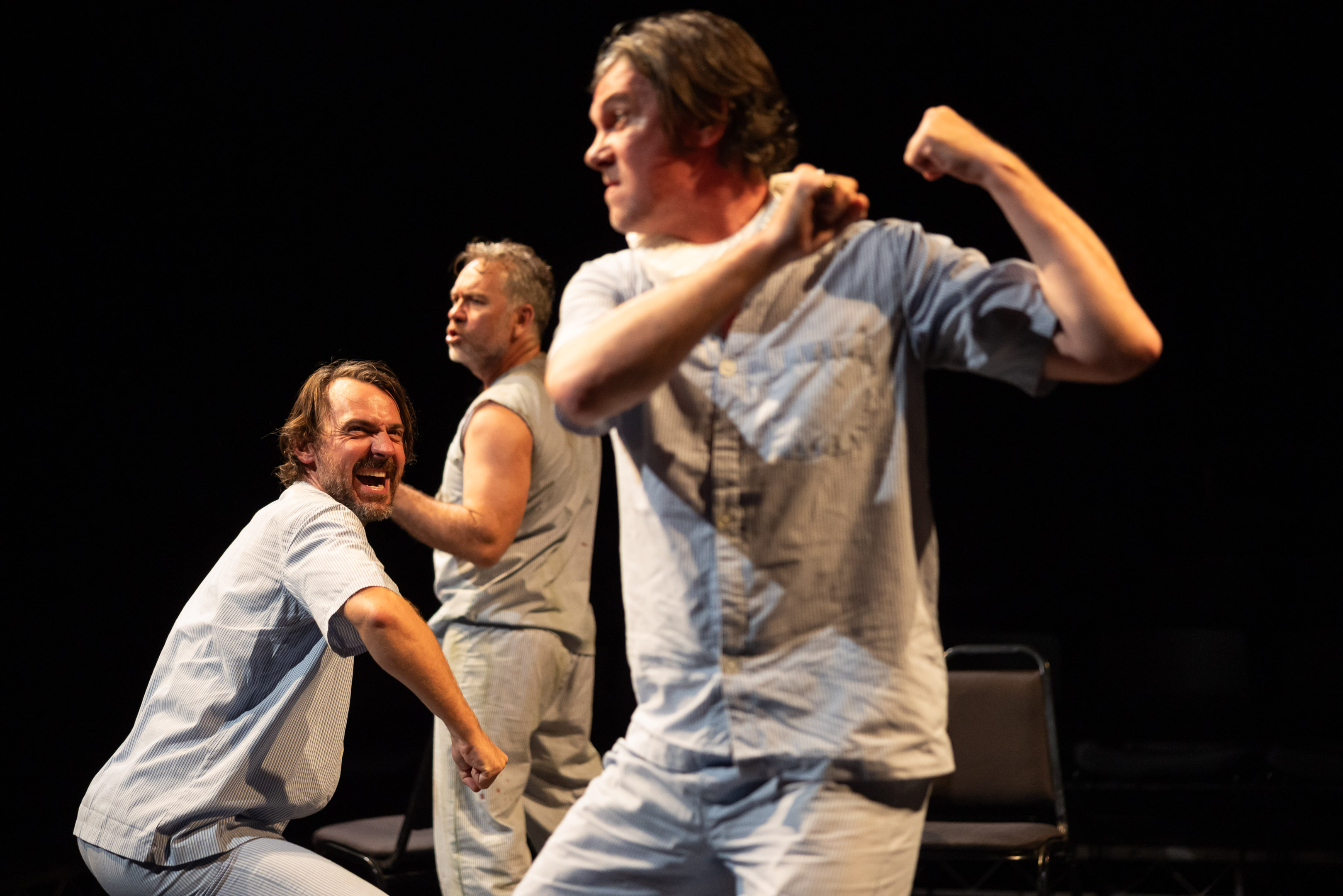
That’s because – after Claudia Haines-Cappeau’s beautifully evocative dance as Ophelia – there comes the title piece, an extended skit in which three actors who’ve played Hamlet are now going through rehab. It’s written by Schmitz, Cowell and Leslie, three actors who’ve played Hamlet and are now…

If the monologues might be autobiographical, the skit certainly isn’t – at least not if read as realism. It is, however, a puckish peep into the weirdly overwhelming experience that playing the Dane apparently is. As suggested, the play’s the thing.

Or can rehab help them realise that it’s just a thing? One thing among many.

The skit is terrifically amusing, a wonderful opportunity for three great comic actors to strut their stuff. It sparkles with insights into what it is to be a performer. (There are plenty of in-jokes about particular past productions, and these are marvellously mischievous, but they don’t dominate.) Frustration is expressed at directors and their determination to own a play by imposing some bizarre idiosyncratic vision. As one recovering Hamlet says, I’d love a director to say ‘Let’s just do the play.’ Also grumbled about are reviewers. Cowell’s character is disturbed that one reviewer described his Hamlet as mercurial. This observation hints at the sensitivity of performers, but it also left me wondering if the greatest tragedy in theatre is not Hamlet, but that reviews are taken seriously.

Another provocative observation is that we romanticise Hamlet, which I took to mean we overvalue both the character and the performance of that character. One of the sessions at the rehab centre is entitled Offstage Women. It seems to refer to the play’s representation of women and how Hamlet himself mistreats them. It also refers, I think, to how male actors lost in the role mistreat the women in their own lives. I make no comment about the impact playing the famous protagonist might have on an actor’s personal relationships, but I find fascinating the suggestion that audiences are asked to admire Hamlet. Perhaps an actor needs to find that connection, but as an audience member I’m more than happy to dislike a protagonist or, more precisely, to hold such a personal response to a character in abeyance. (Perhaps, like the suspension of disbelief, it’s the key to a mature appreciation of fiction.) Take Macbeth and, to a lesser degree, Lear: the achievement of these tragedies is that we’re presented a monster yet, beneath all, we still see their humanity. (I admit this probably doesn’t accurately describe what’s happening in, say, Othello or Romeo & Juliet – so perhaps there are audience members out there who do actually like Hamlet as a person.)

That’s the joy of Hamlet Camp, it’s a deliciously playful invitation to thought.  

Paul Gilchrist

Hamlet Camp by Brendan Cowell, Ewen Leslie and Toby Schmitz

Presented by Carriageworks and Modern Convict

At Carriageworks until 25 Jan

carriageworks.com.au

Image by Daniel Boud

Empire: Terror on the High Seas

7 Sep

I love genre studies. I love asserting which features define a particular genre. I love explaining the popularity of a particular genre. Basically, I love making ridiculous generalizations.

Empire: Terror on the High Seas by Toby Schmitz is part whodunit part slasher.

It’s also flamboyant and fun. And intelligent; wonderfully rich in playful historical allusion.

Empire

Set on a liner crossing the Atlantic in 1925, director Leland Kean’s cast have a ball with the larger-than-life characters. (Ella Scott Lynch and Nathan Lovejoy have particular fun with an RP accent and the beautiful comic juxtapositions it allows.)

Someone is killing the passengers and crew, and we don’t know who. So we try to guess. A whodunnit.

Whodunnits are popular because they suggest, despite the initial chaos, that order will be restored. The investigator, using reason, will bring the criminal to justice.

The slasher genre has no such faith in reason. It luxuriates in the physical; the sexual and, of course, the violent.

The whodunnit builds. The slasher genre tears down.

All philosophy could be described as the struggle between these two approaches; between the systematizers and the wreckers. They probably need each other.

And, in this play, the two have an interesting impact. Schmitz draws attention to certain values and asks us to question them.

Whodunnits, for example, rely on the power of reason, but what’s deemed reasonable is determined by the values shared by the investigator and the audience. ( Yes, Sherlock Holmes reasoning is so logical, but the whole point of that character was that he was an extreme. And, anyway, the audience can’t do the scientific stuff. ) As the audience guesses at the killer, they’re ‘proven’ to be reasonable people when their prejudices match those of the investigator. Except when  the investigator struggles to identify the killer. Then these prejudices are challenged.

The slasher strand is rather more obvious. Kill ‘em all, it says. As far as an indictment of values goes, it doesn’t get much more damning.

And what are the values questioned? In Empire: Terror on the High Seas they are a smug superiority, a privileged complacency, a casual racism.

And though the play is set in 1925, I fear the sun is still rising on that empire.

Veronica Kaye


Empire: Terror on the High Seas

Bondi Pavilion 28 Sept

http://rocksurfers.org/


I want to sleep with Tom Stoppard

5 Sep

I don’t, actually. I’d settle for a warm handshake. And a little intellectual conversation.

So I don’t want to sleep with Tom Stoppard. Toby Schmitz on the other hand…..

I saw a preview of this show. But as many artists know, every performance is a preview. The real action happens later, in the audience’s hearts and minds. Perhaps in the foyer afterwards. Perhaps in the car on the way home. Perhaps when we next choose to replace a harsh word with a soft one, or a simplistic explanation with a gentle smile of bafflement.

I want to sleep with Tom Stoppard is replete with knowledge about the biz and that’s part of its charm. It’s well aware of the theatre world’s foibles, and of the many challenges faced by artists.

Schmitz’s script is clever and very engaging. There are some great situational set-ups and plenty of terrific one-liners. (In some circles, the one-liner is denigrated. It’s not part of naturalism’s doctrine;  it allows characters to be as intelligent as the artists who create them. And that’s a dangerous heresy, for how then would artists be special? )

Director Leland Kean has cast well and elicits winning performances from the entire team. I found Caroline Brazier as the actress (sic) particularly poignant.

Now, everyone’s a critic. Except me. I write about what plays make me think. (For the audience every performance is a preview.)

And what did I want to sleep with Tom Stoppard make me think about?

Early in the play the question of the value of theatre is aired. It then remains suspended in the play’s atmosphere, a thin mist but one impossible to avoid, regardless of the personal stories that unfold.

Of course, the question ‘what is the value of theatre?’ contains a category error. It’s like asking ‘what’s the weather pattern of Wednesdays?’ There’s no such pattern.

There is no ‘value of theatre’. There’s nothing so distinct and clear and unassailable that can transcend the flurry and fuss of life. Sometimes, at their weaker moments, artists would like there to be. Then their challenges – and they are many – would be easier to face.

But whatever value there is in theatre is dependent on too many variables, the audience being one. For every performance is a preview……

Veronica Kaye

I want to sleep with Tom Stoppard

Bondi Pavillion til 22nd Sept

http://rocksurfers.org/