Tag Archives: William Shakespeare

Othello

26 Jul

There’s currently another company in Sydney producing another play by Shakespeare – and they’re employing the slogan All Bard, No Bull.

In contrast, the marketing for this production of Othello led me to expect something somewhat closer to the bull end of that imagined spectrum.

And, yes, bold choices are made – but, at heart, what we’re given is an engaging presentation of Shakespeare’s classic script.

As for most modern productions, that script has been slightly abbreviated. I’ll admit, some of my favourite lines and speeches are missing, but all the key elements of the story remain.

The cast is all female. Some might think this an usual choice, but it’s worth noting that each of the characters retains the gender Shakespeare originally gave them.

Casting is also colour blind. Some might think this an even more unusual choice, as a common reading of the play is that Othello is susceptible to Iago’s deceit and manipulation because of his outsider status. (There’s plenty of textual evidence to suggest Iago takes advantage of Othello’s potential vulnerability as the only black man in a white society.)

The marketing states the production has a “movement-based performance style”, but don’t fear, Shakespeare’s incomparable poetry is not sacrificed to an undue focus on physicality. Director Diana Paola Alvarado’s interest in movement mainly manifests itself in the rearrangement of the set between and within scenes. Designed by Jason Lowe and Leandro Sanchez, and consisting of four industrial-style pillars, the set is moved by the performers with a beautifully fluent choreography, and complemented by Theo Carroll’s wonderfully evocative haze-tinted chiaroscuro lighting design, as the play moves to its climax, the mood becomes increasingly and disturbingly claustrophobic. This perfectly captures the tragedy of Othello and Desdemona: a man who has been through so much, whose life story of “most disastrous chances, of moving accidents … of hair-breadth scape(s)” has elicited from Desdemona “a world of sighs”; a tale that “in faith, ’twas strange, ’twas passing strange; ’Twas pitiful, ’twas wondrous pitiful” is what wins her love – and the ultimate pity of the play is that the lives of two such great souls as these should end in a horror of pettiness.

Sometimes the performers deliver the verse at too great a pace, but intriguing choices are made regarding characterisation. Cassio, played with suitable sophistication and charm by Chloe Schwank, may seem recognisable to audiences, as will be Lucinda Jurd’s delightfully foolish Roderigo, but other choices are less expected. Doubling, Jurd’s Emilia is less earthy than usual, Lisa Hanssens’ Iago is less hail-fellow-well-met in his duplicity than usual, Sedem Banini’s Desdemona is less refined and demure, and Natasha Cheng’s Othello, in the play’s initial acts, less calmly commanding. I’ve deliberately phrased my descriptions of these performances to highlight what they don’t do – and I’m sure that’s frustrating –  but I’d rather not spoil the surprising freshness of the choices.   

Paul Gilchrist

Othello by William Shakespeare

Presented by La Fábrica de Microbios and Gente Perdida

At Flight Path Theatre until August 9

flightpaththeatre.org

Image by Felipe Godoy

Ophelia Thinks Harder

26 Mar

This is high energy feminist fun (with a few scenes that are less fun and more confronting.)

Written by Jean Betts in 1993, it’s an appropriation of Shakespeare’s Hamlet, one that places Ophelia centre stage.

Ophelia has feelings for Hamlet, but she can’t pretend he’s not utterly obnoxious. Her father and her brother are far too interested in her virginity. And Gertrude offers unwanted advice about how to live as a woman in a man’s world. (Don’t think too much.)

Betts cleverly weaves elements of the original text into her version of the story. With only a little tweaking, Ophelia gets all Hamlet’s major soliloquys, and they work magnificently. (Though I have to say I was less excited by the interpolation of so many lines from the other plays and the sonnets. Fortunately, my eyes no longer make that clicking sound when they roll. But what I found tiresome, others will find erudite and inventive.)

There’s also an appropriation of a poem by A E Housman, which is intriguing, and anachronistic (though that can hardly matter in a play like this.) It’s a brave writer who puts her words alongside the Bard and possibly the last great popular poet (that is, before modernism alienated the average reader.) But Betts definitely holds her own, and sometimes left me feeling I’d prefer more of her and less of them.

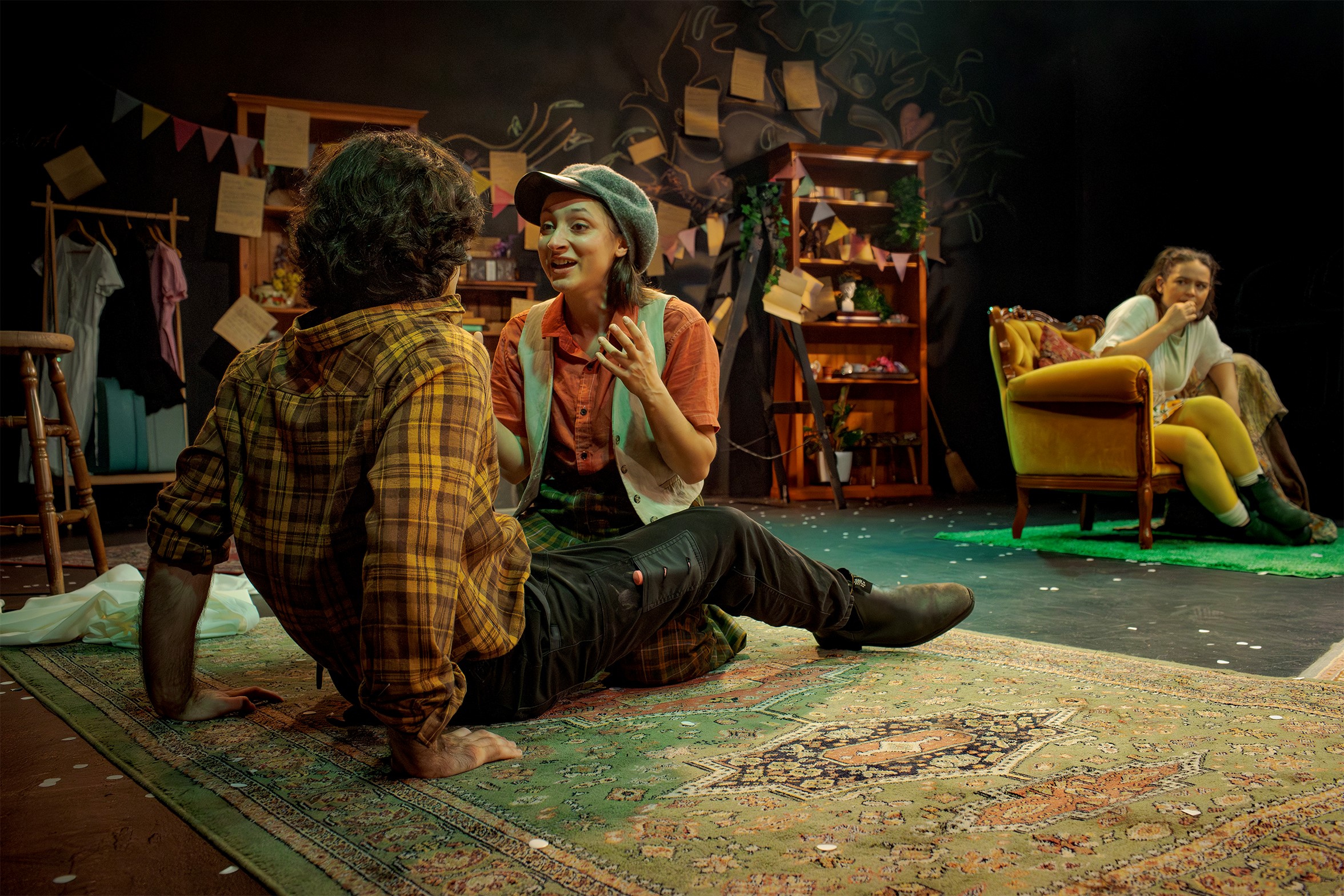
Alex Kendall Robson directs a terrific cast, and the key note is vitality. This is a wise decision; few people come out of a production of Hamlet wishing it were longer. (To stay or not to stay has been pondered at many an intermission. This version, at 150 mins including interval, keeps its engine at full throttle to keep us engaged.)

Brea Macey is superb as Ophelia – but I’ll get back to that.

Shaw Cameron as Hamlet is deliciously brutal, offering an engrossing portrait of the worst of privilege and entitlement. His physicality, especially, is a highlight, being both enthralling and threatening (as hinted in my first paragraph.)

Lucy Miller as Gertrude is a delight. Having accepted the misogyny of her society, the Queen has adopted a transgressive Machiavellianism that makes the character captivating. Many audience members have waited a long, long, long time to see the closet scene with this Gertrude.

Eleni Cassimatis as Ophelia’s maid servant gives the piece a poignant gravity, a terrible, galvanizing awareness of the dangers of this patriarchal world.

Pat Mandziy as Horatio offers a male character beyond the myopic, self-obsession of the other men, and both his performance and his text is crucial for the humane, richness of the work.

I started this article with the bland assertion that this is a feminist piece. Perhaps it occasionally overplays this element. The set is dominated by a painting of the Virgin Mary, and discussion of the history of the Church’s attitude to women gets a lot of stage time, a curious decision considering its all placed in the world of the Elizabethan playwright who was perhaps the most secular (admittedly, in a very religious society.) And this historical focus emphasises the academic. I’m not in a position to comment on whether contemporary women feel the challenges they currently face become more surmountable with the aid of a history lesson, especially one going back to Aristotle, Aquinas and the (aptly named) Church Fathers. I’ve written before that theory has little place in theatre, the form being more suited to the dreadful messiness of human reality than theory’s seductive simplicity.

Having said all that, by positing the protagonist’s problem in sociological or cultural terms, she must respond (at least partially) in kind. The result is that Ophelia has not only an emotional journey, but an intellectual one. 

But the rub is, her response to the theoretical language in which her problems are explained is not to simply regurgitate that language but rather to consider and test how it might inform her life. That is, she thinks – and I, for one, am thrilled to see a thinking character on the Australian stage.

Macey’s Ophelia is glorious, expressing beautifully the conflict between her self-doubt and her fundamental sense of dignity as a person. Macey powerfully presents Ophelia’s growing awareness that, for all her enervating inconsistencies, she deserves more agency than she’s permitted. Betts does well not to make Ophelia some kind of virago; the play is classic bildungsroman, a genre far better fitted to the dramatic form than any platform for slogan sprouting heroines. In the open-ended nature of the conclusion of Ophelia’s journey, there’s a splendid, invigorating optimism.

We know what we are, but know not what we may be.

Paul Gilchrist

Ophelia Thinks Harder by Jean Betts

Presented by Fingerless Theatre, in association with bAKEHOUSE Theatre

At KXT until 29 March

http://kingsxtheatre.com

Image by Phil Erbacher

Antony & Cleopatra

13 Feb

This is an odd one.

It’s probably the most abridged version of this play you’ll see outside a school incursion.

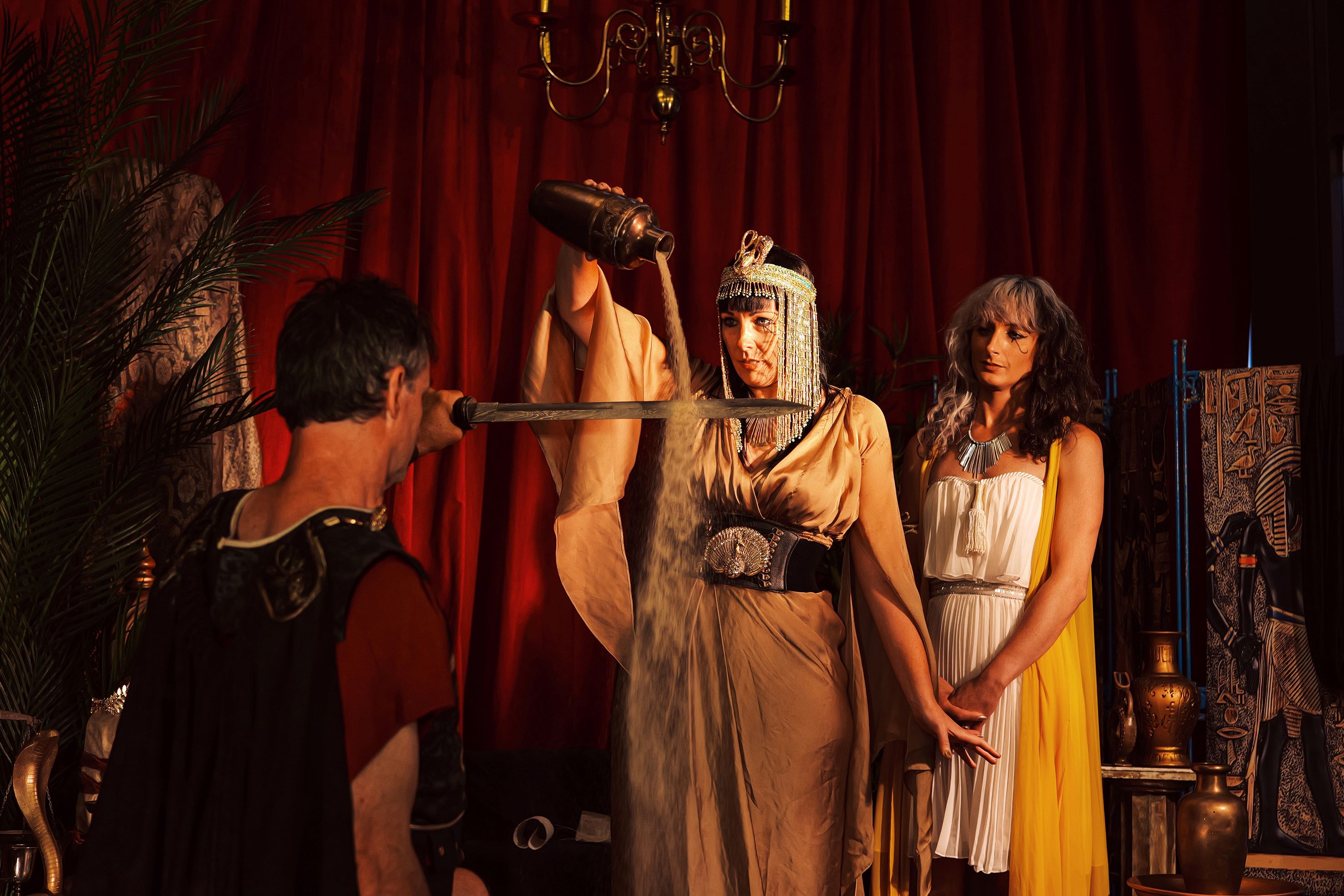
It’s all performed by three actors: Charles Mayer as Antony, Jo Bloom as Cleopatra, and Charley Allanah as everybody else (or at least everybody else who isn’t cut.) Performances are bold and spirited. For reasons that will become more apparent later in my response, design focuses on costume, and these by Letitia Hodgkinson are beautifully lavish.

There’s also a narrator or guide, a role taken by Nathan Meola. He almost gets as much stage time as Shakespeare, though far fewer words. He appears to be adlibbing. He speaks very slowly and quietly, as though he’s speaking to the guests at a spiritual retreat. We’re thanked for the journey each of us has made to get to the theatre, and it’s acknowledged that the journey may have been difficult. (There’s even talk of snow.) We’re asked several times if we feel safe, and at each repetition I feel a little less so. His speaking style is a curious mix of condescension and coercion, made all the more disconcerting by the very convincing illusion that it’s not a created dramatic character being performed. He asserts that we humans are not immune to stories and, for a moment, I question my own humanity – until I recall that he’s ignoring a rather vital point: the power of a story depends on how well it’s told. This narrator recaps what we’ve seen and tells us what we’re about to see – which may seem superfluous, even to those unfamiliar with the play. He also assumes we’re deeply affected by the performance. (In our current theatre scene, in which there’s far too much of telling audiences what to think, it’s refreshing to be told what to feel.)

The marketing describes the production as immersive – which can mean a lot of different things, but here means you may not get a seat. We’re needlessly shuffled back and forth between the foyer (where there aren’t enough seats) and the theatre (where there are plenty.) These changes of location, and the narrator, have a slowing effect, but the whole thing is only 90 mins, including interval.

Shakespeare’s play is reduced to the story of two people going through a dark night of the soul to find eternal love, or divine love, or some such thing. (At least that’s what the narrator tells us is happening.) The political tensions and the grand clash of civilizations are given little space. This reduction enhances the sense the play is being used as a vehicle for a certain New Age philosophy.

So is it “Shakespeare”?

That’s an absurdly conservative question, based on some disturbing essentialist assumptions. But I’ll answer it anyway.

On one level – a particularly academic one – the answer is No. Shakespeare and his contemporaries dragged theatre away from being what was almost a religious ritual, with narratives dominated by religious perspectives. They moved the artform away from the traditional Mystery play. These Elizabethans still acknowledged that spiritual experiences existed (in a way that, say, Jane Austen seemingly does not) – but they viewed those experiences as part of the wider human experience, not necessarily as its key. To be essentialist, they were humanists.

But, soaked in Renaissance humanism, Shakespeare was not an essentialist. He looked at the world with humility and wonder, and I suspect he wouldn’t dismiss a production like this, but would ever so gently chastise those who might. After all, as his most famous creation says, “There are more things in heaven and earth than dreamt of in your philosophy… “

Paul Gilchrist

Antony & Cleopatra by William Shakespeare

Presented by Come You Spirits

At The Lounge, The Concourse until 22 Feb

theconcourse.com.au

Image by Syl Marie Photography