Archive | June, 2025

Blackbird

30 Jun

This one’s probably not for date night.

Late twenties-something Una confronts middle-aged Ray about what he did to her fifteen years ago.

To misquote Voltaire, if this play did not exist, it would be natural to assume it did. Written by David Harrower, it won the Olivier for Best New Play in 2007. And if you were a parochial Australian theatre reviewer – yes, the first two adjectives are tautologous – if you were a parochial Australian theatre reviewer, you might be inclined to view this piece as the epitome of the modern British play. It’s gritty. It presents two characters in a room in real time. It goes to a place most of us don’t want to go. It’s constructed from staccato dialogue that eventually blossoms into beautifully written monologues. It gives voice to characters who in public discourse are standardly reduced to stereotypes: either victim or villain.

As a result, it’s tempting to see it as a well-executed writing exercise or some sort of feat of dramatic ability. And there’s certainly much to admire about the skill. It would be terrific to show aspiring playwrights: What does it do? What doesn’t it do?

I’ve suggested a little about what it does, but what about what it chooses not to?

Despite Ray getting half the dialogue, we don’t really ever learn much about him. This is partly because we’re always deliberately left uncertain whether he is being honest or whether he is performing. This could engage an audience or it could tire them. The challenge is that the more realistically Ray is played, the more banality there is in his evil, the less we will see and enjoy – if enjoy is the right word –  what might be a theatrical Machiavellian duplicity. But another reason we’re left not knowing much about Ray is because his faults, obvious on an ethical level, remain opaque on an ontological level. If you’re of the hopelessly hopeful school that assumes that every human fault is only the desire for some good somehow gone wrong, then it’s difficult to see, with his particular fault in this presentation, what that good ever was. I suspect twenty years ago, the play encapsulated the movement, the moment, when for the first time this particular crime and its prevalence was openly and seriously discussed. And that was sufficient.

There’s another thing the play deliberately doesn’t do. What we’re shown on stage occurs fifteen years after the original crime. Ray has tried to move on. Una can’t. We hear a lot about the past, but we don’t see it. (Would we want to? No. But then, do we want to be shown the present?) This is a play primarily about consequences rather than causes. What we are shown is how individuals – both perpetrator and victim – try to deal with the past, how they create narratives to try to make sense of their guilt, their pain. But as we haven’t been shown that past, this personal narrative building is oddly untethered, pushing us back on assumptions we held before we entered the theatre. As I’ve said, perhaps twenty years ago ….

But, in the face of those who suffer, and who continue to suffer, it’s ENTIRELY INADEQUATE to say But we’ve talked about this already. Every evil must be faced anew; the price of innocence is eternal vigilance.

Directed by Pippa Thoroughgood, this production powerfully urges that vigilance. Performances are committed and courageous. Charlotte De Wit’s Una is a pathos-inducing portrait of fracture: assertiveness battling uncertainty. Her monologue in which vulnerability predominates is delivered superbly. Phil McGrath’s Ray is aptly unsettling: mundanity blends with belligerence, despondency becomes indistinguishable from duplicity.

Paul Gilchrist

Blackbird by David Harrower

Presented by HER Productions in association with bAKEHOUSE Theatre Co.

At KXT until 5 July

kingsxtheatre.com

Image by Ravina Jassani

Instructions for Correct Assembly

28 Jun

Poet Philip Larkin earnt a place eternally in the hearts of many a son and daughter when he expressed perfectly the magical wonder of filial gratitude: “They fuck you up, your mum and dad.”

(More fortunate souls might relate instead to Adrian Mitchell’s parodic response “They tuck you up….”)

The idea of child-rearing is the main focus of Thomas Eccleshare’s speculative comedy.

I use the term speculative because the major conceit is that Max (Jane Wallace) and Hari (Nick Curnow) have purchased a do-it-yourself flat-pack artificially intelligent young man, Jån. Trouble is, as friends quickly notice, Jån bears an uncanny resemblance to the couples’ lost son, Nick. As parents, can Max and Hari get right what they feel they got wrong before?

I don’t have children and, when I’m in the company of anyone who does, I feel enormous admiration for the immensity of their effort and complete bewilderment at the oddness of their choice. I’m inclined to feel that child-rearing should be left to those most suited to it: wolves.

Yet, despite the emotional immaturity and self-obsession that fits me for theatre reviewing, I am aware that a large number of parents, especially middle-class ones, experience a prodigious amount of angst about their chosen role. Am I doing what’s best for my kids? And, the disturbing corollary, how do my kids reflect on me?

Eccleshare’s mischievous script offers huge comic potential, and under the direction of Hailey McQueen, the cast delivers the laughs. As robot Jån, Ben Chapple is absolutely hilarious – and, as the troubled Nick, he offers in counterpoint an honest portrayal of fickle, flawed humanity. It’s a doubling opportunity that allows an actor to show off a tremendous range and Chapple seizes it, giving a virtuoso performance.

The doubling does epitomise the piece’s greatest challenge (that is, apart from the large number of short scenes). The piece has titanic tonal ambition. A certain smallness is being satirised, that middle-class desire for control in the face of Life’s wildness, that determination to make the world one of neat, smooth, straight lines. Yet we’re also invited to care about the characters, or at least to find the genuine or the recognisable in their emotional responses. Throw into the mix that the setup is speculative – or to put it less euphemistically, untruthful – and you’ve got one provocative, audacious piece of theatre.

Paul Gilchrist

Instructions for Correct Assembly by Thomas Eccleshare

Presented by Clock and Spiel Productions

at Flight Path Theatre until 5 July

flightpaththeatre.org

Image by Patrick Phillips

Primary Trust

26 Jun

To misquote Gandhi, We’re all children of God, it’s just that some of us are more childlike than others.

Kenneth is such a person.

Gentle, hesitant, uncertain, he lives a plain life and keeps to himself. He works at a second-hand bookstore. Every night he goes to Wally’s and drinks Mai Tais with his only friend, Bert. It’s difficult for Kenneth to imagine Life without Bert – and that’s curious, because Life doesn’t give many of us a Bert after the age of four. (Bert is the only character in Eboni Booth’s Pulitzer Prize winning play who transcends – in his own wondrous way – the inescapable doubts and wistful regrets of this sublunary world.)

When Kenneth’s bookshop is sold, he’s worried how he’ll find employment. (He got his first job only thanks to a social worker.) At the advice of Corrina from Wally’s, he applies for a position at a bank with the evocative name Primary Trust. According to Kenneth, the manager employs him because he reminds him of his brain-damaged brother.

As his friendship with Corrina develops, his special relationship with Bert changes, in a way that’s confronting (for Kenneth) but beautiful and hopeful.

The supreme importance of relationships like friendship is emphasised by an exquisitely simple speech by Corrina about her best friend, Denise. Corrina loves Denise. We don’t know why: in fact, we know virtually nothing about the briefly mentioned and never seen Denise – except that she doesn’t look after her cat as well as she might. But sometimes, when Corrina thinks about Denise, she cries. Perhaps this sounds sentimental? I think Corrina is just being honest, and being honest with Kenneth is life-changing. It’s this sort of openness that helps him find the connections he so desperately needs.

Primary Trust is an absolutely delightful comedy, informed by a sense of small town dagginess reminiscent of Thornton Wilder’s Our Town. (The set, by James Browne, with a back wall of many coloured doors emphasises this sense of the parochial presented playfully.) But unlike Wilder’s play, this story is one character’s (Kenneth’s), and the view from eternity that warmly infuses the conclusion of Our Town is absent, replaced by the vision, courageous and true, that the only heaven there is we must find here, amongst the struggling souls who surround us.

Except for one alluded-to-but-not-expanded-upon instance of racial injustice, the world around Kenneth is not malignant, only forgetful. (Or a little too complaisant: The sky is blue, what can you do?) But a little reaching out goes a long way.

Yes, it’s an exploration of trauma, highlighting the humanity of those who suffer – but what the play primarily offers is not a portrait of pain but rather models of kindness (the consistent, persistent type that engenders trust.)

Directed by Darren Yap, performances are gorgeously engaging. As Kenneth, Albert Mwangi is superb, both immensely likeable and poignantly pathetic. With a compassionate charisma, Charles Allen plays Bert, wonderfully portraying the perpetual patience and positivity of the best friend of our dreams. Angela Mahlatjie’s Corrina is magnificent: honest and humble yet hopeful; softly unassuming and utterly soul-expanding. And she and Peter Kowitz do some hilarious doubling, with Kowitz’s bank manager true comic gold. Booth’s script –which captures the wavering richness of real speech – calls for virtuoso vocal work, and the cast delivers (aided, no doubt, by the remarkable skills of dialect coach Linda Nicholls-Gidley.)

This Ensemble production is a glorious invitation to laugh, and an irresistible reminder of our shared humanity.

Paul Gilchrist

Primary Trust by Eboni Booth

at Ensemble until 12 July

ensemble.com.au

Image by Prudence Upton

Aphrodite

22 Jun

Ava, an academic, has written a book entitled The Aphrodite Complex. It’s been sufficiently successful that a documentary has been filmed about the subject. During the making of this documentary, Ava becomes aware that a particular member of the crew – Hector – appears to be fascinated by her.

After the shoot, waiting at Athens International Airport, she flirts with Hector. 

Will it go anywhere? 

When Ava mentions her desire to look a particular way, Hector responds But aren’t you about 50?

And so begins an absolutely beautiful exploration of beauty.

Alone, in her room, (it’s a two hander) Ava is visited by Aphrodite herself. (We’re told the goddess is the most beautiful of all because she was ranked us such by the man Paris.)

Aphrodite sings of being irresistible in a world that’s insatiable. She sings that externals are what matter. She promises power through beauty.

Under her spell, Ava responds I am my thick hair. I am my hairless body. I am my plump skin.

By now, of course, alarm bells are ringing for the audience. It’s a bold move to allow Ava, an academic, to be so reductionist in her thinking – but it’s indicative of the seductiveness of the worldview she’s being sold.

And with this evaluation by male standards ultimately questioned, it’s also a bold move to posit a man’s judgement as the catalyst of this doubt. It’s indicative of the ubiquity of the problem.

In some ways, the libretto by Laura Lethlean is a riff on feminist insights as found in such as Naomi Wolf’s The Beauty Myth. In other ways, it could be read as a reflection on ancient Greek sensibilities – the primacy of the body, the value of competition – compared with what I’ll call a Christian sensibility. (I’m thinking of the vision so miraculously shared by Dante, that the body and the soul are of equal value and only complete when together, and that Love is Charity rather than Eros.)

I’ve focussed on theme and concept, but direction by Alexander Berlage brings it all to glorious actuality.  The design by Isabel Hudson is outstanding, a lush domestic realism, ideal for the representation of both the luxury and commonality of sexuality. Under the video design of Morgan Moroney, the live feed marvellously evokes the concept of the gaze, of being always an object to be observed. It also facilitates our enjoyment of the extraordinary dramatic performances.

Both in voice and movement, Jessica O’Donoghue as Ava and Meechot Marrero as Aphrodite are utterly mesmerising. Their vocal performances are superbly nuanced to emotion: the exultation of sexual power, the languor of seduction, the agony of self-doubt.

Performed by Omega Ensemble and conducted by Jack Symonds, the music by Nico Muhly has a sense of melancholic sweetness (like Tennyson’s remembered kisses after death.) It ripples with the poignancy of distance; though a work about desire, we never see the lover.

After the revolution, lipstick will be lipstick. And that’ll be a good thing.

But, sometimes, I wonder.

Though this piece can be validly read as a strong and necessary feminist statement, it can also be viewed through another lens. Aphrodite takes on one of the great irresolvable tensions in the human condition (which is probably what makes great drama).

Everybody desires to be desired. At times, it’s as though we want to be an object. The active longs to be the passive, to be swept up in something beyond our small selves. Sexuality uses us, and we want to be used. It’s one way we find connection – with the community, or the Life Force, or whatever you want to call that which is bigger than us. It assures us a place in the chaos. Yes, there remains the deep wish to be appreciated as more than just a body, to be accepted as a full, complete, complex, independent, dynamic Other – but there, in the very heart of that wish, is the desire to be accepted. We want to be evaluated (even though we don’t.)

At only 60 minutes, Aphrodite is a wonderfully rich theatrical and musical experience.

Paul Gilchrist

Aphrodite music by Nico Muhly, libretto by Laura Lethlean

presented by Sydney Chamber Opera, Carriageworks in association with Omega Ensemble

at Carriageworks until June 28

carriageworks.com.au

Image by Daniel Boud

The Half-Life of Marie Curie

18 Jun

It’s the summer of 1912, and Marie Curie’s good friend and colleague Hertha Ayrton invites her to England to escape the scandal that threatens to destroy her.

Curie has had an affair with a married man, and so now she’s not only a two time Nobel laureate, but also a home-wrecker. The second of these monikers, it would seem, trumps the first. (It can be difficult to believe the misogynistic, hypocritical rage directed at Curie. Or it should be. Unfortunately, history proffers too many examples.)

The wonder of Lauren Gunderson’s play is – that with a focus on this one brief historical moment, and with only two characters – she creates something of incredible beauty and richness.

The critique of the patriarchy is suitably sharp, but even more stimulating is the representation of the complexity of female relationships.

Firstly, there’s a depth to their experience of men. Institutionally, socially, at large, men are unjust: fearful little soulless moustached marionettes, incapable of granting women equality. But on a personal level, both women, now widows, have had husbands who were the best of humankind. William Ayrton called his wife BG (beautiful genius) and Pierre Curie refused a Nobel Prize unless it was shared with his wife. Even Paul, the married man who Curie loves, for all his vacillation, offers an undeniable joy. And it’s worth noting that Ayrton has taken her first name from a poem by a man: “Hertha” by Algernon Swinbourne. His poem, she says, gave her the courage to believe in her own worth as a woman.

And secondly – for those concerned the play might not pass the Bechdel Test – (it does, with flying colours) – the friendship between the two woman themselves is portraited brilliantly. There’s fierce loyalty and honest admiration. There’s shared humour (and whisky) and the glory of two top class minds in conversation. But there’s also an unspoken (delightful and light-touched) homoeroticism. And there’s an argy-bargy that sails awfully close to bullying. Ayrton asserts that Curie is strong, is resilient, can transcend the scandal – but she asserts it just a little too often. Curie is wounded. She doesn’t know who she is anymore, and being told you’re an otherworldly goddess, when you’re feeling so very human, is akin to erasure.

Directed by Liesel Badorrek, Gabrielle Scawthorn and Rebecca Massey give utterly engaging performances. They play each note of Gunderson’s script with a meticulous awareness of its possibilities, bringing to the fore both the delicious humour and the deep humanity. Scawthorn’s Curie is a terrific portrait of power in pain, fraught but ever able to inspire awe. Massey’s Ayrton is beautiful bustle, fire-hearted affection, and no nonsense determination. On a stripped back stage, the physicality of the actors is paramount, and these two are extraordinary: powerfully embodying both suffering and exultation.

(This is probably the time to mention design. James Browne provides a raised transparent podium, which can be encircled by a transparent curtain. It’s spare but layered, aligning with a script that presents a seemingly single, simple historical moment only to reveal its complexity. The choices of lighting designer Verity Hampson and projection designer Cameron Smith wonderfully evoke this complexity – as well as the unseen physical forces that these two scientists explored.)

I was saying Curie is feeling so very human – with all the vulnerabilities and vagaries that entails. And that’s why Gunderson chooses this moment to set her play. Gender tensions might be crucial to the piece, but so is another tension: that between the supposed objectivity of science and the unavoidable subjectivity of the people who work in it. Curie says she loves science, but not scientists. Both women muse on the fact that proof is real, but recognition is political.

And just as the tension between the sexes is represented with a humane richness, so is this tension between knowledge and its knowers. The women’s belief in inviolable proof is undercut by their greatest conflict. The spoiler rule prevents me giving detail about the moment, but the tension is one in which scientific findings are disputed, where two passionate, intelligent women debate when – and if – knowledge can ever become complete. Truth maybe immutable, but Science remains an all too human endeavour.

Constructed from such vital tensions, and presented with such mastery, Ensemble’s production of The Half-Life of Marie Curie is superb theatre.

Paul Gilchrist

The Half-Life of Marie Curie by Lauren Gunderson

at Ensemble Theatre until 12 July

ensemble.com.au

Image by Prudence Upton

Eureka Day

5 Jun

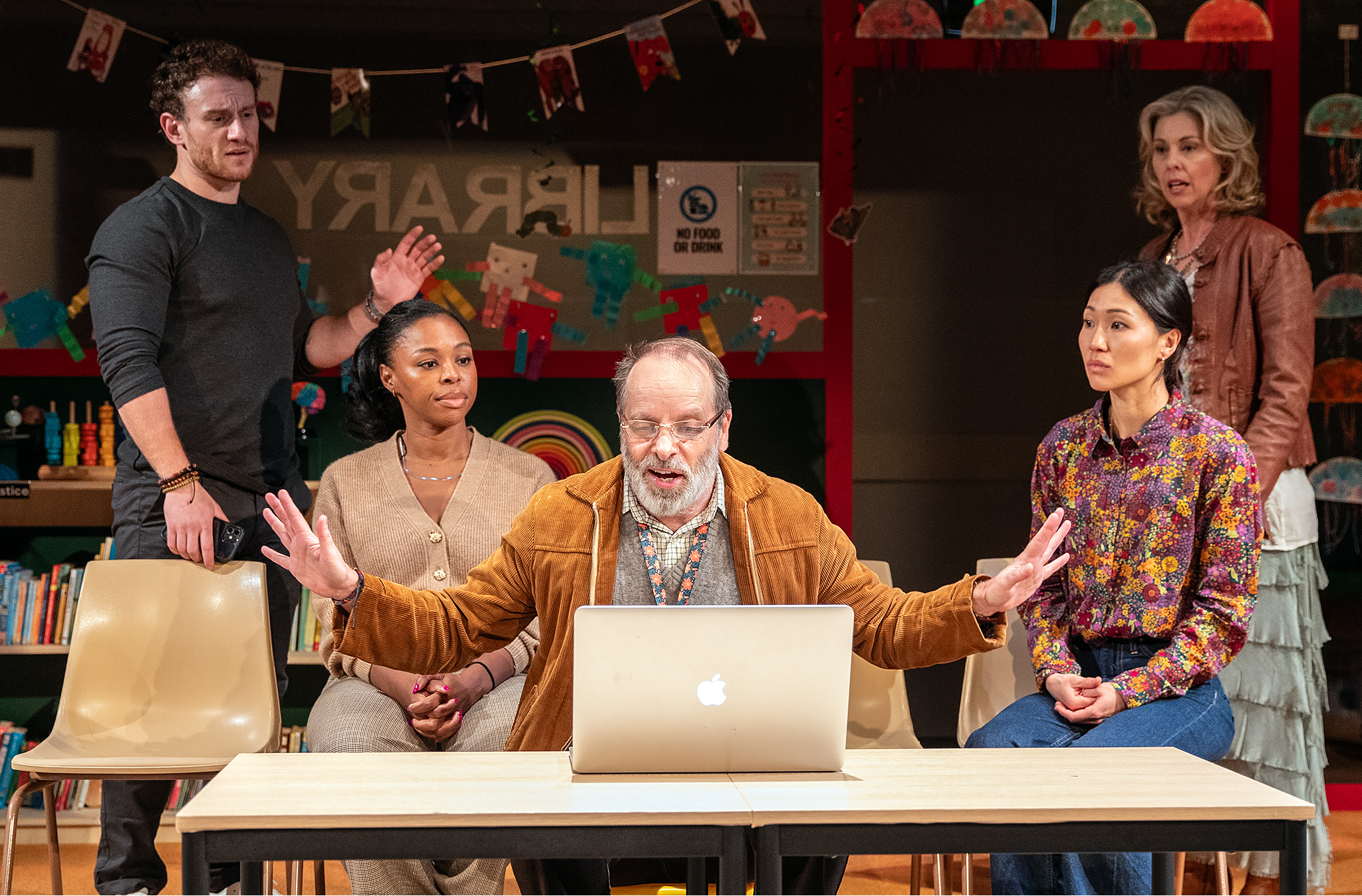
Set almost entirely in the P&C meetings of a primary school, you might assume this is a fun satire of contemporary society.

And you’d be right. Eureka Day by American writer Jonathan Spector is extraordinarily funny. But it doesn’t just make fun, it confronts one of the biggest rifts in our culture.

Eureka Day Elementary is a school built on social justice and inclusivity: a place where everyone feels seen and heard; a place where decisions are reached by consensus; a place where all points of view are valid.

The last of these is the issue. (And possibly the second last.)

Eureka, of course, means I have found it! – and there’s a sense that’s what the P&C believe: that their place is special, that it encapsulates, somehow, the perfect way forward.

But, for all their good intentions, it doesn’t.

Watching their meetings – bursting with thoughtless condescension, moral pedantry and obsession with policy, yet empty of soul-felt kindness, honest humility and genuine openness – is utterly painful. Yes, it’s hilarious, but it’s also excruciating. Earlier, I called the piece satire, but that genre usually employs hyperbole to make its point. But there’s no exaggeration here; it’s just the reality of our present day.

(A reality that feels like one of the rings of punishment in Dante’s Divine Comedy, one in which we’re condemned to an endless repetition of what seem to be absurdities but are actually perverted echoes of our true sins. However, I do think it’s a ring of Purgatory we’re stuck in, rather than Hell; we are purging ourselves; things will improve; there’s no need to abandon hope.)

There are beautiful moments in the piece where our societal problem is artfully diagnosed. One parent jokes that her daughter was very smart but also good-natured, so they knew she would become a benevolent dictator. Another compliments the work of a mime artist, for his subtlety and, we can only imagine, for his rare ability to just remain silent. Another parent says it straight out: she’s sick of the hubris.

This hubris, the belief that they’ve found the correct way, is tested by an outbreak of mumps at the school. Can all decisions be made by consensus? Are all points of view really valid?

As a society, we’ve fallen in love with policy and forgotten politics. And by politics, I mean the sphere of life in which we have to work with other people (as against just shout at them over and over that they are wrong or evil.) The fact that this play centres on meetings where adults must come together and solve problems makes it essential viewing.

(Though I must admit, I’m a little uncertain about the play’s exploration of vaccination. This hot button issue threatens to overwhelm everything else, burying from common view the representation of the political sphere that I so value. But, yes, I know, I know, the dramatic form must deal in the concrete…)

Directed by Craig Baldwin, the production bubbles away at just the right pace, evoking the awful enervating reality we currently endure, yet still assuring us the dramatic boil-over is imminent.

Performances are excellent.

Jamie Oxenbould as Don, a school official, is perfectly, perpetually, and pathetically polite and patient.

Katrina Retallick as Suzanne is both wonderfully comic and deeply poignant, offering a rich portrait of an individual traumatised by the universe’s chaotic cruelty and who overcompensates with a commitment to control.

Christian Charisiou’s Eli is brilliant as the epitome of overtalking privilege, the misguided good that knows not when to stop.

Branden Christine as the newcomer to the school community is magnificent, presenting a fascinating study in intelligence encountering its nemesis: the holding back, the bitten tongue, the seductive whisperings of despair as we wait to speak the Truth.

Deborah An as May has a gloriously warm energy. Her character’s journey is perhaps the biggest of the play, and she pitches it superbly. Her speech in which she posits what she wants for her kids is a highlight, and represents the best of what the play has to offer: the petty hobgoblin of certainty dispelled by a courageous vision of hope.

With this production, Outhouse Theatre shows once again why they are a vital part of the Sydney scene, presenting work that dares to walk our societal fault lines, and keeps its balance with honesty and humour.

Paul Gilchrist

Eureka Day by Jonathan Spector

Presented by Seymour Centre & Outhouse Theatre Co

At Seymour Centre until 21 June

seymourcentre.com

Image by Richard Farland