Mitsue is a survivor of the bombing of Hiroshima. She now works in a library. She’s also a member of a club that collects folktales. She insists they be handed down as they were traditionally told. During story week, she shares them with the local children.
A young physicist, and a potential suitor, has arrived in the city. He’s collecting mishappen objects that illustrate the ferocity of the nuclear explosion that was unleashed only three years ago.
Mitsue’s father suggests ways that these objects could be incorporated in her stories. She’s reluctant. She says no art can be made from what happened to the people of Hiroshima.
This play by Hisashi Inoue proves Mitsue wrong. A story of Little People caught in Big History, it’s both beautiful and profoundly moving. It does what theatre can do so well; it makes concrete what otherwise is lost in abstraction. We all know what happened at Hiroshima 80 years ago, but bewildered by the sheer numbers, the human face of the horror is hidden.
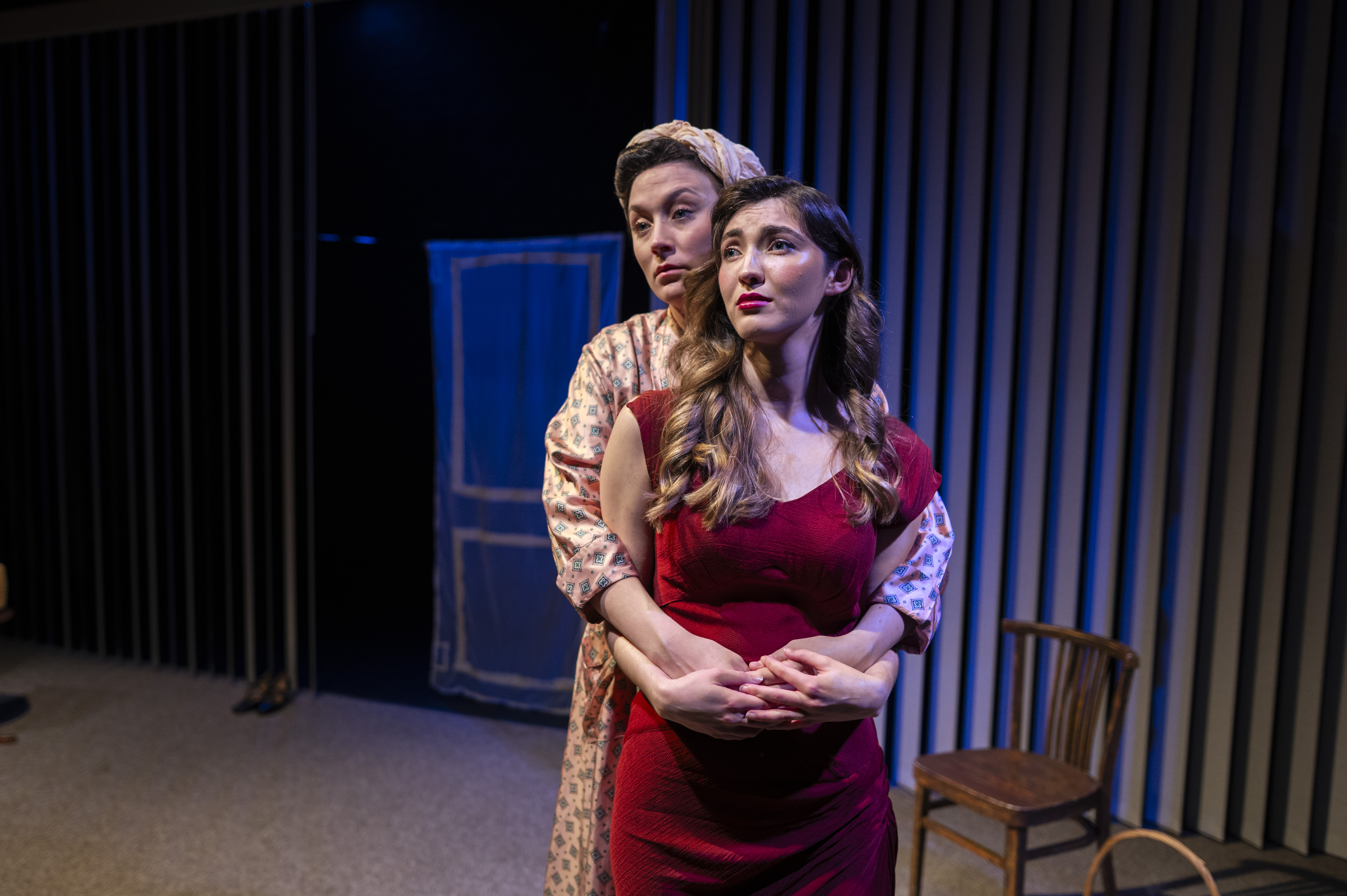
Directed by Shingo Usami and David Lynch, this production is extraordinarily powerful. Mayu Iwasaki as Mitsue and Usami as her father deliver magnificently poignant performances. It’s the gentleness, the restraint, the unforced nature of these performances that have such an effect. “Dripping water hollows out stone” wrote Ovid. Plotwise, we know what’s happened to Mitsue, and we soon guess what’s happened to her father, but over the show’s 70 minutes, which is sprinkled with humour and infused with the warmth of the love between father and daughter, we come to feel their true humanity, in all its wondrous fragility.
In our mad world, the plenitude of pain can petrify us, can turn our hearts to stone. But stone can soften, and by arousing such deep sympathy for those who suffer, The Face of Jizo revitalises hearts that have become too heavy.
Paul Gilchrist
The Face of Jizoby Hisashi Inoue (translated by Roger Pulvers)
Presented by Seymour Centre and Omusubi Productions
Adapted by Alex Kendall Robson, after Aristophanes (about twenty-four centuries after Aristophanes.)
Robson’s adaptation follows a very similar plot to the original.
In an attempt to save the world, Dionysius visits the underworld to bring back the greatest playwright. It might seem an odd strategy, but as the God of Theatre, Dionysius might be excused for overestimating the impact of the artform.
The original play, first produced in 405 BCE, was a mixture of satire and broad humour. Robson’s adaptation is similar in tone, though with slightly more focus on the second of these comic elements.
Aristophanes included songs, though not show tunes. (The Ancient Greeks can be blamed for a lot, including theatre and philosophy, but not for the abomination that is modern American musical comedy.)
With amended lyrics, this adaptation of The Frogs includes versions of Putting on the Ritz and Singing in the Rain, as well as Wayfaring Stranger and something (I think?) from Bizet’s Carmen. The last two aren’t show tunes, but then, the manner in which all the musical numbers are presented doesn’t justify the title’s joking implication that songs such as these are the essence of the tortures of Hell. (Nor does their presentation justify my earlier cheap shot at musical comedy.) Under musical director Zachary Aleksander, the talented cast perform the songs beautifully. (Though I wonder whether amplification might have better delivered the wacky, high-spirited energy this production clearly values.)
Working with Robson’s fun script, and under his direction, the comic performances are excellent. I’ll cherry pick a few. Pat Mandziy as Dionysius is a delicious blend of camp and privileged naivety. Eddy O’Leary as his underling, Xanthias, is a fine inheritor of the long tradition that the disempowered see truths to which the powerful are blind. (The script mischievously asks whether we can call this character a slave – but I’ll get back to that later). Axel Berecry as Heracles is gloriously over the top in his presentation of the stupid he-man. Larissa Turton and Meg Bennetts deliver a terrific parody of two tough-speaking old-school landladies. Bennetts also turns up as Sappho, and her portrayal of a character of gravitas, dignity and wisdom is a sensationally effective change in tone from the rest of the production’s madcap hijinks.
I’ve expressed previously that I think it’s odd that Australian theatre makers are fascinated with Ancient Greece. It’s odd because Ancient Greece is truly a foreign culture – yet we seem to see it as a sort of universal. It’s not. Example: Up to 40% of Ancient Greece’s population were slaves – yet, as this production implies, we have trouble even saying the word. And don’t get me started on the misogyny of the ancient world.
Not that audiences will have any trouble following this adaptation. Robson makes this foreign world accessible – a challenging task when you consider that the original play’s dramatis personae consists of a mixture of mythical characters and historical individuals who are hardly household names in modern Australia. Sensibly, when we get to the two historical playwrights who are contending for the title of the greatest – Euripides and Aeschylus – this adaptation slips into a musical number and a quick bawdy sight gag. It’s a smart choice, as contemporary audiences are likely to find a debate concerning the relative merits of the competing styles of Ancient Greek tragedy more soporific than stimulating.
Another change to the original is the addition of Sappho. As I’ve suggested, it’s a scene that makes for fascinating theatre. But curiously, it also functions as a criticism and rejection of Dionysius’ quest. I say curiously because – up to this point – the assertion of theatre’s ultimate value seemed to be the only serious justification for the piece. (If one was needed.)
But the Sappho scene also highlights what I’ve suggested about the Ancient Greeks being a very different culture from our own. And I know I’m close to spoiler territory here – but, when you go, note Sappho’s prayer. Who she prays to is not anachronistic, but what she asks for is. It involves a conception of human relationships which lay centuries ahead, at least in Western culture.
By now, reading my response, you’ve probably come to the conclusion that it’s not show tunes that are the essence of Hell, but rather nit-picking, such as mine. (The devil being always in the details.)
But, by pointing out an anachronism, I’m not criticising the script. With such a deliberately playful piece that type of petty fault finding would be utterly misguided. (Especially since the piece consciously indulges in it’s fair share of impish anachronism.) And, anyway, I agree with Sappho’s imagined-though-anachronistic solution. I’m merely pointing out that the actual answer the Ancient Greeks would offer to our problems might not satisfy us (…..which is why Robson has rewritten the end of the play.)
Ultimately, this production is an exuberant celebration of love and laughter, and whether that’s a timeless panacea or not, it’s sure as hell welcome now.
Paul Gilchrist
The Frogs: In Hell They Sing Show Tunes adapted by Alex Kendall Robson, after Aristophanes
An increasing familiarity with a writer’s body of work offers real delight.
And it’s not just the delight of the know-it-all or the systemiser, the sort of pleasure that comes from a sense of superiority or control.
It’s the joy of meeting the artist behind the work, of getting a sense of their world view, their fascinations and their fears, what they feel they can attempt and what, for whatever reason, they eschew.
Jane Austen famously described her writing as a little bit (two inches wide) of ivory on which I work with so fine a brush, as produces little effect after much labour – and if you’ve had the good fortune to read her six novels, you’ll know that even in her throw away aphorisms she was the master ironist.
But what of Tennessee Williams?
Many of us are familiar with Williams’ full length plays The Glass Menagerie, Cat on a Hot Tin Roof and A Street Car Named Desire, but we’re less familiar with his short works. This production presents three of those playlets: At Liberty, Auto-Da-Fe and This Property is Condemned.
Williams was very proud of many of his short works.
And they further the impression of the artist and his art that many audiences get from his better known plays. On a linguistic level, they’re constructed from a beautifully heightened language that never loses its connection with the genuine vernacular. On a thematic level, they’re built from the tensions between sexuality and respectability, purity and pretension, and loneliness and fulfilment. And because they’re usually performed in a Southern accent (as they are here) they seem to offer a portrait of a particular part of the USA at a particular time. (You might assert that all theatre does something like my last point; that is, depict a specific place and time, but I think that’s true to varying degrees. Williams always seems aware of Society – that demographic cultural phenomena which is the subject of study of sociology, and is posited by modernity because it recognises the ubiquity of the arbitrary. Williams is aware of this Society in a way that, say, Shakespeare is not. You could argue this is because Williams is more interested in the outsider, but Shakespeare has characters like Othello and Shylock. Williams’ outsiders, however, are not obviously outsiders: he’s the great playwright of the hidden subversive.)
Directed by Megan Sampson, this production is a wonderful opportunity to consider the exact nature of the playwright’s genius (and, if you read this before you go, offers the added pleasure of concluding that my assessment of Williams is utterly inadequate or simply absurd.)
I’ll forgo filler and refrain from a description of each playlet; with the whole evening only 50 mins long, scenarios too easily slip into spoilers. Suffice to say, each piece is a treat, and the six different roles, doubled by Helena Cielak, Will Manton and Emma Wright, are brought to life with a precise energy. Cielak portrays two different women who each in their own way balances a radiant presence with a pathos-inducing bluster. Manton creates portraits of both uptight repression and bewildered innocence. And Wright brings fitting focus to two distinct characters who represent firmness in the face of flailing volatility.
Paul Gilchrist
Three (Short) Plays by Tennessee Williams
Presented by Ground Floor Theatre Company
At the Old Fitz, as the Late Show, until 15 August
Foam by Harry McDonald presents the encounters of skinhead Nicky with a range of men, from those who aim to lure him into far right ideology, to those who are aroused by his brutal persona. (There is at least one man, however, whose attitude is closer to the only good fascist is a dead one.)
Patrick Phillips as Nicky appears in every scene and, under the direction of Gavin Roach, delivers a magnetic performance. The supporting cast of Timothy Springs, Joshua Merten and Chad Traupmann create a range of characters to populate the world around Nicky. Traupmann as the older fascist seeking recruits is suitably calm, confident and deeply disturbing, and as Nicky’s lover movingly portrays both concern and vulnerability. Merten as a gay photographer under Nicky’s spell is both charming and funny. Springs effectively creates characters who are far less enthralled by the protagonist’s antics.
Set in Britain in the 70’s and 80’s, each scene of Foam is separated from the others by several years, and apart from Nicky, the characters don’t appear to have a continuous arc. This makes for a fascinating guessing game as we figure out what has happened to the protagonist in the time between.
Each scene is set in a toilet (though not the same toilet.) And as almost every scene involves Nicky and a lover (or a potential lover), the toilet is a symbol powerfully suggestive of the simultaneous ubiquity and marginalisation of gay experience. (It wasn’t until uni that I learnt that some men met in public toilets for sex – and I learnt it from a book. I read that book not long after I’d read another that claimed to be the work of a reincarnated medieval heretic and, to my painfully narrow experience, the premise of both books seemed equally likely.)
The play is inspired by a true story, and I’m guessing the stimulus was the question How could a queer man get mixed up in far right politics? This seems as provocative as the question Why do bad things happen to good people? and deserves the same answer: Why not? (Perhaps I’m less naïve than I was at uni.) After all, out of the crooked timber of humanity, no straight thing was ever made. (And like Kant when he wrote those lines, I’m not playing on any connotation that invites a reductionist vision of sexuality. Or, indeed, a reductionist vision of anything.)
The script doesn’t really explore why Nicky becomes a fascist. And (probably for the best) it uses the terms nazi and fascist rather vaguely and offers only a few examples of the type of violence that usually attracts those labels.
The piece is primarily about identity. Unsurprisingly, most communities develop a vision of themselves that is positive. I suspect few billionaires are of the belief that billionaires are myopically selfish. The queer community are likely to engage in the same strategy (and for much greater reason than the insanely rich.)
This play confronts us with human complexity, and that is a glorious invitation to growth. And who outgrows that?



 Theatre Red