Archive | November, 2025

Cowbois

25 Nov

Siren Theatre’s production of Cowbois by Charlie Josephine is an absolute visual delight, a whole lot of fun, and a poignant cry from the heart.

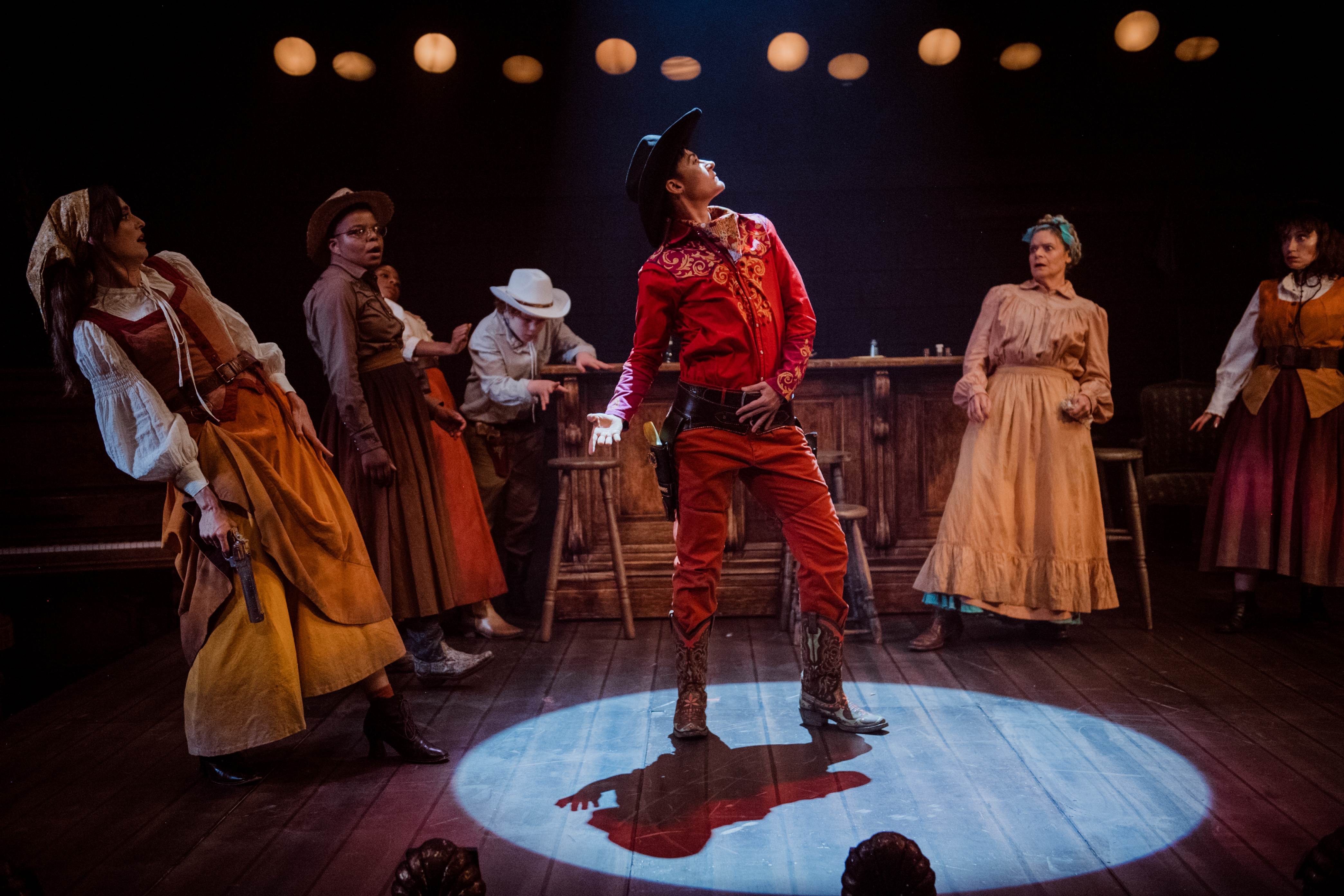
We’re in a small Wild West town, but all the men have gone off to find gold. Left to themselves, the women begin to wonder about possibilities, and with the arrival of charismatic outlaw Jack Cannon, they find gold of a very different sort.

There’s an exhilarating blend of genres: Western meets Magical Realism.

The Wild West is the ideal setting to interrogate assumptions about gender. (The West being a literary myth in which men are men, women are women…..and women are invariably either school teachers or show girls.) It’s a myth that begs explosion – and it gets it here. Jack is a trans man, and he offers a vision of gender identity radically different from what the towns people have previously known. It’s joyous and liberating, and Magical Realism helps represent his life-changing impact.

It’s a case of guns, glitter, and glorious growth.

Director Kate Gaul creates visual magic. The use of space is wonderful and the tableaux alone are spellbinding. Lighting design by Brockman and sound design by Aisling Bermingham add to the enchantment. Clay Crighton’s original songs complete the charm.

There are superb performances. Jules Billington as Jack is the embodiment of charisma, tempered with moments of confronting rawness, of searing emotional honesty. (Wait for when the words “cruel” and “fight” are uttered.) Matthew Abotomey as the drunken sheriff gives a performance of virtuosic range and marvellous physicality. Amie McKenna gives a terrific turn as a smart-mouthed school teacher, displaying brilliant comic timing. Emily Cascarino as the saloon keeper radiates intelligence, wonder and determination. Crighton’s cameo as a laughing trouble-maker is show-stopping.

Being a Western, at the finale there’s a shoot-out. This is handled with comic aplomb by the team. However, the subtext of this shoot-out is not to my peculiar political taste. I find dissatisfying the assumptions that the pursuit of a fair, full life is best described as a fight, that harmony is dependent on having common enemies, and that those enemies are expendable. But my political taste or not, there’s no doubt that what we’re given is a genuine expression of what it feels to experience this particularly cruel form of injustice, one that heartlessly denies who you are, and who you might become.

Paul Gilchrist

Cowbois by Charlie Josephine

Presented by Seymour Centre and Siren Theatre Company

At Seymour Centre until 13 Dec

seymourcentre.com

Image by Alex Vaughan

Gravity

20 Nov

On the way to the theatre, my plus one asked if we were seeing a new play. I replied Yes, that considering the title, it must’ve been written at least post-1687, the year Isaac Newton published Philosophiae Naturalis Principia Mathematica.

A joke like that doesn’t belong in Bradford Elmore’s Gravity; his play is genuinely funny.

But there’s a connection. Elmore presents characters who are intelligent – and this is the surprise for an Australian play – they can read! And they do.

Not that the piece is overly cerebral. Far from it. It’s just that the characters in Gravity have an active interest in the written word – and actually discuss it!

Christopher and Heather have a love of literature and David has a fascination with astronomy.

And all this isn’t gratuitous, a case of a playwright choosing to focus on some bizarre corner of society in order to present a gritty new angle, or an example of a dramatist claiming to give voice to some neglected minority.

The literature and astronomy operate as motifs that give the play a wonderfully rich texture. But to discuss that, I must first outline the play’s basic scenario.

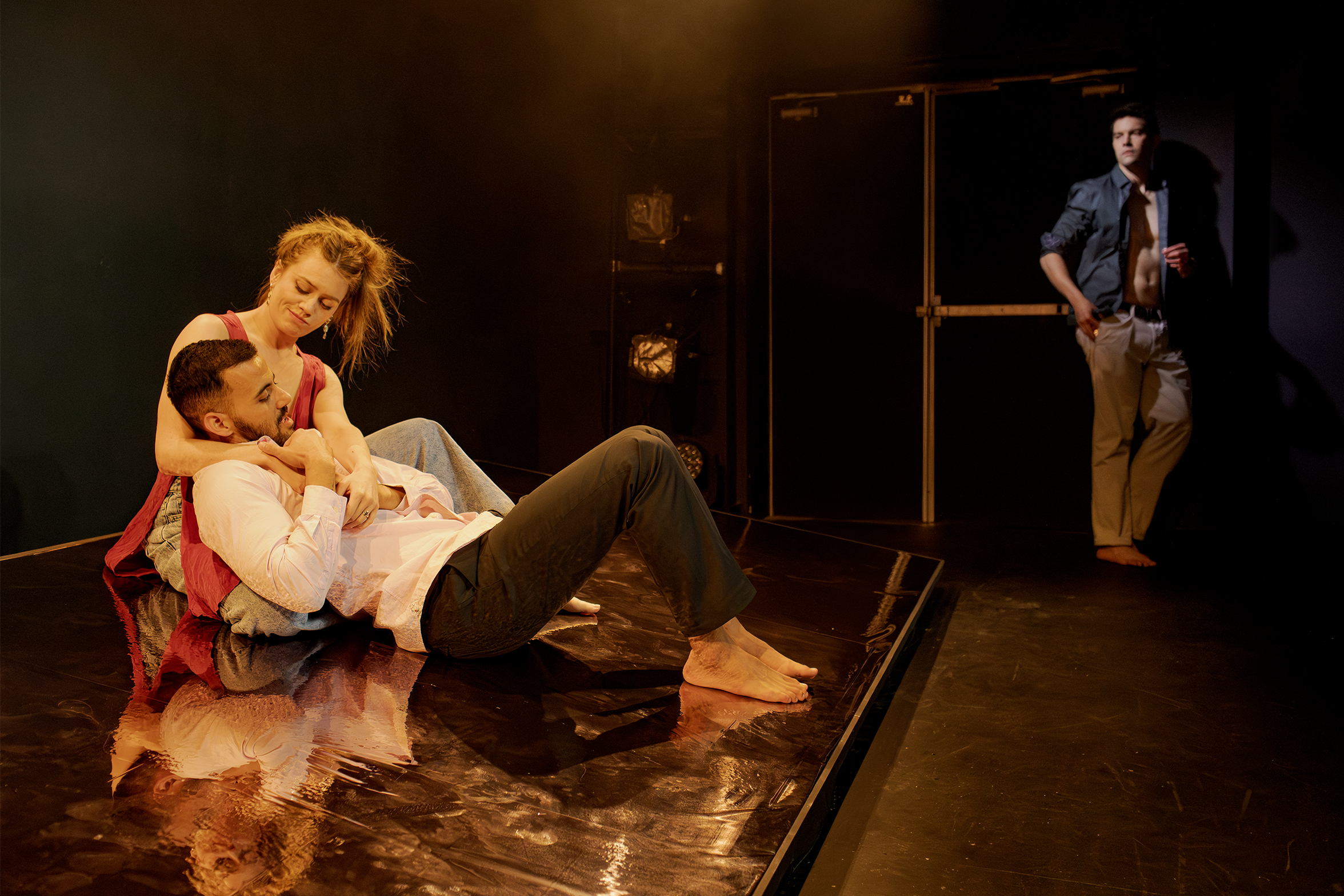
Christopher (Wesley Senna Cortes) and Heather (Annabelle Kablean) have been married for ten years, and he feels he still loves her. But he has now also fallen in love with David (Drew Wilson). How can this be resolved?

Back to the motifs.

David’s interest in astronomy allows consideration of opposing forces, of the difficulty of orbiting two bodies simultaneously, of the danger of being torn apart. But it also posits balance, the possibility of a smooth, untroubled, eternal motion (the type we imagine is enjoyed by the stars.) The relevance to the play’s scenario is beautifully thought-provoking.

Heather and Christopher’s interest in literature allows musings on narrative, and how we’ll stick to things, despite the emotional pain, because we need to know how it turns out. As a play about the challenges of fidelity, the connection is clear.  Discussions of literature also facilitate some playful games about preference, of the Austen-or-Dickens, Tolstoy-or-Dostoevsky type. I’ve made up these examples, but the mischievous premise behind these sort of games – that loving one somehow excludes loving the other – is central to the play’s exploration of relationships.

Anthony Skuse directs and designs, and in this deliciously simple space there’s a gorgeous flow to the movement. Skuse also elicits fine performances from his cast, who make the humour crackle and the heart cry.

Whether you ultimately find the conclusion of the piece satisfying will probably hinge on your willingness to watch it devolve from the higher stakes of dramedy to the easy cheerfulness of rom-com. But I suspect satisfaction might also depend on your own values and emotional experience; what you consider Love, and what you consider Truthful. (Though, if your sole aim in visiting the theatre is to see a reflection of yourself, a visit to the aptly named vanity in your bathroom would suffice. Embrace doubt and surprise; they’re some of the artform’s greatest gifts.)

Paul Gilchrist

Gravity by Bradford Elmore,

produced by Rogue Projects,

at The Loading Dock, Qtopia until 29 Nov

qtopiasydney.com.au

Image by Phil Erbacher

So Young

18 Nov

In writing this review, I’ve allowed the most time to pass I ever have between seeing a show and putting my response on the page.

This is partly because of that pesky thing called Life, which with annoying persistence tries to sideline Art.

But it’s also because – by the time I saw So Young at the Old Fitz – the whole run had sold out. (Though do check for wait lists – tix may become available.)

When responding to theatre I try to write in a way that doesn’t suggest that the producing company has simply outsourced its marketing – but Outhouse’s production of Douglas Maxwell’s play is brilliant.

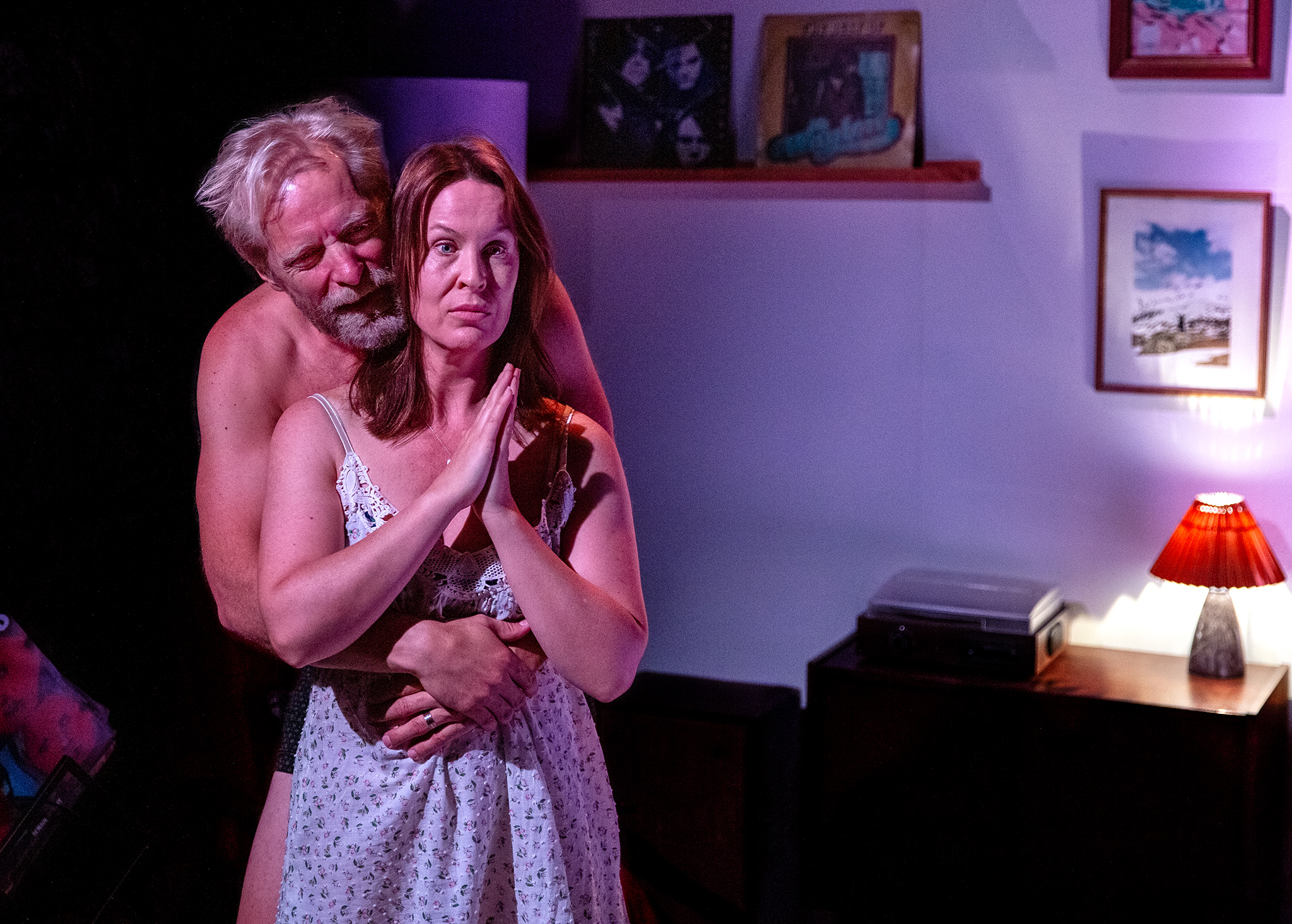
So Young is the story of forty-something Milo finding love again after the early death of his wife. His longtime friends Davie and Liane are shocked to find this new love, Greta, is only 20 years old.

We live in a culture obsessed with demographic divisions. Each one of us is labelled and firmly put in our box. This superb play is about two of the most dominant of these devilish divisions: youth versus age and male versus female. But it’s also about the only demographic division that ultimately matters: the quick versus the dead.

Under the direction of Sam O’Sullivan, the play blazes with humour and heart.

As Liane, Ainslie McGlynn’s performance is magnificent, beautifully boiling and bubbling with the grief that masquerades as anger.

As Davie, Jeremy Waters gives us a splendid portrait of blokeish bonhomie, with that longing for pleasant peace presented in all its complexity. Is it wisdom? Or is it weakness?

Henry Nixon as Milo offers a bewitching bewilderment in the face of Life’s two greatest mysteries – Death and Love.

Aisha Aidara as Greta is gloriously youthful. She marvellously captures youth’s perceived pitfalls – its social naivety, its careless certainty – while all the time radiating courage.

And courage and its close cousin compassion are the qualities most needed by those of us still on this side of the only division that matters.

Paul Gilchrist

So Young by Douglas Maxwell

Produced by Outhouse Theatre Company

At the Old Fitz until Nov 22

oldfitztheatre.com.au

Image by Richard Farland

Crotchless

5 Nov

This is a fine comedy. 

It’s written by Eloise Aiken, this year’s winner of the Katie Lees Fellowship.

The Fellowship is designed to support young female/female identifying theatre makers, and here it has once again shown itself to be a vital contribution to the Sydney theatre scene.

Crotchless is about how contemporary teenagers and their parents navigate the cultural reactions to feminism.

Aiken has a great ear for comic dialogue; the script is funny and truthful and shit. (And, in case it’s not obvious, the last of those three adjectives is meant as an admiring imitation of Aiken’s uncanny ability to portray the language use of the young, rather than some vocab-deficient, mean-spirited evaluation of the play.)

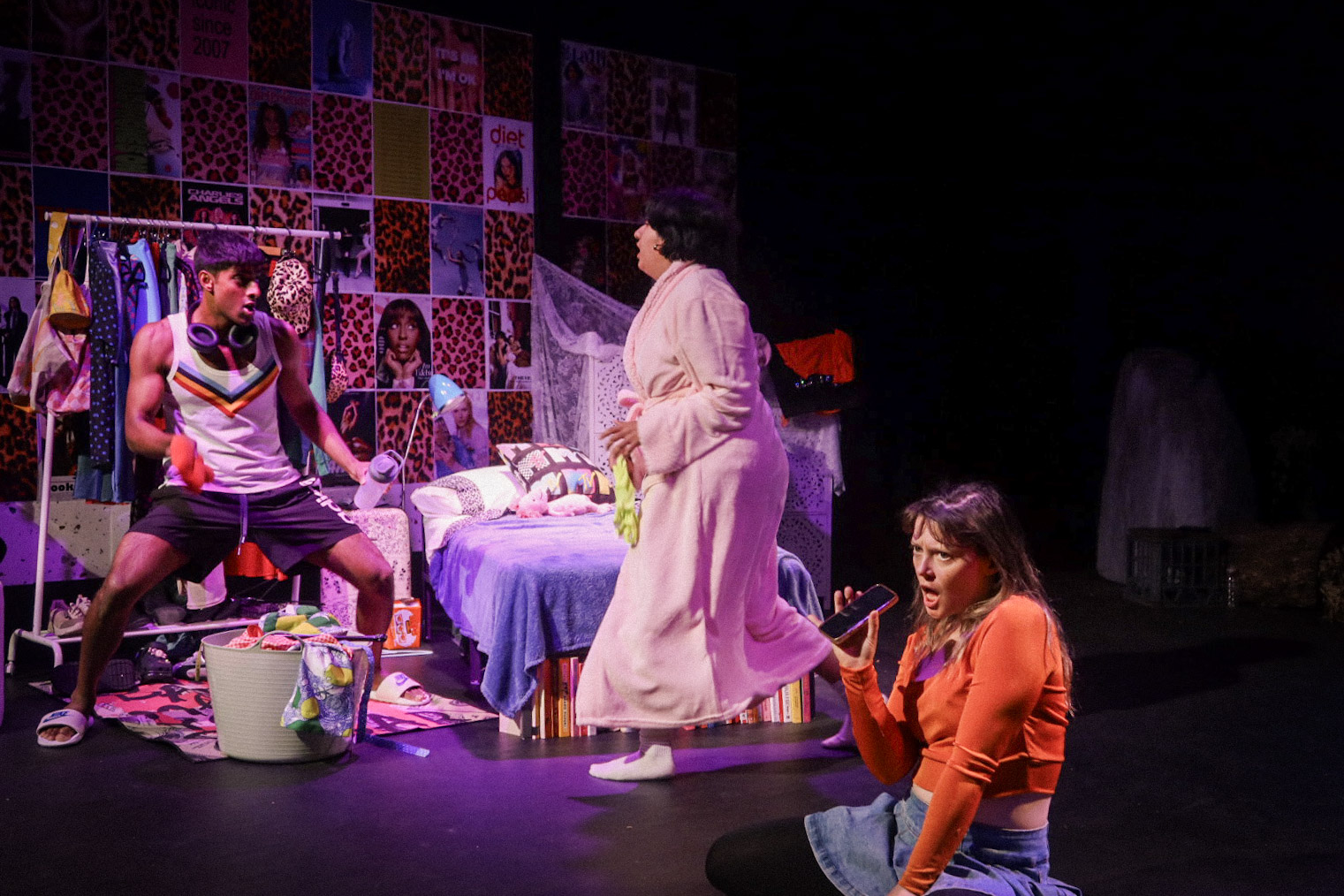
Teenage Shona has dating issues, but it’s her twin brother Owen’s dive into the rabbit hole of misogyny that especially troubles her. Trish, the twins’ single mum, acknowledges Shona’s concerns but is less certain how to prevent her son’s disturbing moral diminishment.

The piece is driven by some fascinating tensions.

One tension is that between the broader culture and personal agency. Owen is admonished for listening to misogynistic podcasts and told to read feminist texts. Of course, what we put into our heads is important, but we’ve come to view ourselves almost as if we were passive computers: just load the correct software and we’ll run appropriately. It’s an understandable but disconcerting assumption – because it seems to erase the possibility of both critical thinking and moral discernment.  (But, we do live in a culture that has rather suddenly become aware of the concept of Culture, and everyone who’s seen Terminator 2 knows the frightening consequences of suddenly becoming self-aware. Skynet isn’t alone in its over-reaction to the unexpected advent of choice.)

Closely related to the tension between instruction and intellectual agency is that between confrontation and love. Should we simply condemn those who disagree with us? Or, as Trish suggests, will that just drive them further away? Is a strict insistence on moral conformity merely counter-productive? Must individuals learn for themselves?  

That Crotchless posits both sides of these tensions suggests its maturity of vision, its beautifully honest awareness of the complexities of Life. If it ultimately comes down a little too heavily on one side of all this, the feel-good-tell-it-how-it-is-for-victory-and-empowerment side, that’s completely understandable. After all, it is a comedy. (And, anyway, is the conclusion of a play actually the sum of its meaning and value? Especially when it’s a comedy. Perhaps the comic happy ending is just one more dramatic convention, as meaningful, say, as the fourth wall.)

Madeleine Withington’s direction is splendid; the pace and bounce is spot on.

Performances are comic excellence. 

Esha Jessy is thoroughly engaging as Shona, the quick-witted teenage girl caught between vigorous assertions of female worth and a risky desire for the rather unworthy male Other.

As Owen, Ashan Kumar brilliantly captures the inarticulate energy of the teenage boy, the hilariously non-threatening high-modality, informed with just the right hint of danger: a cute, clumsy oversized wolf cub trying out his fangs.

Sarah Greenwood is utterly superb. Her performance dances with the lightness of comedy, yet her portrayal of Trish truthfully represents the challenges of maternal love, in all its poignant mix of strength and vulnerability. Greenwood also doubles as Shona’s best friend, Malory, and delivers a playful-almost-parody that is a delight in itself, but also serves to highlight the glorious complexity of her portrait of the more mature of the women.

Paul Gilchrist

Crotchless by Eloise Aiken

At Flight Path Theatre until Nov 8

flightpaththeatre.org

Image by Alex Macleay