Archive | Responses to Plays RSS feed for this section

The Crucible

24 Nov

The Crucible has drawn more tears from me than any other play.

And this incarnation by Emu Heights Productions is a powerful and deeply affecting presentation of a classic text.

There’s a heart rending three way tension in the play – that between what people say is true, what people think is true, and what actually is true.

It’s an exploration of the relationship between truth and power. (Does it suggest that real truth belongs only to the utterly powerless?)

It reminds us that assertions of truth are often politically motivated. (I’m inclined to say they always are.)

The Crucible

One of the reasons I find this play so affecting is Miller’s characterization of Reverend Hale, here played admirably by John Michael Burdon. Hale begins as the good-hearted but unconsciously ego driven expert only to become the great life affirming doubter. In the final scene, he advises Proctor to give the life saving lie, and I always leave the theatre wondering whether in this outlook there’s a blessed humility.

In contrast to Hale is Proctor’s warmhearted (or should I say red blooded?) common sense. The magic of Miller’s characterization is that Proctor is a man in his prime yet dogged by self doubt. Vincent Andriano portrays this marvelously. Proctor won’t make grand metaphysical statements; his feet are too firmly on the ground. But he knows what is not the case.  He can clearly say what is not true.  And, by sticking to this, he ultimately finds (or is it more accurate to say he creates?) a positive truth: that he is indeed a good man.

Director Ian Zammit has elicited strong performances from his cast. It’s a big one (nineteen) so I won’t try to describe all the performances. But I particularly enjoyed Naomi Livingstone’s multi-leveled portrayal of Abigail, a fascinating and frightening balance between playful coquette and cold hearted assassin, giving way at pivotal moments to the honest vulnerability of a woman terrified she may have over played her hand.  Emily Elise’s Mary Warren is a deeply moving portrayal of a girl out of her depth. And David Attrill wonderfully captures Giles, contentious, foolish and lovable; a portrayal crucial for the full impact of what must be one of theatre’s most moving offstage deaths.

And a last word about the design. It’s fluid and beautiful.

It’s one of the many elements that have gone into making this a very engaging and accessible production, one that has no doubt both pleased Miller fans and introduced great theatre to new audiences.

Veronica Kaye

The Crucible by Arthur Miller

Joan Sutherland Performing Arts Centre

15 -23 Nov

More info about Emu Heights Productions

http://www.emuheightsproductions.com.au/

The Maintenance Room

21 Nov

I used to live with a cop. He was a good man, but like us all, he suffered his personal demons.

One Tuesday morning he came home from a night shift more quiet than usual. I asked him how the shift had been. He’d driven around in a patrol car with his partner. At about 1 am they’d got a pizza. At 3 at a late night servo they’d got Slurpees. At 4 they got a call to a house where a teenage boy had hanged himself.

He’d left a note blaming dad.

‘And what was I doing?’ my flat mate said. ‘Just driving around!’

Then, for a while, he said nothing.

‘If I’d been there,’ he said finally, ‘I know what I’d have told that kid: Things change. I know shit all about your dad. Maybe he is the biggest dickhead in the world, I don’t know. But things change. I’m not saying him. I’m saying you.’

For 20 years I’ve told that story to anyone who’ll listen.

In Gerry Greenland’s thought provoking play, two men fortuitously meet at a time in their lives when they both desperately need someone to help them revitalize their world views.

Photo by Geoff Sirmai, Sirmai Arts Marketing

Photo by Geoff Sirmai, Sirmai Arts Marketing

The charming foibles and emotional struggles of these two men are played brilliantly by Lynden Jones and Kim Knuckey. It’s wonderful to see two quality actors play their range. Directors Allan Walpole and Christine Greenough have crafted an engaging piece of theatre.

Walpole’s set design is both effective and evocative. It’s a messy maintenance room at the top of a tall building – we are delving into the grubby hidden recesses of the human heart and the stakes are sky high.

The driving symbol of this piece is maintenance – the importance of not letting our attitudes, and relationships, drift into dangerous disrepair.

It left me thinking about one of the great unremitting conflicts – that between power and fortune, between the things we can control and the things we cannot. But the front in this conflict is perpetually on the move, depending on our life circumstances. To live fully, a vibrant awareness of this movement must be maintained.

Veronica Kaye

The Maintenance Room by Gerry Greenland

at King Street Theatre til Nov 30

http://www.kingstreettheatre.com.au/the-maintenance-room/

Love Field

29 Oct

Billed as ‘a flight of fantasy’, this is a theatrical confection, a fascinating non-typical Australian play.

It’s a conversation between Lyndon Johnson and Jackie Kennedy, set only hours after JFK’s assassination.

Despite being peppered with historical allusion, Ron Elisha’s play is not an attempt to present a truthful account. But it’s certainly engaging, thought provoking theatre.

Photo by Tessa Tran, Breathing Light Photography

Photo by Tessa Tran, Breathing Light Photography

Director Michael Dean elicits eminently watchable performances from both Ben Wood and Lizzie Schebesta.

And Nick Plummer and Susan Millar have done a wonderful job of transforming the simple downstairs TAP white box theatre into the interior of AirForce One.

With two famous people and their milieu presented the play becomes, if not hagiography, then certainly an exhibition of icons. Johnson and Kennedy as political royalty? This is a fascinating tension. America is a democracy, isn’t it? And aren’t we?

The play is an exploration of the connection between the personal and the political.

It can be tempting to believe that our politics (and our morality) are something we attempt to live up to, a guide for our behavior. But a piece that looks at the personal lives of the politically powerful can draw attention to the possibility that our politics are often simply self serving.

And, of course, we’re all politically powerful.

And it’s self serving to assume we are not.

Veronica Kaye

Love Field by Ron Elisha

Downstairs TAP til Nov 2

http://www.bakehousetheatrecompany.com.au/

An Ordinary Person

29 Oct

This one’s a conversation starter.

It’s a truism that our response to a play is based on our personal taste. But it’s often assumed that our taste in theatre is similar to (say) our preference for a particular flavour of ice cream.  It’s thought to be an almost physical response, beyond our control. Like sexual orientation.

I constantly argue that it’s not. Our taste in theatre is based (enormously, though not entirely) on assumptions I would class as political, and therefore assumptions which can be, and should be, questioned.

Pic Katy Green Loughrey

Pic Katy Green Loughrey

Despite being billed as a comedy, Robert Allan’s play is a passionate exploration of a controversial and crucial issue. This highly intriguing play explores the concept of victimhood.

My political assumptions about seeing oneself as a victim could be stated in this way:

  1. What we can give up does us good.
  2. What is taken away from us does us harm.

Do my ideas align with those presented by the play? On the balance, I would say no.

Director Julie Baz draws some good performances from her cast. (I particularly enjoyed Carla Nirella’s portrayal of a woman navigating issues of loyalty and morality.)

This is confronting new work. As it should be.

Do see it, and be prepared for some lively post show discussion.

Veronica Kaye


An Ordinary Person by Robert Allan

Old Fitz til 16 Nov

http://www.sitco.net.au/

The Good, The Bad and The Lawyer

16 Oct

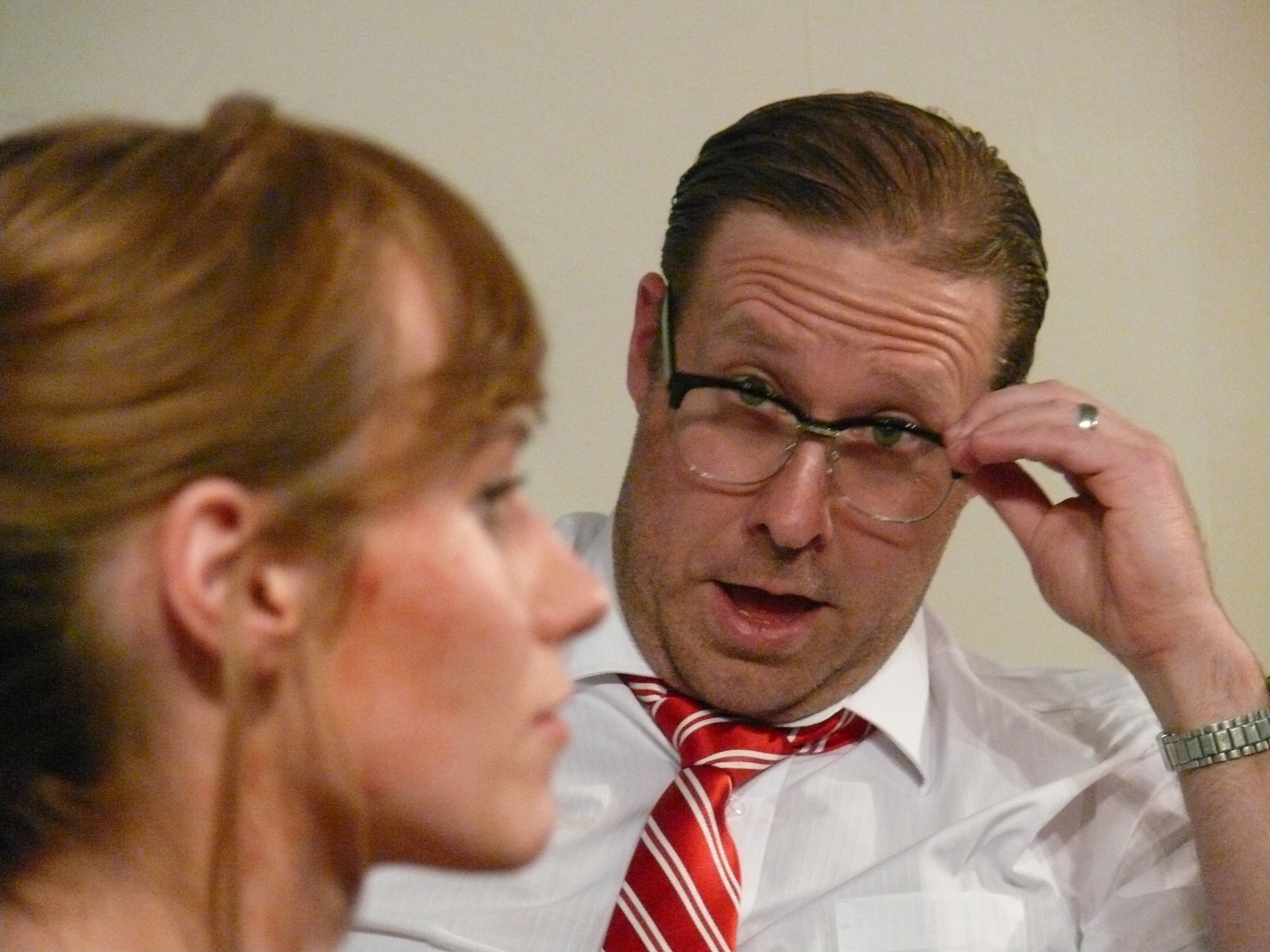
The centre of this play is Henry Crowley, played by Mark McCann. A comfortable lawyer, his world is rocked when his wife (Tricia Youlden) decides to sponsor an asylum seeker (Geoff Sirmai). And to add to Henry’s discomfort, his very working class cousin (Marc Kay) drops in. It’s not good timing; all Henry wants is to present the image of successful stability to a journalist from the Financial Review (Brigid O’Sullivan).

There’s some good laughs in Tony Laumberg’s script and director Richard Cotter elicits big fun comedic performances from his whole team.

GBL 37 - Mark+Tricia

The character traits satirized are self importance and narrow mindedness.

The power of theatre is its concrete nature. No airy abstractions here, not when there are flesh and blood characters so close we could almost touch them.

This is also theatre’s weakness. Henry Crowley in all his glory – parochial and devoid of generosity of spirit – is a particular man.

That man.

Not me.

How many people have sat in a theatre and tried to find comfort in that belief?

Veronica Kaye

The Good, The Bad and The Lawyer

TAP Gallery until 27 Oct

http://www.tapgallery.org.au/2013/09/the-good-the-bad-the-lawyer-starts-october-10-early-bird-offers-2/

Roberto Zucco

7 Oct

With my no doubt frustrating tendency to write philosophy instead of theatre criticism, it might be expected I’d take this play about a serial killer and use it as a launch pad to discuss that old chestnut – “the nature of evil”.

But I won’t. Instead, I’ll use it as an excuse to write about conventionality.

Zucco’s violence, and the responses to it, are symbolic. This is not a blood thirsty play. It’s an amusing and engaging exploration of rebellion.

It begins with the murderer escaping a supposedly inescapable prison. The prison guards are conventional, in the sense they don’t see it coming, and conventional in that they’re characters virtually out of commedia. Played with a wonderful sense of fun by Neil Modra and Sam Dugmore, they return later in the proceedings as gloriously keystone-like cops.

Zucco, played with marvelous energy by Tim Cole, baffles those around him because he is so unexpected. We follow his extraordinary journey.

Photography by Katy Green Loughrey

Photography by Katy Green Loughrey

He has a whirlwind romance with a young girl. Played with a fascinating balance between naivety and dissent by Gemma Scoble, she longs to escape the expectations placed upon her by her family. Their only concern is that she’s marriageable material and can follow the conventional path.

In a powerfully tense scene, Zucco talks to an old gentleman who is lost in the subway. He’s taken a wrong turn, and is confused and vulnerable. Adrian Barnes plays this brilliantly, capturing the deep doubt of one who suddenly finds the world larger than he had ever imagined.

Later, Zucco kidnaps an “elegant lady”. She is more than willing. This is her chance to escape from her stultifying middle class world. Kirsty Jordan, harmonizing humour and dignity, creates a character whose authority and strength drive her to challenge the very milieu that originally empowered her.

Director Anna Jahjah has drawn from her entire cast engaging performances. I particularily loved Lyn Pierse’s joyfully larger than life characterisations.

Martin Crimp’s translation of Bernard-Marie Koltes’ play is rich and intriguing. There are some delectable speeches.

This play is part of a European tradition. Think Jean Genet. Criminality as rebellion.

It’s a risky symbol. And no justification is offered for Zucco.

It just throws it out there the idea that conventionality is problematic. It offers no alternative.

But what alternative can there be?

To live Life fully – and this play reminds us Life can be over much sooner than we imagined! – to live Life fully, we cannot pretend to know it in advance.

Veronica Kaye


Roberto Zucco 

Old Fitzroy until 19 Oct

http://www.sitco.net.au/


Singled Out

4 Oct

I had a friend, who desperately needing to get somewhere, stole a car. I don’t know where it was he was so keen to go, but unless his desired destination was Goulburn Correctional Facility, his decision proved an unwise one.

When he was released, I asked what it had been like. Apparently, apart from the obvious fact he couldn’t leave, the experience wasn’t so bad. Free food. Free accommodation. The only problem? The company. “I had to spend a whole year of my life with a bunch of criminals,” he said.

Other people.

They’re a challenge.

And increasing numbers of us are choosing to live alone.

Why we are choosing this, and what are its consequences, is the subject matter of Augusta Supple’s Singled Out.

Josipa Draisma in Grace De Morgan's "Ikea". Photo by Marnya Rothe

Josipa Draisma in Grace De Morgan’s “Ikea”.
Photo by Marnya Rothe

Supple has pulled together a brilliant team of writers and actors. In a series of playlets, this team explores the phenomena from multiple angles. It makes for a fascinating night of theatre. There’s powerfully delivered monologues, cute puppetry and some good laughs.

I don’t write reviews. I write about what theatre makes me think about.

This production made me think about solipsism – the belief that other people don’t really exist.

It made me think this because the choice to live alone smacks strongly of a desire to avoid others. I make no moral judgement. In fact, I’m going to argue the opposite of what you might suppose.

Solipsism, or the question of whether other people actually exist, is a fascinating philosophical issue. I don’t mean it’s interesting in the sort of silly way, that as an undergraduate student, I cut my teeth on arguments about whether the chair I was sitting on was actually there. It’s interesting because it asks me to question how seriously I take the proposition that other people are independent of me and hence equal to me.

The acceptance of the actual existence of others is the great ethical challenge.

A clever monologue begins Singled Out. Performed by Roland Baker and written by Luke Carson, it cheekily asks what are the economic ramifications of the trend to single living. People are reduced to dollars.

It’s only too easy to reduce those around us, both locally and globally, to something less than human. Other people become extras in our private movie, tin soldiers in our conflicts, annoying randoms in the crowd. We don’t take them, or their needs, seriously.

Accepting that other people are independent of us (that is, real) doesn’t mean we’re isolated from them. In fact, the contrary is the case. Acceptance of true otherness is how a relationship begins. Otherwise it’s just exploitation. Or neglect. I can only understand someone else’s needs when I actually listen to them and not merely play games with the toy version of them I have in my head.

The decision to live alone is an assertion of independence. It’s also a potent symbol for an authentic life, the beginning point where both ourselves and others are given the space to be acknowledged and appreciated as individuals.

It was an exciting theatrical decision for Augusta Supple to explore the concept of living alone, and with an engaging and no doubt deliberate irony, the result is stimulating examination of our relationship with others.

Veronica Kaye

Singled Out

Seymour Centre til 12 Oct

http://www.seymourcentre.com/events/event/singled-out/

Writers: Vanessa Bates, Wayne Blair, Sarah Carradine, Luke Carson, Emma Magenta, Grace De Morgan, Tim Spencer, Alli Sebastian Wolf

Performers: Amanda Stephens Lee, Bali Padda, Rosie Lourde, Josipa Draisma, Leofric Kingsford -Smith, Amber McMahon, Roland Baker, Eloise Snape, Richard Cox, Alex Bryant-Smith, Paul Armstrong and Kate Fitzpatrick

Fully Committed

27 Sep

The customer is always right.

Are there five words that better encapsulate our absurdly mercantile and materialistic society?

Sam, played by Nick Curnow, is the one of the team who takes the reservations for a super trendy Upper Eastside restaurant. It’s the sort of place that’s booked out months in advance, or ‘fully committed’, as the celebrity chef insists. Sam struggles to deal with the demands of both employers and customers.

nick-curnow-233209

Fully Committed is a one man show designed to show off an actor’s virtuosity. And it does. Nick Curnow is superb, creating thirty eight characters in fifty minutes.

Sam is Curnow’s primary character, but he launches into the others with breathtaking energy. Curnow’s ability to delineate such an enormous cast of characters is awe inspiring. The laughs come thick and fast. His vocal work is nothing short of extraordinary.

The script, by American Becky Mode, is witty and wonderfully structured. Director Alexander Butt has facilitated a lively night of fun, and thought.

The customer is always right. The slogan is well known because employers ask their employees to abide by it simply because it encourages return business. But customers parrot it, as though it was a moral truth. ‘I am paying, so I must be right.’ But aren’t both parties entering into the transaction in good faith? You give me this, I’ll give you that. Why should one party be privileged?

There are few more injurious attitudes to a democratic society than this false sense of entitlement.

And one of the funniest and sharpest moments is when Sam’s agent (he is, of course, a struggling actor) tells him how he could do better at castings. He must develop an aura of self-entitlement. This is silver service satire.

Veronica Kaye


Fully Committed

New Theatre

Two shows remaining Fri 27 Sept and Sat 28th Sept

http://2013.sydneyfringe.com/event/theatre/fully-committed-becky-mode

Titus Andronicus

26 Sep

And so I went to a blood bath in a lounge room.

Titus Andronicus is a classic revenge story. It was a huge hit in Elizabethan times. And it works now, especially with smart choices.

It’s also intriguing because of what it suggests about Shakespeare’s practice.

Is the scheming Aaron the Moor a test run for Iago? (And, if so, note the reversal of the ethnicity of the characters in Othello. Did Shakespeare go on to develop a conscience regarding his presentation of particular races? Is it simply that he realised there was more dramatic potential in making a member of a minority group the central character in a tragedy?)

Is Titus a trial run for Hamlet? (In both plays there’s a much put upon hero who feigns madness until the time is right. Or wrong, as is the case in tragedy.)

titus_print

This production’s all female cast is a fascinating decision. Playing against expectation, it energizes and challenges. Director Caitlin Scarr has elicited terrific performances from the entire team. Jacki Mison as Titus is brilliant. Lauren Orrell as Tamora is captivating, and appropriately threatening.

Leah Winterton’s performance as Lavina is particularly moving. The violence done to her is horrific. Shakespeare’s decision to show us the consequences is one of the most confronting moments in his whole body of work.

And here it is in a lounge room.

Well, not really. But the Glebe Café Church Space is warm and comfortable, replete with couches and soft lighting.

And so, for me, this production poses a vital question, and puts it out there bravely:

How tolerant are we of violence?

Veronica Kaye

Titus Andronicus

Glebe Café Church Space

Two performances remaining: Fri 27 Sept and Sat 28 Sept

http://2013.sydneyfringe.com/event/theatre/william-shakespeares-titus-andronicus

Skazka, Told by Night

24 Sep

And they were happy.

Appearing at the end of a tale this line seems simplistic.

Anywhere else it is ominous.

Happiness will be disrupted. The power of the folk tale, despite its exotic and anti-naturalistic setting, is its assertion that we want peace, but it shall be denied us.

This is their insight: not the denial, but the desire.

skazka1

Told By Night is a series of adapted Eastern European folk tales. They are deeply moving tales of family and death.

Beautifully written by Jonathan Dunk, Finn Davis and Jem Rowe, their strength comes from their simplicity.

They are presented somewhere closer to a telling than a dramatization. Directed by Dunk, the performances are absolutely captivating, with both voice and movement seemingly balanced between improvisation and choreography.

This creates a spellbinding immediacy which enhances one of the most fascinating aspects of this piece. These tales were told to the audience, but also to (and with) those present on stage. We hear and see the tales. We hear and see the responses to them.

Stories don’t represent reality. (Especially not folk tales.) They are not truthful. They play us.

The wind chime doesn’t ask if the wind is true.

Veronica Kaye


Skazka, Told by Night

New Theatre

2 shows left Wed 25 Sept and Sat 28 Sept

http://2013.sydneyfringe.com/event/theatre/told-night