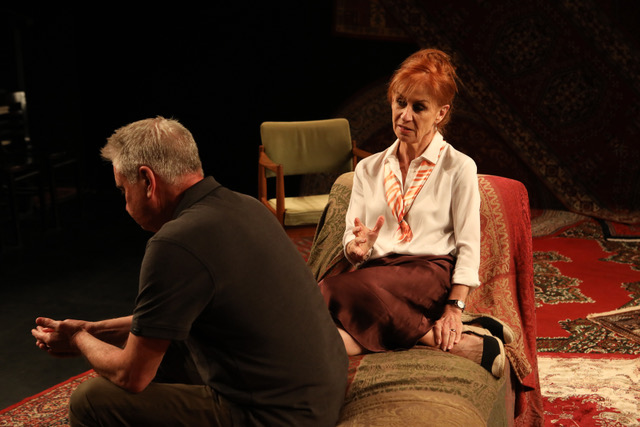
Alan has started to forget things. Just little things, but his wife is concerned. His doctor asks him to remember three words. They become the title of this piece.
Alan has early onset dementia. This one-man show portrays the development of the disease.
Written by David Hendon, it’s a work both beautifully crafted and searingly truthful. Alan does not want to accept this is happening. He desperately holds on to the belief that his memory lapses are mere aberrations. He interprets the concern of his loved ones as a desire to prove him wrong. As his forgetfulness deepens, we see how it’s the ability to maintain a coherent vision of the past that grants us a place in the present.
As Alan, CJ de Mooi is magnificent. He presents such a wonderfully rich portrayal – the denial, the anger, the warmth, the fear – that it feels utterly real, that it seems unbelievable that it’s a just performance. A gushingly naïve evaluation? Such is the power of this show.
It’s an empathy maker: we feel for Alan and – this is a testament to the writing and the performance – we feel for those who care for him, though we never meet them. Alan’s story, their story, is silently repeated in many homes, unnoticed by the rest of us, or deliberately forgotten.
I’ve suggested before that the best theatre either reminds the miserable of happiness or the happy of misery. On the strength of such a production, I would add this: from darkness, theatre makes beauty. Hearts are softened by the honest telling of hard truths.
Paul Gilchrist
Banana Crabtree Simon by David Hendon
Emerging Artists Sharehouse, as part of the Sydney Fringe
The concept of the “great actor” functions as a type of myth. Great actors are like Greek gods. They have human desires and flaws, but they remain above us, always, visitors from some wondrous realm.
Perhaps it’s an accurate description of certain gifted individuals, like Bernhardt. Or perhaps it’s suggestive of the role these individuals fill in popular culture. (It’s curious that we’re only allowed one or two great actors per generation. Too many gods is equivalent to having no gods. The currency must not be debased.)
Susie Lindeman’s Sarah Quand Même presents Bernhardt’s life. Bernhardt recalls to her granddaughter key events. Lindeman performs both roles, and if you were to cast someone as a great actor, she’s your choice. Lindeman’s vocal performance and physicality are superb.
Lindeman has also written the piece (for the anniversary of Bernhardt’s death). She tells a fascinating tale of Bernhardt’s glorious resilience. Quand Même means “despite all” or “no matter what”. Bernhardt was a superstar, and like anyone who mounts the monster of fame, the ride has its moments.
In a particularly poignant choice, Lindeman uses as a motif Bernhardt’s description of the audience as “the monster”. If you have gods, there will be monsters; and perhaps it’s only the gods who can tame them. I would’ve loved to have seen more of Bernhardt the actor, the god who tamed the monster, perhaps a speech or two from the great classics, a sample of her extraordinary ability. Lindeman could do it. Instead, we must be satisfied with review quotes that expound Bernhardt’s talent, and we all know what the opinion of reviewers is worth.
What would you call this? A reportage play? A recent history play? Whatever you call it, it’s a happening genre. Recent events, covered by the media, become a work of theatre.
The reasoning is simple: what the media provides is problematic. The media throws information at us helter skelter, bit by bit, hour by hour, and then moves on. The media isn’t trying to help us make sense of the world; it’s simply trying to get our attention. It treats us like children; it shakes a rattle, it plays peek a boo. For those of us who have achieved object permanence, this can feel a little dissatisfying. I’m informed that such and such happened, but I often don’t know what happened before such and such, and I rarely find out what happens after. A lack of understanding of how motivations, actions and consequences interconnect is a recipe for disempowerment. The media purports to offer information, but often is only selling passivity and impotence.
Dramatists, and writers of other forms, have realised there’s a place for an extended narrative that makes sense of the helter skelter of the media, joining the before and after of an event into a coherent whole.
In 2017, Luke Harding wrote A Very Expensive Poison: The Definitive Story of the Murder of Litvinenko and Russia’s War with the West. In 2019, dramatist Lucy Prebble adapted it, presenting the story of Alexander Litvinenko, poisoned by Russian agents in London in 2006.
Of course, the challenge of this type of writing for theatre is that some of it will naturally be invention. Did Putin really say that? Fiction can be taken as fact. Prebble guards against this through the use of a playful meta-theatricality, reminding us to remain alert, that the passivity endemic to television viewing is no option.
The point of all this – apart from entertainment, and this play and this production are hugely entertaining – is to impart political insight. Sure, some of these insights may appear too obvious to earn that title. That expediency often trumps justice, that determination is necessary if justice is to be ultimately achieved, are assertions unlikely to enlighten anyone – but in any seriously engaged political life they bear repetition.
Other insights offered are more drama-ish. (Yes, a made up word.) By it I mean the insights that drama is particularly suited to give. These are often of the giving-voice-to-the-devil type. Several men whose ethics we might find reprehensible are given voice in this piece. One tells of Russia’s history of suffering, suggesting that our moral objections might, from another perspective, seem merely irrelevant self-indulgent scruples. Not for a moment does Prebble suggest that Litvinenko deserved to be murdered; her intention is clearly to indict a Russian regime capable of such an atrocity, and to critique Britain’s reluctance to seek justice. But it remains a valid point, that despite our deepest wishes, moral systems are not universal. To successfully live with others (other countries, other individuals) and to retain the hope that we might nudge the world a little closer to the ideal we desire, we need to know this.
Have I made all this seem rather heavy? It’s not. Prebble’s script is brilliant, and director Margaret Thanos’ production allows it to shine. With movement director Diana Paola Alvarado, Thanos gives a show brimming with pace, energy and pizazz.
Performances are excellent. Richard Cox as Alexander Litvinenko gives a moving portrait of the relationship between moral exertion and woe. Chloe Schwank as Marina Litvinenko beautifully portrays a journey from fear and frustration to strength and resoluteness. Tasha O’Brien as Putin is absolutely marvellous; she gloriously embraces the comic possibilities of the role while simultaneously presenting a character whose personal awkwardness and deep mistrust make a truly dangerous enemy.
Written by Irish playwright Mark O’Rowe, and first produced in 2018, The Approach is about relationships. This might seem an absurdly naïve thing to say; after all, isn’t that what all drama is about, it being the artform best suited to exploring how we relate to each other?
But this work is fascinating in its seeming simplicity and focus. Through only a series of tete-a-tete conversations between friends, it forefronts our desire for human connections, despite the pathetic inadequacy of so many of these connections. It’s La Rochefoucauld, without the exuberance he derived from cynicism. The relationships portrayed in The Approach are filled with grievances, resentments, dishonesties and envies, and are maintained by characters who struggle for self-awareness, and who would probably choose to live without these relationships if they could.
Some people might suggest this is simple Truth; theatre at its most beautifully realistic. Perhaps. I’m not sure calling it Truth isn’t merely the romanticisation of garden variety misery. But, if it is, who am I to complain about how others cope?
It’s a finely wrought play, eighty minutes of tight, engaging writing. Director Deborah Jones keeps the production splendidly sparse, allowing her excellent cast to shine. It’s a joy to witness Linda Nicholls-Gidley, Lindsey Chapman and Sarah Jane Starr present these characters, like watching sunlight glimmer through the discarded pieces of a broken stained glass window. I use this ostentatious simile deliberately: the play presents a world in which individuals have seemingly lost the ability to look up. There’s one particularly poignant motif: a fourth character, who we never meet, who climbed a nearby mountain and lit a fire. In rich ambiguity, this serves as both a powerful image of troubled flight, and of the desperate need to go beyond.
Ghost stories are not about ghosts; they’re about fear. They ask what makes us frightened and what type of safety we crave. They also ask when is fear natural and beneficial, and when is it irrational and dangerous.
Richard Hilliar’s adaptation of Henry James’ classic novella is funny, fascinating, frightening, and entirely engaging.
Ostensibly, it’s a ghost story and, as director, Hilliar works multiple theatrical elements to create a deeply creepy atmosphere. Set, sound, lighting, costume and performance all combine together brilliantly to establish this mood. (Set designer Hamish Eliot deserves special mention: the creation of the late 19th century house and its surrounds is extraordinarily rich.)
Adaptation is a tricky business. The audience will always slot into two distinct categories: those familiar with the original text and those who are not. Though there have been dramatizations before, I would think James’ novella stubbornly resists the form, being so dependent on the subjective psychological experience of the protagonist. The original novella is in first person and the protagonist is the archetypal unreliable narrator. (Here she is played by Lucy Lock with affecting horrified bewilderment.) The achievement of the original text relies on silences, both deliberate and contextually determined. James’ narrator doesn’t tell us certain things, either out of self-interest or from lack of self-knowledge. And James himself, working at the end of the Victorian era, was presumably reluctant to spell out the more confronting possibilities latent in his tale. Hilliar’s version is much more explicit.
It could be argued that James’ novella is the culmination of the gothic, a tale in which the external supernatural and the internal psychological collapse into one. After The Turn of the Screw, modern horror developed because the genre had nowhere else to go.
But Hilliar creates a play and a production that engages in a fascinating conversation with the original, as well as being a deeply intriguing work in its own right.
Paul Gilchrist
The Turn of the Screw by Richard Hilliar (after Henry James)
The myth of a vagina equipped with teeth has been with us for quite a while. The myth functions in several ways. It expresses the male fear of women, their dangerous allure, their power, the fact that the sexual act radically changes the participants. It also expresses the female desire for safety, the longing to secure themselves from sexual assault.
I don’t want to oversimplify; if the meaning of the myth was obvious and indubitable it wouldn’t be a myth, but merely a parable or fable, or even a truism. Myth works well in drama because it invites reflection rather than reduces to sermon.
And Erica J Brennan’s take on the myth of vagina dentata warmly invites reflection. Brennan reworks it as speculative fiction, imagining the phenomena to have occurred to most contemporary women. How we would navigate this concrete physicalization of our subconscious fears and desires?
Brennan sets the action in a dinner party, the archetype of privileged normalcy, and lets the characters attempt to make sense of it all. Their dialogue is stilted and sparse, evocative of the challenges of the new world in which together they find themselves, but also of the deep troubling internal darkness that alone they’ve always inhabited. Director Cam Turnbull effectively ramps up the sense of dislocation by slowing the pace. Lighting designer Jasmin Borsovszky also powerfully disrupts any illusions of a comfortable reality with unexpected and haunting variations. The addition of clever, catchy songs by Jake Nielsen further subverts complacency.
The cast do some good work. A highlight is Kira-che Heelan, as Neeve, offering an engaging performance that marvellously mixes the horror, the despair, the anger and the hope. Claudia Shnier’s Sasha is beautifully and provocatively part conniving minx and part feminist warrior, and all vulnerable human being, as she attempts to cope with forces much larger and more ancient than herself. David Woodland’s Mark, in his desperate, bumbling attempts to make connections despite the world’s brutality, is a splendidly sympathetic everyman.
The Hero Leaves One Tooth is like a gem dragged up from the underworld; deliberately only half-polished, it glimmers and shines while still suggesting the darkness from where it came.
Paul Gilchrist
The Hero Leaves One Tooth by Erica J Brennan
Presented by Ratcatch Theatre in association with bAKEHOUSE Theatre Company
Fun and endlessly fascinating, this play deliberately resists easy interpretation.
A descendant of the absurdist comedies of Beckett, Philip Ridley’s Pitchfork Disney takes a simple scenario and posits it as a symbol of the human condition.
Presley and Haley, brother and sister, live alone. Perhaps they’ve been abandoned by their parents? They’re fearful of the outside world and their diet consists exclusively of chocolate. But Presley and Haley are not children; they’re adults, reduced to a childlike state by the absence of an authoritative world view. In a pathetic attempt to establish some sort of meaningful vision of Life, they tell each other their nightmares, retell outlandish stories, and recall a past when Mum and Dad provided a secure centre to their existence. Ridley’s genius is the conscious use of cliché and allusions to consumer pop culture to evoke the malaise of modern meaninglessness.
Into this closed world comes Cosmo Disney, a two bit entertainer who makes a living by supplying his audience with a “daily dose of disgust.” In a world devoid of higher purpose, at least fear and repulsion are constant.
Director Victor Kalka does wonderful work with this classic of modern theatre, creating a space in which imminent threat and comic exuberance play chicken.
The cast is exceptionally strong. Jane Angharad as Haley is magnificently vulnerable, her childlike physicality and her delivery of Ridley’s evocative monologues a delight. James Smithers as Presley, onstage through virtually the entire production, gives a virtuoso performance; doubt, bravado, terror, reluctance, desire, wonder, all brilliantly brought to life. Harry Winsome’s Cosmo is a beautifully disturbing portrait of self-serving confidence, operating both as a foil to the two adult children he impinges upon, and granting insight into the unexpected ways in which moral emptiness manifests itself. James Hartley provides a terrific cameo – of which the spoiler rule reduces me to silence – except to say it’s both powerful and hilarious.
Teenage Dick by Mike Lew is a brilliant play and director Dan Graham’s production is superb.
Lew takes elements of Shakespeare’s treatment of Richard III and places the action in a modern American high school.
Like Shakespeare’s Richard, Lew’s protagonist has a disability that pushes him to the periphery. Both characters respond by focusing on the pursuit of power. Shakespeare was clearly exploiting the Elizabethan fascination with the Machiavellian villain, and Lew’s play makes that explicit: the students are asked to discuss The Prince. Is it better to be feared than loved?
Dean Nash as Richard is absolutely magnificent, a mesmerising stage presence. (I suspect Richard Burbage, the original Richard in Shakespeare’s company, would be thrilled by what Nash does.) Graham provides Nash with a wonderful supporting cast. Chloe Ho as Anne Margaret offers a deeply moving portrait of vulnerability. Rocco Forrester is terrific as the self-obsessed school jock, Eddie. Holly-Jane Cohle’s Buck is gloriously no-nonsense wit. Amy Victoria Brooks, in a performance both hilarious and disturbing, nails the hapless teacher, Miss York.
The character names evoke Shakespeare’s play and, if you’re familiar with the Elizabethan text, the conversation between this play and the earlier one is intriguing. But no knowledge of Shakespeare is required.
This is an extraordinarily timely play. We live in an era in which some of us so passionately strive to right previously unacknowledged injustices that we valorise rage and grant ourselves moral holidays. Richard desperately wants power because he’s so denied it, but are the means he chooses defensible? Are they even effective? This play does what theatre is made to do: honestly present the fracture lines in our vision of Life.
Shakespeare called his play a tragedy. Lew’s extraordinarily powerful final scene leaves us asking if his is too.
Paul Gilchrist
Teenage Dick by Mike Lew
Presented by Flight Path Theatre & Divergent Theatre Collective
Chris Aronsten’s Off The Record was shortlisted for the 2021 Silver Gull Play Award and here it is on New’s stage. (New Theatre deserves congratulations for continuing this award – as does whoever initially established it.)
Off The Record is a fun comedy that deals with serious issues.
In some ways, it’s a curious example of contemporary Australian writing; for instance, it’s set in contemporary England.
There are laughs aplenty, but there’s also a powerful exploration of what it takes to blow the whistle.
Corporate heavyweight Tony has done wrong. Employee Janine and TV journalist Jenny seek justice for the victims. But Jenny is an alcoholic and Janine is … well, eccentric. (Tony complains – and perhaps I paraphrase – “You can’t call a woman crazy anymore.”)
Director Jess Davis’ cast deliver wonderful performances. Michela Noonan as Jenny magically blends sass and vulnerability. Suzann James’ Janine is both very funny and very moving. Belinda Hoare as Jenny’s AA sponsor has a magnificently truthful delivery; simple, honest and raw. Joe Clements as Tony gives a suitably disturbing portrait of pompous privilege.
The script has some intriguing absences. Tony’s sin is outlined but (fortunately) not shown. His guilt is never really up for question, but is what he’s done a crime? Or is it an abuse of power? Abuses of power are not automatically illegal. (Perhaps this was all clarified and I simply missed it.)
The other absence is the victims. They remain off stage.
The result of these creative choices is that the whistleblowers, flaws and all, are placed front and centre. And what we get is a beautiful portrait of what it is to do right, to try to do right. To make a better world, saints are not required. We’ll do.
Though fiction, this is theatre that bears witness. (Of course, all theatre does – in a way – but it’s not all that it does.)
But bearing witness is certainly a focus of contemporary theatre making. We’re keen to present what we believe are under-represented voices.
Ladybird Ladybird by Linda Nicholls-Gidley bears witness to the often unacknowledged suffering of many women, both before they give birth and after. In powerful images and in script built from deeply affecting monologues and insightfully sharp dialogue, we’re presented pain both physical and mental.
Director Anthony Skuse and designer Henriette Gabreal give the characters a simple, stark, stepped stage. There’s nowhere to hide; there’s only climbing to do – an almost Sisyphean image of pain unending.
Supported by a very capable cast (Leilani Loau, Danielle Stamolous and Silvana Lorenzo de Shute), Nicholls-Gidley’s performance as the protagonist, Veronica, is brilliant. Her control of both the language and physicality is outstanding. Veronica’s suffering elicits tears and offers no consolation.
Absent from the stage is Veronica’s husband. This absence highlights his personal culpability, but also functions as a potent symbol of the patriarchy’s deliberate obtuseness regarding the challenges of motherhood.
But another provocative consequence of Nicholls-Gidley’s decision to people her story with solely female characters is to challenge any superficial faith in the sisterhood. Veronica’s mother and supposed friends oscillate between making narrow unsympathetic judgements and offering glib unwanted advice. It’s the brutality of this portrait that gives the piece a soul-stretching veracity, that asks us – all of us – to listen more closely, more openly, to the people in our lives.
And theatre that does that, has done a wonderful thing.