Comfort, Spin, Travel

3 Mar

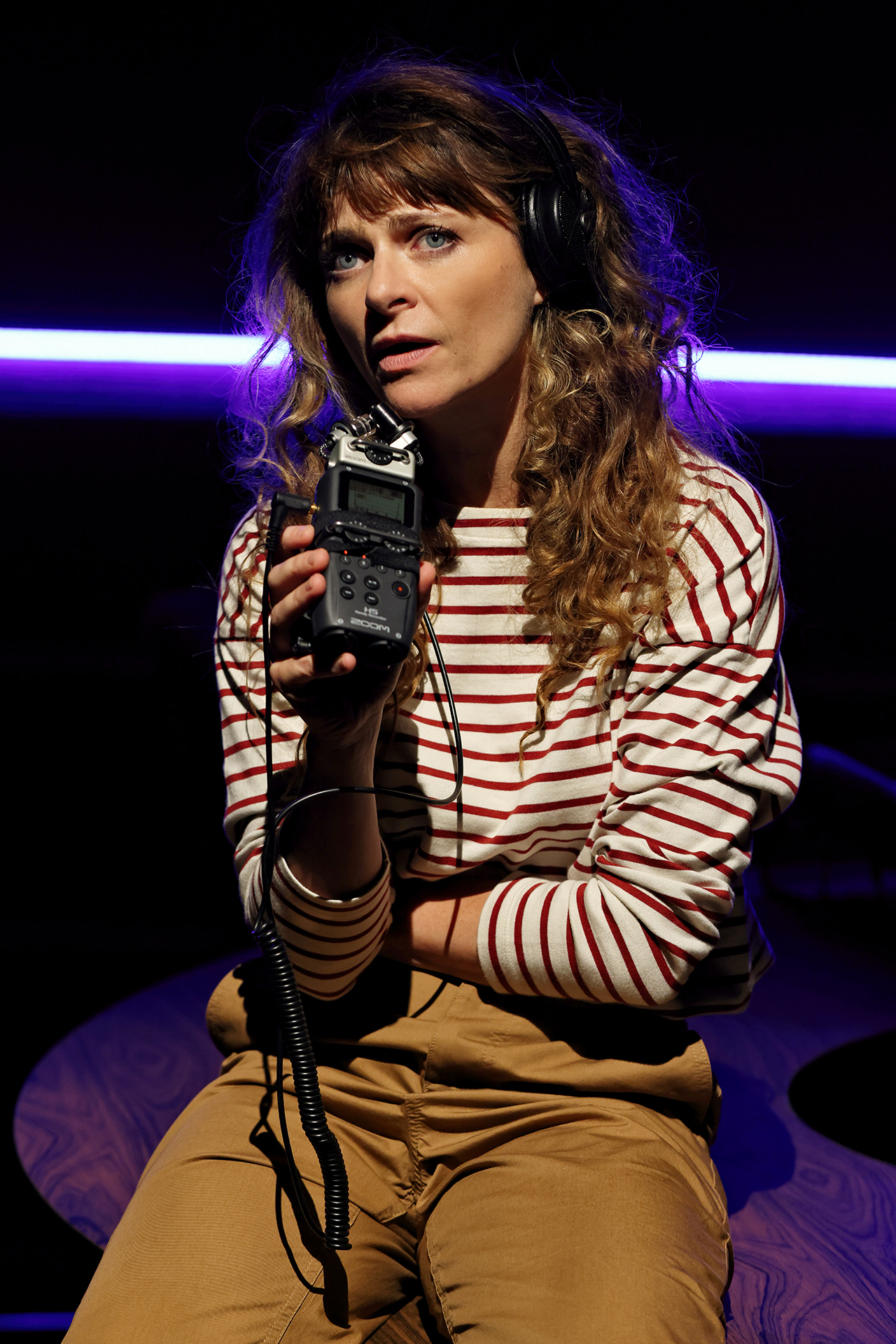
They are in an Officeworks store. They’re trying out the different office wheely chairs, determining which is the most comfortable, which rotates the best, and which moves around the space most effectively. They’re not looking to purchase. They’re reliving a game they used to play with their much loved little sister.

Comfort, Spin, Travel (written by Lu Bradshaw and directed by Emma Burns) presents as a generous-spirited sharing of what it is to live as a trans person. Its focus is relationships – not romantic ones – but rather those had with strangers and acquaintances, friends and family. Clearly, all is not plain sailing. There are issues regarding the nature of allyship and solidarity, the use of pronouns and personal terms of address, the pressure to advocate, the right to body modification, the importance of safe spaces … and of basic acceptance.

Performer Hadrian Conyngham has an extraordinarily engaging stage presence. The moment of coming out (“I no longer identify as a girl”) is presented with an everyday gentleness, a domestic ordinariness, that underlines its poignancy. The tale of dealing with cisgendered female friends who feel they can crash Queer Night is both an amusing self-deprecating anecdote and a moving expression of anger.

Setting the story in a late night visit to a stationery store allows for some delightful cameos from the supposed staff. Rachel Seeto, on stage throughout, creates a deliciously comic character, capturing both the lethargic alienation of the young student forced to work in retail and the vibrant human soul beneath.

This piece makes some fascinating dramatic choices. I suggested it presented as a ‘sharing’, and the honest expression of the difficulties experienced by a trans person suggests it is non-fiction, but the Officeworks scenario and the repeated reminders that the narrator might be unreliable evoke the opposite. (The press release tells me the piece is a semi-autobiographical creation of the writer.)  

Another intriguing choice is the playful conceit of the trying of the different chairs, a conceit which invites comparison with the serious story, the one about identity. Is it a trivialisation? No, it’s a theatrical artifice that forefronts the tension between choosing and being. From the outside, the chair a person ultimately chooses appears subjective; from the inside, it is an expression of the individual’s objective reality.

Which leads me to the other musing this piece launched me on. I’m not really riffing on the LGBTQIA+ moniker, but it is true that we are often tempted to view our identity as though it were like a letter in an alphabet. Who we are, is who we are. ‘B’ is not defined by ‘A’, or ‘C’, or ‘D’. They are just other letters, separate and distinct. But the phenomena of identity is perhaps more like numbers. The number ‘2’ is defined by the number ‘1’. The number ‘15’ is in a fundamental relationship with ‘14’. (For fun, or something approximating it, Google the meaning of ‘15’. Go on.) Despite the desperate weirdness of my analogy, I think it encapsulates the situation. Our identity is a deeply personal, existential thing, but it is – at least partly – dependent on society. We can identify any way we want, but if this identity is not accepted by others, we are troubled, or tortured or erased… Even the concept of pride is reactionary: an assertion that I am valuable despite any negativity from you. That the experience of identity is both personal and social is one of the great unresolvable tensions in the human condition. I imagine no-one would endure this tension if they could transcend it (but that might be more indicative of the limits of my imagination than the actual variety of lived lives.)

My self-indulgent philosophical ramblings aside, Comfort, Spin, Travel is a beautiful, vital little piece of theatre.

Paul Gilchrist

Comfort, Spin, Travel by Lu Bradshaw

presented by Fruit Box Theatre

at Meraki Arts Bar until 11 March

www.fruitboxtheatre.com.au/comfort-spin-travel

Image by Matthew Miceli Photography

Choir Boy

28 Feb

Choir Boy explores the experience of a young queer man in an environment that frowns on difference.

It’s an absolutely beautiful piece. The songs are traditional spirituals performed a cappella, and with the guidance of musical director Allen René Louis, the cast present them brilliantly. Directors Dino Dimitriadis and Zindzi Okenyo elicit wonderful dramatic performances from the entire cast, and splendidly choreographed movement by Tarik Frimpong aids both the musical numbers and the scenic transitions.  

Tarell Alvin McCraney’s script is captivating and thought-provoking. Set in a boys’ high school of predominantly African-American students, it’s a fascinating exploration of the tensions within a group that we – on the other side of the globe – can be tempted to perceive as monolithic. Oh, if everyone just stayed in their box, life would be so simple ….and dull, and oppressive, and untrue. (Individuals remain in their allotted boxes only in bad art, and worse politics.)

Pharus is the choir leader; he’s gifted both musically and  intellectually, and he wants those gifts recognised, but his queerness challenges those around him. Darron Hayes’s portrayal of Pharus is utterly engaging and deeply moving. He presents a glorious talent, whose oscillation between cockiness and self-doubt is an understandable reaction to a small world. 

But the play offers multiple scenes in which individuals refuse to be contained or constrained.  Anthony, Pharus’ roommate (in a uplifting portrayal of openheartedness by Quinton Rofail Rich) shares an anecdote about his shock at his brother’s homophobia. Pharus delivers an electric speech challenging reductive interpretations of traditional spirituals: were they really just code use by the enslaved to fool the oppressors or, like all human expression, are they complex, multifaceted and so truly alive? Pharus even engages in a surprisingly stimulating verbal quibble with his nemesis, Bobby (portrayed by Zarif with a magnificent aura of brooding menace.) Should we speak of “slaves” or “the enslaved”? The former was good enough for Michelle and Barack, but ways of seeing develop, offering further opportunities for humanity to flourish. No box is ever big enough.

McCraney creates two adult characters who offer the younger men models of maturity, that open-eyed acceptance of complexity. There’s the teacher who runs a critical thinking course, portrayed by Tony Sheldon with that delightful collision of social awkwardness and intellectual grace of the academic. And there’s Headmaster Marrow, played by Robert Harrell, in a powerful portrait of authority and concern. Marrow must maintain school rules, and that might be of little help to Pharus, but inherent in the principal’s discussions of school boards and student codes is a hidden, hopeful reminder that our judgements are created things. All can be made anew.  

Paul Gilchrist

Choir Boy by Tarell Alvin McCraney

Presented by National Theatre of Parramatta in association with Sydney WorldPride

Until 11 March at Riverside Theatres

riversideparramatta.com.au/show/choir-boy/

Image by  Phil Erbacher

CAMP

22 Feb

I love a good piece of history. I love stories that model change.

I’ve noticed in this year’s Pride Festival an interest in history; an awareness that, while change is still required, much has been achieved.

Because it has duration, drama is a perfect artform to explore change. When the house lights finally come up at the end of the performance, where the characters are – and where you are – is usually a long way from where you all began.

I suspect another reason that artists exploring the queer experience are currently interested in history is that the generation who began the public fight for rights are, if they’re still with us …of a certain age. Stonewall was in 1969. The first Sydney Mardi Gras in 1978. It’s a good time to honour and celebrate their achievements.

(I also suspect an older generation of activists might tire of an attitude sometimes expressed by those newer to the fight, an attitude of ‘Why isn’t the world the way I want it to be? What have you people been doing?’ It’s an attitude whose close cousin is the complaining ‘Karen’, she who’s always demanding to see the manager, whose sense of entitlement blandly assumes the automatic existence of structures that have to be both built and maintained.)

Elias Jamieson Brown’s CAMP presents the exploits of the Campaign Against Moral Persecution, a group of activists who in 1971 were the first in Australia to hold a public gathering of gay women and men.

The play presents their struggles to build awareness and achieve justice, and the personal challenges they faced. Particularly precious is the focus on the lesbian experience (maybe I should get out more, but it’s still a representation that gladdens my soul the rare times I see it). I’m not sure if the characters are fictional or if they’re based on specific historical individuals, but they’re fully and richly human, a glorious mix of failings and flaws, passion and determination. Petty jealousies vie with noble dreams (the surest test of human reality) and for these beautiful portraits of living souls we have to thank Jamieson Brown’s script, Kate Gaul’s direction and the gifted cast.

Our focus is on Krissy (Jane Phegan), Jo (Tamara Natt) and Tracy (Lou McInnes) as they navigate the tension between private needs and group goals. (It’s great to see these tensions represented on stage. It’s the romanticisation of political engagement that so often robs us of agency; a portrait of activism as utterly exciting only enervates us when we find it merely necessary.)

In wonderfully realised transitions and tableaux, Gaul powerfully presents a world of action, where the co-existence of the political and the personal is made manifest.  

Juxtaposed with scenes set in the 1970’s, Jamieson Brown shows us the women as they are now, played respectively by Anni Finsterer,  Genevieve Mooy and Sandie Eldridge. It’s over forty years later, and much has been gained, and much has …changed. It’s an intriguing device, an invitation to consider time, that great gift, the one which always goes, whether we use it or not.

How should we use it?

This is big, bold, inspiring theatre, with a very human heart.

Paul Gilchrist

CAMP by Elias Jamieson Brown

presented by Siren Theatre Co and Seymour Centre in association with Sydney WorldPride

at Seymour Centre until 4 March

www.seymourcentre.com/event/worldpride-2023-camp/

Image by Alex Vaugh

Gay Sydney: A Memoir

20 Feb

We often make statements that follow this formula: ‘So-and-So made History by doing Such-and-Such’. (It’s indicative of the naïve inadequacy of such a formula that So-and-So is often a cricketer and the Such-and-Such is the scoring of a century.)

But history is made in the telling; or more precisely, it is the telling. And someone needs to do it. Someone needs to tell us what happened and how it all strings together. In regard to gay experience in this city, William Yang is in the perfect position to make history: he was there, and he took beautiful pictures.

In Gay Sydney: A Memoir, with his stunning photographs and his gentle wise voice, Yang creates a story that is both deeply moving and deeply inspiring. It doesn’t feel like a performance, but rather a generous sharing.

With personal anecdote and eye witness authority, Yang speaks of events from 1969, when he first came to Sydney, to the present day: the birth of Mardi Gras, the flowering of the Darlinghurst “gay ghetto”, the decriminalisation of homosexuality, the tragedy of the AIDS epidemic, the success of the marriage equality movement…

Such histories are invaluable because they give voice to queer stories. But histories also matter because intrinsic to them is the concept of change. A trend we currently suffer is the privileging of ways of seeing the world that unconsciously deny change. These ways of seeing, theories if you like, recognise injustice but offer little insight into the processes by which it might be overcome. (An example of a theory unconsciously wedded to the status quo might be one that asserts an individual’s life experience, and their understanding of that experience, is determined solely by demographic factors: race, sexuality, age….) One cure to the childlike infatuation with this sort of disheartening theory is a good dose of actual history – which Yang provides. (Though he wastes no time on philosophical nonsense, as I do.)

Accompanied by evocative music created and performed by Timothy Fairless, Yang’s memoir is simple, powerful, and most of all, uplifting –  a wonderful celebration of a way forward.

Paul Gilchrist

Gay Sydney: A Memoir by William Yang

at Seymour Centre until Feb 23

presented by Seymour Centre in association with World Pride

www.seymourcentre.com/event/worldpride-2023-gay-sydney-a-memoir/

Image by William Yang

French Letters and Leather Cleaner

16 Feb

This is like a glass of bubbly; fun, light, effervescent – but with a kick.

Robbie runs a queer sex shop on Oxford Street. For many years it has proven a safe haven for the queer community. Kris, who now works there, was given shelter by Robbie, as was Santi, the drag queen.

But things have changed; developers want the site. Then one evening, Donkey Thursday (long story; at least 8 inches), a seemingly straight couple turn up at the store, and….

Laurent Auclair’s script has great one-liners, and some of the best go to Mat Oldaker as Santi and Dennis Clements as Robbie, who deliver them superbly. But the decision to present the story in real time creates challenges for both actors and audience; does change happen so fast? I assume the script has realism as its goal, but the characters’ occasional meta-theatrical awareness of the audience, and the choice to vary lighting states that in reality would be static, give my assumption a disconcerting shake.

But forget the shake, back to that kick I began with. It’s in some of the characters’ intriguing nostalgia for the past, when to be queer was to be, well… queer.

Every revolution has unintended consequences. The drive to equality can lead to homogeneity. Once accepted, do you simply blend in? Do you merely dissolve, like a sugar doll in a vast tepid ocean?

Successful revolutions always leave a smattering of revolutionaries struggling to find an identity in the new order. It’s a phenomena that invites us to question the concept of identity itself.

Self-definition by opposition is drearily binary and ultimately limiting. You risk being reduced to someone else’s shadow, if you allow your shape to be defined by their light. Or, to reverse the analogy, definition by opposition assumes a monolithic opposition, and maintaining that assumption is a whole lot easier if you don’t point your light too closely at what darkness leaves in convenient simplicity.

We live in the age of identity, where the question “Who am I?” takes precedence over the question “What is to be done?” But, I suspect, identity is one of those things that the fortunate individual ultimately freely chooses to relinquish. But that is a suspicion; what I know is that what is taken from us does untold damage. French Letters and Leather Cleaner is a valuable assertion of the queer community’s continuing need for safe spaces. The revolution ain’t over. (Are they ever?)

You gotta love a piece of theatre that invites such speculation.

Paul Gilchrist

French Letters and Leather Cleaner by Laurent Auclair

Presented by Fruit Box Theatre in association with bAKEHOUSE Theatre Company

At Kings Cross Theatre until 24 Feb

www.kingsxtheatre.com/fruitbox

Image by Matthew Miceli Photography
Big Screen, Small Queen

14 Feb

(Everything I Didn’t Learn at Film School)

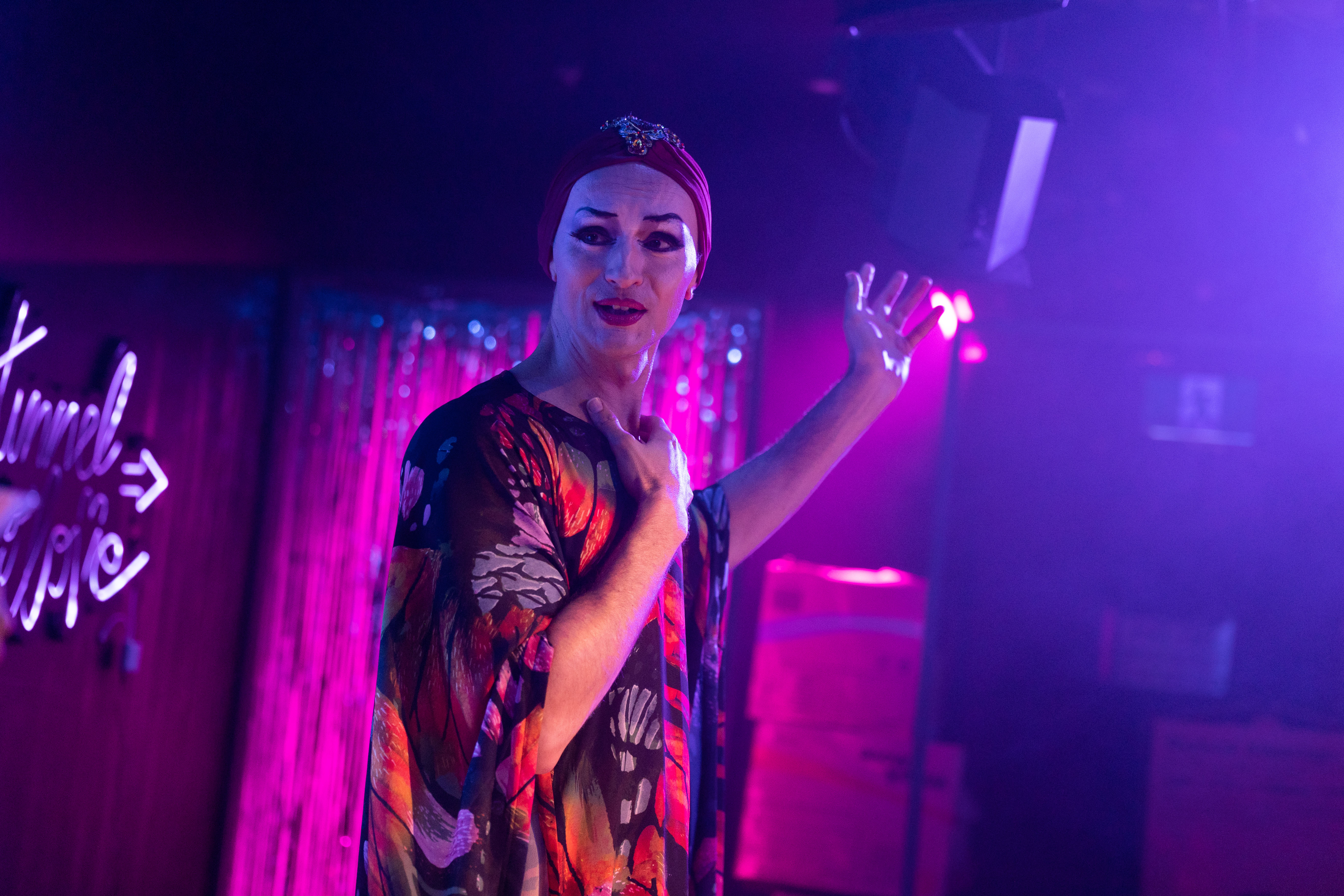
Etcetera Etcetera has an extraordinary stage presence. Big Screen, Small Queen is a sharing of how the performer discovered the artform of drag – when they were supposed to be studying film. (Hence the show’s subtitle.) It’s a humorous and heart-warming tale of self-discovery and self-expression.

In the time honoured tradition of drag, most of the musical numbers are lip-synched, but they are visually spectacular. Performed by Etcetera, Jack Williams and Carter Rickard, and choreographed by Rickard, the dancing is electric. And then there’s the frocks; designed by Erin Caroll and worn beautifully by Etcetera, they’re truly fabulous. Add to this Aron Murray’s magical lighting and the result is a delightful, life-affirming confection.

Etcetera does perform live Peggy Lee’s hit song “Is That All There Is?” It’s a moving and amusing expression of disappointment. For Etcetera, film school was meant to open a doorway to glamour. (Is ‘disappointment’ the correct word? Or is it ‘decadence’? I’m not making a moral point; I don’t mean ‘decadence’ as in excessive indulgence, but rather as the need for more and more stimulation. It’s one of life’s great mysteries that some people can stare rapt at a mere rock pool for hours while others soon tire of the ocean – and so dream a fanta-sea.)

But there’s an absolutely fascinating paradox in drag; it is utterly performative, but in being so performative, so artificial, the performer reveals their true self. Etcetera says early in the show words something like: I can’t trust anyone who hasn’t torn down their identity and rebuilt it from scratch; I can’t trust anyone who hasn’t performed drag.

This show is designed to highlight drag’s glorious paradox. All costume changes (wigs and all) happen in full view. And the whole time there’s a full length mirror on stage and a camera capable of projecting Etcetera’s performance on a screen. The sheer artifice of it all is made apparent. Drag is an archetypal example of what’s termed philosophical irony: none of us are in the position to make God-like pronouncements of ultimate Truth, we’re all just making it up as we go along – and so artificiality is our reality. Our ability to perform is who we are.

It’s a remarkably grand and liberating vision of life (as vast and deep as any ocean, seen or dreamed.)

Paul Gilchrist

Big Screen, Small Queen by Etcetera Etcetera

Presented by Fruit Box Theatre in association with bAKEHOUSE Theatre Company

At Kings Cross Theatre until 23 Feb

www.kingsxtheatre.com

Image by Matthew Miceli Photography

A Broadcast Coup

3 Feb

I used to laugh at reviews that referenced theorists such as Michel Foucault. When the play being critiqued did not actually mention the famous philosopher, and he had most certainly not written the thing – he hadn’t even volunteered to do front of house one night – then a discussion of his ideas seemed somewhat out of place.

But sometimes we learn (and, in doing so, become the cause of mirth in other petty-minded individuals.)

One of Foucault’s most famous works is The History of Sexuality. It’s three volumes long, and being a theatre critic, beyond my attention span. Fortunately, the dynamite is lit in the title: the history of sexuality….. how can sex have a history? Isn’t sex just a biological thing, as fundamental, as universal and as immutable as, say, breathing. Except in terms of some deep evolutionary perspective, how can sex be said to change? But Foucault was pointing out that sex is contingent on other aspects of the human experience. And, for Foucault, the key other aspect is power.

Sex and power; this is playwright Melanie Tait’s subject matter, and she approaches it with sharp humour, vibrant characters, recognisable tensions and a captivating story (and absolutely none of my theoretical pomposity.)

Mike King is a much lauded radio presenter. After so long at the top, his manner is imperious (if not quite Nero, certainly not Marcus Aurelius). In a wonderful portrayal, Tony Cogin captures both Mike’s charisma and selfishness. Mike is faithfully served by Louise (Sharon Millerchip), who admires his talent and cleans up the mess. Mike makes life hell for Troy (Ben Gerrard), the station manager, dismissing him as a mere “bureaucrat”. But new assistant producer, Noa, presents a challenge. Alex King brings to the role a brilliant energy that presents the truth of youth: that the blaze of righteous passion is partly fuelled by naivete.

And then there’s Jez, played by Amber McMahon. I’d pay to hear McMahon read the phonebook (though I appreciate such tickets might be expensive due to the rarity of the prop.) Jez is an ex-colleague of Mike’s, now producing a red hot podcast exposing the mistreatment of women in the workplace.

Tait’s script works a thrilling tension: that power is an aphrodisiac, and that power determines what is deemed acceptable sexual behaviour.

Our society is trying to work this tension out….and if Foucault is right, and sexuality has a history, then change for the better is possible (at least until that better is again redefined.)  

Paul Gilchrist

A Broadcast Coup by Melanie Tait

at Ensemble until 4 March

www.ensemble.com.au

Image by Prudence Upton

Othering

14 Jan

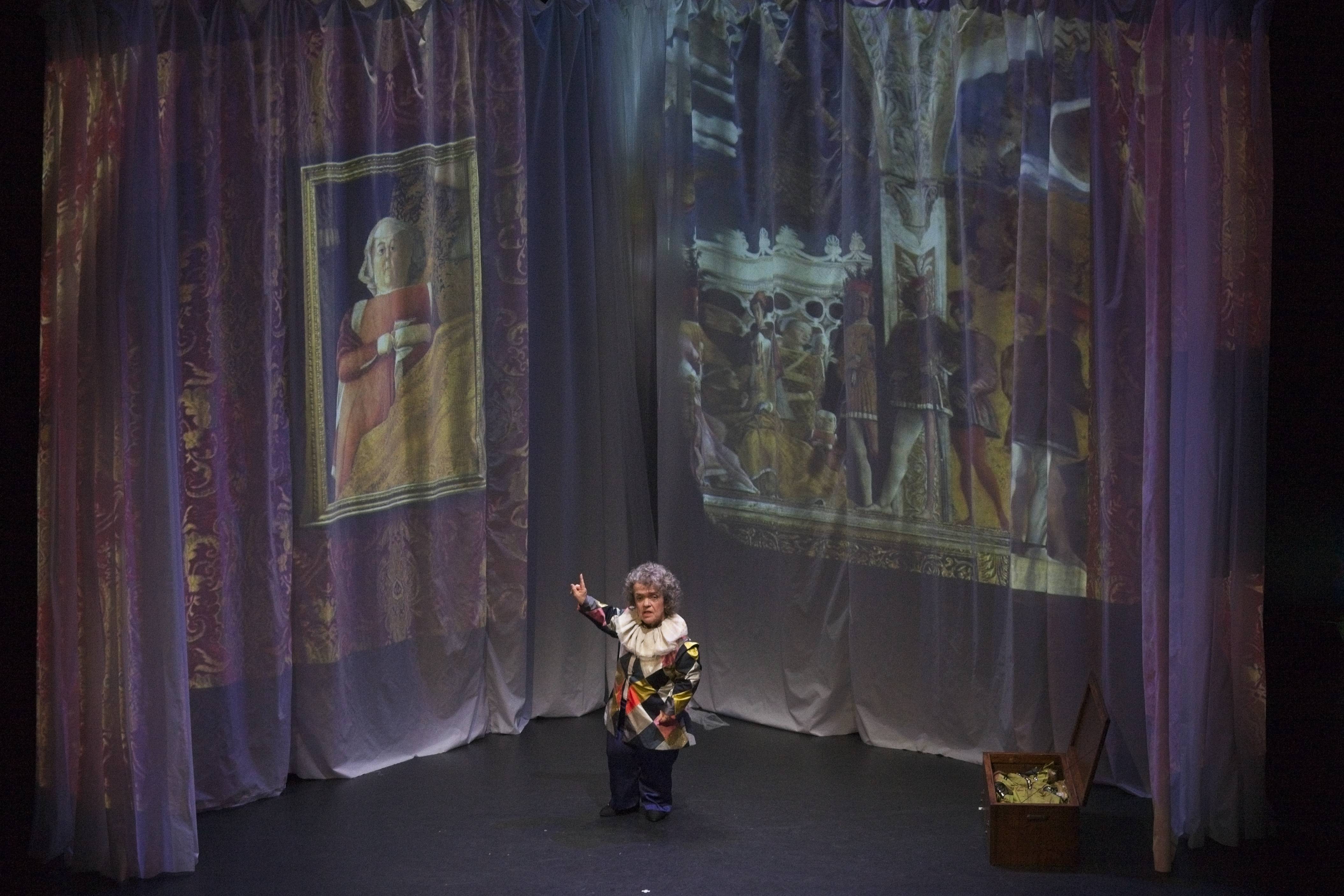
Othering is a sharing by Debra Keenahan of what it is to live as a dwarf. This is theatre as non-fiction.

Othering bears testimony to injustice, adversity and hope. Keenahan has an absolutely beautiful stage presence – warm and humorous, generous and wise.

Keenahan wants not to be othered, that is, wants not to be perceived as fundamentally different. To be othered is a step to dehumanisation. Her claim to equal dignity is magically paired with a pride in who she particularly is. In a playful sequence that begins the show, we’re encouraged to repeat after the performer the word ‘dwarf’. No need for discomfort; diversity in body shape is simply a fact of life. (I will add that the word ‘othered’ has an interesting history. It was virtually non-existent until the mid 1980’s, and before that it was not uncommon for progressives to use a variation of the term in a very different way. They spoke of ‘granting otherness’, that is acknowledging that other individuals were not in any way beholden to our assumptions about them. But every work of art must function within its context.)

In the second half of the performance, Keenahan employs another trope of contemporary theatre making – moving away from the personal to focus on theory. Keenahan’s experience is placed within a framework of cultural studies. With the aid of voice over and projection, we’re offered a fascinating potted history of the representation of dwarfs, from classical times through the Renaissance and the Victorian freak show to contemporary pop culture. The majority of these representations are negative, condescending or downright debasing. Keenahan asserts these representations have facilitated ongoing discrimination and injustice, and that’s no doubt true. (I’d add that the discussion of representation in cultural studies often downplays the audiences’ ability to discern; after all, art tells us as much about the artist – if not more – than it tells us about reality.  And when non-fiction addresses fiction there can be a disconcerting sense of being witness to the meeting of two mutually incomprehensible languages.)

Director Katrina Douglas creates a stage world which affirms Keenahan’s glorious truth telling. The set by her designer, Kate Shanahan, not only facilitates projection but impressively evokes maternity ward, surgical ward and circus tent. The sound design of Paul Prestipino effectively highlights both the ominous and the wondrous.

Any contemporary production with the aim of promoting justice faces an existential challenge. In a pluralistic society like ours, what are the shared values that ultimately enable the achievement of the desired justice? This production reaches for what it hopes will be unalienable and self-evident; Keenahan makes close reference to the Universal Declaration of Human Rights. (And prior to the particular performance I attended there was both a welcome to country and two separate acknowledgements of country. Recently a good friend, a wonderful playwright, queried my occasional reference in my reviews to welcomes and acknowledgements of country. He wondered whether I questioned their value. I do not. But I do think they’ll only have value if we continue to discuss them.) This production follows the belief that the consensus required to achieve justice for the marginalised might derive from the repetition of value statements or of aspirational statements.

But, much more powerfully, it does what live performance can do so brilliantly; it presents us with a real person whose truth is undeniable, and who we refuse to hear only at risk of diminishment of our own humanity.

Paul Gilchrist

Othering by Debra Keenahan

13 – 15 January at Casula Powerhouse Arts Centre (as part of the Sydney Festival)

www.casulapowerhouse.com/visit/othering

Image by Robert Brindley

The Woman and The Car

12 Dec

This is the first outing for indie company Ship’s Cat and they’ve chosen an intriguing piece.

Written by Mark Langham, the play presents Dorothy Levitt, a British racing car driver, and it being the early 1900’s and her being a woman, a feminist icon.

Levitt raced cars, motor boats and flew planes – all at a time when women were denied the vote, and even the right to open a bank account.  Langham doesn’t attempt a detailed history of Levitt’s extraordinary life, but focuses on a few days in 1909 in which she commits to write The Woman and the Car, a guidebook for female motorists. The book’s subtitle was A Chatty Little Hand Book for Women Who Motor or Want to Motor and this very Edwardian phrasing hints at the source of Langham’s unusual choice of tone. This is not a stuffy, pedantic bio-play but a type of drawing room farce. It’s littered with brilliant one-liners and terrific comic set ups and, under the direction of Cam Turnbull, the whole thing feels like a parody of those dreadful one room dramas of the early 20th century (which would be rightfully forgotten if they weren’t resurrected with painful regularity by amateur theatre.) The cast adopt the declarative tone and RP accent that dominate such pieces and play the humour brilliantly.

Lib Campbell is Dorothy Levitt, capturing her independent spirit, her fierce wit, and growing sense of desperation. One of the fascinations of the production is Campbell’s immensely watchable portrayal of Levitt’s character arc, from wise cracking swagger to debilitating misery.

Alexander Spinks is Selwyn Edge, Levitt’s married lover and employee of Napier, the company that provided her car. Selwyn functions in the piece as the archetypal obtuse male. He wants all he can get from Dorothy, both financially and physically, but he can’t make sense of her dissatisfaction with the patriarchy. One of my favourite lines is when Selwyn insists on telling Dorothy what it is that she is feeling: “being a woman – that seems to annoy you greatly”. His lack of understanding and empathy are painfully laughable.

Zoe Crawford is Isabel Savor, a female adventurer absolutely besotted with Dorothy. Though wanting to present as a confidant daredevil, Isabel is plagued by insecurities. She is unfulfilled by the limiting gender roles of her time, but struggles to forge a path of her own. She once proudly “shot a tiger in the face”, but her growing discomfort with hunting’s brutality indicates that her adoption of hyper-masculine behaviour was purely reactionary. A shot at genuine authenticity is possible when she admits her sexual feelings to Dorothy, but when they’re not rejected, Isabel has little idea how to act upon them. Crawford plays both the jokes and the pathos wonderfully.

Now, back to where I started: the unusual tone. Dorothy Levitt didn’t race her way joyously to old age; she’s presented as suffering a growing substance abuse problem, driven by both injuries sustained in competition and her bitter frustration at injustice. So why all the jokes? Some of them are, after all, deliberately rather silly. Don’t they just get in the way of a serious historical story?

Well, no. They capture something of the era, with its droll Edwardian humour. They capture something of Levitt’s exuberance. And, finally, they call attention to the fact that this (theatre, society) is a constructed world. (Man-made, if you like.) A story of patriarchal injustice is told in a way that highlights the artificiality of social structures, and so reminds us that what is made can be remade.

I look forward to seeing more from Ship’s Cat Theatre Co.

Paul Gilchrist

The Woman and The Car by Mark Langham

107 Projects until 18 Dec

www.shipscattheatreco.com

Image by Clare Hawley

Boxing Day BBQ

11 Dec

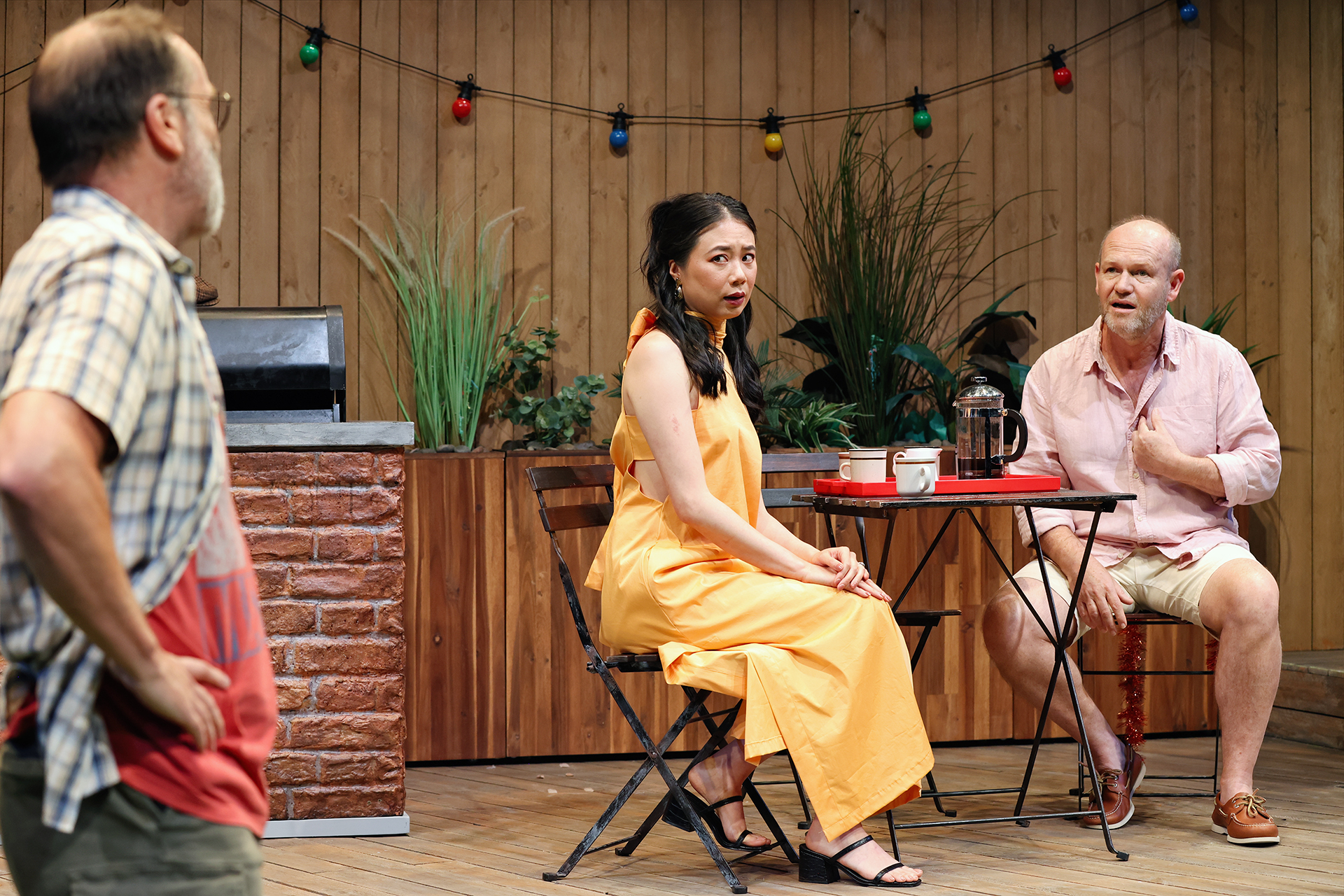
Sam O’Sullivan’s Boxing Day BBQ is a fun take on some serious fracture lines in our society. Directed by Mark Kilmurry, the cast deliver comic magic.  

The BBQ is a family tradition. It was grandpa’s baby, but he and g-ma are gone, so now the younger generation(s) skate the hot plate. The gathering throws together the usual mix of ill-fitting pieces that make up the insolvable jigsaw that is family. (Comedy plus tragedy equals family; though this play is definitely comedy – the tragedy lies offstage, in the reality this comedy gives us the courage to acknowledge.)  

The new self-appointed patriarch, Peter, proudly wields the BBQ mate, finding what scant meaning he can from the upholding of banalities. Brian Meegan wonderfully captures Peter’s mix of unthinking privilege and dismayed emptiness. His daughter, Jennifer (Harriet Gordon-Anderson), is about to volunteer a year of her life as part of the crew of the Sea Bandit (a riff on the environmental activists’ Sea Shepherd.) Peter is horrified. His new wife, Val (Aileen Huynh) is not much of an ally, not because she agrees with Jennifer, but because intellectually she has vacated the field. (More on this below.) O’Sullivan gives Val one liners of beautiful vacuity, which Huynh plays to perfection. Peter’s sister Connie (Danielle Carter) is also at the do, an intelligent, articulate woman navigating both her brother’s obtuseness and her ex-husband’s gentle but futile longing. Jamie Oxenbould as Morris, her ex-husband, delivers a brilliant performance, heart-warming and full of pathos.    

Those fracture lines I began with? O’Sullivan’s play is a musing on objectivity versus subjectivity, and the collapse of these two categories into one in contemporary discourse. This is presented partly through discussions of perception; Peter is a wine merchant who takes for granted the notoriously slippery language of taste descriptors. But it is mainly explored through the characterisation of Val, who consistently avoids the tough issues by asserting the mantra of the lightweight Right: you have to question everything. This is, of course, never the radical and universal doubt of Descartes, but rather the selective use of ignorance to shore up privilege. (In the play, some characters are correct and others are not, and we’re invited to laugh at the inflexibility of the latter, and we do – but I won’t pretend that it wasn’t slightly disconcerting to find myself so easily enjoying the mockery of those who endorse intellectual humility, even when they don’t practise it.)

The play also explores change versus continuity, questioning the value of tradition. We’re told about the monkey step ladder experiment, in which five caged primates are sprayed with icy water if one attempts to climb a certain step ladder. Place a banana at the top of that ladder, replace some of the monkeys, and those remaining familiar with the spraying will police the others – inadvertently ensuring the banana is wasted. Val laughs at this experiment as an example of the absurdity of much that purports to be science but, of course, the story functions as a fable. Mechanical adherence to convention limits our ability to think outside the cage, leaving a lot of bananas wasted – or one planet, as is the case for us as we refuse the changes that might avert environmental disaster. (But traditions and conventions can also have value; they’re a type of cultural capital. One such tradition is that social tensions can be profitably explored through the dramatic trope that posits disparate characters and places them in an inescapable situation like a family Boxing Day BBQ – though O’Sullivan does disrupts this convention, offering the spoonful of honey of some magical realism to ease our acceptance of radical change.)

Finally, the play also offers itself as a representation of generational conflict. In the real war between the generations, the ultimate outcome is dully predictable; all that’s of interest is whether – this time – anything will be learnt from the vanquished before they forever quit the field. But this is comedy, and Boxing Day BBQ is a merry war, a playful paean to reconciliation and hope.

Paul Gilchrist

Boxing Day BBQ by Sam O’Sullivan

Ensemble until 15 Jan

ensemble.com.au

Image by Prudence Upton