So says Clyde to one of her employees. (Apologies to playwright Lynn Nottage if I’ve misquoted her beautiful words.)
Clyde runs a sandwich shop frequented by truckers and staffed by ex-cons like herself.
Clyde, played by Nancy Denis with superbly exuberant strut and sass, actually is mean. In a unjust world, it’s a totally understandable survival strategy.
But this play is about not letting yourself be defined by what’s been done to you. It glories in agency, in responsibility, in the shedding of the excuses that hold us back.
Sandwich hand Letitia, played by Ebony Vagulans with a mesmerising combination of swagger and vulnerability, says she wants to stop blaming other people. Co-worker Jason is dreadfully ashamed of his past racism and is desperate to leave it behind, and Aaron Tsindos presents him as an utterly fascinating battle between anger and restraint. Rafael, in a performance by Gabriel Alvarado that glitters with comic magic, firmly looks forward, seeking reasons to celebrate. He and his fellow employees gain encouragement from Montrellous, the Buddha in the ‘hood (to paraphrase Rafael). Charles Allen captures Montrellous’ magnificent dignity and his ability to inspire others to find a beauty that can transcend cruel mundanity. Nottage’s masterstroke is to make the beauty they seek the perfect sandwich. It’s so every day that it can speak to everyone.
Darren Yap’s production of this splendid play is gloriously uplifting.
Is the world perfect? no.
Can everyone transcend their suffering? maybe not.
Is it worth being reminded it’s a possibility? yes. Yes. And YES!!!!
Tennessee Williams’ play was first seen on Broadway in 1947. This production, co-directed by Tom Massey and Meg Girdler, captures what makes it a timeless classic.
Blanche, down on her luck, comes to stay with her sister. She expresses shock at where Stella lives and most particularly at Stanley, the man her sister has married. In Stanley and Blanche, Williams presents the eternal conflict between instinctual brute spontaneity and deliberate fanciful pretence. The beauty of Williams’ characterisation is that neither character is solely one nor the other.
And it’s this complexity that this production presents so well. Riley McNamara’s Stanley is strikingly both animal energy and gossipy pedantry. Georgia Britt’s Blanche is both airs and graces, and longing sensuality. Britt’s performance is magnificent, and the sense of fragility she evokes is utterly heartbreaking.
Where can Blanche find some sort of shelter?
Perhaps with Stanley’s ex-army buddy, Mitch (played by Matthew Doherty with a moving mixture of quiet hope and angry disappointment.) If not, surely Blanche will always have her sister, Stella (played by Ali Bendall with a beautifully truthful combination of patient tenderness and bewildered frustration.)
Because, up to now, Blanche has “always depended on the kindness of strangers” – perhaps the most poignant line in modern theatre. When Britt delivers it, the pathos is extraordinary, and the production achieves what the play was made for: the awakening of pity for all who are lost.
Arthur Miller’s All My Sons premiered in 1947 (yes, over seventy five years ago) but this American standard is still searingly relevant and utterly engaging.
It was originally an antidote to American triumphalism. Following victory in the greatest conflict in human history, Miller was determined his nation didn’t slip into self-satisfied complacency.
The scenario is simple. Chris has invited Anne back to her hometown. She was the girl-next-door, and he wants her and she wants him. But the problem is this: she was once his brother’s sweetheart. Larry has gone missing in the war and his mother, Kate, still awaits his return. To this domestic drama – the universal tension between the way things were and the way they might be, dreadful enough in itself – Miller adds an ethical dimension. The fathers of both lovers were convicted of supplying faulty aircraft components that resulted in the deaths of twenty-one American pilots. Chris’s father, Joe, has since been exonerated, and is now a wealthy man. Anne’s father is still in gaol.
Joe can claim to have been simply “practical”, getting ahead when the opportunity arose, and this might conflict with his son’s “principles”, but Miller suggests this tension is not merely academic. The worm at the heart of capitalism spoils everything.
This is intensely emotional theatre, and director Saro Lusty-Cavallari elicits brilliant performances from his cast. Kath Gordon’s Kate is a deeply moving portrait of obsessive denial. Kyle Barrett’s Chris encapsulates both the inspirational strength of the morally engaged individual and the bewilderment that comes with the realisation that his lone efforts may not be enough. Bridget Haberecht’s Anne is beautifully rich, capturing both the wild hope for a happiness she thought had passed her by and her growing fear at the enormity of the obstacles that remain. Her pain is palpable; it’s an extraordinary performance.
This is a wonderfully powerful production of a classic play, a necessary indictment of any society in which getting ahead matters more than those that might be left behind.
As a writer, one might assume I have a deep love for language (though, being a theatre reviewer, one might expect that love to be expressed in the form of a disturbing fetish for cliché, banality and formulaic structure.)
But it’s not all about language. One of the glories of theatre is that it combines language with physicality. There aren’t just words, there are bodies saying those words. And what those bodies do as they say the words, and what they do when they’re not saying the words, produces a splendid complexity. (I love that in theatre a character can say how much she adores her husband at the very moment she is seen making love to someone else.)
What happens when language is taken out of theatre? (It’s worth noting, that in the rehearsal room of new work, the most common alteration to the text is the cut: I don’t need those words, says an actor, to present that emotion.) What happens in a performance when movement is privileged? What happens is a beautiful reminder of physicality: its richness, its expressiveness, its significance.
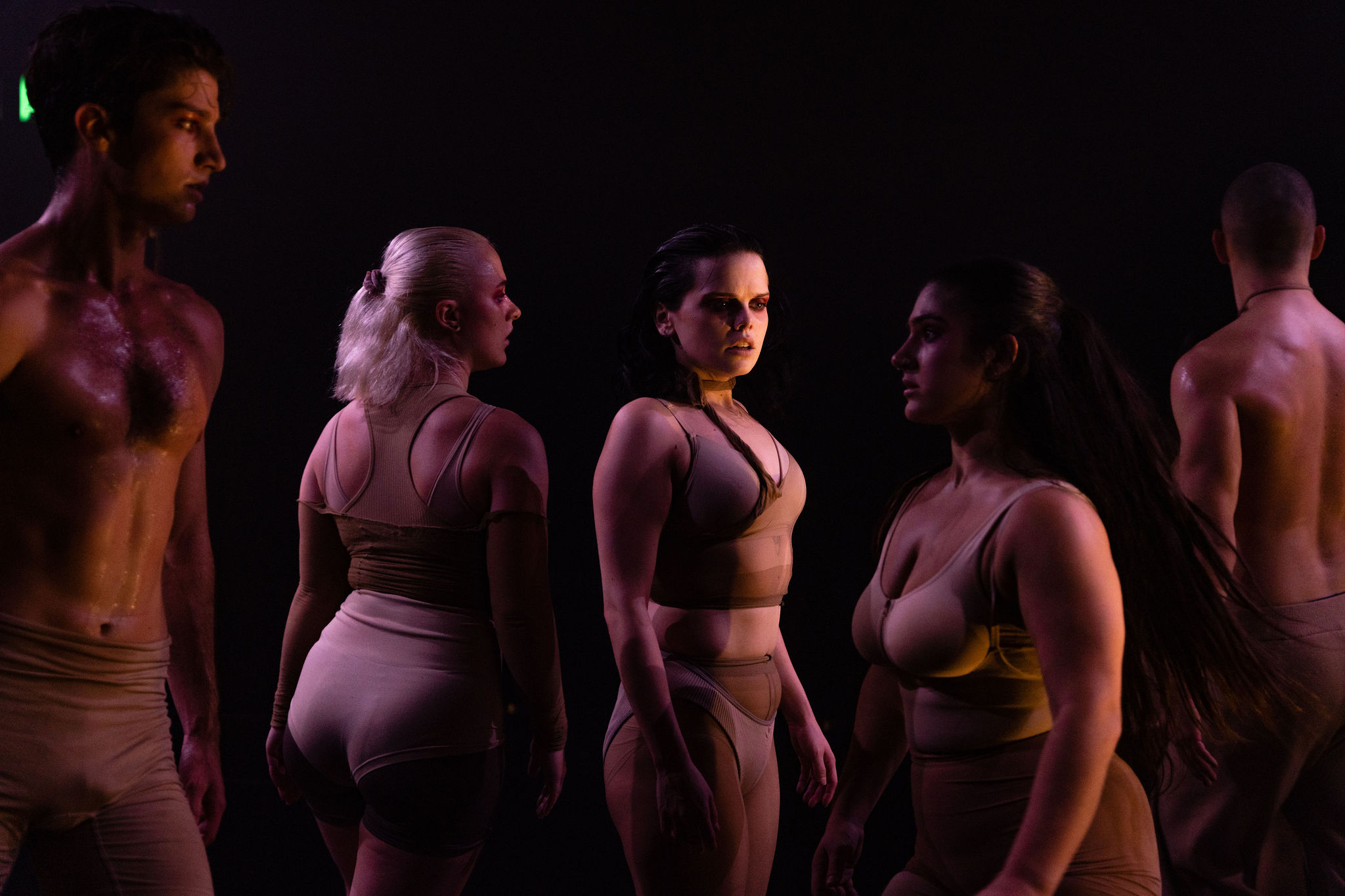
That’s what Mortel is. This 60 minute piece of physical theatre is a paean to the body; its energy, its strength, its beauty.
Directed magnificently by Steven Ljubović and performed by a gifted cast (Phoebe Atkinson, Gemma Burwell, Abbey Dimech, Giani Leon, Meg Hyeronimus, Levi Kenway, Aiden Morris, Bella Ridgway, and Shannon Thomas) Mortel highlights the experience of embodiment, of what it is to be a body. This might seem a strange thing for me to assert, but as Wittgenstein suggested “The human body is the best picture of the human soul”. Witnessing the extraordinary things the body can do is a reminder of possibility, of potential, of the flame that burns within us (which I think is a pretty passable definition of the ineffable entity that is the soul.)
It’s probably not accurate to call Mortel a dance work, but the cast interact beautifully with Kieran Camejo’s evocative and ingeniously varied soundscape. And with the space lit magically by Clare Sheridan, Ljubović creates powerful images, ones of passionate interactions and of poignant isolation. Both the initial and concluding tableaux are deeply moving expressions of the essence of individuality, that blessing and burden shared by us all.
Paul Gilchrist
Mortel directed by Steven Ljubović
Presented by Merak in association with bAKEHOUSE Theatre
When I was a child, my father would occasionally threaten to buy me a model train set. Fortunately for me, he retired early and had ample time to build his own. He laboured for seemingly endless hours in what came to be called “the train room”, one of the many rooms vacated in the family home by deserting children. Having spent forty years behind a desk as a railway clerk, my father needed to learn the skills required to create a miniature world (as against those required merely to survive one.)
Visits home invariably included visits to “the train room”, and seeing the set complete, not once did I wish my father had made good the threat that had hung over my early years. However, though a self-obsessed, opinionated twenty-something, I could still admire his skill and his effort, and found it easy to praise his achievement.
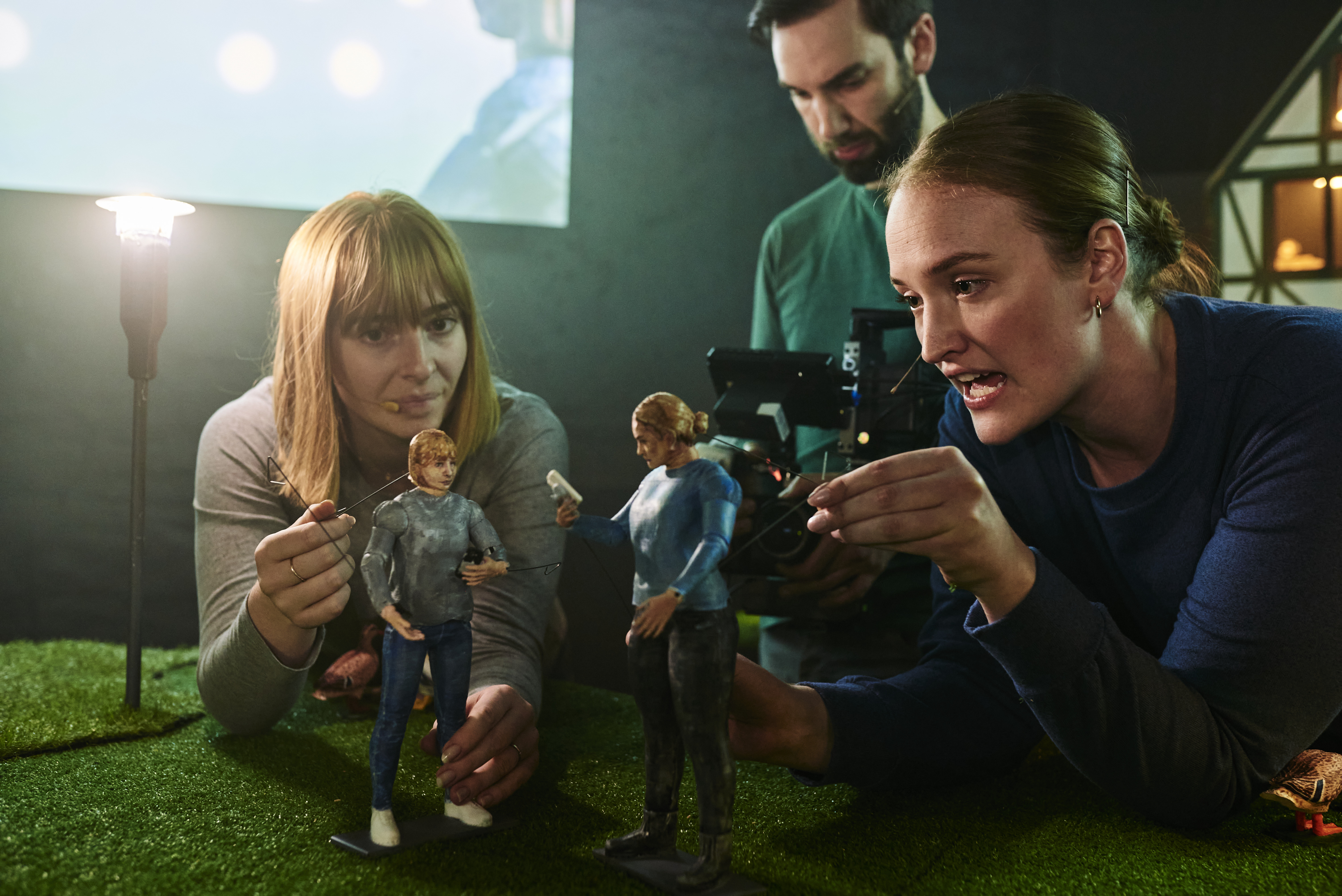
UFO, written by Kirby Medway and directed by Solomon Thomas, struck me as a bit of a train set. The 65 minute performance consists of four actors manipulating small models of themselves situated in a golf course (?), the site of a supposed UFO landing. The actors both voice the figurines and photograph them in the miniature landscape. These images are projected onto two large screens. The result is something like watching the creation of a stop motion animation.
Meticulously constructed, the images are beautiful and haunting.
The story is Denis Villeneuve’s Arrival meets Kafka’s The Castle meets Gerry and Sylvia Anderson’s The Thunderbirds. It’s Arrival in that the characters are closely monitoring a landed UFO that may or may not be attempting to communicate with them. It’s The Castle because the characters are little people struggling to make sense of the human world, impotent and bewildered victims of a mysterious bureaucracy. It’s The Thunderbirds because … I used to really like The Thunderbirds.
There’s plenty of humour, which the cast (Matt Abotomey, James Harding, Angela Johnston and Tahlee Leeson) deliver wonderfully.
Because there’s such a focus on the technical side, it’s tempting to see this production as an experiment in form that has little interest in presenting meaning.
But, I guess, a bunch of tiny manipulated figures, who display only pettiness in the face of what is possibly the greatest challenge in human history, would seem for many a fitting metaphor for current affairs.
The more discerning theatre-goer might surmise from the title that this is a comedy.
The fourth wall is firmly down as three actors share their attempt to present all 36 of Shakespeare’s plays.
Having said that, only Romeo and Juliet, Macbeth and Hamlet are presented in any meaningful way (providing that wacky parody fits your definition of ‘meaningful’.) Most of the other plays are merely namedropped. Considering the alternative, this is in no way a criticism.
As an abridgement of Shakespeare’s plays, The Complete Works is equivalent to summarising Moby Dick with the word ‘whale’.
Written by Adam Long, Daniel Singer, and Jess Winfield, it’s been kicking around since the 1980’s. Ironically, for a piece that responds to our obsession with the Bard, I’ve seen it more times than I’ve seen most of his plays.
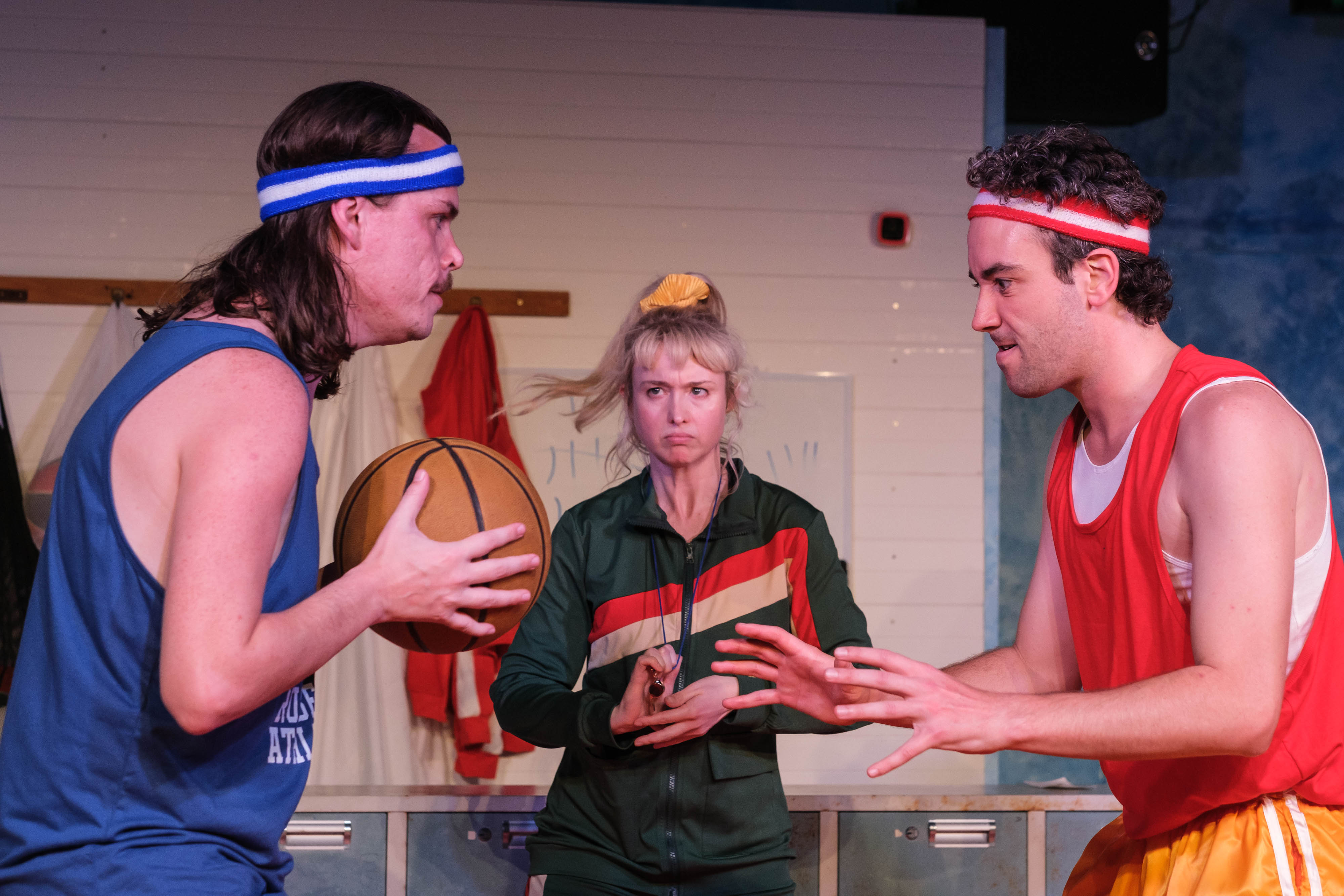
There’s some theatre in-jokes, but no need for any knowledge of the canon. The whole thing operates simply as an opportunity for some seriously crazy comedy. It’s audacious, exuberant and effervescent. Under the skilful direction of Madeleine Withington, the brilliant cast (Alexander Spinks, Lib Campbell and Tel Benjamin) gives this madness the high energy performances it deserves.
Once or twice the poetic (though not the dramatic) genius of Shakespeare is allowed to shine through, creating a poignant contrast that only enhances our enjoyment of the zaniness.
The original play is designed to facilitate improv and extra dialogue, and this team add some contemporary sparkle. (Though I’m not sure the references to the venue, both its history and nature, are conducive to the openhearted relaxed mood required to appreciate this sort of playful froth.)
Rachel Scane’s design is magnificent. Part locker room, part synthetic playing court, and peopled with characters in daggy sportswear, it’s a world where the trivial competes with the impossible, as weirdly captivating as the silliest of Guinness Book of Record feats.
80 minutes of energising entertainment; Shakespeare would have loved it.
Paul Gilchrist
The Complete Works of William Shakespeare (Abridged) by Adam Long, Daniel Singer, and Jess Winfield
Theatre is a weird art form. (Though, they all are, if you think about it.) What’s odd about theatre is the predominance of interpretive artists. Compare it to visual arts and literature, which are filled with creative artists.
Let me explain. If you buy a play from overseas, or dip back into the canon, no-one in your team is doing the original creative work. Everyone is interpreting what already exists. And, in theatre, this is par for the course. (It could be argued it’s what actors and directors always do, no matter from where the play is sourced.)
In theatre, no-one blinks an eye when you choose to produce, say, Hamlet … again. What is important is your take on the play. On opening night your hope is not that someone will say something like “Where’s the playwright? I got to meet the guy who absolutely nailed the debilitating chasm between the brutal simplicity of action and the rich ambiguity of thought.” No, you hope the buzz is more: “Swahili speaking puppets? What a brilliant choice!”
As result, we get what I call “cover theatre” – in the way a band is said to do a “cover” when they play a song they didn’t write. Those sort of musicians are usually relegated to RSL clubs, but fortunately, in theatre, there’s no such privileging of originality. (And, please, read to the conclusion of my review before concluding my attitude to this phenomena.)

Consider Crisscross’ production of James McManus’ Cherry Smoke. The play is American and has been kicking around for a decade or so. But, here and now, director Charlie Vaux’s production is an invitation to an intriguingly foreign world. It’s brutal; these characters are from the south of the US, and they’re seriously down and out. Cherry (Meg Hyeronimus) is homeless, effectively abandoned by her deeply damaged, and damaging, family. She looks for more in Fish (Tom Dawson), her “angel”, but he was forced into the boxing ring as a child, and so violence, and the incarceration that often follows, is his existence. He knows there’s something wrong with the “wires” in his head. Duffy (Fraser Crane) tries to guide Fish, but it’s a challenging task, especially when his garage barely breaks even and his own relationship with Bug (Alice Birbara) is troubled. She desperately wants a baby, and her childminding and occasional midwifery is, in Fish’s words, like being an alcho working in a bar. She “hates God” because He won’t give her what she feels she needs.
How do you find hope in such a world? Well, Cherry espouses a sort of soft-metal romanticism. It’s tough, sensual and hyperbolic. She calls Fish “Baby” a lot, and can’t eat, or breathe (she says) without him. She claims Jesus once lit her cigarette, with His finger. The smoke was cherry coloured. She offered Him one, but apparently He’s trying to quit. Her conclusion: He’s broken – just as they all are. There’s little more religion than that in the play, but the sequence evokes perfectly the pathos of weaving meaning from scraps.
We do cover theatre like this because it reminds us of basics. The world of the characters is one in which a “meanness” swirls endlessly, and lands randomly, refusing to be shaken off. In this world, posited by McManus and brought back to life here by Vaux and his committed cast, we meet again those age old problems of suffering and evil.
And so, in KXT’s cool new space in Broadway, we’re invited to a foreign place, to be reminded of our common humanity.
Paul Gilchrist
Cherry Smoke by James McManus
presented by Crisscross Productions in association with Bakehouse Theatre
There’s a long tradition of the subversive puppet. Think Punch and Judy, Lamb Chop, Basil Brush, Agro. These puppet’s cheekiness and exuberance challenge adult norms. They’re like a personification of the Medieval Carnival; they turn the world upside with their irrepressible glee. Brash and insensitive, they topple convention with their childlike mischievous simplicity. It’s as if, when all the hobgoblins perished in the searing sun of the Enlightenment, they reincarnated as puppets.
I’ve often wanted to write puppet reviews, to respond to shows with a refreshingly impertinent naïve directness. My puppet personality would write that Waiting for Godot is “repetitive rubbish”, that Hamlet is “indulgent slop”, that this show is “puerile nihilism”.
But I’m not a puppet, and my response to theatre is more adult. (‘Adult’ as in considered and staid, rather than ‘adult’ as in naughtily scatological and profanely sex aware, which is the way the word is used when a show like this is described as an ‘adult’ puppet show. )
Richard Hilliar’s Apocka-Wocka-Lockalypse is a heap of crazy fun. It’s post-apocalypse, a disaster brought on by human greed. Melissa has found haven in a bunker, which she shares with four furry little monsters. She is part nurturing house mother, part controlling authority figure. She and her monster ‘friends’ play out a children’s TV show. There’s no audience; it’s as though by continuing familiar routines they can assure themselves all is right with the world. They sing songs, play games, read children’s books and Melissa is Miss Melissa, the kind and caring adult who gently guides her little monster friends. Well, at least that’s how it begins.
The puppets, initially, have had much of their subversive element drained out of them. They behave as grateful but cowed children. Brilliantly crafted by Ash Bell, they’re gloriously brought to life by the cast – Matt Abotomey, Lib Campbell, Zoe Crawford and Nathan Porteous. There’s a wonderful magic in being able to see both puppet and operator, a mesmerising echo between the puppet’s reactions and that of the performers. Nicole Wineberg’s Miss Melissa is comic genius, a terrific parody of the children’s TV presenter with a magnificent black comedy shadow.
Hilliar’s script is very funny, capturing both the absurdity of the situation and its growing darkness.
There’s a couple of absolute stand out moments. Crawford’s performance of Alexander Lee-Rekers’ very clever song “Maybe a Baby” is both hilarious and heartbreaking. Wineberg’s reading of a children’s book that is surprisingly and delightfully petty-minded is a riot.
Bell’s set beautifully mimics that of children’s TV set, with its bright, bold colours and its symbols of hope.
But what happens in this space belies the brightness.
Asking if saccharine positivity is really the cure for our current crises or merely a façade for malignant, manipulative forces, Apocka-Wocka-Lockalypse is a deliciously dark comedy.
Reincarnation is an alluring belief, and may even be true.
The depth of our emotions, especially for others, can lead us to feel that one life is not enough. Perhaps, somehow, there will be other lives in which our love can continue.
The problem – for those of us with a modern sensibility – is proof.
But none is needed. A belief (or faith or hope) in reincarnation requires no verification; its value is expressive. One might as well ask for proof that my favourite colour is blue.
In Alan Jay Lerner and Burton Lane’s musical, Dr Mark Bruckner hypnotises Daisy Gamble, in an attempt to understand her apparent Extra Sensory Perception. Exploring her memories, he discovers Melinda Wells, an English woman who passed over a century ago.
Perhaps my philosophical pretensions make the subject matter sound heavy, or just plain weird, but it’s not – it’s light, breezy, and beautiful; a glorious expression of our dearest desires.
The play has a history of revisions, and Jay James-Moody (who also directs and performs) has adapted and updated the original story. In this version, following a 2011 Broadway revision, Daisy is a gay man, David, and as Mark falls for Melinda, he must ask what are his feelings for the man in whom she resides. It’s all about…. fluidity.
James-Moody’s production is visually delightful, musically superb, and very funny. As David, James-Moody is both movingly vulnerable and deliciously comic. His timing is spot on. Melinda is played by Madeleine Jones with a mesmerizing pizazz. Blake Bowden’s Mark wonderfully captures both the psychologist’s obsessive drive for knowledge and the man’s desperate need for love.
The vocal performances are terrific, with highlights including “When we are 65” sung by James Haxby and James-Moody, “Don’t Tamper With My Sister” sung by Jones, “Come Back to Me” sung by Bowden, and the title song, performed by James-Moody, Jones and the company. Natalya Aynsley’s orchestra is brilliant. Choreography by Leslie Bell is cheeky and playful, perfectly suiting the gorgeously non-conventional relationships portrayed, and the cast perform it with aplomb.
On A Clear Day You Can See Forever is an exuberant reminder to look beyond the mundane and be open to the surprise of joy.
Paul Gilchrist
On a Clear Day You Can See Foreverby Alan Jay Lerner and Burton Lane, revised and adapted by Jay James-Moody
It’s natural to assume, that as a theatre reviewer, I’d relate to a story about failed artists.
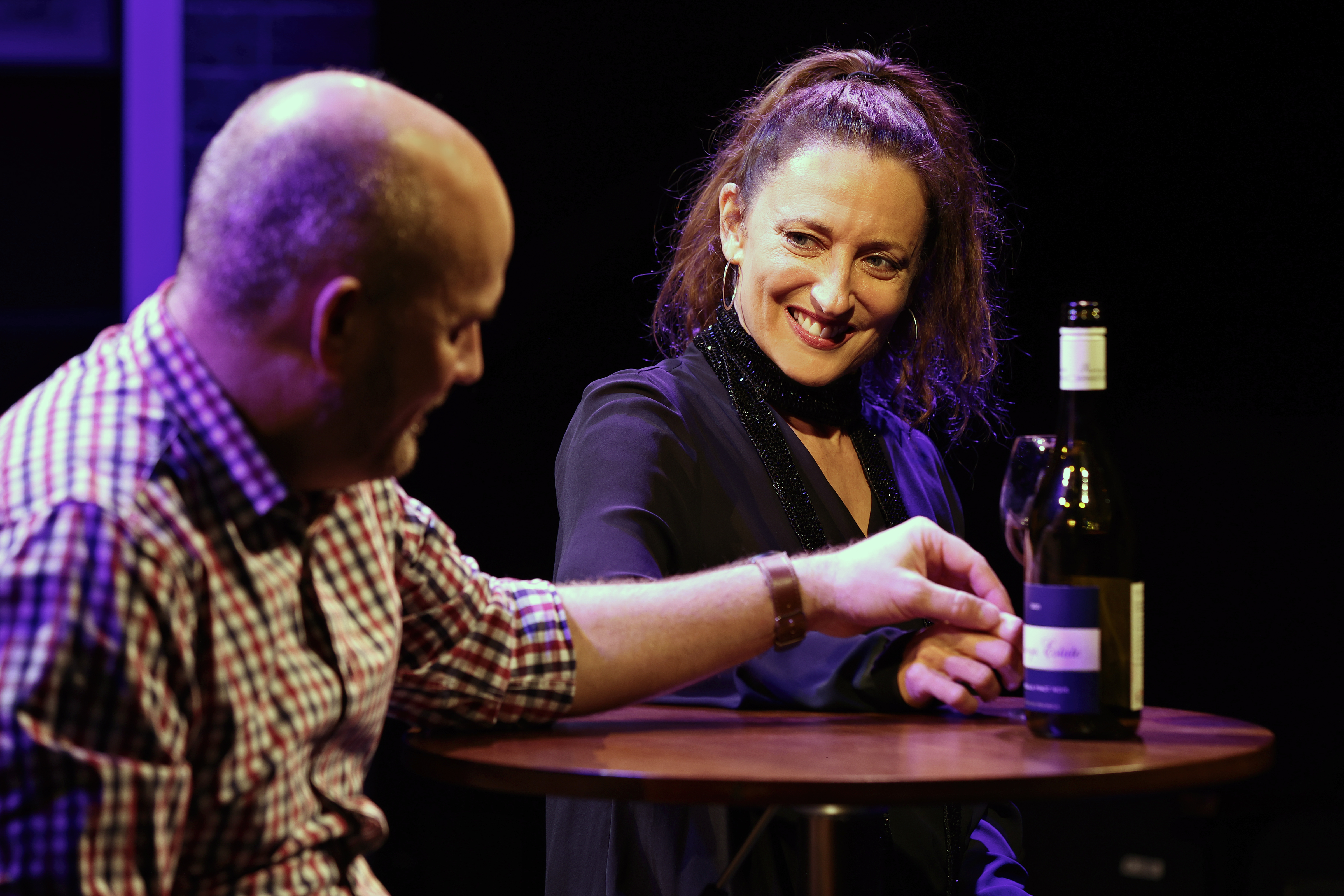
David Williamson’s Rhinestone Rex and Miss Monica, directed by Mark Kilmurry, is a light two-hander, a gleeful rom-com, performed with comic expertise by Georgie Parker and Glenn Hazeldine.
It’s a simple tale of the need to be open-minded. (If you’re thinking No, not that again; I’ve had it up to here with that I salute your obtusity.)
Monica can no longer perform with the Sydney Symphony; tendonitis has robbed her of the ability to play the violin.
Her life is one of rage and renovations; rage at the injustice of a career cut short and renovations ….well, just renovations. She’s getting her kitchen done.
Gary does kitchens. He used to play country. Think Golden Guitar. And there’s nothing that makes you appreciate country music’s perpetual paean to loss more than installing kitchens when you were meant to be playing Tamworth.
Does this make them a pair of failed artists? Sort of. The true failure lies elsewhere. Apart from kitchen quibbles, their source of tension is the refusal to accept the other’s taste in music. She loves Mahler and Shostakovich; he loves Cline and Parton. In comic shorthand, she’s a snob, he’s a philistine. Narrow mindedness, of both types, has long been a source of laughter, and with it Williamson and these two wonderful actors make hay. Not that I’m suggesting with my rural reference that the play favours the unsophisticated – but it certainly makes a space for the sort of thing it is itself: unashamedly simple fun.
Before getting back to that failure thing, I’ll mention one scene in particular. The pair are out together for the first time. They’re at a pub in Glebe. Is it a date? Confronted by the possibilities the evening offers, Monica has drunk too much before Gary has even arrived. Is this a door opening or closing? It’s brilliant comic work from both Parker and Hazeldine, a spotlight on human ambiguity, an acknowledgement of multiplicities (which belies my earlier assertion about the play’s simplicity.)
And what is artistic failure – and we’re all artists – but the failure to say Maybe this too?
Paul Gilchrist
Rhinestone Rex and Miss Monica by David Williamson




 Theatre Red