Fireface

6 Aug

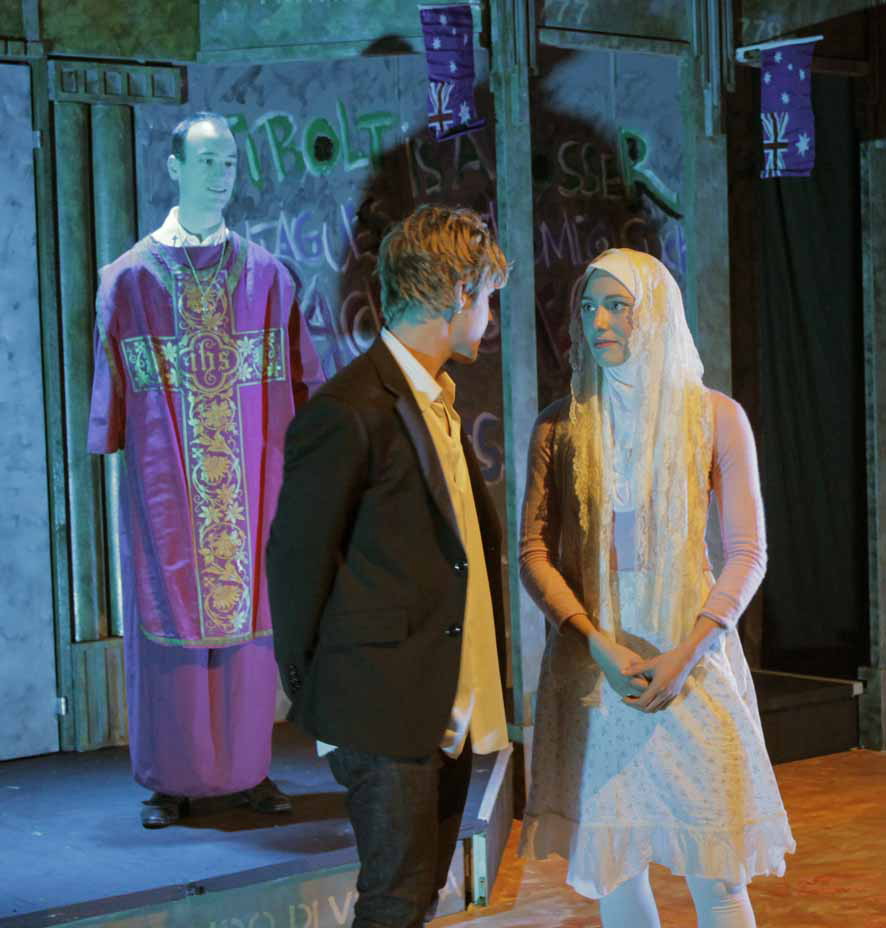
Fireface could be read as an exploration of some pretty extreme behaviour.

But it spoke to me of a more universal experience – the eternal dialogue between childhood and adulthood.

To the child, adulthood is a foreign land, and the dubious passport into that land is sexuality. You’re a child until you’ve been with a man, mother tells daughter. It’s poor advice, and she takes it.

Her troubled brother is still in puberty. As he’s told. Repeatedly. As though that explains.

He’s a superb portrait of adolescent self righteousness, believing that only he tells the truth. But, in at least one insight, he’s correct – that it’s the adults who define normalcy, who determine what will be considered a proper life.

Children have an understandable dissatisfaction with this narrowness. Adult breath is stale, we are told.

But as the children’s behaviour increasingly becomes a challenge to the adults in the play, mother offers father a poignant paradox; the children are sacrificing themselves for us. It is children who give life to adults.

Photo by Phyllis Wong

Photo by Phyllis Wong

Fireface is a beautifully rich play, and this production is brilliant. The performances are superb and director Luke Rogers’ staging is a joy to watch.

Fireface leaves an audience with a lot to think about, from the extremities it presents to the eternal tensions that fueled them. It’s a cry from that distant land of childhood.

Or to indulge in imagery suggested by the play; it’s as though childhood were a fire, and we leave that fire unattended, in the belief it will simply die down. But it doesn’t, sometimes with catastrophic consequences.

Veronica Kaye

Fireface by Marius Von Mayenburg (translated by Maja Zade)

featuring Darcy Brown, Darcie Irwin-Simpson, James Lugton, Lucy Miller and Ryan Bennett

at ATYP Under the Wharf until 17 Aug
http://www.atyp.com.au/under-the-wharf/productions/fireface

Beached

1 Aug

Are we our bodies?

Beached tells the story of Arty, a shut in. He must lose weight. According to the stats, that’s true for at least half of us.

In the first world we die because we have too much. With all our privileges, this is what we choose.

Wonderfully written by Melissa Bubnic and cleverly directed by Shannon Murphy, this play is both funny and thought provoking.

There were two moments that hit me right in the gut, as it were.

One was when Arty’s mum, played with comic perfection and emotional power by Gia Carides, tells her very likable son (Blake Davis) that he doesn’t need to lose weight. His fat is him.

Of course, she’s enabling his problem.

But isn’t she right?

Beached

In a society where materialism rules, aren’t we just our bodies? Her ‘enabling’ is just the natural conclusion of the dominant world view.

Kate Mulvany as the social worker assigned to Art is magnificent. She doesn’t share Arty’s problem, but her life is utterly empty. Blake Davis as the TV producer also presents a hilarious portrait of profound shallowness.

And the other moment that hit me? Arty’s explanation of why he needed  to eat – to fill that hole inside.

True of an entire society?

Veronica Kaye

Beached

at Griffin til 31 August

http://www.griffintheatre.com.au/whats-on/beached/

Romeo and Juliet

1 Aug

Passion is about me. Politics is about us.

George Bernard Shaw famously took issue with Shakespeare, arguing that the bard’s politics were naïve.

And consider Romeo and Juliet. Shakespeare gives no explanation for the feud between the families. He makes the unlikely assertion that the warring groups are equal in strength. And the long lasting feud suddenly ends when the older generation realizes something that must have always been apparent – that it was harming the young. I can understand where GBS was coming from. This is not a play about politics.

It’s a play about passion. The purpose of the political context is to show us that the young lovers will risk all to be together. (Without some sort of impediment, desire is not a story.) Their decisions are rash and ill advised. If Othello is a tragedy of jealousy, and Macbeth of ambition, Romeo and Juliet is a tragedy of impulsiveness.

Photo by Eva Kiss

Photo by Eva Kiss

Rainee Lyleson as Juliet and Dan Webber as Romeo do a wonderful job of creating the two lovers, overwhelmed by passions greater than they have known. But a particular pleasure is watching these two actors develop these characters. They begin as almost children, but in the final third of the play, after they are separated, we watch them negotiate the world, no longer merely as excitable adolescents, but as adults who know that desire is but one aspect of life. As an example, Romeo’s dealings with the apothecary of Mantua are those of a man who desperately feels his own circumstances, but still has insight into the lives of others. Shakespeare’s famous, final, absurd scene counters this growing maturity – but that, I guess, is his point. Passion is powerful.

Director Stephen Wallace gets good performances from his entire cast. Byron Hajduczok as Mercutio and Rob Baird as Benvolio are eminently watchable. Alan Faulkner as Peter the servant, the prince, the apothecary and the prologue is superbly versatile. Adam Hatzimanolis gives a terrific portrait of the gloriously varied Capulet.

Much discussion of this production will centre on the decision to set it in the world of the Cronulla riots. I don’t think the play is political. Am I saying this decision is a mistake? Not all. It’s this sort of decision that opens up a play, making us revisit, and reconsider.

Shakespeare gave us a controversial play. It’s only fitting that our productions of our it are equally thought provoking.

Veronica Kaye

Romeo and Juliet

at King Street Theatre until 24 August

http://www.kingstreettheatre.com.au/romeo-and-juliet/


Dangerous Corner

30 Jul

Only God knows the complete Truth. And She’s not sharing.

JB Priestley’s brilliantly intricate play Dangerous Corner is a fascinating exploration of the concept of Truth.

The premise of the play is that everyone has secrets. It’s a popular myth, because it suggests we are more than we seem. It’s a myth that says, despite appearances, that we are actually endlessly fascinating and intriguing. “He must live a double life,” the more catty among us say, “because his life couldn’t really be as dull as all that.”

And much of Priestley’s play involves the unraveling and revealing of the character’s secrets. Director Peter Lavelle, with an intelligent light hand, makes this enthralling theatre. His cast very skillfully present characters torn between the desire to conceal and the seeming relief of letting it all come out.

Photo by Craig O'Regan

Photo by Craig O’Regan

But the play does more. It’s not just an Agatha Christie style whodunit. It raises some very thought provoking ideas about the very concept of Truth itself.

Any chain of questions aimed at discovering the reality of a situation must come to an end, and that end, really, is rather arbitrary. What we call the Truth is simply the point at which we cease asking questions. The Truth is merely the point at which we abandoned the search.

Perhaps only a four year old can perpetually ask ‘why?’ And perhaps that’s why we are told we must become like little ones if we are to enter the kingdom of heaven.

Because all they know is that they don’t.

Veronica Kaye

Dangerous Corner

at The Genesian Theatre until 10 Aug

http://www.genesiantheatre.com.au/index.php?mode=now

Snobbery in Theatre

26 Jul

(An article you’d read – if it was in the Sydney Morning Herald.)

Recently, an acquaintance asked me if it was true that the theatre world was filled with pretentious wankers and self-indulgent children.

‘Of course not,’ I answered, ‘You’re forgetting the stuck up snobs.’

Jokes aside, if you were to come across an example of snobbery or unfriendliness in the world of theatre, the understandable reaction (apart from surprise) would be to ask for its cause.

If snobbery does exist in theatre, it would be for the same reason it exists anywhere – a lack of confidence.

And, let’s face it, in the theatre world, there’s plenty of reason to lack confidence. There’s limited opportunities and loads of competition. Evaluation of our work is arbitrary and therefore unpredictable. And the majority of the population doesn’t even notice what we’re doing.

But why does a lack of confidence so easily lead to snobbery and a general unfriendliness?

In the simplest terms, we choose to fake it until we make it.  If we don’t feel superior, one solution is to act as though we do. Feelings follow behaviour. It’s a remarkably powerful psychological tool. And, in this case, a tragic one. If I choose to deal with the challenge of others by dismissing them, I’m committing a crime against humanity, and I’m the primary victim.

Choose the view

Choose the best view

Snobbery creates the shallowest of theatre. (And that’s probably the least of it.)

So what’s the solution?

Be more confident.

Is that ridiculous advice?

I don’t think so.

If I can decide to act as though I’m better than others, I can just as easily decide to act as though I consider myself their equal.

And then watch the theatre I make.

Theatre that speaks to my audience.

Veronica Kaye

Top Girls

25 Jul

Gender issues are not what I usually write about. For obvious reasons.

But it’s not something I’ve had to skate around that often. Which is rather sad.

So it’s an absolute delight to see a cast solely of women and a play that puts issues that women face centre stage.

Both heartbreaking and hilarious, Alice Livingstone’s production of Caryl Churchill’s play is superb. The cast are brilliant.

Photo by Bob Seary

Photo by Bob Seary

Top Girls is a provocative, engaging and deeply annoying title. It encapsulates the thorny issue at the play’s heart, and the issue that makes this play of abiding relevance.

Every member of an oppressed group faces an extra challenge in addition to the many that make them a member of an oppressed group in the first place. That challenge is the responsibility they have to the other members of the group.  An unavoidable question must be faced: “If I personally can break out of the circumstances that previously held me back, am I obliged to help those I left behind?”

Am I an individual? Or am I a member of a group?

( Margaret Thatcher’s answer, it’s worth noting, was “There is no such thing as society. There are individual men and women.”)

For me, the most poignant moment in the play comes at the end of the second act. I don’t do spoilers, so go and see it.  Suffice to say, this moment encapsulates the very issue I’m discussing. It’s a line delivered by Julia Billington, whose entire performance is extraordinary. Billington plays Marlene, the top girl who exists in both the play’s present (Thatcher’s Britain), and in the play’s intriguing opening, a dinner party where the guests are a broad sample of women from the past. (The stories these women share around the table are enough to make you feel that the world really is a vale of tears. Or at least the world we’ve allowed to exist.)

But back to that moment.  Marlene’s line is about one of her relatives, poor simple Angie, played marvelously by Claudia Barrie. Marlene’s line is delivered with throw away perfection. For when our hearts have hardened we no longer have a use for them.

Sharply intelligent and deeply moving,  this play argues for softness but does it with an iron strength.

Veronica Kaye

Top Girls

New Theatre until 3rd August

http://www.newtheatre.org.au/

Boutique Theatre

24 Jul

I like to tell people Sydney has a vibrant theatre scene.

Perhaps it’s true.

I say it because I’m working on the principle that if you want a child to be good you don’t constantly tell her she’s bad.

But what, exactly, would make a vibrant theatre scene?

A large number of productions?

A large number of ‘quality’ productions?

A large percentage of original works?

A large number of productions from outside the canon? (Perhaps some Japanese Noh theatre? Or some seventeenth century Spanish tragedy? Or even a production of Shakespeare’s King John?)

Here’s my suggestion for an essential component of a vibrant theatre scene – the existence of boutique theatre.

Ok, I’m coining a term here. What I mean by boutique theatre is independent theatre that does not see itself as a stepping stone to somewhere else.

I have no objection to small co-op actors’ companies putting on a Neil LaBute play in order to show off their wares. But if every indie production was this I think it would be a shame.

Similarly, if you write, direct and produce your original play at somewhere like TAP Gallery and only a handful of people come, it’s quite natural to want one of those handful to be either Andrew Upton or Ralph Myers. Andrew or Ralph or both will then be waiting in the little bohemian bar after the show and they will plead with you to allow them to include your work in their 2014 season. Who wouldn’t want that? However, and I have this on reliable authority, occasionally that doesn’t happen.

Boutique theatre appreciates that every play is not for everyone. It is satisfied with whatever audience it receives.  It does not constantly aspire. It does not say to the audience who do attend you are just part of my career strategy.

I appreciate that some people might find this attitude anathema.

If your small piece of theatre touches one soul, surely it would be better if it it touched more?

A vibrant theatre scene would be one where the answer to that question is allowed to be “No”.

Veronica Kaye


Thought in Theatre

15 Jul

The bias in theatre is that characters do not have ideas.

Characters are presented as beings who have desires, but not thoughts. Or, if they do have thoughts, these thoughts are merely rationalisations of desires.  Discussion involving ideas  are mined for their subtext.

This approach might be useful for actors, but it hides the power of ideas.

This is not some sort of mad call for the presentation of intellectuals on stage. Far from it. My contention, radical though it may seem, is that everyone’s head is full of ideas.

After hunger and thirst, ideas are the primary human experience.

Ideas determine how we see the world and how we act upon it.

So why do characters on stage so rarely discuss ideas?

There’s an obvious answer. (And it’s not that it makes for dull theatre.)

The answer is this: on stage there already is someone presenting a vision of Life, and that person is the writer. They don’t want competition from from their creations. Characters with ideas bear the same relationship to the writer as the monster does to Dr Frankenstein.

To ensure a writer’s vision of Life goes unchallenged she pretends there are no ideas.

Only an amateur makes the mistake of creating a straw man with ideas opposing their own, because even though such straw men are easily knocked down, the possibility there could be alternative ideas has been aired.

I’m fond of misquoting Shelley: “Playwrights are the unacknowledged legislators of the world”.

Why unacknowledged? Because playwrights present their ideas, their visions of life, surreptitiously.

Philosophers fight fair. That’s what makes them philosophers. In a fight, a philosopher attempts to punch you in the head.

A playwright punches you below the belt.

And so they are banned from the ring.

But the pugilistic tendencies remain, and will be indulged, in scrappy street fights and bar brawls – and in that most unlikely intellectual arena, the theatre.

And, as everyone knows, outside the protection of the ring, there is only one rule:

Never throw the first punch, unless you can be guaranteed it’ll be the last.

And, for a playwright, that punch is the complete play.

Veronica Kaye


Electra

16 Jun

To see ancient Greek drama is a blessing.

To see it done well is a gift from the gods.

I saw director Richard Hilliar’s production of Sophocles’ Electra on the last night of its run. I wished I had seen it earlier, because I would’ve gone to see it again.

Firstly, because it was a superb production. Hilliar’s use of the stage is brilliant. The entire cast is wonderful, and Amy Scott-Smith as Electra is just extraordinary.*

Secondly, because well produced classical theatre is a window into another world.

I know many people will disagree with this attitude. They will argue eternal relevance. They will argue that the passions explored in ancient Greek drama are universal.

I doubt the existence of such universals. I’m not sure who would ever be in the position to judge that such feelings were so ubiquitous.

Sophocles wrote in a particular time and place for a particular audience. If he is appreciated now it is because of excellent productions such as this, and because he continues to speak to particular people.

For me, the ancient Greeks are too fierce. And they care too much about family.

Sure, I’m being facetious, but also I’m not.

I suspect some things have been added to the philosophical ‘tool box’ since they lived. And I do mean in terms of ‘ways of seeing’, rather than the obvious material benefits that make our lives longer, safer, and dare I say, more middle class than theirs.

Let me give a single example. It’s a ridiculous historical generalization and I don’t mean to defend it, but here it is anyway:  I suspect something happened on the fields of Assisi that altered human sensibility, or at least added another way of looking at the world to the many already available. When Francis sang to Brother Sun and Sister Moon, and lived a life of what can only be described as extreme gentleness, something else was added to the ‘tool box’.

And this ‘adding’, or at least rediscovering, has happened over and over again. (Though, again as a single undefended example, the early 20th century suffragettes might seriously question whether any ‘rediscovering’ was going on as they fought for representation.)

My point, long winded though I have been, is that Sophocles’ vision of life is particular, and limited. As must everyone’s be.

That’s my universal.

Productions like this are magnificent because they make us realise, or remember, that there can be this ‘way of seeing’ too.

I suspect this is the greatest gift theatre can give.

Veronica Kaye

Electra by Sophocles

at TAP Gallery til 15 June


* For those new to my blog, it’s probably worth pointing out that I write what I call responses, rather than reviews.


Enron

13 Jun

Enron was an energy company. Fittingly, Louise Fischer’s production of Lucy Prebble’s play is high energy, fun and deeply thought provoking.

I don’t usually warm to satires that attack the giants – big business, big government, mass society. Audiences members are never the target. This sort of satire is usually safe, and some how self serving. ‘I’m privileged enough to spend Saturday night in the theatre, but the real injustices in the world are bigger than me, far bigger, so what can I do?”

What can you do? What have you tried.

Photograph © Bob Seary.

Photograph © Bob Seary.

Enron asks us to question our complicity in injustice. Some of the most thought provoking speeches are delivered wonderfully by Matt Young as Enron’s Jeffrey Skilling. They ask us to question whether our  society is reliant on the sort of foolish and greedy choices presented in the play to create and sustain our extraordinary wealth. And, if this is the case, isn’t it a bit rich if we only complain when the pain becomes our own.

Nick Curnow gives an engaging performance as the socially awkward originator of some of Enron’s most dubious accounting practices. Hire the kids that were bullied, says Matt Young’s character, they’re hungry to prove themselves.  We all want ‘in’, and only complain when we personally are excluded.

Yes, there are giants that stalk the earth, but they stand on our shoulders.

Veronica Kaye

Enron by Lucy Prebble

New Theatre til 29 June

http://newtheatre.org.au/