Empire: Terror on the High Seas

7 Sep

I love genre studies. I love asserting which features define a particular genre. I love explaining the popularity of a particular genre. Basically, I love making ridiculous generalizations.

Empire: Terror on the High Seas by Toby Schmitz is part whodunit part slasher.

It’s also flamboyant and fun. And intelligent; wonderfully rich in playful historical allusion.

Empire

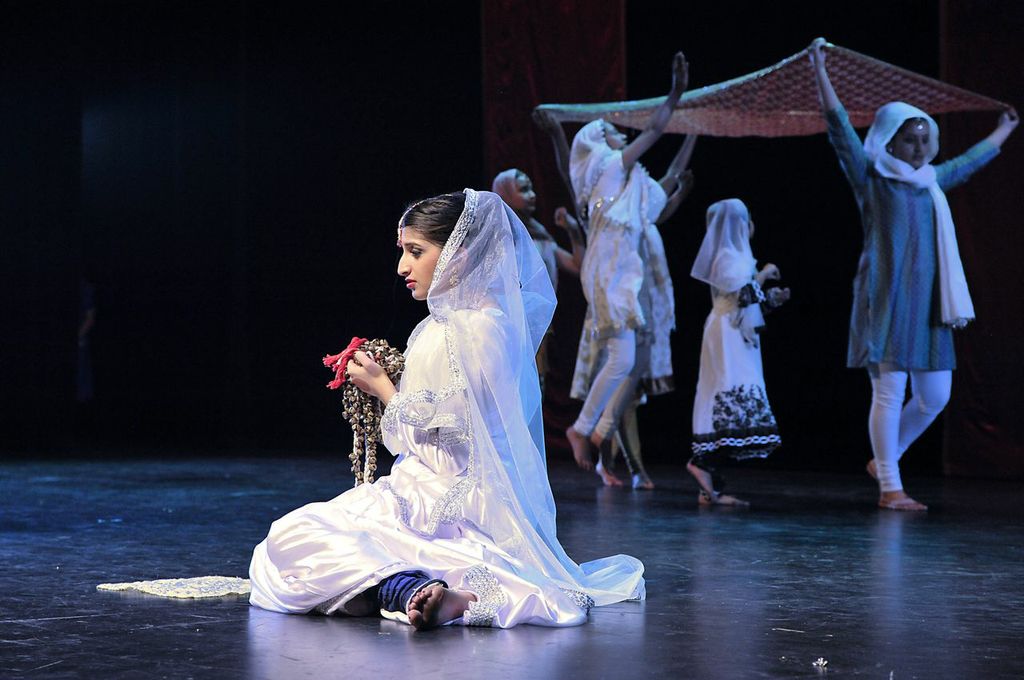
Set on a liner crossing the Atlantic in 1925, director Leland Kean’s cast have a ball with the larger-than-life characters. (Ella Scott Lynch and Nathan Lovejoy have particular fun with an RP accent and the beautiful comic juxtapositions it allows.)

Someone is killing the passengers and crew, and we don’t know who. So we try to guess. A whodunnit.

Whodunnits are popular because they suggest, despite the initial chaos, that order will be restored. The investigator, using reason, will bring the criminal to justice.

The slasher genre has no such faith in reason. It luxuriates in the physical; the sexual and, of course, the violent.

The whodunnit builds. The slasher genre tears down.

All philosophy could be described as the struggle between these two approaches; between the systematizers and the wreckers. They probably need each other.

And, in this play, the two have an interesting impact. Schmitz draws attention to certain values and asks us to question them.

Whodunnits, for example, rely on the power of reason, but what’s deemed reasonable is determined by the values shared by the investigator and the audience. ( Yes, Sherlock Holmes reasoning is so logical, but the whole point of that character was that he was an extreme. And, anyway, the audience can’t do the scientific stuff. ) As the audience guesses at the killer, they’re ‘proven’ to be reasonable people when their prejudices match those of the investigator. Except when  the investigator struggles to identify the killer. Then these prejudices are challenged.

The slasher strand is rather more obvious. Kill ‘em all, it says. As far as an indictment of values goes, it doesn’t get much more damning.

And what are the values questioned? In Empire: Terror on the High Seas they are a smug superiority, a privileged complacency, a casual racism.

And though the play is set in 1925, I fear the sun is still rising on that empire.

Veronica Kaye


Empire: Terror on the High Seas

Bondi Pavilion 28 Sept

http://rocksurfers.org/


Spur of the Moment

3 Sep

Spur of the Moment by Anya Reiss has a sparkling opening scene. Twelve year old Delilah is in her bedroom with three friends.  They’re young girls doing their stuff. They’re singing to High School Musical. They’re filming themselves on their phones. They’re talking about how the young man who boards in Delilah’s house is HOT.

Spur of the Moment is a simple tale, beautifully told.

I want to avoid spoilers, but suffice to say this play captures being twelve; the tweeness of it. Delilah is so obviously still a child, but …….

You’re in such a hurry to get older, her mother tells her, but when you are, you won’t want it.

The young girls are played brilliantly. Holly Fraser as Delilah gives an astounding performance. She’s innocent and vulnerable, but hungry to grow, and with that comfortable confidence intelligent children often have before the trauma of teenage years.

And Delilah’s world is changing, and the emotions and situations she must face are new, and raw.

Her parents aren’t much help. They’re lost too. Zoe Carides and Felix Williamson give wonderful performances, balanced perfectly between humour and pathos.

This play is about loving, and mostly about that overwhelming need to be loved. Do we ever shed it? Should we?

Is maturity when you realize that to love, as against be loved, is the most important thing? That’s the grand insight of many religious traditions – but it’s only made possible by the attendant belief that no matter what the world throws at you, you’re loved anyway.

But what twelve year old has got that far?

Holly Fraser

What am I saying? Who ever gets that far? We try. We try to forget ourselves. Or we try to define ourselves in ever widening circles. We try to teach ourselves to love.

But in childhood, being loved is crucial. Usually our parents do the job. Usually. But as we grow, we begin to feel their love is insufficient, and we realize the love we now crave is far, far less assured. We enter exciting but disturbingly uncertain terrain.

Director Fraser Corfield has done a marvelous job with this deeply engaging, deeply affecting play.

It comes to a climax on the morning of Delilah’s thirteenth birthday. Happy birthday? Oh, Delilah. The final image is heartbreaking.

Veronica Kaye


Spur of the Moment

ATYP Under the Wharf til 14 Sept

http://www.atyp.com.au/whats-on/productions/spur-the-moment

Brad Checks In and Summer of Blood

1 Sep

Now, why do they call them “plays”?

Could it be that they’re “play”ful?

Because they take “play” seriously?

Creation is God playing Hide and Seek with Herself. The more serious the game, the harder She is to find. And, perhaps, the less serious the game, the more She shines through.

That’s why silliness can be such a blessing.

And these two plays are a lot of fun.

Brad Checks In, written by Paula Noble and directed by Steven Tait, plays with the adult dating scene. Built on the standard sitcom conceit that adults are just big kids, this entertains with snappy dialogue and high energy performances. Chris Miller as Brad gives an endearing portrayal of a real goof.

Romance is the silliest of the serious things. And even though its comedy, this play got me thinking about gender stereotyping, and the fact that one of the greatest threats to the modern democratic project of universal equality is sexuality. (Ok, pretty heavy, I know, but I did begin this response to a couple of screwball comedies by talking about God.)

BRAD all cast 01

Summer of Blood, written by Robert Armstrong and directed by Stephen Carnell, plays with slasher films. Once again, there’s plenty of quick fire quips, and this time, a reel of film insider jokes. Carnell elicits from his actors the wonderfully appropriate larger-than-life performances that make this sort of silliness sing. Katie Shearer has a ball with the role of the ambitious starlet.

It’s a play about film.

Now, why do they call them “films”?

Could it be because they’re

(Oh, hang on. That’s not going to go anywhere.)

Veronica Kaye


Spring Comedy Double Bill

Brad Checks In and Summer of Blood

at TAP Gallery until 7 Sept

http://www.tapgallery.org.au/2013/08/spring-comedy-double-bill-tuesday-27-august-saturday-7-september-6-30pm-8-15pm/

Jerusalem

31 Aug

I don’t write reviews. But I always include a bit of evaluation. (People seem to like it. I guess it’s a way of looking back at the production, instead of forward to how the production could inform your life.)

I’ll get it out of the way to begin with:

Helen Tonkin’s production of Jez Butterworth’s play Jerusalem is superb theatre. It’s brilliantly acted. Nicholas Eadie, as Rooster, gives a mesmerizing performance, and he’s supported by a top cast.

The play is very funny – and deeply thought provoking.

Photo by Matthias Engesser

Photo by Matthias Engesser

And my last comment might also help explain the popularity of evaluation. It’s easier to write.

Jerusalem is a very rich play. It’s one I find difficult to come to terms with.

(And so what follows is probably rather shallow. In my defense, I direct readers to my article ‘Why being a reviewer is tough’ – https://theatrered.wordpress.com/2012/07/08/why-being-a-reviewer-is-tough/ )

Jerusalem is very English; not in the sense that it’s somehow typical of English plays, but because it explores English-ness. I suspect it’s part of that foreign country’s culture wars.

But I don’t mean it’s not relevant here.

Jerusalem is an exploration of reaction. And that happens everywhere.

Threatened with eviction by representatives of the local council, Rooster refuses to budge. He’s told the law requires him to vacate, the English law. But it’s not his law, because it’s not his England.

Rooster connects with a deeper, older tradition. It’s as though he believes merry old England has been lost. And to underline the point, the play is set on St George’s Day, the day of the local fair, with its May Queen and its Morris dancing, and other pathetic corruptions of a distant past.

Rooster is reminiscent of Falstaff and, like Shakespeare’s creation, he has a semi-loyal entourage. One of them, Lee (played with engaging vulnerability by Brynn Loosemore), is off to Australia. The decision has been made, but it’s troubling. Another of Rooster’s followers, Davey, asserts he’ll never leave England. With perfectly pitched cockiness, Alex Norton as Davey says, ‘Travel to Land’s End, and you’re eff’n close to France. And then after that it’s just country after country. What’s that about?’*

And the play evokes a deeper tradition still. There’s talk of fairies, and giants, and druids, and Stonehenge.

Rooster is a lovable and entertaining raconteur, but he’s not an answer to the challenges of modernity. He avoids dealing with the State by dealing drugs. And despite the threat looming throughout the play he does nothing to try to avert it. He’s a victim rather than a champion.

Jerusalem is an exploration of reaction. Reactionary attitudes are those that say the present is troubling and the past was better.

And, of course, the past is better.

Regardless of whether we share its values, it can no longer trouble us with the need for present action.

Veronica Kaye


Jerusalem by Jez Butterworth

New Theatre til 14 Sept

http://www.newtheatre.org.au


* If my memory has failed me, apologies to Jez Butterworth.

Devdas the Musical

26 Aug

Romantic love is the perfect subject for the dramatic form. It’s particular – this soul adores only this soul. It’s deeply personal, yet it speaks to us all. For many people, this is theatre par excellence – where the concrete leads to the universal.

Devdas is the story of a man loved by two women. He can’t have one and does not love the other.

Devdas the Musical is a spectacle, an explosion of colour and sound. The audience is treated to a banquet of musical styles, provided with great virtuosity by composer/performer Aparna Nagashayana.

Visually the piece is a delight as well, with gorgeous costumes, and beautiful dancing choreographed by Ruchi Sanghi.

Director Viral Hathi does a wonderful job of both marshalling a huge cast and painting precise and poignant moments.

Despite their universality, or perhaps because of it, love stories can sometimes seem one dimensional. But not in this case – the novel on which this (and the many movie versions) is based sources a richer tradition.

Photo by Dusk Devi Vision

Photo by Dusk Devi Vision

One of the great gifts of Hinduism to the world is the insight that sexual love can be an evocative symbol of our longing for the divine. Radha longs for her Krishna.

It’s been said that young poets write of sexuality in the language of spirituality, while old poets write of the spirit in the language of sex. And some would assert that spirituality is merely sublimated sexuality.

But perhaps sexuality is sublimated spirituality.

Whatever the case, Devdas is a story of devotion and the consequences of failing in it. It’s a reminder of the power of love.

Photo by Dusk Devi Vision

Photo by Dusk Devi Vision

In the West, discourse about spirituality has been high jacked by the success of the scientific revolution. (It’s difficult to underestimate the allure of a technological culture that has doubled our life spans in the virtual blink of an eye.)

But the way of knowledge is only one path. Love and devotion are another. Termed bhakti in Hinduism, it’s a path that finds expression in most religious traditions.

To look plainly and honestly at the world is an ability we rightly admire.

But it’s not the same as loving the world.

Veronica Kaye

Devdas the Musical

NIDA Parade Theatre 24 August

http://www.devdasthemusical.com/index.html

Writing Satire

26 Aug

I used to write satires.

I was the author of several plays burning with rage at our sleeping spoilt society. (Don’t bother googling for them; I wrote them under a different name, before I was the woman I am now.)

‘We live healthier wealthier lives than any time in human history, yet we’re bunkered down like it’s the Ice Age,’ my satires would say.

They objected to our materialism, but saved their greatest vitriol for the fact we didn’t even know how to enjoy it.

I don’t know if my audiences ever learnt a thing from my satires.

But I learnt two things.

Every satire has a target.

The first thing I learnt was that audience members never expected to be that target. If they found they were, they were shocked – an entirely understandable response from anyone who is perfect.

(It fascinated me that anyone would choose to identify themselves as the target. It’s not as though I named names. But they did. And paid for the privilege of doing so.)

The second thing I learnt was that offended audiences members had a simple defense mechanism, a mantra they would repeat. They didn’t always use the same words, but the gist was the same.

I was told I shouldn’t underestimate an audience; an attitude that proved difficult to adopt when audiences kept turning up, only to be surprised that I’d written a play aimed at the people who might actually attend.

‘That’s obvious’ they would say.  As if the purpose of a satire was to take them  on a journey of intellectual discovery, and at the end of the class they would understand relativity, or something else that had absolutely no relevance to their day to day lives.

But satires are not about knowledge. They’re about ethics. They’re not interested in what you know. They’re interested in what you do.

Satires aren’t classrooms. They’re trials.

And when you’re convicted of crimes against humanity there’s no point saying you didn’t know it was wrong.

Or that you did…………

I no longer write satire.

Now, I write with a gentler irony. Which kind friends might call maturity and honest ones despair.

Veronica Kaye

Indian Embrace

23 Aug

If you’re reading this, you’ve won the lottery of life.

You could have been living at a time prior to the technological culture that makes this blog possible.

Or you could be living in a part of the world that still does not have access to this culture.

This culture, within two short centuries, has doubled our life spans.

Indian Embrace by Carol Dance is a fascinating exploration of the responsibilities that come with winning the lottery of life.

Photo by Chris Lundie

Photo by Chris Lundie

It’s the story of three Anglo Australians who visit India. It’s a family reunion – in more way than one. It’s a play about appreciating the connections we have with a wider humanity.

It explores how aid can help developing countries. It explores how business might do the same thing. (It doesn’t answer these questions, but it raises them. And, in an Australian play, that’s too rare.)

Yes, the play is set in India. And, yes, it’s an Australian play. This is an exciting theatrical choice. We should write – and think – big. ( The politics of identity should not become a tool of reactionary ideology. Remember when the most important question was ‘What is to be done?’, rather than ‘Who am I?’)

And, in Dance’s play, the Indian characters are beautifully realized. They’re living in a society not yet entirely overwhelmed by the culture of technological materialism. But they know its allure, and its danger.

The scene between Roopa (Ambika Asthana) and her father-in-law Vikram (Shashidhar Dandekar), in which they argue their ties to India, is pure theatrical gold. Dandekar’s later monologue about loss and resilience is deeply moving.

Director Lenore Robertson draws some good performances from her cast, eliciting both tears and laughter from the audience.

The final monologue, delivered with powerful understatement by James Herrington, completes an engaging night of theatre. It asks not just ‘who are we?’, but more importantly, ‘what is our role in the world?’

Veronica Kaye


Indian Embrace by Carol Dance

til 25 Aug at Riverside, Parramatta

http://riversideparramatta.com.au/show/indian-embrace/

Theatre Experts

16 Aug

Whenever someone says they see a lot of theatre, I’m not sure whether it’s a claim to expertise, or a cry for help.

I do not claim to be an expert.

This is not because of a lack of experience.

I’ve been around.

It’s simply because I hear such a claim with suspicion. (There’s a hidden violence to it, like the Australia Day air force fly by;  it’s official, and ominous.)

I imagine there are fields of human endeavour where the claim to expertise can be fairly made. Perhaps stamp collecting.

I don’t think it can be made in theatre criticism.

I’m not arguing that a theatre critic cannot, and will not, amass something that might pass as knowledge. (And I’d certainly argue they should be trying to!)

What I’m arguing is that to identify yourself as an expert is a political act.

You’re asserting an authority to which you have no right. Your knowledge is so tied up with your values and preferences (aesthetic, philosophical and political) as to be best thought of as personal.

And there’s nothing wrong with that. There’s no reason why you shouldn’t share that very personal knowledge with others. It is, after all, what the theatre makers are doing in the first place.

But the assertion that your knowledge transcends your personal perspective and somehow speaks for us all is something a psychologist might indeed describe as a cry for help.

The rest of us could be excused for hearing it as a war cry.

Veronica Kaye

Theatre as a Career

14 Aug

I regularly tell people I don’t want a career in theatre.

I am regularly misunderstood.

It is assumed I’m not serious.

But I’m deadly serious about what the art form can achieve.

I want more than a career.

I’m not suggesting the absurdity that there’s something wrong with being paid for creating art. I’m not peddling the conservative myth that somehow it’s more noble to starve.

And I fully appreciate that being paid for creating art over an extended period of time (which I guess is how you might define a career) could prove to be exactly how some great art is made.

(But there was a poster doing the rounds of facebook recently suggesting something like this: ‘Art work is work and should be paid.’ It struck me more as a mischievous slogan rather than a serious attempt to engage with an issue of economic justice. Of course, if you paint a picture and it sells you should get money for it. But why should you get money just because you paint a picture?*)

When I say I’m not looking for a career in theatre, what I’m saying is simply that the most important thing is not that I get paid.**

And when people speak as though it is, I think it is they who aren’t serious.

Veronica Kaye


* Yes, I’ve answered a slogan with a slogan. More on this later.

** And what is the most important thing? That we give the audience a twofold gift: Joy, and the ability to pass it on. Much, much more on this later.


The Merchant of Venice

12 Aug

Playwrights make plays in the way that barrel wrights make barrels. They just bang ‘em out.

That’s what Shakespeare did with The Merchant of Venice, and all of them.

And that’s what makes Steven Hopley’s current productionwith its brilliant cast, so fascinating and watchable.

(If this seems counter-intuitive or illogical, please stick with me anyway.)

Merchant of Venice

Shakespeare lived before the great age of Romanticism, which promoted artists to the role of high priest. He was just making entertainment, and a living.

He tried not to tread on too many toes.

For example, there is little of the spiritual life in Shakespeare. His plays are remarkably secular.

Was he just being true to his experience? Or was he simply avoiding the great religious controversies of his time? Remember, ‘heretics’ were still being persecuted.

The Merchant of Venice, despite having more talk of religion than most his plays, is intriguing because it’s still not spiritual.

(There are claims the play is anti-Semitic. To a modern sensibility, these claims are often mitigated by the fact that the Christians portrayed fare little better in our estimate than the Jews.)

Shakespeare talks of religion in The Merchant of Venice simply because he is making dramatic use of an imagined difference between Christianity and Judaism.

He exploits an old trope – that of the spirit versus the letter.

Shylock the Jew (played magnificently in this production by Mark Lee) will have his pound of flesh because the contract stipulates he can. And his downfall is ultimately because of this very insistence on the letter of the law.

And Portia (played by Lizzie Schebesta with a beautiful precision) gives her famous speech in praise of mercy. This one moment is an inspiring expression of the spirit. Give up on the law, it says, and just show love.

The spirit versus the letter? ‘We got this right, and the Jews did not.’ This is a story Christians have told themselves through the millennia. Ironically, in its harsh and simplistic judgement, it’s an attitude that negates the very insight it supposedly celebrates, and makes clear that the division between the letter and the spirit is not a division between religious traditions at all.

Rather, it’s a battle that must be fought in every life.

Which brings me back to Shakespeare.

I find him, in many ways, a dissatisfying voice, because he shows so little interest in the spiritual. (A lack of interest which goes a long way to explaining the currently fashionable claim that he’s universal, when really he just speaks to our own materialist society. Is it the greatest of cultural tragedies – that our most acclaimed writer is so deficient in one beautifully rich sphere of life?)

And what of the decision to continually produce his plays? The letter or the spirit? Going perpetually back to the ‘canon’ smacks very strongly of the former. Are we making theatre that breathes life, or is it an exercise in borrowing authority and aiming to get things right?

But this production, with its superb performances and the simple beauty of its staging, is a marvelous piece of theatre.

It’s an eminently watchable performance and an extraordinary stimulant to post show discussion.

See it, and consider both theatrical choices, and life choices.

Veronica Kaye

The Merchant of Venice

at TAP Gallery until 24 August

http://www.sydneyshakespearecompany.com/#!current-production/cb3i