Tag Archives: Blinking Light Theatre

3 Billion Seconds

1 May

This is part black comedy, part satire, and all fun.  

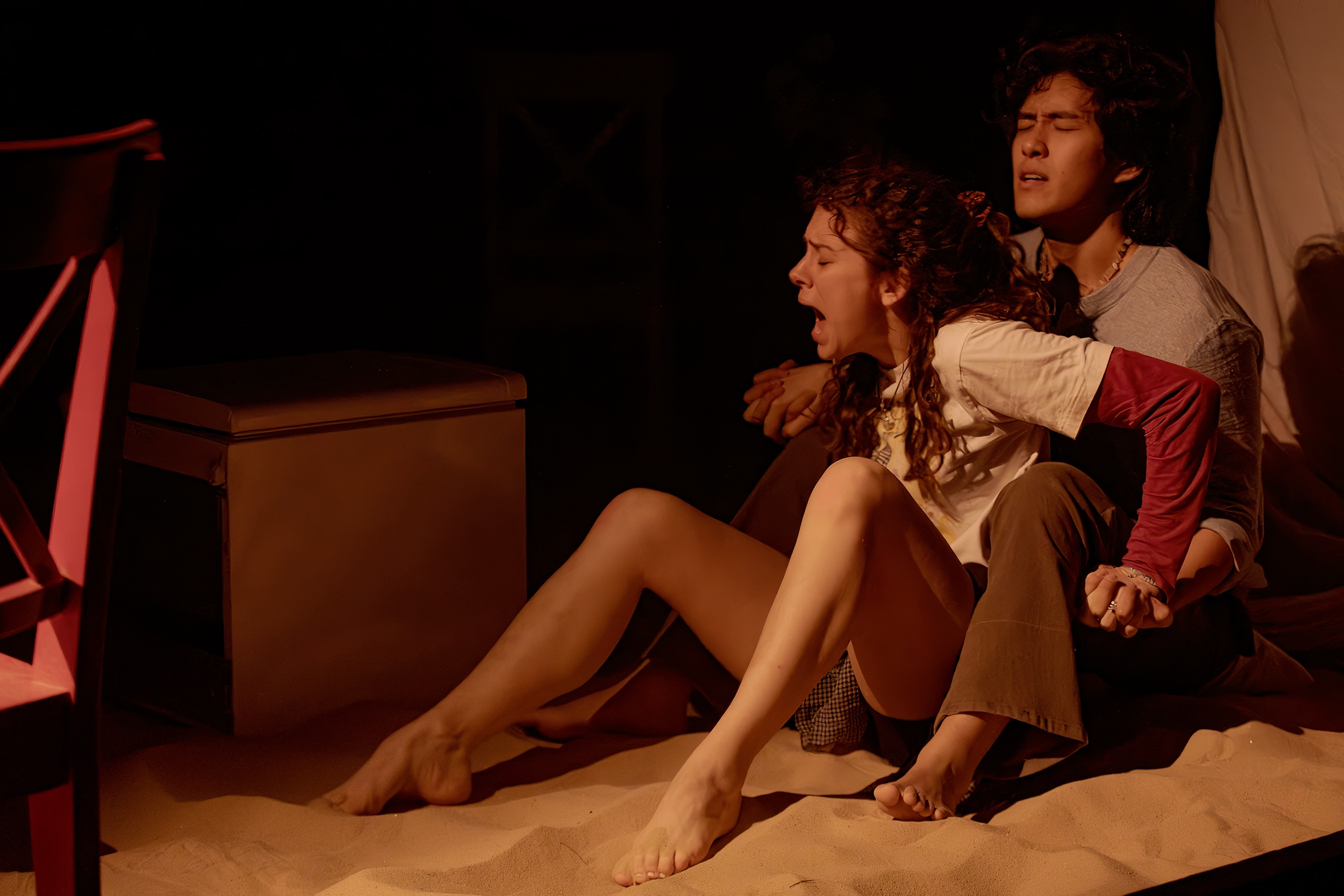
Directed by Dominique Purdue, the show is thrillingly fast-paced. Actors Izabella Louk and Victor Y Z Xu give wonderfully audacious, high-energy performances. (I’ll admit it took me time to attune to the piece’s theatrical language: at first, I was fearful of sensory overload.)

By British playwright Maud Dromgoole, 3 Billion Seconds tells the story of two population growth activists, Daisy and Michael. Acknowledging that one of the greatest challenges facing humankind is our exploding numbers, they dedicate their lives to raising awareness about the problem. And then they find they have a little problem of their own: Daisy is pregnant. How can they offset the impact of bringing a child into the world?

Their answer is what makes this black comedy.

The satirical element could be broken into two strands.

One is a poke at the dreadful arithmetic of consequentialism, that oddly reductive vision of ethics which (in its worst forms) assumes the difference between right and wrong can be calculated numerically. In the play, this is signified by a fixation on pie charts. Consequentialism’s vision of morality is based on outcomes. To most people, this might seem an entirely natural approach. After all, don’t we determine whether an action is right or wrong depending on its consequences? Trouble is, we don’t always know the consequences. (A radical critique, or a radical honesty, might suggest we never know the consequences. And certainly not in a way that can be expressed numerically.) It takes little imagination to see that an ethical philosophy that manifests both a whiff of epistemological arrogance and a weakness for calculation might only too easily mutate into a force for dehumanisation. The events of the play certainly suggest this – though not with little imagination, with glorious comic invention.

The other satirical strand targets anyone (everyone?) who puts their personal wants before the needs of the community. (And that community can be defined in ever widening circles.) The production’s final haunting image brilliantly encapsulates this threat. But juxtaposed with this image of menace are the closing lines of dialogue, which are a very human expression of a very human desire. In this refusal to be reductive, the piece attains dramatic excellence. To face the greatest of challenges – the threat to our planet, to our species, to all species – we will need all our best qualities, and that includes honesty.

Paul Gilchrist

3 Billion Seconds by Maud Dromgoole

presented by Blinking Light in association with bAKEHOUSE Theatre Co

at KXT on Broadway until 2 May

kingsxtheatre.com

Image by Phil Erbacher

These Youths Be Protesting

10 Apr

Aye, they do be protesting.

I’m not sure why the title of this one is in Pirate. The rest of the play is not, and that’s probably a wise decision, as it’s set in contemporary Australia, me hearties. (Yes, I’ve got to admit, I’ve been fighting the temptation to write my response entirely in the language of the buccaneer. After all, in a flat, consumerist society such as our own, what is any serious theatre review but some quaint, seemingly old-fashioned, musty document … but one that shows the way to hidden treasure?)

And this play, written and directed by Izabella Louk, certainly has its treasures.

I’m guessing it’s inspired by the student climate crisis protests of a few years ago, where young people quite understandably answered criticism that they should be in school with the assertion they’d like to be, if only the adults would do their job and protect the planet.

All the characters in this play are fifteen and, surprisingly, that’s the source of its strength.

Louk and her talented cast nail the high energy of youth, and the piece is fast-paced and very funny. Karrine Kanaan as the bossy would-be school captain offers a terrific satirical portrait of the obsession with self-advancement. Rachel Thomas’ Georgie is hilariously prim, and her journey to independence fascinating. Hamish Alexander’s Jimbo is slow-witted and good-hearted, great fun and greatly inspiring. Mây Tran’s Mandi is the serious heart of the play, and her impassioned speech about the challenges and necessities of political engagement is deeply affecting. But the script also gives Mandi plenty of scathing sarcasm, and Tran delivers it with delicious bite.

In these four characterisations, there’s a real sense of the dreams and doubts of youth.

But in making all the characters fifteen, doesn’t the play risk being about being fifteen? Is it a creative decision that threatens to overwhelm the more pressing issue of climate change?

Perhaps. Louk’s script reveals a maturity of political vision that belies its dramatis personae. The challenges of political action are candidly presented: How do you deal with those who support your cause but do so for selfish or stupid reasons? How do you work with people who claim to have the same goal as you but demand a different strategy? How do you not hate those who oppose your cause or, even more provokingly, seem entirely oblivious to it? How do you cope with the hate directed at you?

These challenges are not presented to dissuade us from political action, but to clarify what it is. Despite the current rhetoric, everything is not political. There are the things we can only do alone and there are the things we can only do together. The second of these clauses describes the political sphere of life, and its key word is together. Learning how to do things with other people is the key to political action.

This might seem naïve and simplistic, but this recognition of the true nature of politics is invaluable. The play may portray children, but many adult Australians appear to believe they’re being politically engaged when they’re merely spouting opinions. By representing the political sphere of life as it is first encountered by a group of teenagers – as they first learn to work together – the adults in the audience are gently, and surreptitiously, given a lesson in political maturity. (It’s a trick Harper Lee uses to great effect in To Kill A Mockingbird.)

On an even plainer level, the play’s exclusive representation of youth has an irresistible emotional impact. In regard to that most critical of issues, climate change, reason alone should prompt action, but the sight of fear in the eyes of a child is a powerful motivator.

Paul Gilchrist

These Youths Be Protesting by Izabella Louk

Presented by Blinking Light Theatre, in association with bAKEHOUSE Theatre

At KXT until 19 April

kingsxtheatre.com

Image by Karla Elbourne