Tag Archives: Belvoir

Snakeface

15 Apr

The marketing gave me the impression this piece would interrogate the experience of queer black women in white Australia via ancient Greek myths. This struck me as inauspicious, the equivalent of attempting to explain quantum mechanics using hieroglyphics.

But, as they say in Jurassic Park, “Theatre finds a way” (or they say something like that; I couldn’t really hear over the roar of all those dinosaurs.)

As it turns out, this piece does not claim to represent the queer black experience. Nothing in the monologue implies anything so outrageously reductive.

And the use of Greek myth is beautifully subtle and intensely powerful.

I will admit, however, that for a while, I feared this one had defeated me. The 90 minute monologue was a challenge, both because of its confronting subject matter and because of the difficulty I had following its narrative.

But, ultimately, it offers a rich, raw and deeply humane insight into love and vulnerability.

Written and performed by Aliyah Knight, and directed by Bernadette Fam, Snakeface presents a fictional character who seeks love and suffers brutality. Knight has a wonderfully warm, engaging stage presence, generating immense sympathy for the character.

Knight’s language is stunningly poetic. Its ruling motif is physicality; it’s visceral, sensual, violent. There’s much talk of bodily fluids and organs. There’s the suggestion that Truth is found only in the rag and bone shop of existence: one lover is judged honest or genuine because of the animal-like noises he makes in the bedroom.

Knight’s own physicality, a hypnotising balance of rhythm and writhe, emphasises the primacy of the body.

The set by Keerthi Subramanyam is dominated by a huge slab of clay, reflecting the character’s interest in sculpture and the plastic arts. But also, via its biblical and classical connotations, it suggests vulnerability. Are we made of mere clay? Will we be reduced to stone? (It also hints at the hopefulness of creation, but more on that later.)

Back to the Greek myths. The Medusa motif effectively expresses the seemingly overwhelming desire to destroy those who have hurt us. And the character has been seriously mistreated, a victim of at least one sexual assault. And though rage is presented as an utterly natural response to brutality, the inspiring maturity of the piece is that it’s not valorised. Rage is an attribute of a monster, one wrought by cruelty. Rage is no resting place.

And a resting place is finally offered, a new creation is possible, one that embraces the physical, but also knows a calm that transcends it.

Paul Gilchrist

Snakeface by Aliyah Knight

Presented by Fruit Box Theatre, as part of 25A

At Downstairs Belvoir until 27 April

belvoir.com.au

Image by Abraham de Souza 

Big Girls Don’t Cry

14 Apr

There’s something thrilling about historical drama, a sense of being transported to another time and place.

Big Girls Don’t Cry, written by Dalara Williams and directed by Ian Michael, is set 1966 in Redfern. The fundamental question – how far have we come in sixty years? – is clear. The answer is less clear (for reasons I’ll return to later.)

The piece feels more like a slice of life than a narrative. Not that things don’t happen, but the purpose seems more the capturing of indigenous experience than the weaving of a story.

Queenie (Megan Wilding), Lulu (Stephanie Somerville) and Cheryl (Williams) are preparing for their debut. It’s the first one being held for indigenous women. Trouble is, Cheryl’s man Michael (Matthew Cooper) is overseas, fighting in Vietnam, and the other two women seem to be having difficulty finding a partner. Ernie (Guy Simon) has just returned from the Freedom Rides, with a vision of a better world, and with a friend, Milo (Nic English), who’s interested in Cheryl….

It’s a snap shot of a time and place, brimming with heart and humour.

The scene in which Ernie and Queenie work out their differences – or work out what’s at the heart of the differences – is comic gold.

But the piece is not merely light-hearted fluff. Within the first few minutes, we hear our first story of racial injustice. And this builds, until the end of the first act. By the time we’re confronted with a scene depicting racist brutality, we’ve heard several speeches complaining about its (incontestable) ubiquity, and afterwards we hear more. A play of this length – 2 hours 50 minutes with interval – would benefit from a greater trust in showing rather than telling.

As a historical drama, it’s oddly dissatisfying, partly stuck in the present while at other times lost in the past.

Sometimes, there’s a whiff of anachronism. Perhaps this is inevitable; we chose to tell a story set in the past but our purpose is still to speak to the present. I’ll begin with something really small (which might simply be an example that underlines my ignorance). The characters speak of living in the colony and ask others whether they’re allies to the indigenous cause. This language feels very 21st century, but perhaps it has taken sixty years for these usages to move beyond the indigenous community to the non-indigenous community.

Another potential anachronism is the presentation of the 1967 referendum. The play’s action occurs in the build up to this historical event and the referendum is referred to – but generally negatively, with responses like It won’t do enough and Who are they to make decisions about us? No doubt, this was part of the indigenous response. But, because of the iconic status of the referendum in the history of the civil rights movement, if it was so displeasing to indigenous people I would have loved to have had this displeasure more fully explored, especially in relationship to the hope manifest in movements like the Freedom Rides. But I suspect what we we’re getting is not a response to the 1967 referendum, but rather a response to the more recent, failed, one.

Yet, despite these examples suggesting the play speaks more of now than then, in other ways it’s firmly located in the past – and one that seems a foreign country.

Events lead up to the inaugural Sydney Indigenous debutante ball of 1966, but we’re left with tantalising gaps. How did the ball happen? Why did it happen? Considering a debutante ball is the epitome of privileged white upper middle class aspirational culture, and that Ernie uses the term assimilation in a totally understandably scathing way, I wanted to know more about how and why these women navigated this extraordinarily weird experience. (I know I’m probably being unreasonable, wanting more sociological analysis than a play like this – one sourced, at least partly, from personal testimony – can offer.)

How far have we come in sixty years? It’s difficult tell.

But there’s no doubt we’ve further to go.

Paul Gilchrist

Big Girls Don’t Cry by Dalara Williams

At Belvoir until 27 April

belvoir.com.au

Image by Stephen Wilson Barker

Furious Mattress

17 Mar

This is a beautifully realised production of a fascinating, and odd, play.

Written by Melissa Reeves and directed by Margaret Thanos, it tells the story of a backyard exorcism.

Though based on a true story, it’s a mix of satire and black comedy.

Reeves’ script invites theatricality, and Thanos gleefully accepts that invitation, giving us a show that is gloriously wild.

Performances are excellent. Matilda Ridgway as Else, the victim of the exorcism, is an ever-intriguing mix of impish mischief, startled bewilderment and sheer panic. Julian Garner is terrific as Pierce, her husband, an uncomfortable, naive dag who reveals a terrifying coldness. And it’s a delicious insight of both script and performance that this callousness is shown to spring directly from Pierce’s less threatening qualities. Anna, a member of their church, is keen to assist at the exorcism, and Alex Malone plays her with a delightful whiff of superiority and hypocrisy. (The truly religious are probably much shallower – or much deeper – than the rest of us.) Shan-Ree Tan is hilarious as the exorcist: part-cowboy, part-clown and all glib hubris.

I began by suggesting the play was odd, and there are several reasons for my assessment.

Firstly, in so far as it is satire, the target seems oddly specific. But perhaps exorcism is a more common problem in Australia than I’m aware. Or, if the play is meant as a criticism of Christianity in general, I suspect many members of that faith might question its validity, feeling it’s the equivalent of a satire aimed at Islam that focusses solely on suicide bombers.

The second element of oddness is the structure of the play. It begins with the end. Considering the nature of that end, for the rest of the performance it was difficult for me to laugh at the characters’ gullibility and hubris because I knew, only too clearly, to what horror they ultimately led.

The spoiler rule makes the third element of oddness challenging to discuss; so I’ll be appropriately vague. We’re shown scenes of wonderful theatricality, but they seem to imply that the wacky demonology of these Christians is not as preposterous as the satire might have us believe.

But that’s why the play is fascinating, as well as odd. I’ve called it a black comedy and a satire, but I’m probably being far too reductive. Reeves’ keen, clever, crazy script deserves an assessment more concordant with its explosive, transgressive nature. As a representation of a community dealing with evil, or what they assume is evil, the piece invites reflection, both serious and stimulating.

Possession by demons is a rather minor narrative in modern Christianity. The major narrative is that our faults can be forgiven if we are repentant. But what the minor and major narratives have in common is that the individual and the evil are differentiated. In the minor narrative, it’s the demon that’s evil; in the major narrative, it’s the sin. In both, the individual is presented as redeemable.

Ironically, it’s our secular philosophies that increasingly conflate the individual with evil. (Ironic, because it’s those philosophies that most enjoy satirical jibes at Christianity). Admittedly, current events in America do make very tempting the conflation of the individual and evil. But it only takes a modicum of ethical maturity to question such too-easy-simplicity. Political maturity also suggests that such a simplistic vision is problematic, as it precludes the possibility of positive change. Telling people they’re evil is not a particularly effective rallying cry. In fact, in the political sphere, as long as we view those we disagree with as simply evil, there seems only one way to deal with them – one uncannily like what happens in this play.

Paul Gilchrist

Furious Mattress by Melissa Reeves

presented by Legit Theatre Co.

at Downstairs Belvoir, as part of 25A

until 29 March

belvoir.com.au

Image by Robert Catto

Song of First Desire

21 Feb

Drama is in love with the productions of time, to misquote William Blake. Drama is an artform concerned with duration. Unlike, say, lyric poetry or sculpture, drama represents what happens next.

This was done and so This followed, and then This … and so on. As Arthur Miller has suggested, drama is the artform that portrays the chickens coming home to roost.

As a consequence, dramatists have long been attracted to historical stories. (Shakespeare wrote plenty, over a third of his output. But more on him later.)

Song of First Desire is set in Spain, and through intertwined stories, explores the ways in which the Civil War of the 1930’s continues to cast a dark shadow over that nation. If war is hell, then civil war is its innermost ring (to borrow from both Sherman and Dante.)

One strand of the story tells of a Columbian immigrant who comes to contemporary Spain and finds himself working in a house with some rather scarred occupants. The other strand of the story is set in the same house, but in 1968, nearly thirty years after the Civil War, but while the nation was still controlled by Franco’s victorious fascists (a dictatorship which lasted until at least 1975.)

The characters in the two story lines are personally connected, but I have to admit it took me a long time to figure out exactly the nature of those connections. Now, I know that there are members of the audience who like to have something to think about while the characters onstage are just talking – but for me, having to pay attention to the present action while simultaneously attempting to draw the connections with the past was a multi-tasking challenge: not so much chewing gum while walking as putting together a 3D jigsaw puzzle while riding a unicycle. Homer is rightly blamed for inventing the flashback, and it’s probably worth noting that Shakespeare maintains a healthy abstinence from the technique. (What happens next? always being a more interesting question than Why did that happen?)

But having said all that, this production is one hour fifty minutes long without an intermission – yet the time flew, and offered the glorious, heartrending vistas born of such flight.

Writer Andrew Bovell and director Neil Armfield are Australian theatre legends, and masters of the craft, and this piece is utterly enthralling. The four-strong cast (Kerry Fox, Borja Maestre, Jorge Muriel and Sarah Peirse) are brilliant, embracing the challenges of doubling and creating remarkably vivid characters in each of the two storylines.

If Bovell is more interested in disrupting a story’s chronology than, say, Shakespeare, it’s possibly because as a modern he’s working our contemporary interest in historical sociology. We knowing our present is a product of our past, but is it also its prisoner?

In Song of First Desire several characters suggest there are some doors to the past that should be left shut, but they say it in such pained desperation we wonder if it’s a word of the wise or a cry of the wounded.

Now, I know there are members of the audience who like to have something to think about after the characters stop talking – and Bovell’s powerful play is a provocative invitation to consider our own nation’s dialogue with its past. As a society, do we consciously forget in order to move forward? Or do we consciously remember in order to heal? And is either of these options actually psychologically possible?

Though no Spaniard, French philosopher and later mystic Simone Weil volunteered for the Republicans in their battle against the fascists in the Civil War. And though not concerned exclusively with the history that each of us carries, she wrote a line that resonates with Bovell’s vital interrogation, and which here I’ll paraphrase: What’s taken from us does us harm; what we relinquish does us good.

Paul Gilchrist

Song of First Desire by Andrew Bovell

At Belvoir until 23 March

belvoir.com.au

Image by Brett Boardman

Jacky

22 Jan

This is a superb play, beautifully performed.

Written by Declan Furber Gillick and directed by Mark Wilson, it’s the story of an indigenous man navigating between (what might be called, in the broadest sense) black and white cultures. But it’s also a deeply humane exploration of the concept of identity, and a magnificent example of the richness of the dramatic form.

Jacky lives in the city, far away from his family, and from his country. He rents a one bedroom place, but he’s making good money, and hopes soon to buy. He’s good-hearted and well-liked.

Because of some mischief at home, little brother Keith comes to couch surf. The contrast between the brothers is wonderfully, and hilariously, realised: Jacky the epitome of mature, common-sense responsibility, and Keith all youthful, high-spirited indolence. When pushed to finally find a job – the sort you’re expected to turn up to every day –  Keith says wouldn’t the old fellas laugh at us. True that may be, but a longing for the pre-colonial way of life at this point in the play seems merely a risible excuse for lazy self-indulgence.

But Keith’s presence alerts us to how little Jacky knows about what’s actually going on back at home. What sort of life is he making for himself in town?     

Follow the money. One source of income for Jacky is a traineeship he has with employment agency Segue. They want him on the books because, being black, he helps them maintain funding. His other source of income is as a rent boy. Even here, his identity is a selling point.

He’s a black man prostituting himself to white society. But it’s not a heavy-handed metaphor; rather, it’s a set-up that positions Jacky’s story as ideal for telling in the dramatic form.

But before I unpack that, let me talk about the performances. Guy Simon as Jacky is electrifying, perfectly embodying a gentleness that is suggestive of the many sources of that complex behaviour: confidence and intelligence, fear and despair. Danny Howard as Keith is brilliant: high-energy, fast-paced vocals coupled with a physical lethargy creates a tremendous portrait of the tension between youthful hopes and uncertainties. Mandy McElhinney’s Linda is pleasingly soft-spoken, reasonable, generous – and sublimely unaware of (or unconcerned with) the knottiness of Jacky’s position. It’s a stealthy and unsettling portrait of the white ally. Greg Stone as Glenn, one of Jacky’s clients who’s exploring some rather disturbing sexual fantasies, offers a powerful and utterly truthful mix of awkwardness, shame and brutality. It’s very funny, until it’s shockingly not.         

Back to my comments about the use of the dramatic form. Presented in concrete, believable situations, and in deliciously natural dialogue, the resonances, echoes and parallels in the script are gloriously evocative: Jacky focusses on Keith’s supposed uncleanliness in a way that disturbingly echoes a client’s racist abuse; potential supporters of the employment agency seem overly interested in the gender of the Indigenous participants, recalling the sexual interest of Jacky’s late night customers; both Linda and Jacky compromise themselves for property, while other (offstage) indigenous characters are concerned with the integrity of country; Linda thanks Jacky for playing along, while Glenn thanks him for his role-playing in the bedroom; and, perhaps most perturbingly for a majority white audience, this particular racist client has a fascination with the art created by marginalised peoples.

Parallels and resonances aside, the fundamental tension driving the piece is that everybody wants Jacky to embrace his identity – just in different ways, and for very different reasons. One of the most painful and poignant moments in the play is when a fellow indigenous person tells him to get back in your box, Jacky. The reprimand he receives is completely deserved, and though my phrase isn’t the one used, it hints at an aspect of identity often overlooked.

What is identity? A case could be made that it’s a response of our psychological immune system. When we’re endangered, we make an identity. It’s a strength in times of trouble, but redundant in times of calm. (One of the things that binds Jacky’s family together is a shared love of Country and Western music. And, as Glenn says, that’s crying music.) Perhaps the fostering of identity is a type of honourable strategic withdrawal? (I’m not suggesting Furber Gillick’s script asserts this, but as a splendidly sophisticated piece of writing, it got me thinking. The final line of the play was a particular stimulus to this train of thought. Due to the spoiler rule, I can’t repeat that line, but it was the sort of declaration of defiance one makes most often in retreat. Accordingly, it was simultaneously inspiring and saddening.)

Jacky is an outstanding piece of theatre, composed with humour that entertains, honesty that engages, and sorrow that humanises.  

Paul Gilchrist

Jacky by Declan Furber Gillick 

Produced by Melbourne Theatre Company

At Belvoir as part of the Sydney Festival until Feb 2

belvoir.com.au

Image by Stephen Wilson Barker

August: Osage County

16 Nov

This a heart-achingly good production of a modern classic.

Written by Tracy Letts, it was first presented by Steppenwolf in the USA in 2007. I’ve now been fortunate enough to see this play three times in Sydney. This production by Belvoir, directed brilliantly by Eamon Flack, is deeply moving and utterly hilarious.

Set in the near present in Osage County, Oklahoma, it tells the story of a family who gather to deal with the disappearance of a loved one – and to deal with each other. In many ways, Letts is a descendant of Chekhov, presenting a world in which love is real but somehow always misdirected.

This tragi-comedy has become a modern favourite because it provides actors with the chance to really show off their stuff. There are thirteen beautifully rich roles and Flack’s cast grab the opportunities offered and give us something truly special. It’s an ensemble of the highest order.

I’d rather not reduce my response to a list of accolades for individual actors, so here’s the smallest tasting plate from what’s a theatrical feast.

Pamela Rabe is superb as Violet, the matriarch of the family. Her meanness is deliciously funny until pain erodes it to pathos. Tamsin Carroll as eldest daughter Barbara is magnificent; she too perfectly balances humour and heart, and the fearful recognition that she’s becoming her mother is played with a soul-withering awareness that what binds us together is also what keeps us apart. Barbara has her own tensions with her daughter, Jean, played by Esther Williams, who wonderfully captures the precocity and petulance of the intelligent teenager. Barbara’s speech to Jean beginning I don’t care what you do with your life and ending in the most heart-rending way, and then her daughter’s glib response, is a moment of shining insight into the human condition, one of many in this extraordinary play.   

In addition to tragi-comedy, August: Osage County has elements of the state-of-the-nation play. Barbara shares her father’s observation that America has always been a whorehouse, but at least it had promise. Now it’s just a shit hole. (These are not direct quotes from the play.) She muses that cataclysm is preferable to dissipation, and is horrified that the nation’s promise may have slipped away without anyone noticing.

These themes are introduced from the get go. In the opening scene, Beverley (John Howard) hires Johnna (Bee Cruse), a Native American, as a housekeeper. Beverley invites her to read any of his books and quotes to her TS Eliot, “Here we go round the prickly pear” (It’s not the only line in the play from The Hollow Men.) Despite the madness around her, Johnna maintains dignity and a concern for others.

State-of-the-nation plays are an odd genre, inviting us to see a small set of individuals as representative of something much, much larger. It suggests a hubris more natural to the critic than the playwright. But I guess it’s just an invitation (though I’m not sure we gain much by accepting it; currently, we have no shortage of armchair sociologists and patio political scientists.)   

I’ll admit I found the conclusion of this production a little disappointing. I’m not evaluating any skills; I’m simply responding to creative choices. It seems to me the final moments of the play are an opportunity for something majestic, an intimation of eternal custodianship, a sense of the always was, always will be despite everything. But a different choice is made, a somewhat smaller, sadder one. The play concludes with a line from Eliot. That line is not “the end of all our exploring will be to arrive where we started and know the place for the first time” – though I wonder if it might be made to feel as though it is.

But that’s the joy of returning to established work in theatre; we rediscover a past love and we discover how it is loved differently by others. It’s like the speeches at a wedding; always gloriously familiar, always gloriously fresh.

And this production is glorious, both for those who know the play and for those experiencing it for the first time.    

Paul Gilchrist

August: Osage County by Tracy Letts

At Belvoir until 15 December

belvoir.com.au

Image by Brett Boardmann

Ruins أطلال

5 Oct

A woman travels to Lebanon. It was trip she was meant to make with her father, a man who’d expressed great attachment to the country of his origin.

Written by Emily Ayoub, Madeline Baghurst & Mine Cerci, and conceived and co-directed by Ayoub & Baghurst, Ruins explores connections with family and with place.

Though having an engaging text – much of which is delivered with a wonderfully rich, wistful regret by Tony Poli as the father – it’s at heart a piece of choreographed movement.

As such, it’s a stunningly beautiful work of visual metaphor. A door dances about the stage, a potent symbol both of entrances to new worlds and barriers to those lost.  A tray becomes a mirror and, looking at herself, the woman sees the past to which she is intrinsically linked. Ayoub’s performance powerfully expresses the complex joys and pains of love and loss. There’s projection: the woman and her father watch together films by Jean Cocteau, and discover his motif of mirrors, doors to the underworld, to the past. Does every mirror in the world lead here?

But perhaps the most salient image is the ruins of the temple of Baalbek. The woman is told she should visit the ruins for two reasons. One is that they teach ephemerality (also taught by this show’s 45 min running time). The other reason is to find a bond with the past.

The temple is to Baal. Baal is an ancient god, worshipped possibly before Yahweh, and certainly before the father of Jesus of Nazareth or Allah (if these sort of temporal differentiations make any sense in relation to the divine.) And Baal is a jealous god. He extracts a toll on everyone who leaves the homeland over which He rules: a piece of their heart. It’s a poignant image of the pain of displacement.

The focus on Baal avoids contemporary tensions in the Middle East, but it also harks back to a pre-Axial Age world view. Baal is ancient, and perhaps old fashioned. By old fashioned, I don’t mean irrelevant; I mean in conflict with challenging modern realities. In a world where so many people are adrift, so many people have migrated, so many people live on lands different from their ancestors, so many people must share their ancestral homes with the displaced, any intense bond to a particular place inevitably means heartache.

It all had me thinking about Simone Weil’s observation that What is taken from us does us harm, while what we give up does us good.

This splendid meditation on connection and loss is both evocative and provocative.

Paul Gilchrist  

Ruins أطلال by Emily Ayoub, Madeline Baghurst & Mine Cerci

Presented by Clockfire Theatre Company

at Belvoir as part of 25a, until 20 Oct

belvoir.com.au

Image by Geoff Magee

Well-Behaved Women

4 Oct

I’ve never really warmed to Laurel Thatcher Ulrich’s famous comment, that “Well-behaved women seldom make history.”

To make a difference, you’ll always have to challenge the status quo. But Ulrich’s comment seems to conflate the fight against patriarchal dominance with unethical action, as though it were men who determine what’s right and what’s wrong. It oddly privileges a male perspective, and has a whiff of the juvenile about it, expressing more the thrill of getting away with the naughty rather than the steel-in-the-spine determination to stand up for what you know is right.

(Skipping maths for a sneaky smoke as you hide behind the girls’ toilets versus abandoning work to march in the streets in front of armed men hiding behind uniforms.)

Of course, I’m being pedantic. Those who deal in words probably should be.

But we all need inspiration, and Well-Behaved Women delivers inspiration in bucket loads.

With music and lyrics by Carmel Dean (with additional lyrics by Miriam Laube), and directed by Blazey Best, the show presents famous women through the ages. Some are fictional, most are not.

There’s no narrative as such; each woman sings of the challenges they face, and the world they intend to make. We hear from inspirational women as varied as Boadicea to Malala Yousafzai. I could list them all, but part of the joy of the show is guessing who’ll be next. (Of course, at 70 minutes, plenty will be left out. Interesting factoid: a 3 min song for every woman who’s ever lived would take 165 billion minutes, or 940 000 years. And that’s without an interval.)

The musical approach is the perfect creative decision: the climb to inspiration is rarely by the ladder of logic but rather through emotional epiphany.

Dean’s songs are beautiful, and range in style from power ballad to musical comedy show tune to African American spiritual. The band is superb. (And I got to say, to go to a show where music is played live and to understand virtually every word is a rare treat.)

Four brilliant performers – Stefanie Caccamo, Zahra Newman, Elenoa Rokobaro and Sarah Murr – take on all the roles with consummate skill. (On the night I attended, Murr stood in for Ursula Yovich).  

To give a sense of the thing, here are some standout moments:

Newman as Eve sets up the whole conceit, and is magnificently cheeky, bold and sassy.

Caccamo as Virginia Woolf sings of Judith Shakespeare, the imagined sister of the playwright, musing on how a woman of genius might have fared in the Elizabethan Age. It’s provoking and poignant. (And, if you haven’t read Woolf’s original version in A Room of One’s Own, do – it’s a game changer.)  

Caccamo also excels as Mary Magdelene, the only woman at the table at the Last Supper. It’s witty, fun and delightfully satirical. Peter, pass the unleavened bread …. Peter, could you please pass the unleavened bread! Unlike the Magdelene of Andrew Lloyd Weber and Tim Rice, this one’s not so much bewildered and awed by the divine, as bewildered the men are all so in awe of themselves.

Murr as Boadicea is splendidly ferocious, radiating a defiant, vital energy.

Rokobaro as Harriet Tubman is awesome. The famous African American abolitionist believed God spoke to her, and perhaps it’s true, because echoes of the divine still linger in this amazing performance.

The doubling and tripling of characters works wonderfully, not only showcasing the extraordinary talent of the cast, but evoking the shared experience of womankind and their dreadful, glorious inheritance.

This is a show about icons and role models.

Do they tell us how to behave?

No, they don’t make demands. (Hey, maybe they don’t even make history; after all, it is a rather nebulous phrase.)

What role models do is make suggestions, offer ways to navigate the mysterious mess that is Life.

So, we look backwards to find our way forward? Yes, the paradox is a recognition that we’re all in this together – and a show that draws attention to this is a true gift.

Paul Gilchrist

Well-Behaved Women by Carmel Dean

At Belvoir until 3 Nov

belvoir.com.au

Image by Brett Boardman

The Curious Incident of the Dog in the Night-Time

25 Aug

This is a big, bold adventure in theatre making.

Several years ago, when I heard that the novel had been turned into a play, my first response was How? (Though that was very closely followed by a Why?)

The most distinctive feature of the famous novel by Mark Haddon is that it’s narrated by a neurodivergent teenager.

Apart from one-character shows, drama really doesn’t do the whole first-person thing. Its glory is that it’s multi-voiced.

Simon Stephens’ stage adaptation tries to keep central Christopher’s voice, but not surprisingly, a play that’s 2 hours 40 minutes long (including interval) looks for ways to create texture.

One way is by giving some of Christopher’s narration to his mentor Siobhan, who reads from his notebooks. In fact, Siobhan (played by Brigid Zengeni with a stage presence that is noble, authoritative and warm) becomes almost a semi-divine figure, a type of guardian angel, making us feel no real harm can come to our hero. These decisions downplay Christopher’s isolation, but deliberately make the piece safe and inviting (which, perhaps, only devotees of the Theatre of Cruelty will regret.)

Another way of texturing a predominantly first-person narration is to privilege the dialogue from the novel at the expense of its more discursive elements. However, one of the charms of the book is that Christopher often records other character’s words without understanding their subtext. The reader gets what his father means, but Christopher does not. Of course, you can do this in drama, but, ironically, it ceases to be dramatic irony; it becomes just misunderstanding. Perhaps this creative decision is a more humane, egalitarian-spirited response to Christopher’s situation, but it does mean the dialogue functions differently than it does in the novel, and that it does not especially underline Christopher’s isolation, or what might be distinctive about his experience as a neurodivergent individual.

(Should it? I suspect this play, this production, will be valued as a representation of a marginalised group – or dissed as an inaccurate one. It’s odd how we’ve come to read fiction in this way. If you wanted to tell the truth about an entire demographic group, why would you choose a form that by its very nature focuses on the individual, the particular, the specific? Invariably, you’ll elicit dissatisfaction when another individual, particular, specific characteristic is not represented. Though, admittedly, most of the audience are in no position to judge the veracity of your representation anyway; they’re positioned to passively accept it.)

Another way of granting texture to a work originating in first-person is movement. On multiple occasions, the cast mirror Christopher’s movements, and this is cute, fun and well executed – though it raises the spectre of bad faith in the script. It feels as though gaps are being filled, ones that another production might have filled (possibly no more satisfyingly) with high tech.

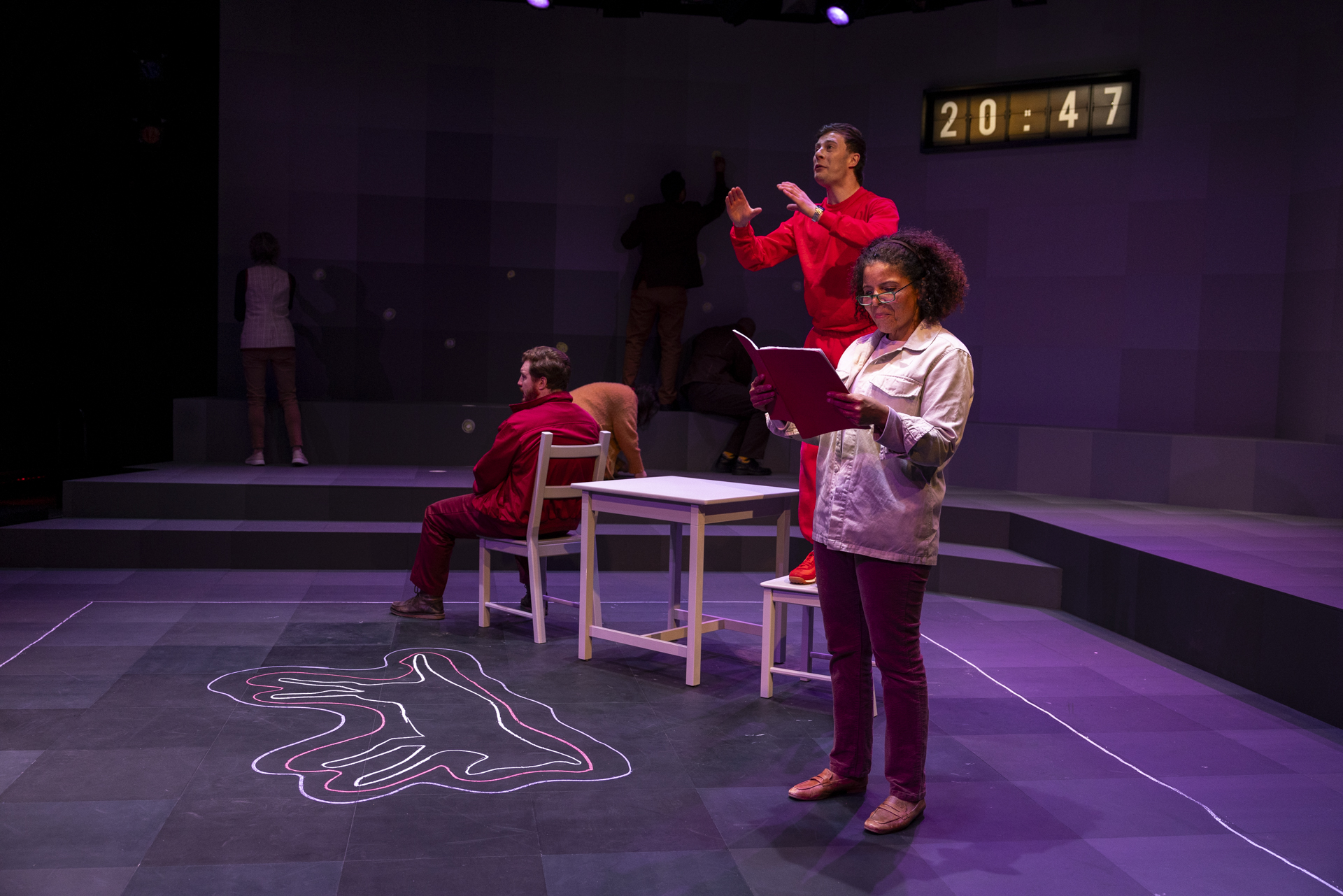
Speaking of tech, above the stage is a device which displays words, warnings, and the time. In the novel, Christopher often tells us exactly when things happen. He makes statements like At 4.02 pm father did X. But the device I’ve mentioned means Christopher doesn’t tell us the precise time, we know it – but, of course, we don’t need to know it, except in so far as this hyperbolic precision tells us something about Christopher. Similarly, the protagonist’s love of mathematics is presented as a very Belvoir dance number, a delightful high energy parody, but one perhaps hinting more at the assumptions being made about the audience than about Christopher’s passion and skill. (Though see my earlier comments about representation.)

Christopher himself expresses uncertainty whether his experience can be turned into a play. (If dramatic irony is when the audience knows more than the characters, what do you call it when characters know more than their creators?)

But does it matter if the play reflects the novel? Or if it accurately represents a lived experience?

Apart from these things, what does the play, the production, do?

Under the direction of Hannah Goodwin, we’re given some wonderful performances. Matilda Ridgway as Christopher’s late mother, a simple woman who struggles with the complexity of raising her son, beautifully balances vibrancy and vulnerability. Daniel R. Nixon as Christopher has a gargantuan role, and he presents it brilliantly, eliciting both pathos and humour, while embodying an inspiring individual dignity.

It’s a deeply human story told with fun and feeling.

Paul Gilchrist

The Curious Incident of the Dog in the Night-Time, based on the novel by Mark Haddon & adapted for the stage by Simon Stephens.

Belvoir until 22 September

belvoir.com.au

Image by Brett Boardman

Counting and Cracking

3 Jul

This is theatrically exciting and dramatically thrilling.

Written by S. Shakthidharan with Eamon Flack, and directed by Eamon Flack with S. Shakthidharan, it spans two continents and several generations. It’s grand storytelling at its best.

In the early 2000’s in Sydney, Siddhartha lives with his mother, Radha. (Siddhartha is played by Shiv Palekar with delicious charm. Nadie Kammallaweera as Radha is the backbone of the production, and she’s suitably spiky and magnificently strong.) Siddhartha was born here, but his mother fled Sri Lanka during its time of civil conflict. The play jumps between the past in Sri Lanka and the turn of the century both there and here.

Three ideas explored in this production make it extraordinarily vital.

The first of these ideas is encapsulated in a line delivered by Radha’s grandmother (played with engaging verve by Sukania Venugopal). She repeatedly asserts “Weddings are more important than politics!” We’re now so accustomed to the mantra that the personal is the political that we blur the difference between the two spheres of life, potentially to the detriment of both. Here’s a working definition: the political is what can only be done with others, and the personal is what can only be done alone (or, at least, in the intimacy of what we call personal relations.) A full life requires acknowledgement of the separate existence of both of these spheres. If you don’t, you run the risk of living a personal life that’s selfish and parochial or a political life that’s shallow and inhumane.

The second idea that makes the production so timely is this: Don’t court division. Apah (played superbly by Prakash Belawadi) is the only Tamil in a Sinhalese dominated cabinet. He believes in unity and equality, and he distrusts tribalism. When escalating violence challenges his convictions, his granddaughter, the young Radha (played wonderfully by Radhika Mudaliyar), urges him to keep his nerve – and it’s an electrifying scene. “There’ll never be another Gandhi ji!” he cries, and it’s the intensity that the dramatic form facilitates that turns this despairing lament into a direct challenge to us. Currently, our culture is tempted to conflate assertions of difference with the attainment of justice. It’s also being seduced into valorising anger and justifying violence. There are several reasons for these disturbing trends, but a key one is the sheer historical ignorance born of privilege. This production gives a frightening glimpse into the hell of civic disorder – and is a powerful cautionary tale. 

The third idea is implied in the play’s title, and gains clarification in the scene I’ve just referred to. What exactly does the political sphere consist of? Is it always either the counting of heads that is voting OR the cracking of skulls that is physical coercion? Does the political reduce solely to the various manifestations of brute power? Or are there other things at work? Perhaps too late, young Radha urges those fearful of the imminent violence to seek refuge with the people they can trust. A just and peaceful civic society is dependent on the building of relationships.

I began by suggesting the production was theatrically exciting. This is thanks to Belvoir’s trade mark rough magic house-style. Actors become a clothes line. A beach is represented in the most delightfully nostalgic way. Scene changes are fast, fluid and gloriously energetic. Perhaps a quarter of the text is in languages other than English and this is translated “live”, with a gleeful awareness of translation’s tricksy nature. All this adds up to a production that constantly reminds us that it is telling a story – this story.  Not too long ago, this particular story was unlikely to appear on our main stages, and we’re being cordially invited to celebrate that change.

I also suggested the play is dramatically thrilling. It makes the most of the multi-voiced nature of the artform. I don’t mean there’s explicit tension between characters (that’s just the bread and butter of drama). What I mean is that there’s also grand unspoken tensions, the ones that explain why Life’s big problems are so notoriously difficult to solve.

Take this as an example: In the Sri Lanka of last century, we’re presented characters who warn of the dangers of tribalism. Meanwhile, in 21st century Australia, Siddhartha and his girlfriend Lily (played with an enchanting stage presence by Abbie-lee Lewis) are embracing their tribal identity. We assume it’s the right thing for these generous-hearted young people to do. But when does the positive form of tribalism start to become the other, more hazardous, form? The play doesn’t explicitly offer an answer; it doesn’t even explicitly acknowledge the possible danger. It simply places the two forms side by side with beautiful honesty.

Paul Gilchrist

Counting and Cracking by S. Shakthidharan with Eamon Flack

a Belvoir production at Carriageworks until 21 July

belvoir.com.au

Image by Pia Johnson