Tag Archives: comedy

Crotchless

5 Nov

This is a fine comedy. 

It’s written by Eloise Aiken, this year’s winner of the Katie Lees Fellowship.

The Fellowship is designed to support young female/female identifying theatre makers, and here it has once again shown itself to be a vital contribution to the Sydney theatre scene.

Crotchless is about how contemporary teenagers and their parents navigate the cultural reactions to feminism.

Aiken has a great ear for comic dialogue; the script is funny and truthful and shit. (And, in case it’s not obvious, the last of those three adjectives is meant as an admiring imitation of Aiken’s uncanny ability to portray the language use of the young, rather than some vocab-deficient, mean-spirited evaluation of the play.)

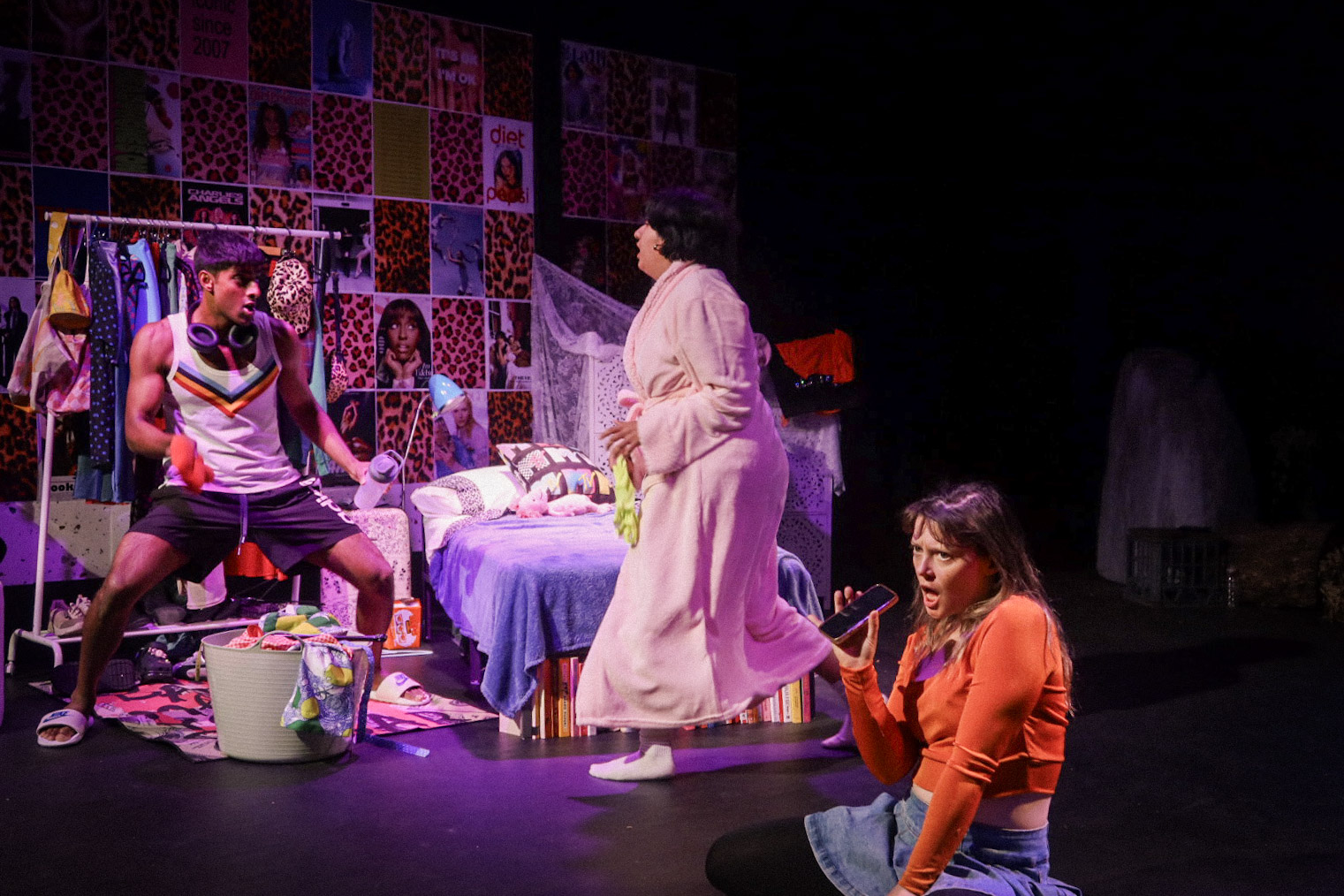
Teenage Shona has dating issues, but it’s her twin brother Owen’s dive into the rabbit hole of misogyny that especially troubles her. Trish, the twins’ single mum, acknowledges Shona’s concerns but is less certain how to prevent her son’s disturbing moral diminishment.

The piece is driven by some fascinating tensions.

One tension is that between the broader culture and personal agency. Owen is admonished for listening to misogynistic podcasts and told to read feminist texts. Of course, what we put into our heads is important, but we’ve come to view ourselves almost as if we were passive computers: just load the correct software and we’ll run appropriately. It’s an understandable but disconcerting assumption – because it seems to erase the possibility of both critical thinking and moral discernment.  (But, we do live in a culture that has rather suddenly become aware of the concept of Culture, and everyone who’s seen Terminator 2 knows the frightening consequences of suddenly becoming self-aware. Skynet isn’t alone in its over-reaction to the unexpected advent of choice.)

Closely related to the tension between instruction and intellectual agency is that between confrontation and love. Should we simply condemn those who disagree with us? Or, as Trish suggests, will that just drive them further away? Is a strict insistence on moral conformity merely counter-productive? Must individuals learn for themselves?  

That Crotchless posits both sides of these tensions suggests its maturity of vision, its beautifully honest awareness of the complexities of Life. If it ultimately comes down a little too heavily on one side of all this, the feel-good-tell-it-how-it-is-for-victory-and-empowerment side, that’s completely understandable. After all, it is a comedy. (And, anyway, is the conclusion of a play actually the sum of its meaning and value? Especially when it’s a comedy. Perhaps the comic happy ending is just one more dramatic convention, as meaningful, say, as the fourth wall.)

Madeleine Withington’s direction is splendid; the pace and bounce is spot on.

Performances are comic excellence. 

Esha Jessy is thoroughly engaging as Shona, the quick-witted teenage girl caught between vigorous assertions of female worth and a risky desire for the rather unworthy male Other.

As Owen, Ashan Kumar brilliantly captures the inarticulate energy of the teenage boy, the hilariously non-threatening high-modality, informed with just the right hint of danger: a cute, clumsy oversized wolf cub trying out his fangs.

Sarah Greenwood is utterly superb. Her performance dances with the lightness of comedy, yet her portrayal of Trish truthfully represents the challenges of maternal love, in all its poignant mix of strength and vulnerability. Greenwood also doubles as Shona’s best friend, Malory, and delivers a playful-almost-parody that is a delight in itself, but also serves to highlight the glorious complexity of her portrait of the more mature of the women.

Paul Gilchrist

Crotchless by Eloise Aiken

At Flight Path Theatre until Nov 8

flightpaththeatre.org

Image by Alex Macleay

I, Julia

24 Sep

Julia Louis-Dreyfus is a comedy icon. Audiences know and love her from Seinfeld and Veep.

Lily Hensby, writer and performer of this fun show, claims to be obsessed with her.

The premise of I, Julia is that if Hensby manages to evoke Louis-Dreyfus’ comic skills sufficiently, the woman herself will turn up – giving Hensby validation and a boost to her own comic career.

The spoiler rule prevents me from revealing if Louis-Dreyfus does show.

But we are treated to some classic moments from her body of work, such as Selina Meyer and the croissant, Elaine’s fear of having rabies, and (my favourite) Louis-Dreyfus’ acceptance speech when she won the Mark Twain Prize for American Humour.

Under the direction of Kate Ingram, what Hensby offers is not so much straight mimicry, as a joy in making the material and the characters come alive.

Hensby herself has a wonderfully engaging stage presence and terrific comic delivery. Constructed around a premise of the persona having to wait, the script throws out formidable challenges in terms of pace, with the performer having to navigate the variations between the moments of tight, high-energy when she plays Louis-Dreyfus’ characters and something slower and looser when she plays her own created persona.

The piece is an impish invitation to think about some pretty big issues.

One of those issues is validation. Performers often put extraordinary pressure on themselves by setting international fame as the only criteria for success. Considering the odds, it’s sadly akin to a gambling addiction.

Another issue is the nature of humour. We’re asked directly What do you find funny? At least one audience member, unsurprisingly, found this question difficult to answer. (Much laughter derives from a reversal of expectations; to explain a joke may not be to murder it, but it does usually result in accidental humourcide. Note: this pun is not Hensby’s, but mine. Second Note: Very little laughter derives from puns.)

Hensby admires the musicality of Louis-Dreyfus’ delivery, her ability to make every syllable funny. Many directors and writers will concur with this vision of the script as a score and will encourage actors to play every note.

But on a less technical level, Hensby suggests that Louis-Dreyfus’ popularity has come from her ability, and willingness, to play unpleasant people.  Often her characters are incredibly shallow and totally self-obsessed. We’re invited to laugh, with the performer, at such characters. By laughing at human faults, we remind ourselves that we’re susceptible to them, and that we can recognise and transcend them.

So the question becomes What is the value of laughter?

As Hensby notes, there aren’t many situations which laughter won’t improve – and this show embodies that spirit of playful jubilance.

Paul Gilchrist

I, Julia written and performed by Lily Hensby

At the Emerging Artist Share House (Erskineville Town Hall) as part of the Sydney Fringe

Until 27 September

sydneyfringe.com 

Image supplied.

Lesbian Sex Diaries

19 Sep

This is absolutely joyous.

Constructed mainly from comic monologues, interspersed with some song and dance, it’s also very funny.

Co-creators Rebel Star and Melody Rachel are superb comic performers.

Warning – absurd generalisations that attempt to delineate performance styles: Star employs a giggly infectious effervescence, punctuated by devastating dead-pan. Rachel employs the well-placed pause and the slight but-oh-so-evocative vocal intonation.

Sometimes the monologues are honest sharings, such as Star’s beautifully sweet reminiscence of a teenage dalliance, or Rachel’s tale of her first LSD experience (which includes the best definition of God I’ve ever heard.)

At other times, the monologues are playful representations of aspects of dating, like Rachel’s brilliantly written and delivered piece on keeping it casual.  

It’s tempting to share some of the show’s hilarious one-liners – but, for reasons of critical integrity, I won’t. (But I did last night, as soon as I got home, to my partner’s delight.)

With simple production values, and a running time of 50 minutes, Lesbian Sex Diaries is fun fringe. And, if I can hazard a wider comment on queer theatre, it’s a glorious example of that genre as pure celebration.

Paul Gilchrist

Lesbian Sex Diaries by Rebel Star and Melody Rachel

At the Loading Dock, Qtopia, as part of the Sydney Fringe,

Until 20 September

sydneyfringe.com

Image supplied.

Eureka Day

5 Jun

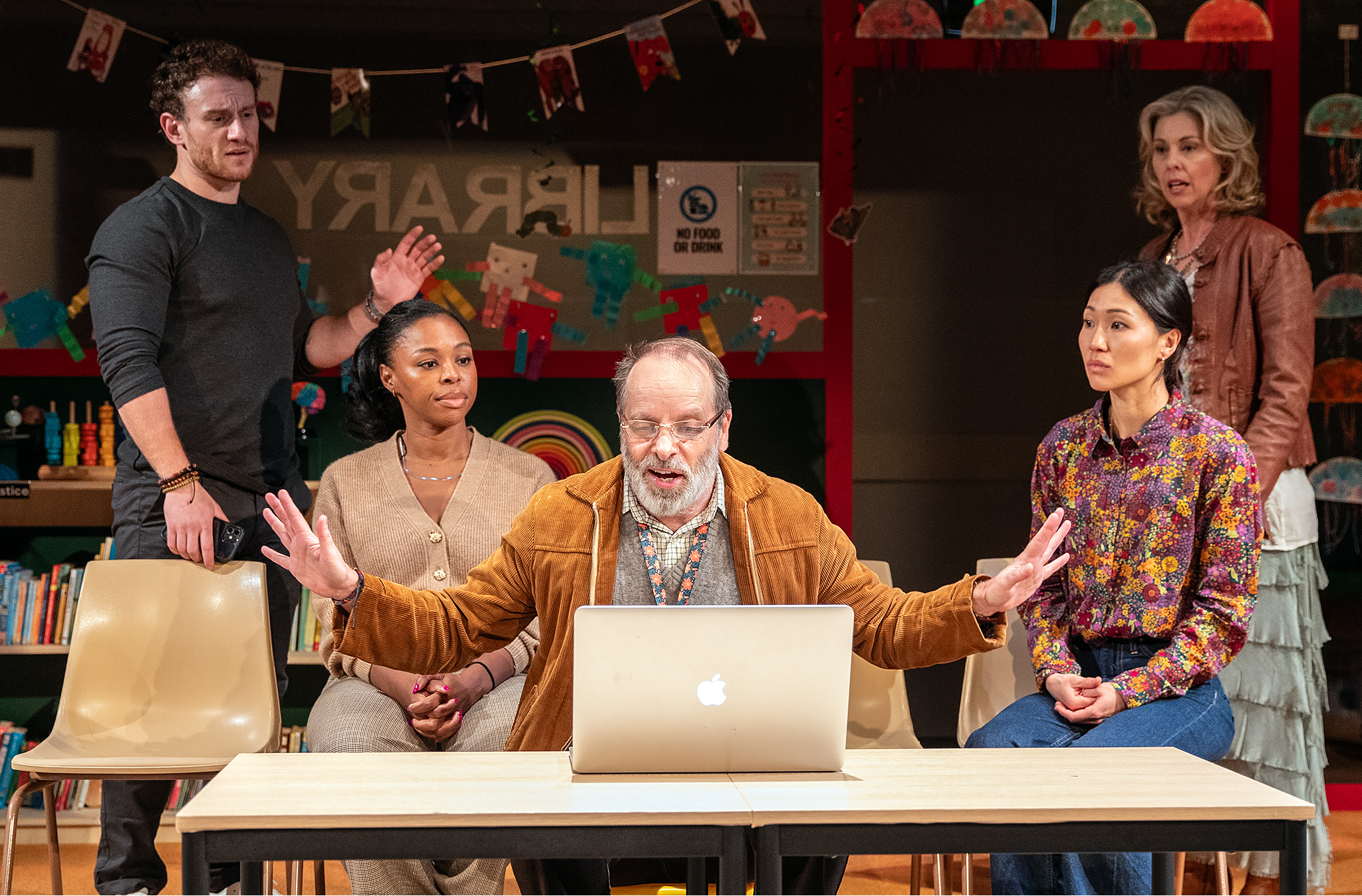
Set almost entirely in the P&C meetings of a primary school, you might assume this is a fun satire of contemporary society.

And you’d be right. Eureka Day by American writer Jonathan Spector is extraordinarily funny. But it doesn’t just make fun, it confronts one of the biggest rifts in our culture.

Eureka Day Elementary is a school built on social justice and inclusivity: a place where everyone feels seen and heard; a place where decisions are reached by consensus; a place where all points of view are valid.

The last of these is the issue. (And possibly the second last.)

Eureka, of course, means I have found it! – and there’s a sense that’s what the P&C believe: that their place is special, that it encapsulates, somehow, the perfect way forward.

But, for all their good intentions, it doesn’t.

Watching their meetings – bursting with thoughtless condescension, moral pedantry and obsession with policy, yet empty of soul-felt kindness, honest humility and genuine openness – is utterly painful. Yes, it’s hilarious, but it’s also excruciating. Earlier, I called the piece satire, but that genre usually employs hyperbole to make its point. But there’s no exaggeration here; it’s just the reality of our present day.

(A reality that feels like one of the rings of punishment in Dante’s Divine Comedy, one in which we’re condemned to an endless repetition of what seem to be absurdities but are actually perverted echoes of our true sins. However, I do think it’s a ring of Purgatory we’re stuck in, rather than Hell; we are purging ourselves; things will improve; there’s no need to abandon hope.)

There are beautiful moments in the piece where our societal problem is artfully diagnosed. One parent jokes that her daughter was very smart but also good-natured, so they knew she would become a benevolent dictator. Another compliments the work of a mime artist, for his subtlety and, we can only imagine, for his rare ability to just remain silent. Another parent says it straight out: she’s sick of the hubris.

This hubris, the belief that they’ve found the correct way, is tested by an outbreak of mumps at the school. Can all decisions be made by consensus? Are all points of view really valid?

As a society, we’ve fallen in love with policy and forgotten politics. And by politics, I mean the sphere of life in which we have to work with other people (as against just shout at them over and over that they are wrong or evil.) The fact that this play centres on meetings where adults must come together and solve problems makes it essential viewing.

(Though I must admit, I’m a little uncertain about the play’s exploration of vaccination. This hot button issue threatens to overwhelm everything else, burying from common view the representation of the political sphere that I so value. But, yes, I know, I know, the dramatic form must deal in the concrete…)

Directed by Craig Baldwin, the production bubbles away at just the right pace, evoking the awful enervating reality we currently endure, yet still assuring us the dramatic boil-over is imminent.

Performances are excellent.

Jamie Oxenbould as Don, a school official, is perfectly, perpetually, and pathetically polite and patient.

Katrina Retallick as Suzanne is both wonderfully comic and deeply poignant, offering a rich portrait of an individual traumatised by the universe’s chaotic cruelty and who overcompensates with a commitment to control.

Christian Charisiou’s Eli is brilliant as the epitome of overtalking privilege, the misguided good that knows not when to stop.

Branden Christine as the newcomer to the school community is magnificent, presenting a fascinating study in intelligence encountering its nemesis: the holding back, the bitten tongue, the seductive whisperings of despair as we wait to speak the Truth.

Deborah An as May has a gloriously warm energy. Her character’s journey is perhaps the biggest of the play, and she pitches it superbly. Her speech in which she posits what she wants for her kids is a highlight, and represents the best of what the play has to offer: the petty hobgoblin of certainty dispelled by a courageous vision of hope.

With this production, Outhouse Theatre shows once again why they are a vital part of the Sydney scene, presenting work that dares to walk our societal fault lines, and keeps its balance with honesty and humour.

Paul Gilchrist

Eureka Day by Jonathan Spector

Presented by Seymour Centre & Outhouse Theatre Co

At Seymour Centre until 21 June

seymourcentre.com

Image by Richard Farland