Tag Archives: Kate Gaul

Eden

9 Apr

If you’ve passed through Australian drama, Australian literature, you know this place.

It’s a country town.

The townspeople are small, they are broken.

They have names like Killer and Runt.

The landscape is riven by a tension. On one side, the trivialities of human society: the servo, the takeaway shop. On the other side, the ferocious beauty of nature: the bush, the river, the sea.

In this place, you are an adolescent.

And, desperately, you need to leave.

These type of stories reflect the personal experience of some of us. But, for most of us, they function symbolically. They effectively express our deep dissatisfaction with modern Australia and its perception of what it is to be an adult, of what is a full human life.

I’ll admit, I often find these type of stories disappointing. It’s not that I haven’t felt the sense of being trapped they express, but I’m frustrated that they always seem to end right where I believe the story begins, at the escape. It’s as though the actual step into maturity is inconceivable, it’s representation impossible.

It’s as though this place seems to negate all alternatives.

But, with Eden, Kate Gaul not only shows she knows this place, she has understood it.

Gaul’s script tells the story of two teenage girls, trapped in this place. But her presentation pushes always to liberty and to openness.

Firstly, the voice. The girls tell their own story. Though there are moments of dramatic realism, the majority of the piece is direct address. We’re not served a purported factual picture; we’re spoken to by characters with agency, women in charge of their own narrative.

Secondly, the beautiful poetry. Much of this poetry is observational, in that Truth is the goal, rather than a reductive coherence. Of some pieces you can say This a beautiful gem, because it’s as though you can hold it up to the light, complete, and by turning it, and looking at it from different angles, you can see how the multiple parts fit together to create a single whole. Gaul’s rich poetry resists this; it’s not stone-solid, it’s fluid, like a moving body of water. (Example: the river that runs by the town is a motif that resists simple interpretation. Likewise, the title, Eden. If Paradise, is it irony? Or is this place the place of the Fall? Or is it where the story, all stories, must begin?)

Thirdly, the narrative. The town is initially established as a place of male misbehaviour and violence: a teen gang named the Mongrels marauds the streets; one of the girl’s fathers has left her mother for a younger woman; the other girl’s father is a wife-beater. But their escape? Honest admission: I didn’t understand the final fifth of the text, I didn’t understand what was happening. But what might lead to frustration with other pieces, is here a continuing invitation to openness. Freedom is that which does not slam shut.

Gaul directs her script magnificently. Simple staging forefronts the ever-fascinating language. Nate Edmondson’s soundscape powerfully underlines key moods and tonal changes (and, I suspect, could be listened to and enjoyed for its own sake.)

Actors Karrine Kanaan and Lara Lightfoot are splendid. They skilfully move between different characters, but it’s in the presentation of Gaul’s language that they particularly shine. This is poetry performed, rather than vernacular speech patterns imitated. This heightening is key. I suggested earlier Gaul not only knows this place, but understands it: it is a place of containment, of smallness, of perpetual reference to what-has-been rather than what-could-be. And if there can be an intimation of what follows the escape, it can’t be another tiny truth, but a flourishing – like this.  

Paul Gilchrist

Eden by Kate Gaul

presented by Siren Theatre Company

at The Substation, Qtopia, until 18 April

qtopia.sydney.com.au

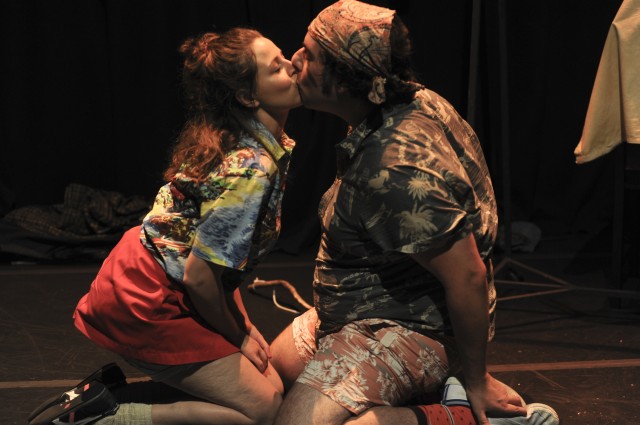
Image by Natalia Ladyko  

Four Dogs and a Bone

19 Sep

Brenda: I want to be famous!

Bradley: Why?

Brenda: I don’t know! *

First and third lines said with equal force.

This encapsulates John Patrick Shanley’s satire on the film industry.

This play is very funny. It’s jam-packed with tremendous one-liners.

Amanda Collins, photo Katy Green-Loughrey

Amanda Collins, photo Katy Green-Loughrey

It’s probably one of Shanley’s less substantial plays. The assertion that the film industry is laughable is hardly ground-breaking stuff. However, an enormous amount of money is invested in the triviality that is film while children starve (in the South Sudan as I write). So that means satires like Four Dogs and a Bone don’t lose their bite.

Shanley has created big characters and director Kate Gaul allows her cast to fill them. Design and blocking is kept appropriately simple, creating the space for linguistic brilliance and joyous hyperbole. There were a few opening night problems with pacing, but these will mend, and the cast will provide a terrific night’s entertainment.

Theatre’s revenge on film. Stage’s little brother is big on budget, but small on substance. And Shanley has fun with this. Victor, played by Paul Gerrard, is a stage writer hungry for money and therefore ripe for seduction by celluloid. Collette, played with glorious energy by Amanda Collins, is the star of the movie, but Collette is hampered by that most disgraceful of descents: she’s a theatre actor. Brenda is Collette’s support in the film and hence her rival in life. (Melinda Dransfield gives a delightful portrait of the nightmare performer: a façade of sweetness masking utter self obsession.) Belinda gleefully tells Colette that she looks grotesque in the daily rushes. As a stage actor, she is too big. A delicious irony – after all, regardless of performance style, big budget film rarely does subtlety.

Veronica Kaye

* Possibly a paraphrasing; my hunger for accuracy unequal to Brenda’s desire for fame.


Four Dogs and a Bone by John Patrick Shanley

Old Fitz til 27 Sept

http://www.sitco.net.au/


The Violent Outburst That Drew Me To You

25 Jun

Why do people keep telling me what to do with my life?

Finegan Kruckemeyer’s play is an intriguing exploration of teenage anger, positing both causes and solutions.

And Kate Gaul’s production of The Violent Outburst That Drew Me To You is extremely engaging theatre.

It’s visually exciting, with snappy dialogue and high energy performances (yes, I’m obviously holding down the cliché key on my keyboard).

Kruckemeyer’s script is a brilliant blend of both imitation and parody of teenage language – which is exactly what teenagers do. (How many adults parody their own language use?* Or, indeed, themselves?) And the cast do great work with Kruckemeyer’s words, finding their zing and mining their spirited humour.

 PHOTO BY HEIDRUN LOHAR


PHOTO BY HEIDRUN LOHAR

Michael Cutrupi is terrific as Connor, the angry teen.

Connor has difficulties at both home and school. Emily Ayoub and Anthony Weir give top portraits of dull-but-caring parents. Renee Heys produces a wonderfully vibrant school girl. Natalia Ladyko’s endlessly patient but smart-mouthed teacher is superb.

In an attempt to solve his difficulties, Connor is sent ‘into the woods’ to find himself. (Which is a little different from the way most teenage boys find themselves.) There he meets Lotte, another teenager with anger issues. She’s played by the three female members of the cast and it’s a device which effectively suggests the personality shattering effect of anger. It also helps push this sequence of the play into a sort of magical realism, and prevents the play’s conclusion from feeling too neat.

For our vision of the world is coloured by our emotions, and it is in our teenage years that this frightening and thrilling discovery is made.

Veronica Kaye

*The exception, of course, is theatre reviewers.


The Violent Outburst That Drew Me To You by Finegan Kruckemeyer

SBW Stables Theatre (Griffin) til 12 July

http://www.griffintheatre.com.au/


Penelope

19 Sep

United we stand. Divided we stand – in an empty swimming pool, waiting to be butchered by a legend.

That’s the scenario of Enda Walsh’s play Penelope. Four men have unsuccessfully vied for the affections of Penelope and soon her long absent husband, Odysseus, will return. There will be consequences.

Walsh’s play is rich and playful. It sets competition against co-operation. Are we really capable of the latter?

Director Kate Gaul’s production is superb. The cast is top class, and they bring to life Walsh’s snappy word play.

Thomas Campbell as Burns. Photo by Kathy Luu

Thomas Campbell as Burns. Photo by Kathy Luu

There are some extraordinarily powerful speeches, which provide an effective foil to  the lighter raillery. The monologues by Nicholas Hope and Thomas Campbell alone will get me back a second time.

Gaul and designer Tom Bannerman have magically transformed the space. We are in the pool. Or is it the gladiator’s amphitheatre?

But they’re a sorry lot of gladiators. Perhaps collaboration is their only hope.

Dramatists have a vested interest in seeing hostility at the heart of human nature. It’s their ideology. With out this belief it’s hard to spin stories.

But is it true? News reports provide easy confirming evidence. But journalists are the close cousins of dramatists, and share their needs.

This play puts it out there; competition or co-operation?

It’s a fascinating question. With no answer.  Except, of course, the one we make with our own lives.

Veronica Kaye


Penelope

TAP Gallery til Oct 6th

http://www.sirentheatreco.com/