Tag Archives: Last Waltz Productions

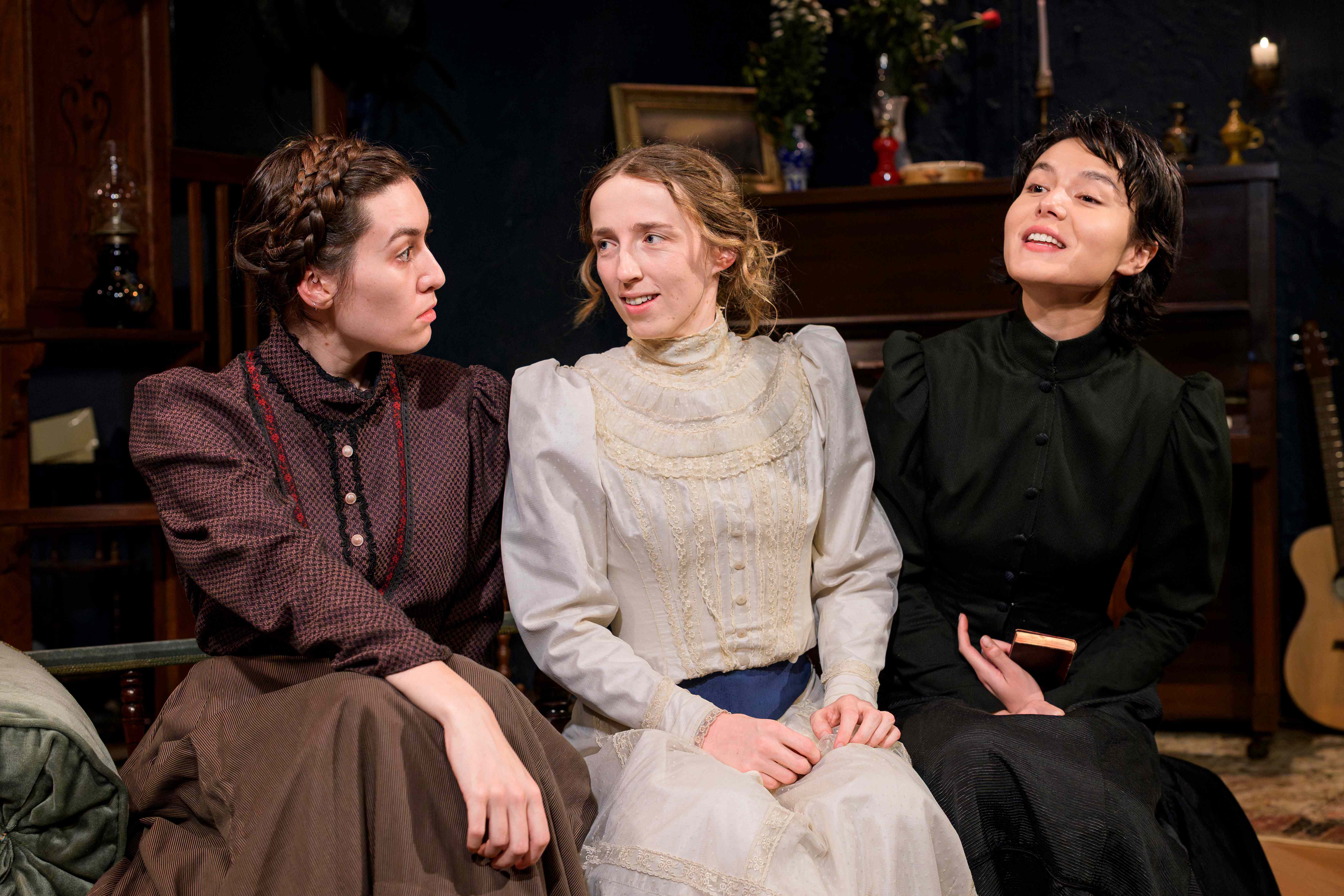
Three Sisters

23 Apr

“With love to lead the way, I’ve found more clouds of gray / Than any Russian play could guarantee”

So go the lyrics of the Gershwin classic But Not for Me.

You can only assume it’s a reference to Chekhov.

The Russian playwright’s meditation on melancholy – and whether love (or work) is its cause or its cure – is also a classic.

Can you really claim to be educated in modern theatre if you haven’t seen Chekhov’s big four: The Cherry Orchard, The Seagull, Uncle Vanya and Three Sisters?

This production by Last Waltz gives you the opportunity to fulfil part of the course requirements with only a three hour commitment (including interval.)

The translation by Laurence Senelick retains the original setting, and the design team under director Clara Voda effectively evoke the world of pre-Revolutionary Russia.

Chekhov is rightfully famed for the truthfulness of his work. And this production is true to that – in a rather provocative way. Vocal performances sometimes push to a realism that repudiates any assumption that art is a finely crafted thing: sometimes actors are too soft or too loud or too giggly. (Life, though, is all these things.) Occasionally, dialogue seems ad libbed, which may be indicative of a complete immersion in the reality of the characters, or it might just be ad libbing.

These bold choices encouraged me to consider the value of the original play.  If we value Chekhov because he is truthful, it’s not because he presents an accurate representation of the human condition. It’s difficult to relate to these self-indulgent middle-class whingers. (Just go to Moscow, for God’s sake!) If we were ever meant to relate to their plight, then I suspect that time has passed (at least for me) and Chekhov can be safely dropped from the (fictitious & facetious) curriculum.  

But I don’t think representing the human condition is what Chekhov really does. Instead, he gives us human behaviour, warts and all. And that’s the gift of this production.

Paul Gilchrist

Three Sisters by Anton Chekhov (based on a translation by Laurence Senelick)

presented by Last Waltz Productions,

at the Old Fitz until May 9.

oldfitztheatre.com.au

Image by Robert Miniter

Dear Elena Sergeevna

4 Apr

This is an absolute cracker of a play.

Written by Lyudmila Razumovskay in the 1980’s in the Soviet Union, it’s a masterclass in building tension.

Four senior high school students arrive at the home of their teacher on her birthday. She is surprised. The students bear gifts, and one dubious request.

This is a classic battle-of-the-generations tale. Elena stands for an idealism which the students think is quaint and naïve. Elena thinks the younger generation are cynical materialists. We are your children, they tell her.

What makes this exploration of intergenerational conflict so rich is that Razumovskay makes it obvious that it’s not simply a matter of conflicting intellectual fashions. She recognises it’s also about power. The younger generation are fighting, not just for a new vision of the world, but for ownership of it. (It’s been suggested elsewhere that one reason Stalin’s purges didn’t lead to the total collapse of Communist Russia, despite their seeming irrationality and their certain brutality, is that there were sufficient young people who knew they would benefit. The murdered fill unmarked graves, but leave vacant more coveted positions.)

In this case, the young people want what they want, and one weapon they use to get it is to suggest Elena’s ethics are old fashioned, out of touch with hard reality. Anyone of a certain age is familiar with this strategy, only now the trick has been updated so that the younger generation’s claim is that they are more moral than their elders.

But it’s really about power. Volodya, the student ringleader, says it explicitly.

Volodya is a terrific portrait of a talented, dangerous young man. Once again, in tribute to the richness of the play, Volodya’s suggestion that his generation are the inheritors and natural development of Communism has sufficient a ring of Truth to make it perfect material for drama. (Out of the crooked timber of humanity….) With the collapse of the traditional religious consensus in Europe in the nineteenth century, the cry Everything is Permitted was heard in the winds that urged change. No longer was Communism, or any other political philosophy, to be restricted by old parochial moralities. If you had to crack a few eggs to make an omelette, you had to crack a few eggs. But it proved only a small step from Everything is Permitted to Everything is Possible. With the right planning, the right organisation, anything could be achieved. Hannah Arendt has observed this is a core belief of totalitarian movements. And Volodya has learnt from the masters. He comes to Elena’s apartment determined to make her give into their will. His friends will gain materially if she submits, but for him it’s just the thrill of dominance. (Those familiar with 1984 will see a whiff of the villain O’Brien about him.)

This production, directed by Clara Voda, makes some bold, thrilling decisions. Fitting the societal interrogation which is the play’s purpose, Voda goes for an ultra-realistic style of performance. This means the talented cast achieve an impressive level of authenticity (especially considering they all play characters substantially different in age to themselves.) Faisal Hamza as Volodya is particularly frightening, exuding the type of allure usually reserved for rattle snakes. Madeline Li as Lyalya captures the pathos-inducing, innocent arrogance of youth. As Pasha, Toby Carey nails that quiet sense of entitlement that screams ignorance – and its usual attendant, moral myopia. Harry Gilchrist as the group goof is likeable when required and threatening when not. Teodora Matović as Elena portrays a spiritual strength in the face of rising panic.

The ultra-realism of the production does have drawbacks. Sight lines are sometimes obstructed, and vocal delivery, while aiming for verisimilitude, occasionally slips into inaudibility.    

Paul Gilchrist

Dear Elena Sergeevna by Lyudmila Razumovskaya

produced by Last Waltz Productions

at the Old Fitz until 11 April

oldfitztheatre.com.au

Image by Noah David Perry