In writing this review, I’ve allowed the most time to pass I ever have between seeing a show and putting my response on the page.
This is partly because of that pesky thing called Life, which with annoying persistence tries to sideline Art.
But it’s also because – by the time I saw So Young at the Old Fitz – the whole run had sold out. (Though do check for wait lists – tix may become available.)
When responding to theatre I try to write in a way that doesn’t suggest that the producing company has simply outsourced its marketing – but Outhouse’s production of Douglas Maxwell’s play is brilliant.
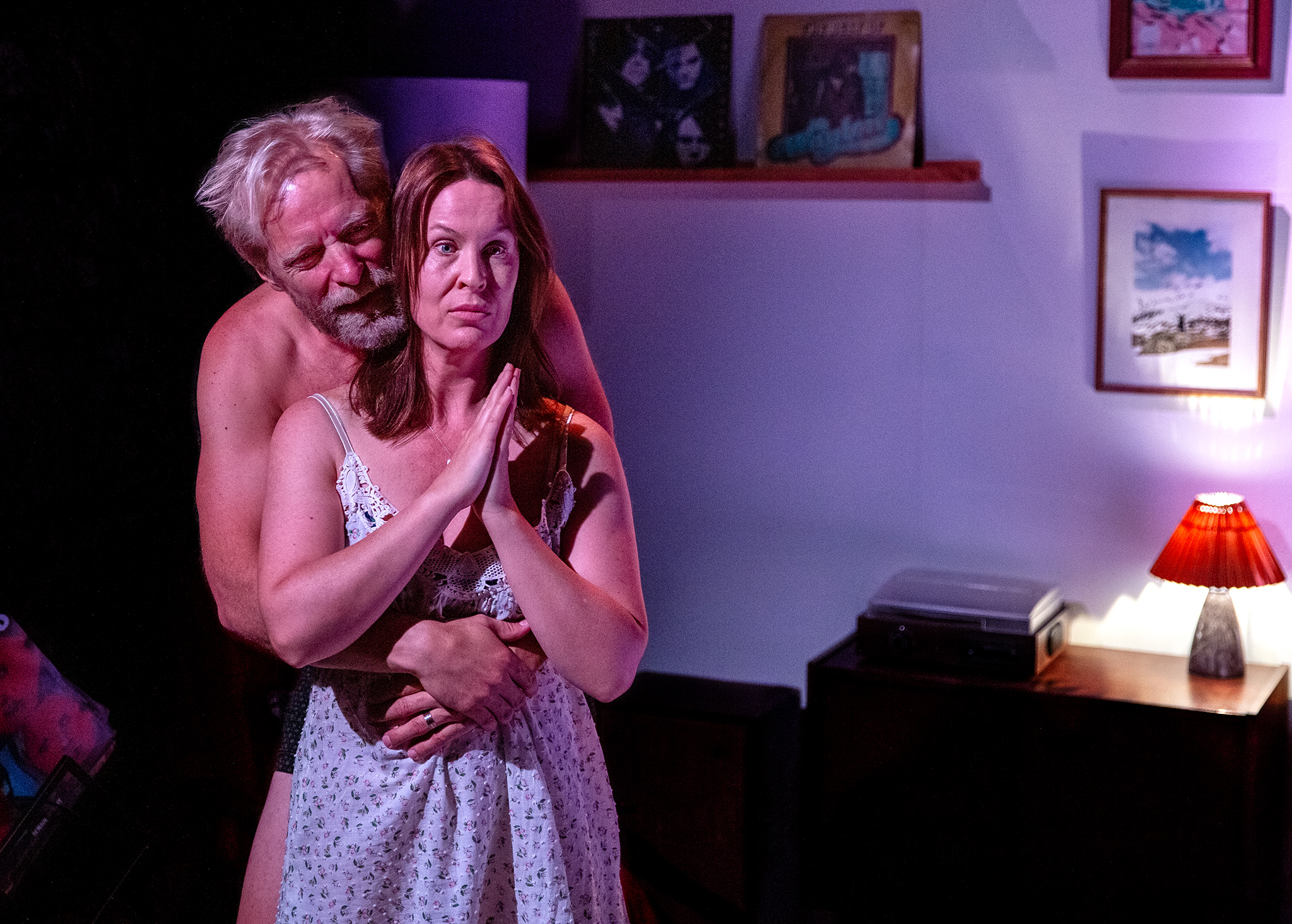
So Young is the story of forty-something Milo finding love again after the early death of his wife. His longtime friends Davie and Liane are shocked to find this new love, Greta, is only 20 years old.
We live in a culture obsessed with demographic divisions. Each one of us is labelled and firmly put in our box. This superb play is about two of the most dominant of these devilish divisions: youth versus age and male versus female. But it’s also about the only demographic division that ultimately matters: the quick versus the dead.
Under the direction of Sam O’Sullivan, the play blazes with humour and heart.
As Liane, Ainslie McGlynn’s performance is magnificent, beautifully boiling and bubbling with the grief that masquerades as anger.
As Davie, Jeremy Waters gives us a splendid portrait of blokeish bonhomie, with that longing for pleasant peace presented in all its complexity. Is it wisdom? Or is it weakness?
Henry Nixon as Milo offers a bewitching bewilderment in the face of Life’s two greatest mysteries – Death and Love.
Aisha Aidara as Greta is gloriously youthful. She marvellously captures youth’s perceived pitfalls – its social naivety, its careless certainty – while all the time radiating courage.
And courage and its close cousin compassion are the qualities most needed by those of us still on this side of the only division that matters.
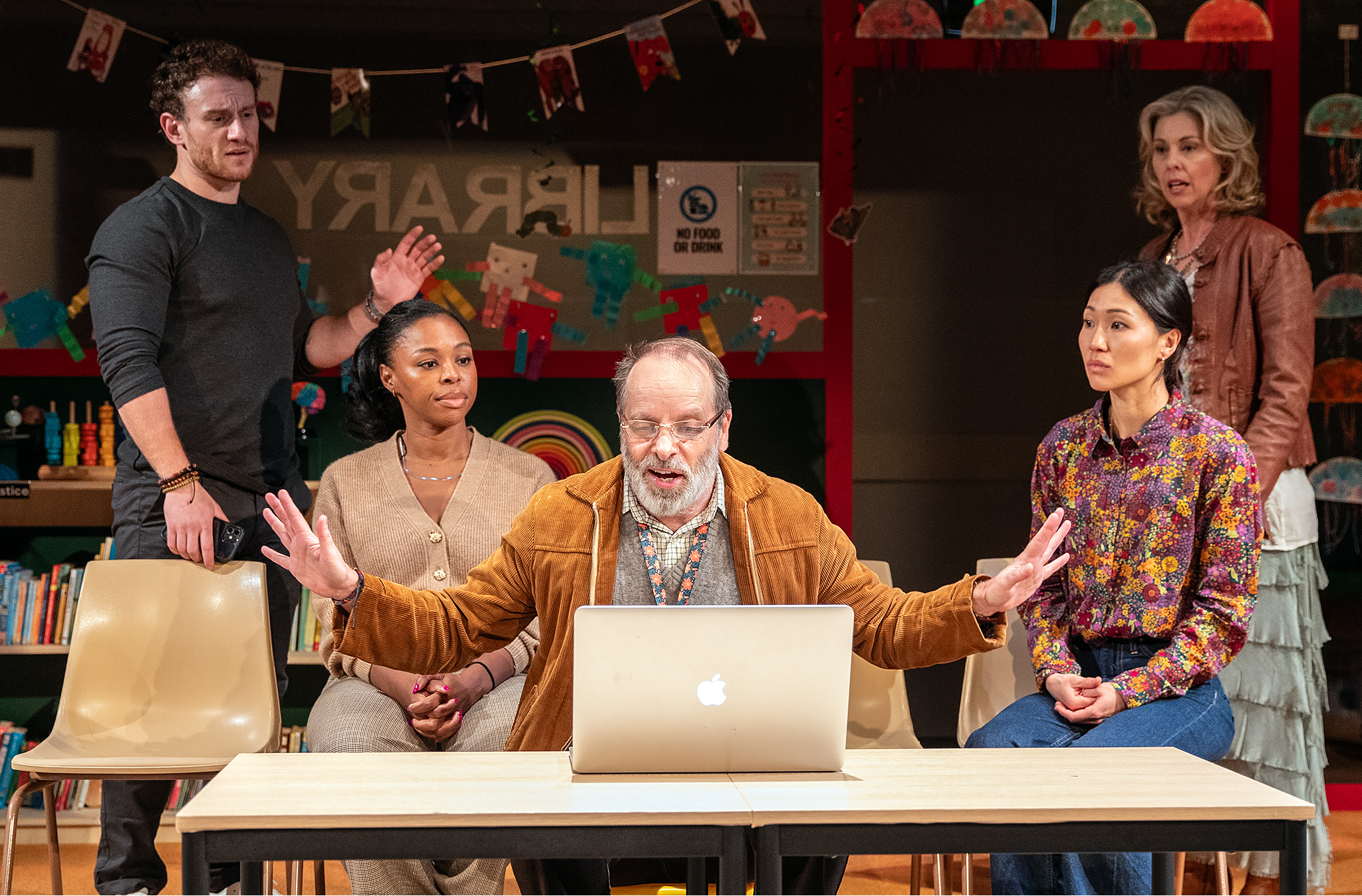
Set almost entirely in the P&C meetings of a primary school, you might assume this is a fun satire of contemporary society.
And you’d be right. Eureka Day by American writer Jonathan Spector is extraordinarily funny. But it doesn’t just make fun, it confronts one of the biggest rifts in our culture.
Eureka Day Elementary is a school built on social justice and inclusivity: a place where everyone feels seen and heard; a place where decisions are reached by consensus; a place where all points of view are valid.
The last of these is the issue. (And possibly the second last.)
Eureka, of course, means I have found it! – and there’s a sense that’s what the P&C believe: that their place is special, that it encapsulates, somehow, the perfect way forward.
But, for all their good intentions, it doesn’t.
Watching their meetings – bursting with thoughtless condescension, moral pedantry and obsession with policy, yet empty of soul-felt kindness, honest humility and genuine openness – is utterly painful. Yes, it’s hilarious, but it’s also excruciating. Earlier, I called the piece satire, but that genre usually employs hyperbole to make its point. But there’s no exaggeration here; it’s just the reality of our present day.
(A reality that feels like one of the rings of punishment in Dante’s Divine Comedy, one in which we’re condemned to an endless repetition of what seem to be absurdities but are actually perverted echoes of our true sins. However, I do think it’s a ring of Purgatory we’re stuck in, rather than Hell; we are purging ourselves; things will improve; there’s no need to abandon hope.)
There are beautiful moments in the piece where our societal problem is artfully diagnosed. One parent jokes that her daughter was very smart but also good-natured, so they knew she would become a benevolent dictator. Another compliments the work of a mime artist, for his subtlety and, we can only imagine, for his rare ability to just remain silent. Another parent says it straight out: she’s sick of the hubris.
This hubris, the belief that they’ve found the correct way, is tested by an outbreak of mumps at the school. Can all decisions be made by consensus? Are all points of view really valid?
As a society, we’ve fallen in love with policy and forgotten politics. And by politics, I mean the sphere of life in which we have to work with other people (as against just shout at them over and over that they are wrong or evil.) The fact that this play centres on meetings where adults must come together and solve problems makes it essential viewing.
(Though I must admit, I’m a little uncertain about the play’s exploration of vaccination. This hot button issue threatens to overwhelm everything else, burying from common view the representation of the political sphere that I so value. But, yes, I know, I know, the dramatic form must deal in the concrete…)
Directed by Craig Baldwin, the production bubbles away at just the right pace, evoking the awful enervating reality we currently endure, yet still assuring us the dramatic boil-over is imminent.
Performances are excellent.
Jamie Oxenbould as Don, a school official, is perfectly, perpetually, and pathetically polite and patient.
Katrina Retallick as Suzanne is both wonderfully comic and deeply poignant, offering a rich portrait of an individual traumatised by the universe’s chaotic cruelty and who overcompensates with a commitment to control.
Christian Charisiou’s Eli is brilliant as the epitome of overtalking privilege, the misguided good that knows not when to stop.
Branden Christine as the newcomer to the school community is magnificent, presenting a fascinating study in intelligence encountering its nemesis: the holding back, the bitten tongue, the seductive whisperings of despair as we wait to speak the Truth.
Deborah An as May has a gloriously warm energy. Her character’s journey is perhaps the biggest of the play, and she pitches it superbly. Her speech in which she posits what she wants for her kids is a highlight, and represents the best of what the play has to offer: the petty hobgoblin of certainty dispelled by a courageous vision of hope.
With this production, Outhouse Theatre shows once again why they are a vital part of the Sydney scene, presenting work that dares to walk our societal fault lines, and keeps its balance with honesty and humour.
However, I suspect the title might put off an Australian audience.
Australians like to believe we’re less literal than our American cousins. Case in point: we often joke that they don’t get irony. But, ironically, when it comes to religious language, we’re the ones reluctant to use it in any way other than literally. In many other cultures, writers comfortably evoke God without fear that it automatically commits them to the theological tenets of some religion. Religious language is employed to suggest or symbolise the grand, the awe inspiring, the universal. Sometimes, it can feel like the only discourse big enough for these things. An honorary American, Albert Einstein, was famous for using religious language in this way. His oft quoted comment, expressing his objection to quantum theory, that God does not play dice, was simply an assertion that mere chance could not be fundamental to the fabric of the universe. He was saying nothing that we unsophisticated Australians would interpret as religious.
The title of Samuel D. Hunter’s play uses religious language in a similarly evocative way. In this superbly crafted two hander, no one says a word about religion. Not a word. The two male characters discuss money, work and most of all, their children. They build an unlikely friendship. The title simply implies hope, that despite problems, things might work out OK. (I know I’m getting awfully close to spoiler territory here, but the final scene, which is a theatrical surprise and an utter delight, reminds me of the conclusion of Thornton Wilder’s Our Town, only more secular. Wilder himself borrowed the idea from Dante, that towering poet who spoke of the human heart via religious language – because only it had the grandeur to do justice to his topic.)
Director Craig Baldwin’s production is wisely pared back so that the focus is on the two splendid performances by Elijah Williams and Anthony Gooley.
Keith is an educated musicologist, working as a mortgage broker. As a single gay man, his dream of adoption is proving difficult, so he fosters a new born in the hope that the relationship might be allowed to become more permanent. Surviving a divorce, working class Ryan seeks a mortgage to help give his baby daughter a real home. Out of a similar sadness, the friendship between the men grows.
Williams’ Keith is brilliant: prickly, vulnerable, articulate and lightning fast. Gooley’s Ryan is marvellous: slow, awkward and inarticulate. Both characters are beautifully generous-hearted. It was pure pleasure to spend ninety minutes in their company.
A case for the existence of God? Amongst other things, it’s their friendship that suggests the possibility. (See above. God is love is not marketing hyperbole; it will reward deep reflection in a way that Coke is It cannot.)
In a play jam-packed with scorchingly truthful moments, one of my favourites is when the two men, sharing a bottle of scotch, begin to discuss the history of Western music (as you do.) Keith mentions the invention of polyphony, a term which is, of course, meaningless to Ryan. And then the penny drops: harmony! Ryan can’t believe there was a time before harmony. The symbolism is not overplayed, the scene does what drama excels at: concrete moments played so honestly they intimate something universal.
Paul Gilchrist
A Case for the Existence of God by Samuel D. Hunter

 Theatre Red